

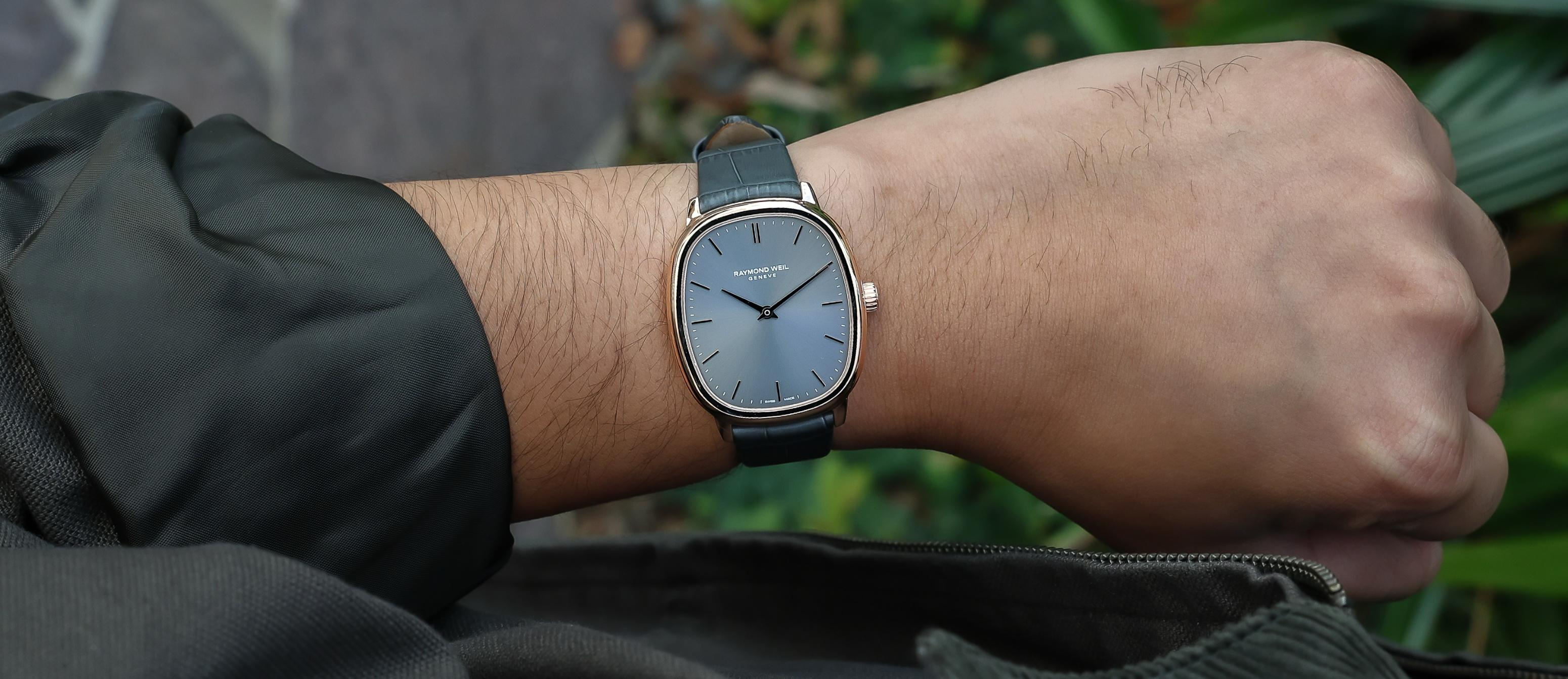
Raymond Weil’s Toccata Heritage wears its inspiration on its sleeve, but is the flash backed up by substance? Let’s find out!
What We Love:
- Elegant, flowing case
- Beautiful movement
- Incredible price point
What We Don’t:
- Soft but fragile strap
- Power reserve feels low compared to on-paper
- Is luxury ever attainable?
Overall Rating: 8.5/10
- Value for Money: 9/10
- Wearability: 8.5/10
- Design: 8.5/10
- Build Quality: 8/10
The definition of luxury is, for the most part, anyone’s guess. Maybe it’s the hundred-million-dollar, feature-laden superyacht crewed by Playboy models, or perhaps it’s something as mundane as a carton of eggs at the grocery store. I find that luxury is relative to one’s financial circumstances: a want that’s just slightly out of reach, not entirely necessary to one’s sanity or physical wellbeing, but something whose acquisition feels like reaching a new level in life.
This is entirely different from a pipe dream, such as the aforementioned superyacht, but the watch world often treats the two as one and the same. Luxury watches aren’t often considered truly luxurious until they cross a certain price threshold, usually somewhere in the high four or five figures, if not six.
But ‘accessible luxury’ isn’t quite the oxymoron the industry might have you believe, and Raymond Weil is proof. Since 1976, the independent watchmaker has sought to make traditional elegance more attainable, offering classically styled timepieces at comparatively accessible price points.
Once dismissed by some enthusiasts as a ‘mall watch’ brand, Raymond Weil has clawed its way back into the spotlight in recent years with award-winning releases like the Millesime and heavy hitters like the Freelancer Complete Calendar. From there, the brand has continued to establish its place in the middle market, with newer collections like the A.R.T. further broadening its appeal.
Yet, amid the glamour of Raymond Weil’s new era lies the understated Toccata Heritage. Combining classical dress-watch proportions with traditional Swiss watchmaking, it occupies a quieter corner of the catalogue, offering a more restrained expression of the brand’s ambitions.
Its design language may be familiar to seasoned enthusiasts, but familiarity isn’t what’s being judged here. The true question is whether it can deliver a compelling, luxurious experience without the need for a lofty price tag. That’s what I wanted to find out when I took the Toccata Heritage out into the wild for review.
First Impressions
Let’s not beat around the bush any longer. When Raymond Weil released the Toccata Heritage, most enthusiasts’ minds went to one place: the legendary Patek Philippe Golden Ellipse. Introduced in 1968, the watch became an icon of the dress watch scene, and remains one today. The crowning feature of its design, however, is its predominant lack of adornment. Neither circular nor rectangular, the unique elliptical case is what draws the most attention to the watch.
But while the Golden Ellipse is the most famous elliptical watch, Patek Philippe were by no means the only ones making them. Girard-Perregaux and Piaget, for example, were two other major players during the Golden Ellipse’s era, creating similar timepieces. And whilst each is distinctive in its approach to the case shape, the common thread running through them is their upper-echelon standing in the watch world.
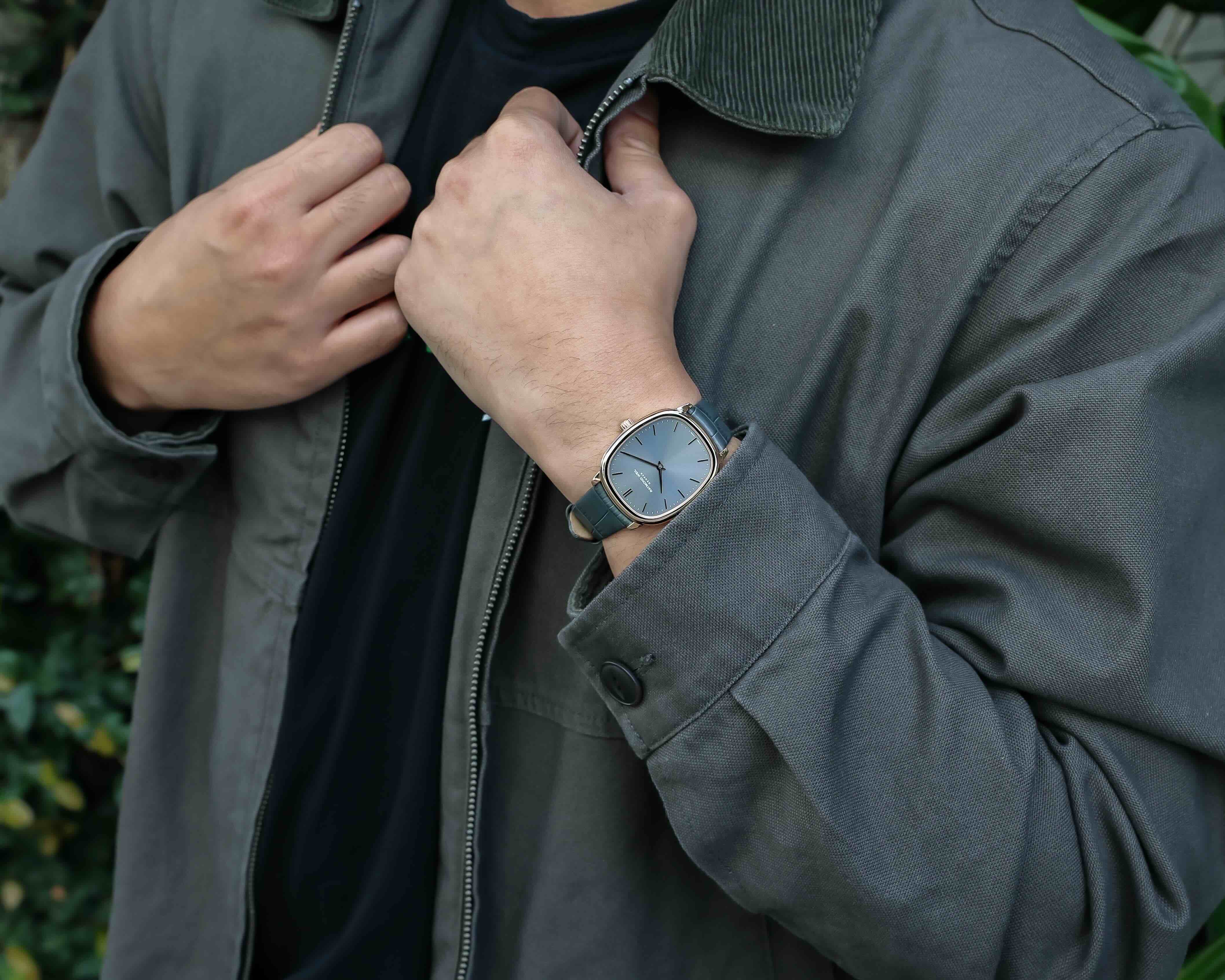
By contrast, Raymond Weil’s middle-market positioning puts it much further down the totem pole in terms of price point. But is that truly a bad thing? I didn’t think so. When the Toccata Heritage was first announced, I remember rocketing out of my seat like I’d just witnessed a Mike Tyson knockout. Taking a case shape inherently associated with unobtainium and making it accessible to a wider audience is a delightful provocation, challenging the watch industry to question its perceptions of luxury.
For all my aesthetic and mechanical tastes in watchmaking, nothing piques my interest quite like a narrative disruption. So, I jumped at the opportunity to review one of the latest references in the collection.
The Design
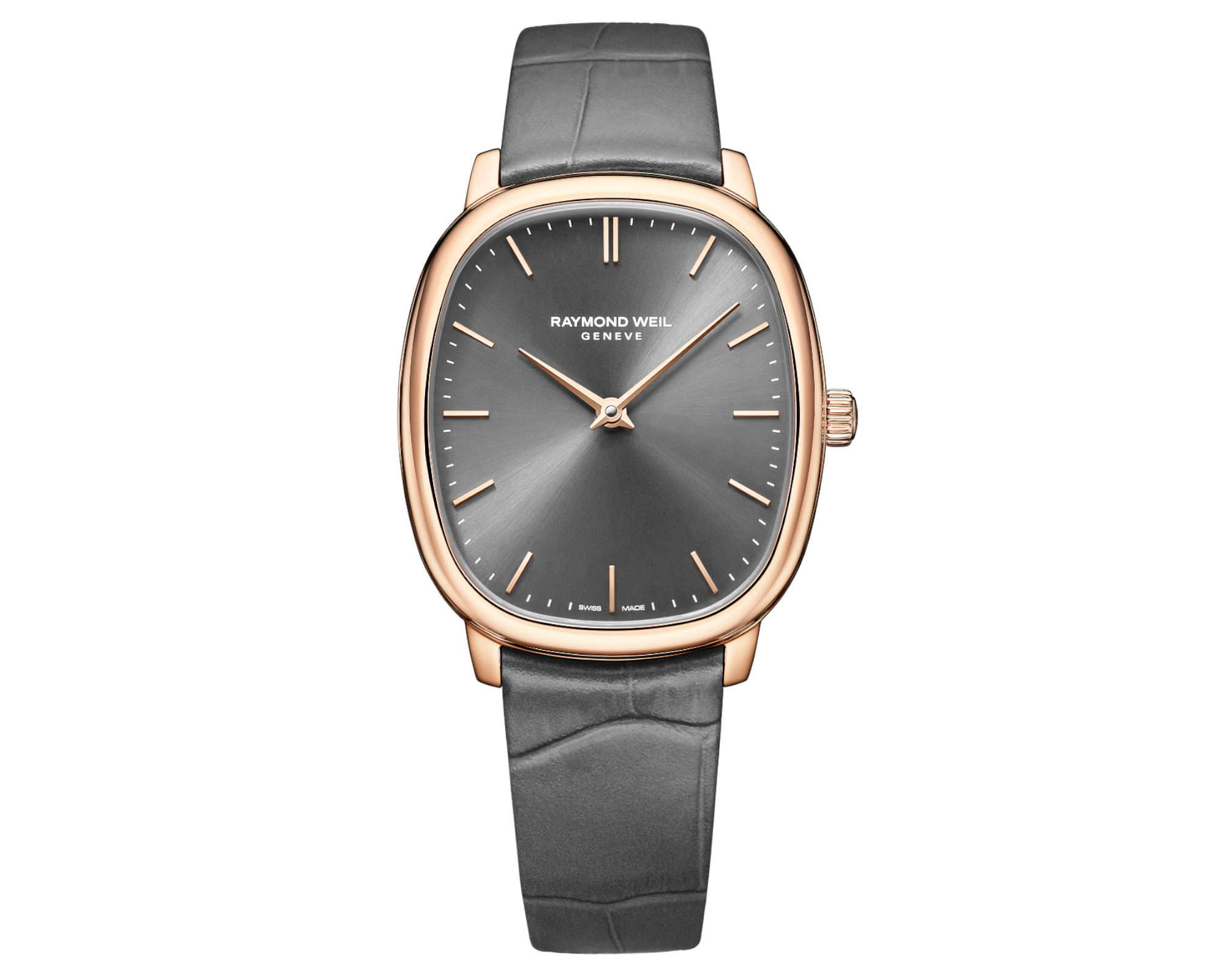
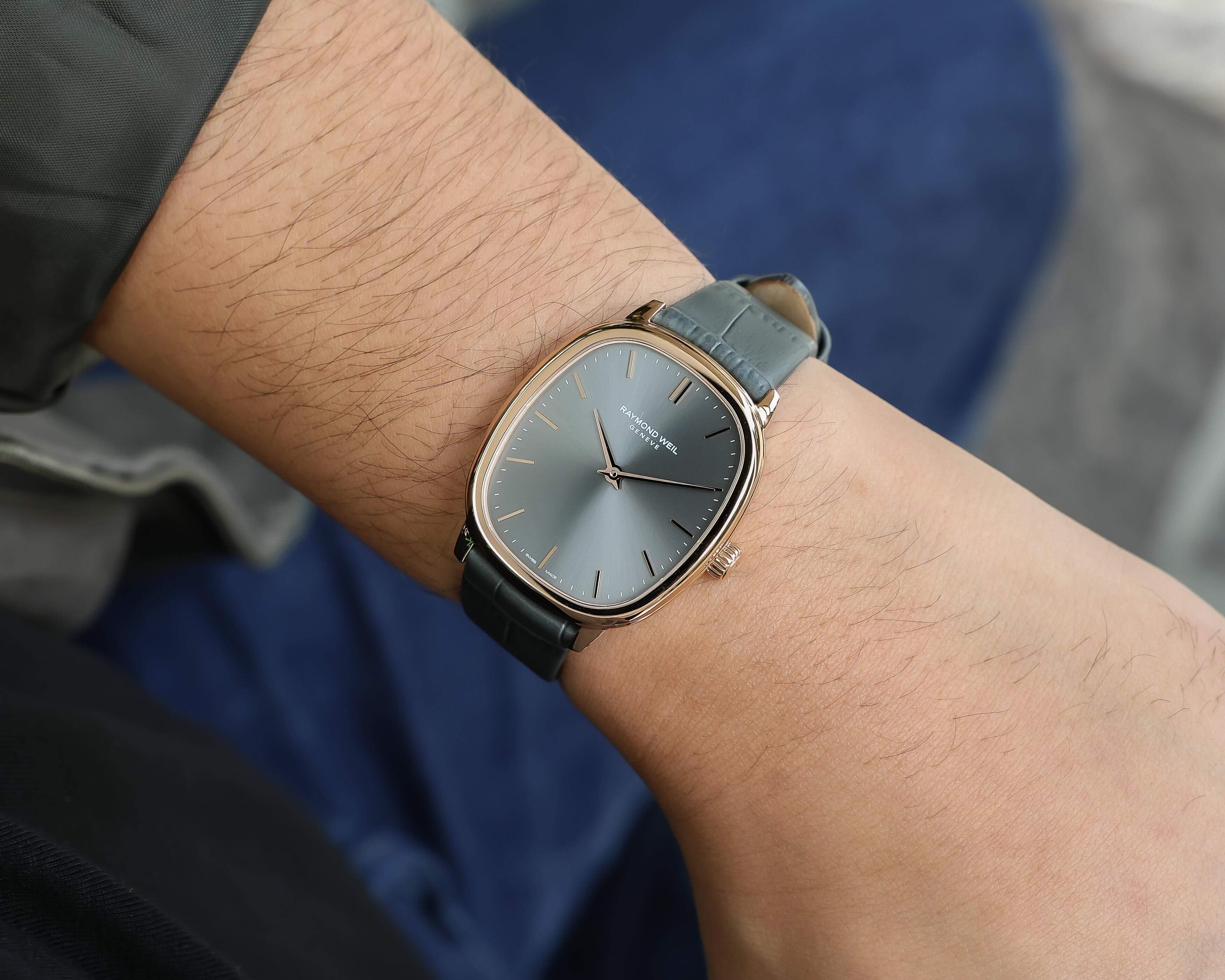
Given that the point of a minimalist dress watch is to be, well, minimalist, there isn’t much to embellish about the Raymond Weil Toccata Heritage. Its features are incredibly simple and easy to understand, but that doesn’t mean it’s boring. In any case, I’ll take you through what you’ll find here, beginning with the dial. It’s simple enough, with a sunray-brushed grey finish radiating from the central axis.
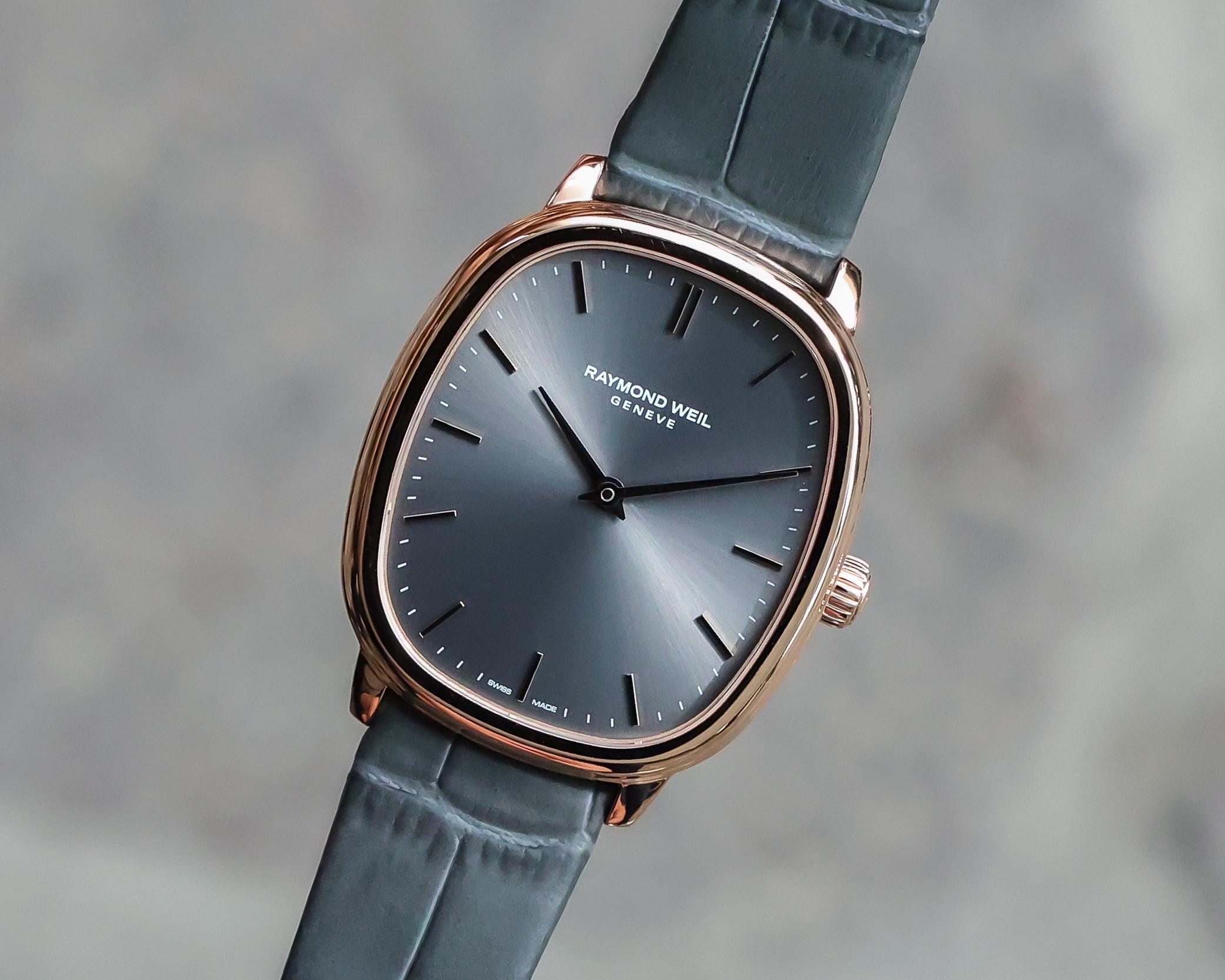
There’s a contemporary appeal to dial tones like muted blues and greys. Personally, I believe they factor in light play from an element that’s hardly considered: the weather. Dial tones such as this look good in any conditions, regardless of whether the sky is overcast or completely clear. It won’t look good at night, though, as the lack of lume makes the watch disappear into the darkness. That’s by no means a point off the docket, so to speak. Dress watches don’t really need lume, anyway.
Accompanying the dial is a set of polished, faceted Dauphine hands indicating only the hours and minutes. Interestingly, the hands aren’t as sharp as those you might find on a Jaeger-LeCoultre Reverso or other dress watches with the same hand type. I think this is a considered choice by Raymond Weil, as sharper hands would create too stark a contrast against the rounded silhouette. Each hand points to a set of simple, applied baton indexes, complemented by a white printed minute track.
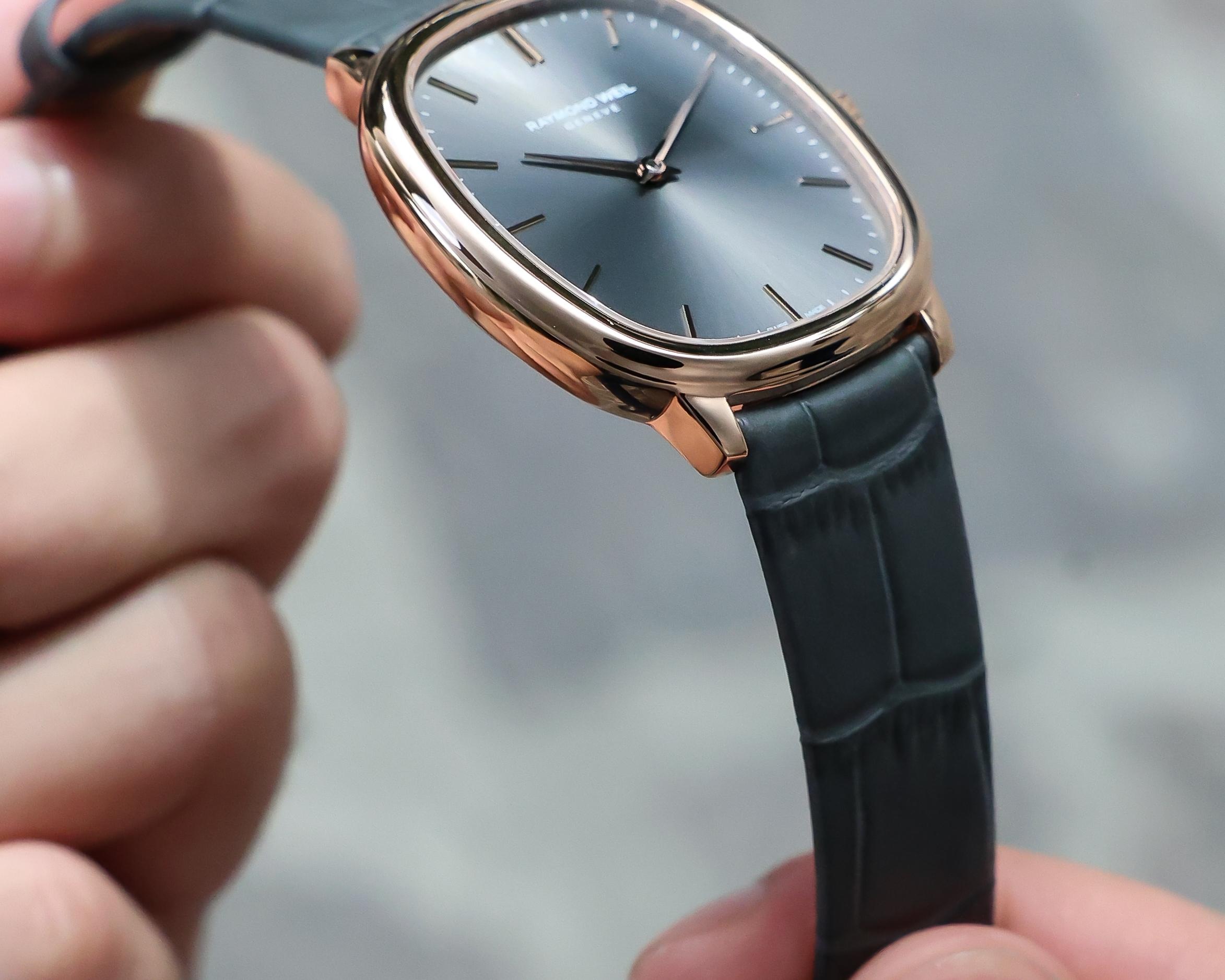
While these are simple additions, this is where the Toccata gets a bit of a leg-up on its upper-class peers. Though removing the minute track helps concentrate the horological purity of a dress watch design, I much prefer keeping it. Raymond Weil’s execution doesn’t detract from the holistic elegance of the watch, while maintaining the practical purpose of time-telling and setting. On a personal level, I like knowing the time to at least the nearest minute, not the nearest five.
Moving out from the dial, you’re immediately met by the watch’s crowning feature: the elliptical case. The reference I had was finished in rose gold PVD over stainless steel, its shape only interrupted by the fluted and signed crown. Though I miss the density of real gold, the PVD is a welcome, warm contrast to the grey dial, further complemented by the hands and indexes, which share the same finish.
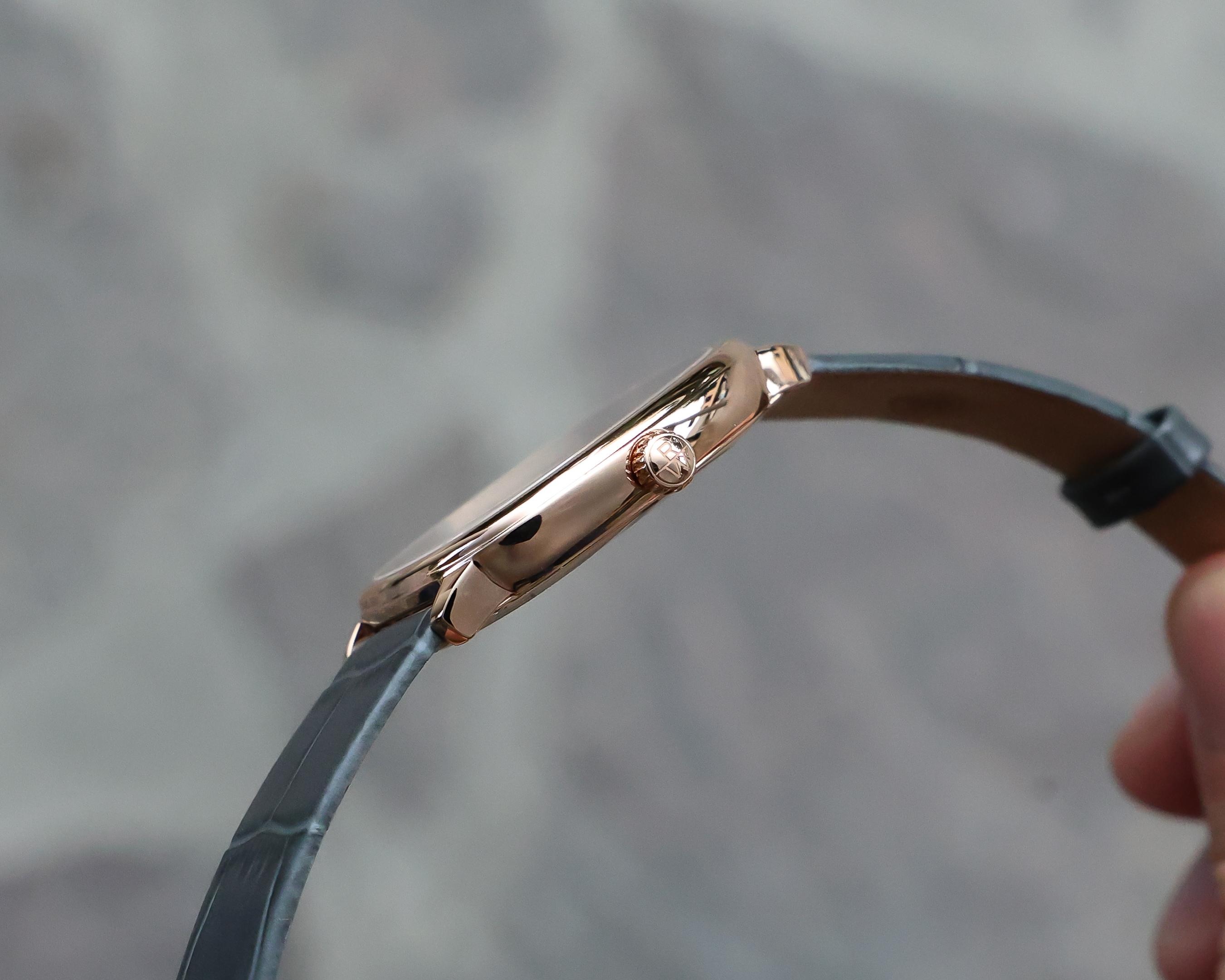
Completely polished, the Toccata Heritage takes after its older peers well. Turning the watch around reveals the open caseback, through which the movement can be seen alongside the usual engraved serial text. It’s about as familiar as it can get, albeit with one major difference. You see, most elliptical-cased watches tend to emphasise their shape with a lugless design. The Toccata Heritage, however, sports small, rounded lugs that are more in line with those of conventional watches.
While some might view the inclusion of lugs as a drawback, much like the minute track, I don’t think that’s the case here. Aesthetic trends are as ephemeral as ever, and designs like the Golden Ellipse and those of a similar calibre tend to drift in and out of the spotlight. But the addition of something as simple as lugs gives the Toccata Heritage a familiar visual constant, establishing its timelessness and making the case shape more approachable to mainstream enthusiasts. It does take away from the so-called ‘mystique’ of the elliptical case, but whether that’s a bad thing is entirely up to you.
The lugs extend to a matching grey calfskin strap with an embossed alligator pattern, terminating in a regular pin buckle finished in matching rose gold PVD. While I have no problem with the embossing, I feel Raymond Weil could have simply committed to the calfskin in general.
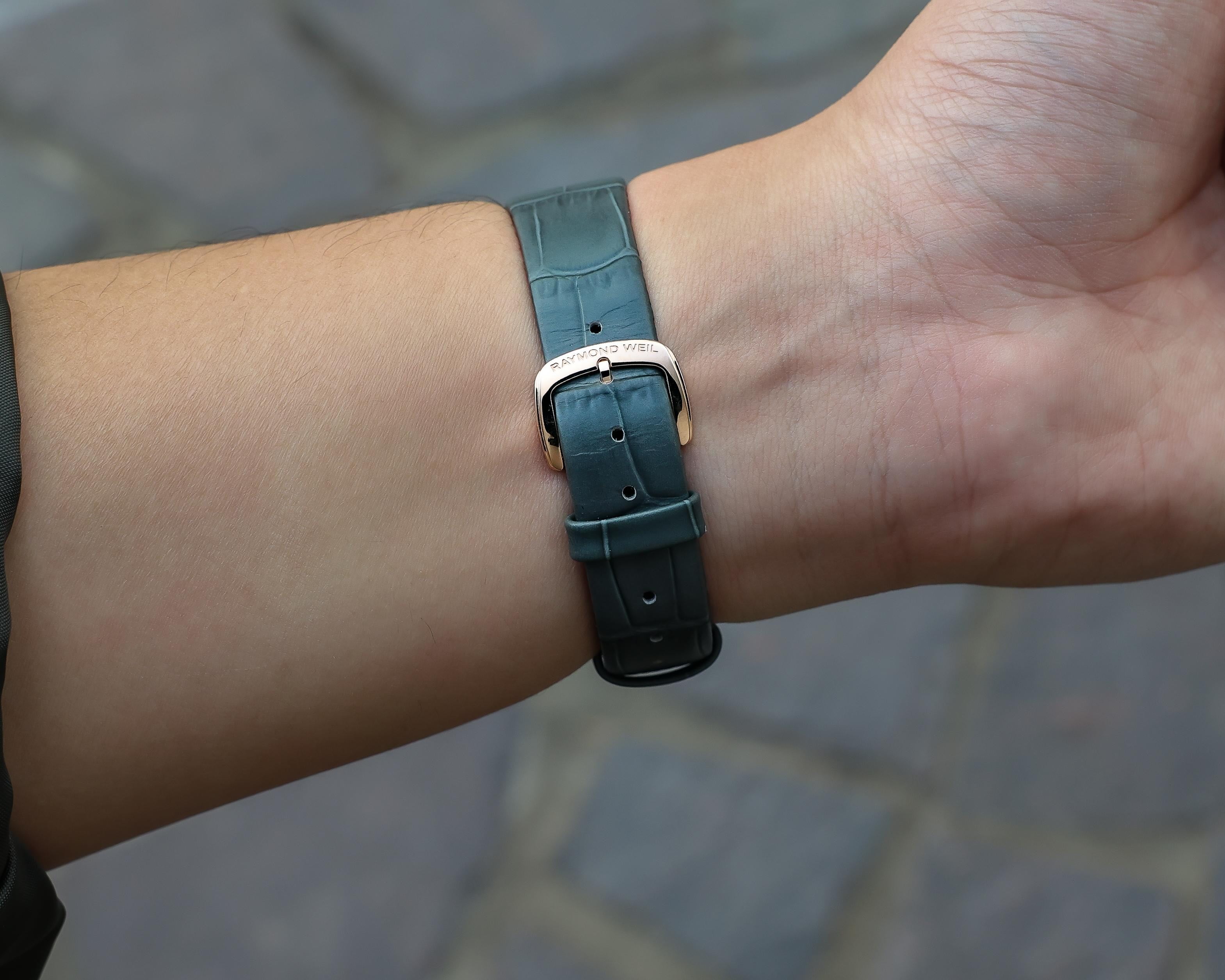
Not that it needs to be identical to the leather straps found on other watches in its catalogue, but a different type of leather would have been nice to see. I’d be intrigued to see how the watch’s character changes on nubuck or suede straps, where the texture of each would interplay with the Toccata Heritage’s general smoothness.
Overall, I think Raymond Weil has done well to work within the constraints of the dress watch rulebook. It’s an extremely difficult thing to do, especially when you consider the fine line between timelessness and genericism in the dress watch space. Yet the brand has succeeded in avoiding the territories of homage and abject boredom, creating its own measured, elegant take on the fabled case shape.
How It Wears
Measuring 33mm in case diameter, 38mm lug-to-lug and 6.95mm thick, the Raymond Weil Toccata Heritage sits comfortably within vintage dress watch proportions. On my 6.4-inch (16.4cm) wrist, it wears surprisingly broad, taking up as much real estate as it possibly can.
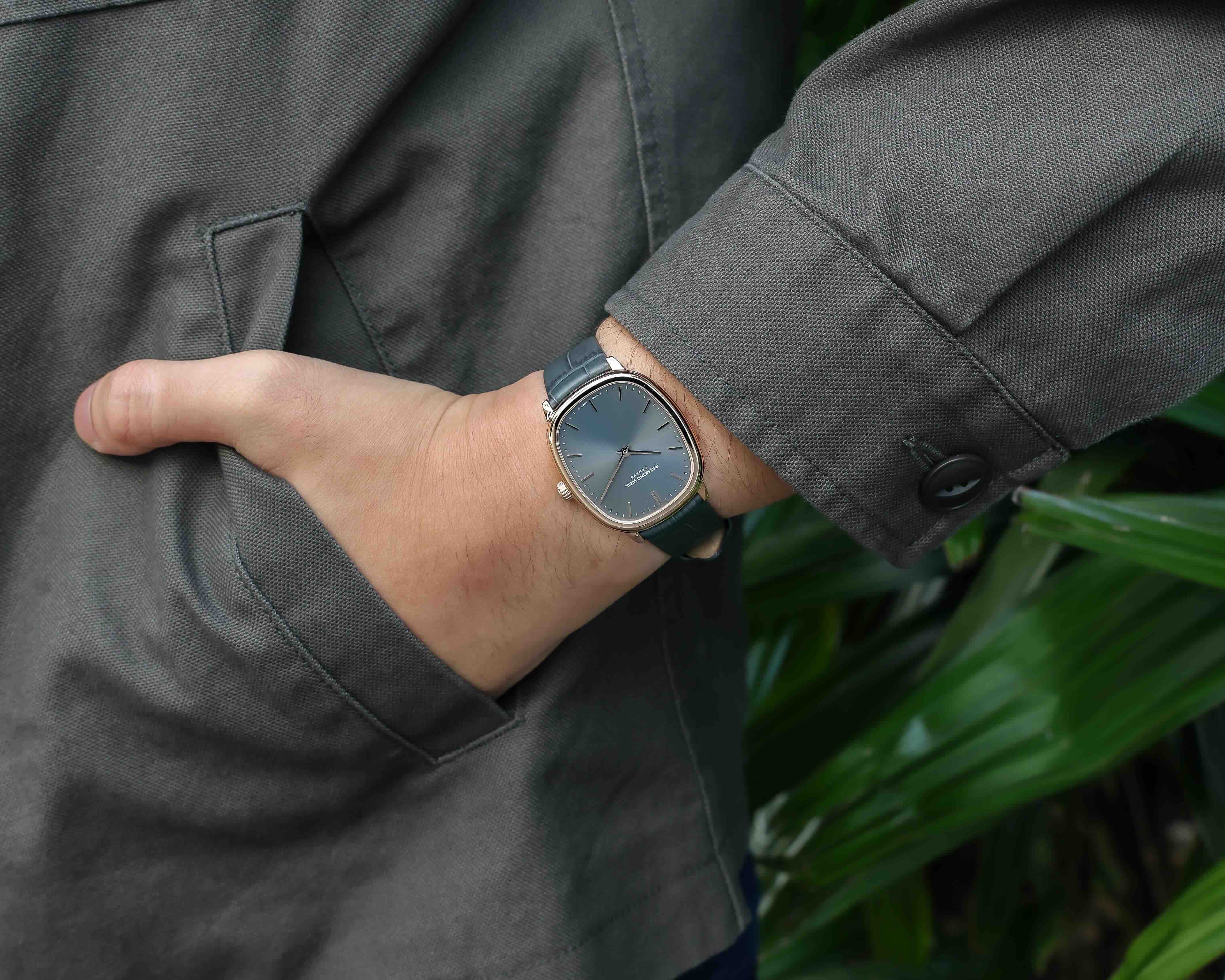
Another comparable dress watch with a similar profile is the Cartier Tank, which measures around 33.7mm in case width at its largest. However, the rounded nature of the Toccata Heritage’s elliptical case makes it feel far more organic than the rectangular shape of a watch like the Tank.
Another factor that enhances the watch’s profile is its thinness. At 6.95mm thick, it’s not often we see such proportions from larger commercial brands, let alone household names, so it’s always great to see Raymond Weil bring the ergonomic benefits of thinness to the middle market dress watch scene. At 30m of water resistance, it certainly is a dress watch through and through. So, don’t take it anywhere near the water unless you like wearing a metal bracelet instead of a watch.
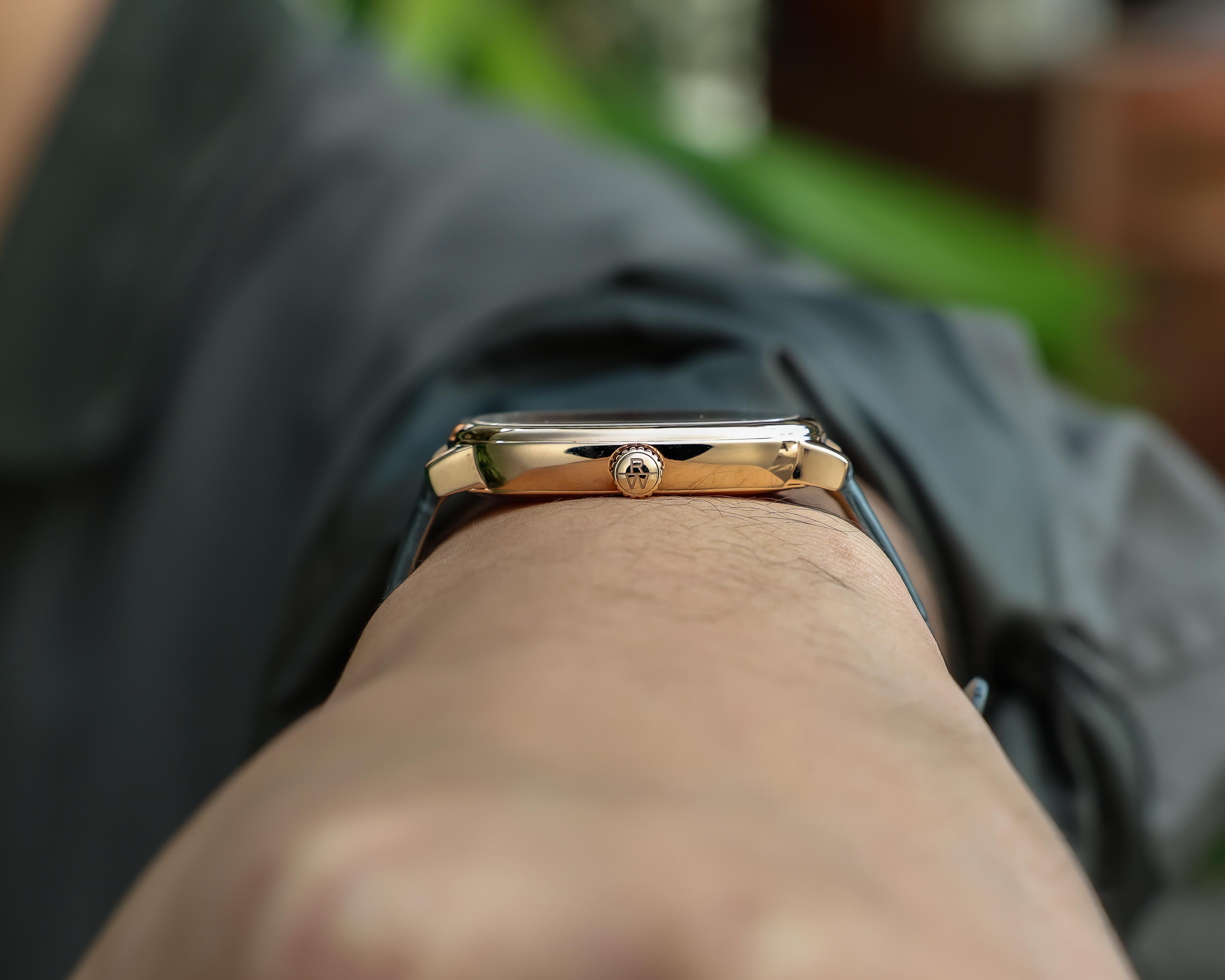
But the last, and perhaps most important, element to consider is the use of lugs. Not only do they give the watch a distinct personality from its predecessors, but they also help lengthen and strengthen its profile on the wrist. A lugless design, where the strap is tethered beneath the watch, might have caused it to shrink visually. It may also have compromised Raymond Weil’s ability to implement a display caseback. But we’ll get to all that later.
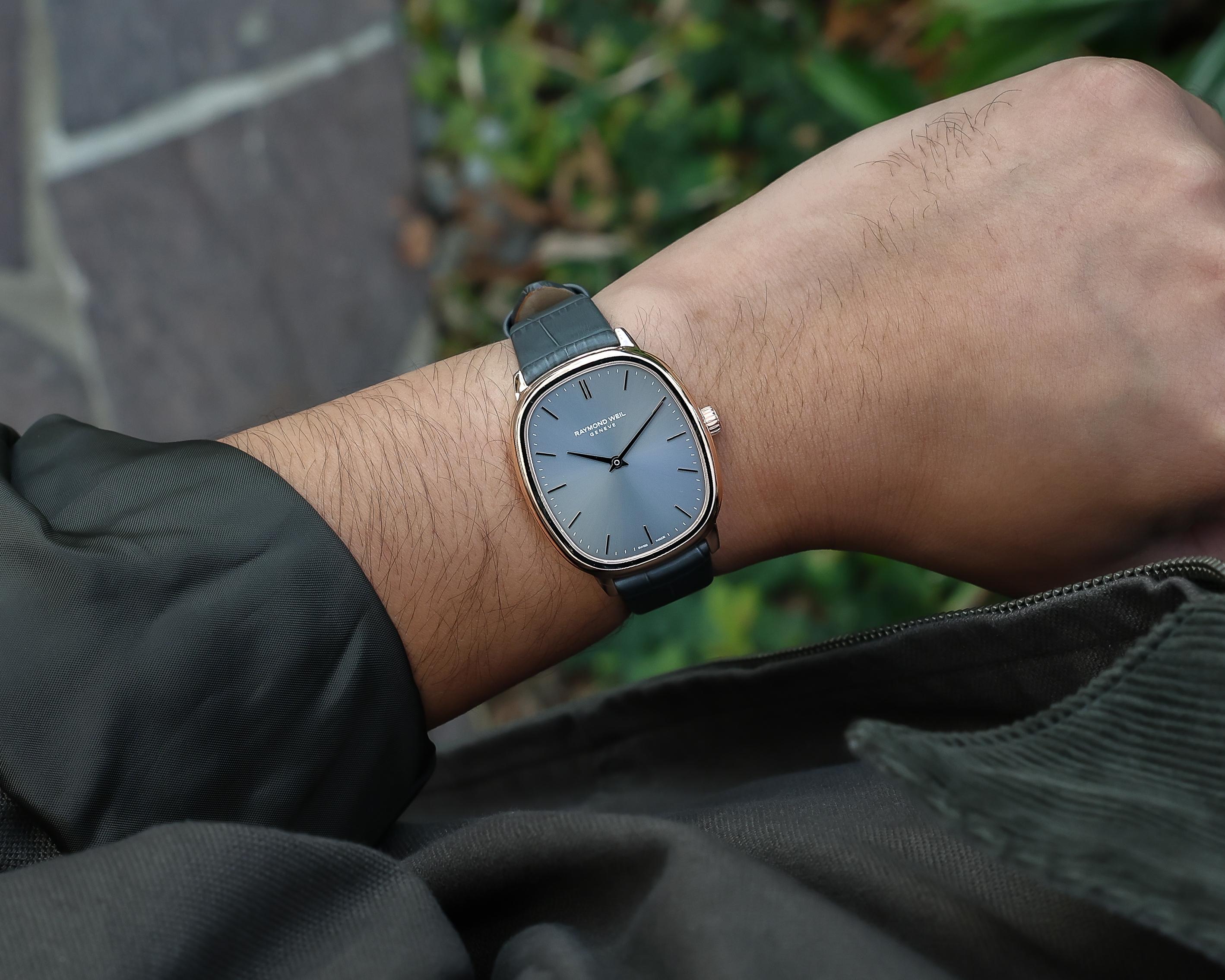
On the supplied leather strap, the Toccata Heritage feels exceptionally comfortable. It works in conjunction with the thin profile to reinforce the watch’s wearability, and is incredibly soft even when new.
Interestingly, Raymond Weil hasn’t supplied the strap with a tool-less interchangeability system, meaning you’ll need a traditional spring bar tool if you want to switch up the watch’s profile. While this makes customisation a little more difficult, I think the matching grey suits the watch best. Therefore, it’s not really a major issue unless you want to experiment with a different grey-toned strap.
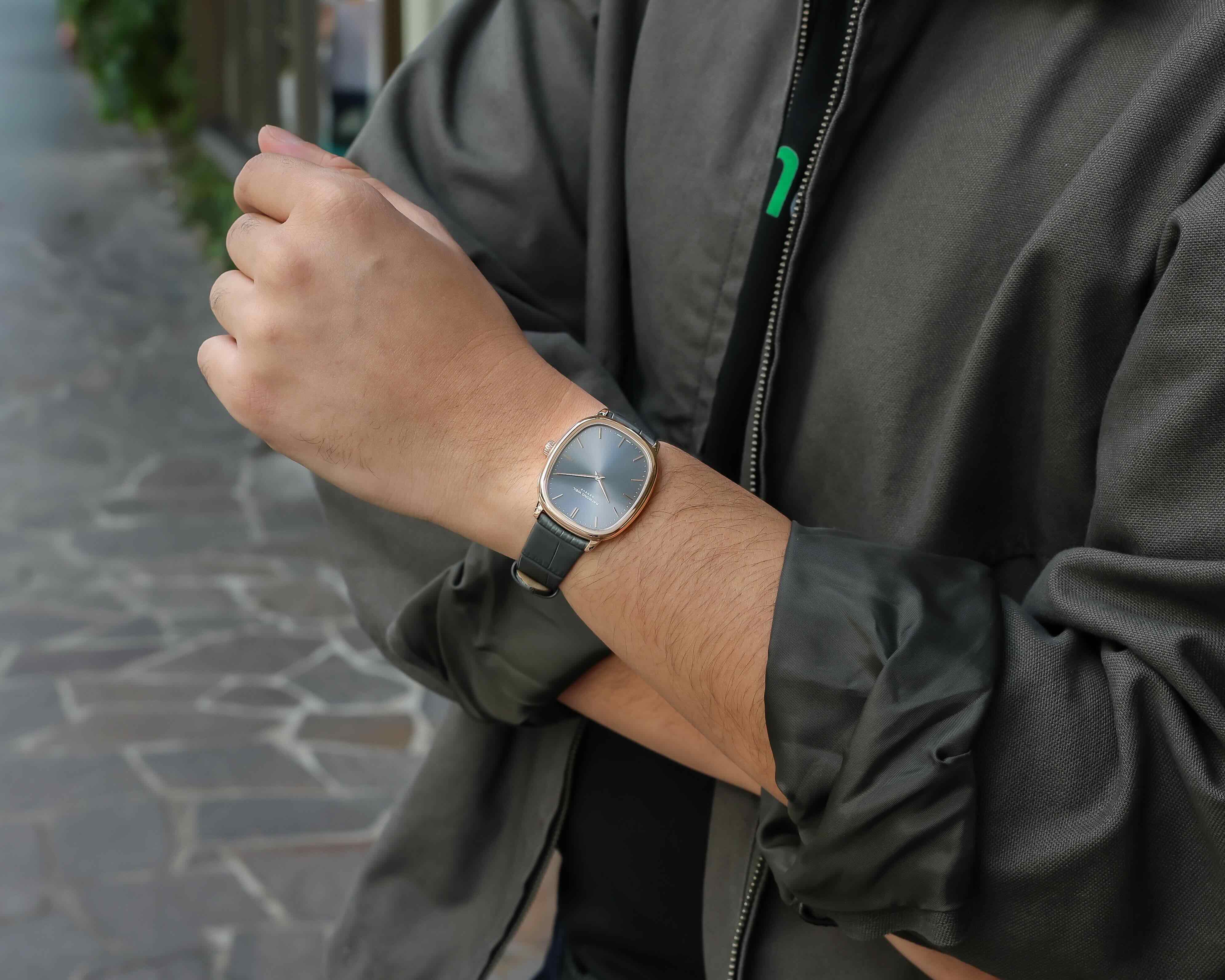
But for as good as the strap is, I do find myself worrying about its durability. The alligator pattern feels somewhat frail, as if it can be easily scraped off with a fingernail. This is also why I believe Raymond Weil should have leaned more into bolstering the calfskin itself rather than opting for a faux-alligator finish.
It’s not that faux-alligator can’t be pulled off. Seiko has done it several times with its leather straps. But they tend to have the opposite problem, requiring pressure equivalent to a hydraulic press to break them in straight out of the box. If I had to choose between one issue or the other, I’d rather not choose at all. But if pushed, I wouldn’t want to worry about the durability of a strap or its finish straight out of the box.
The Movement
Turning the watch around reveals an oval-shaped open caseback, showcasing the manual-winding Cal. RW4100. With a luxury-standard beat rate of 4Hz (28,800VpH), the watch offers a power reserve of up to 45 hours on a full wind.
If the movement looks familiar, don’t be alarmed, as that’s by design. Raymond Weil has a longstanding partnership with Sellita, which assists the brand by providing the movement architecture for its calibres. In the Toccata Heritage’s case, the Cal. RW4100 is based on an ébauche of the Sellita SW210-1, which traces its lineage back to the ETA 2801 and the iconic ETA 2824.
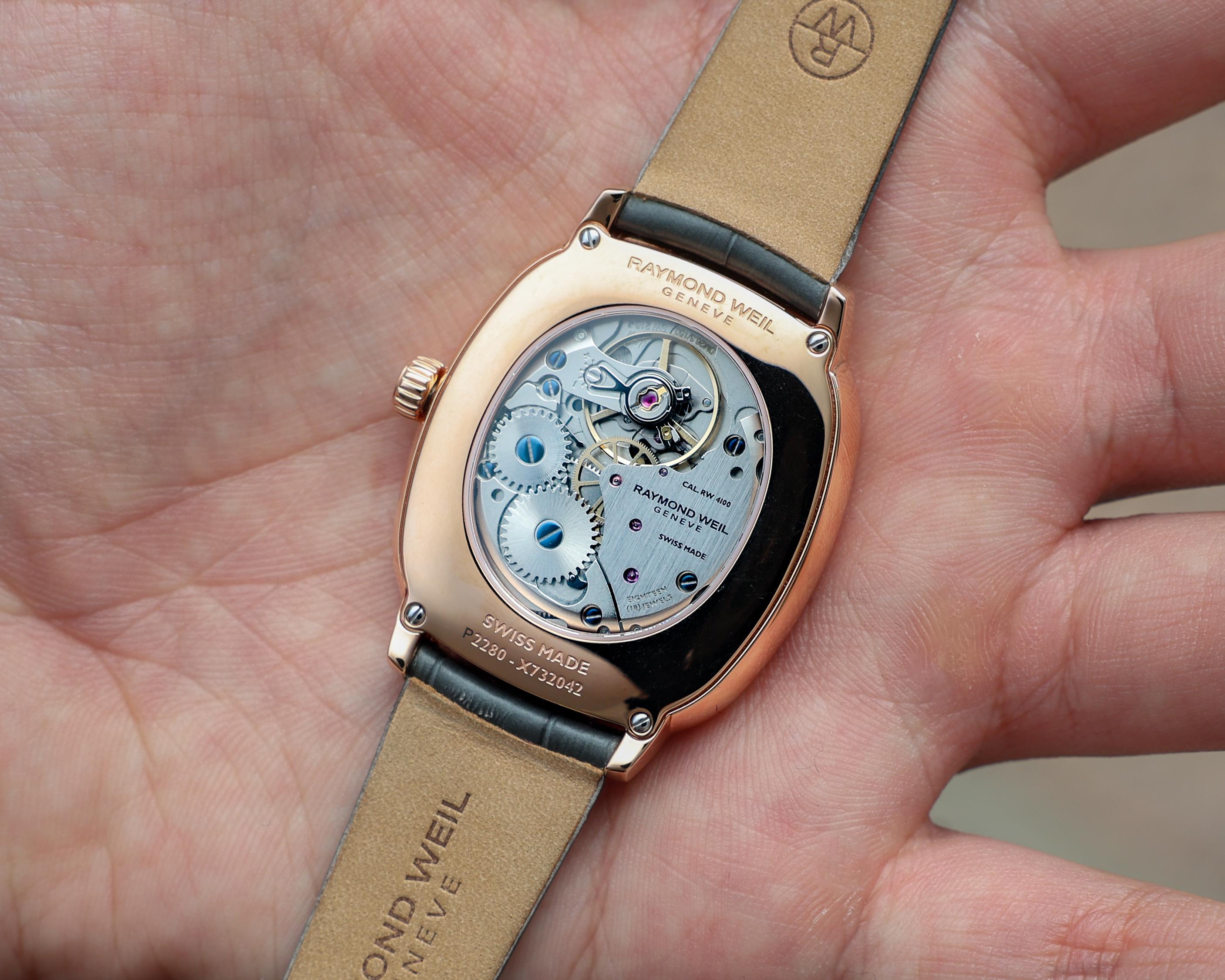
I understand that manual winding isn’t for everyone, especially if you’re accustomed to the grab-and-go convenience of quartz or automatic watches. However, I think Raymond Weil made the right choice in opting for a manual-winding movement. The lack of an automatic rotor keeps the watch incredibly slim, and I don’t believe the elliptical case would work nearly as well if it were any thicker.
The finishing of the Cal. RW4100 is also notable. Compared to other watches in Raymond Weil’s catalogue, it’s excellent. It’s not going to win any major awards in the grand scheme of things, but the addition of blued screws adds plenty of intrigue to the brand’s otherwise bare-bones finishing principles. It’s something I’ve wanted to see from Raymond Weil ever since reviewing the Millesime, so I’m glad to see the brand finally taking it on board. An automatic rotor would have obscured much of the movement, so here you get to admire it in all its glory.
Speaking of admiration, the use of an open caseback is a great move. With a watch that only displays the hours and minutes, it can be difficult to tell at a glance whether your dress watch is functioning as it should without a view of the movement. While you can hold it up to your ear to hear it ticking, watching the escapement in action is still the best way to check.
More often than not, though, I found myself wondering why the watch had stopped not long after I’d given it a decent wind. One night, I wound it, left it on my bedside table and woke up to find it had stopped. I’m no watchmaker, so I couldn’t fully diagnose the problem, but it’s certainly worth keeping an eye on, especially when the power reserve is advertised at 45 hours.
Beyond that, I had no further issues with the watch. Crown operation was simple and easy, if a little fiddly, but a 33mm watch can only offer so much room to work with. Ultimately, the Cal. RW4100 preserves what makes Raymond Weil and Sellita’s watchmaking efforts so compelling, with just the right touch of spice in those blued screws to bring the whole thing together.
Final Thoughts
It’s easy to create a watch through addition: more water resistance, bigger numerals, micro-adjustment, movement finishing. But to paraphrase author and aviator Antoine de Saint-Exupéry, perfection is achieved when there is nothing left to take away. In that spirit, the dress watch scene is perhaps the most difficult arena in which to pursue perfection. The rules of engagement are especially strict, giving watch brands very little room to improve or express themselves.
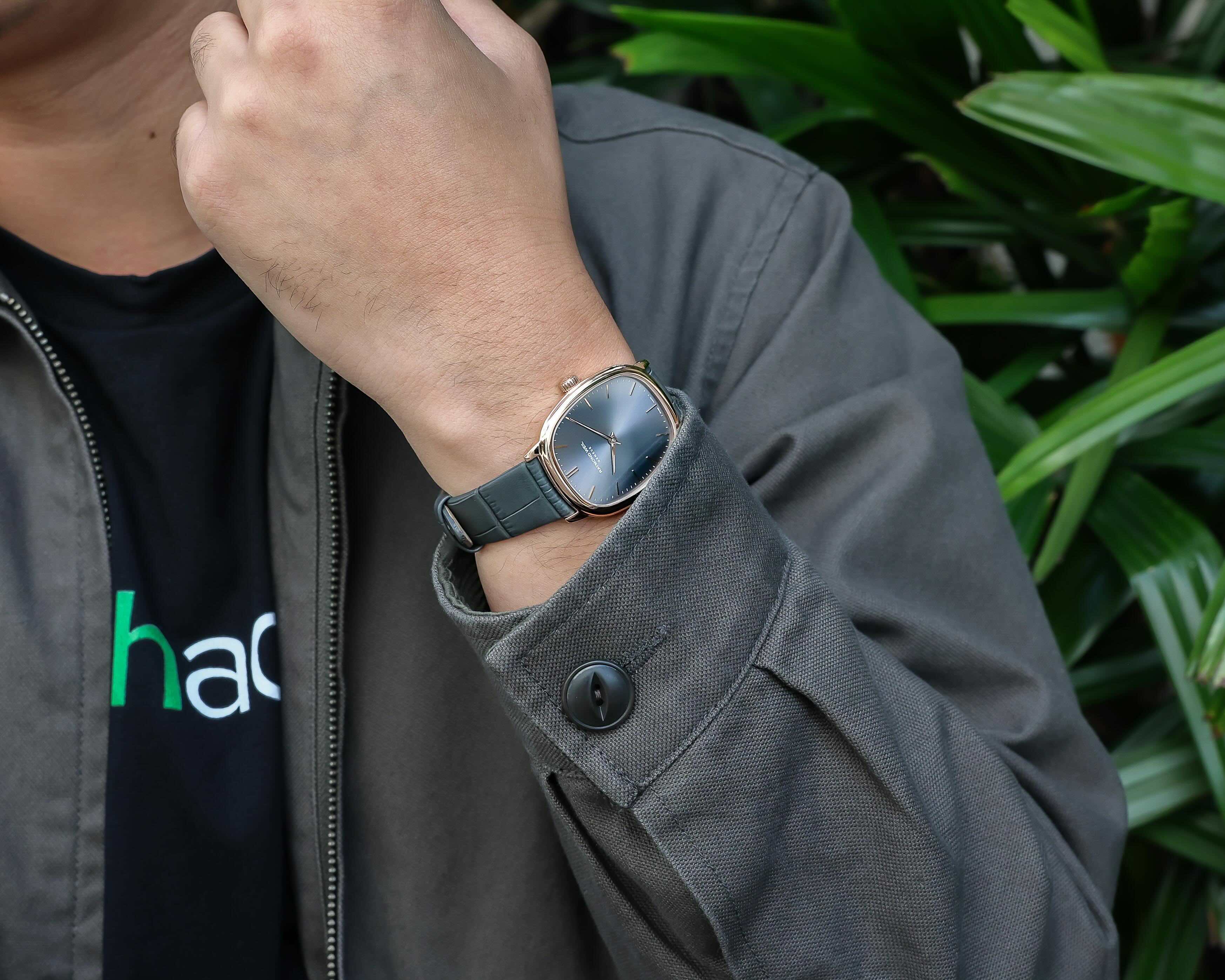
Though no watch is ever truly ‘perfect’, Raymond Weil comes remarkably close with the Toccata Heritage. Judging it solely by its classy shape, remarkable thinness and manual-winding movement, you’d never guess that the brand was operating on a fraction of the budget available to horology’s S-tier watchmakers. The limitations imposed by function and form eventually reveal themselves, but they’re not immediately apparent unless you really put the watch under scrutiny.
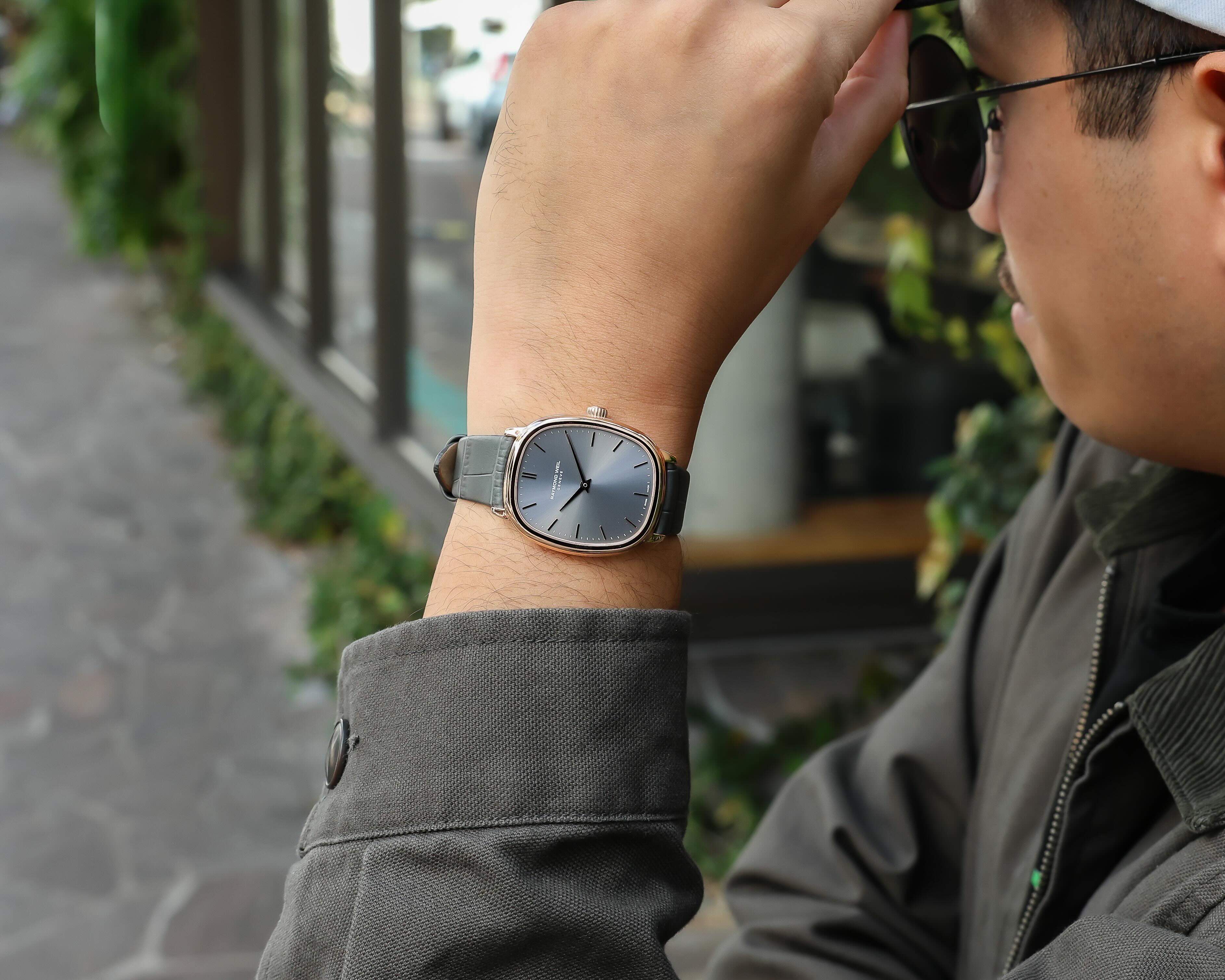
Which brings me to the price point: AU$2,995. Professionalism aside, it’s a wonder Raymond Weil can offer such a good watch at this price without losing money. That doesn’t exempt it from competition, though. The AU$2,500 Seiko Presage Classic Series Craftsmanship Enamel Dial SPB537 sits just below it, while the AU$3,500 Nomos Tangente offers a fully in-house-developed movement.
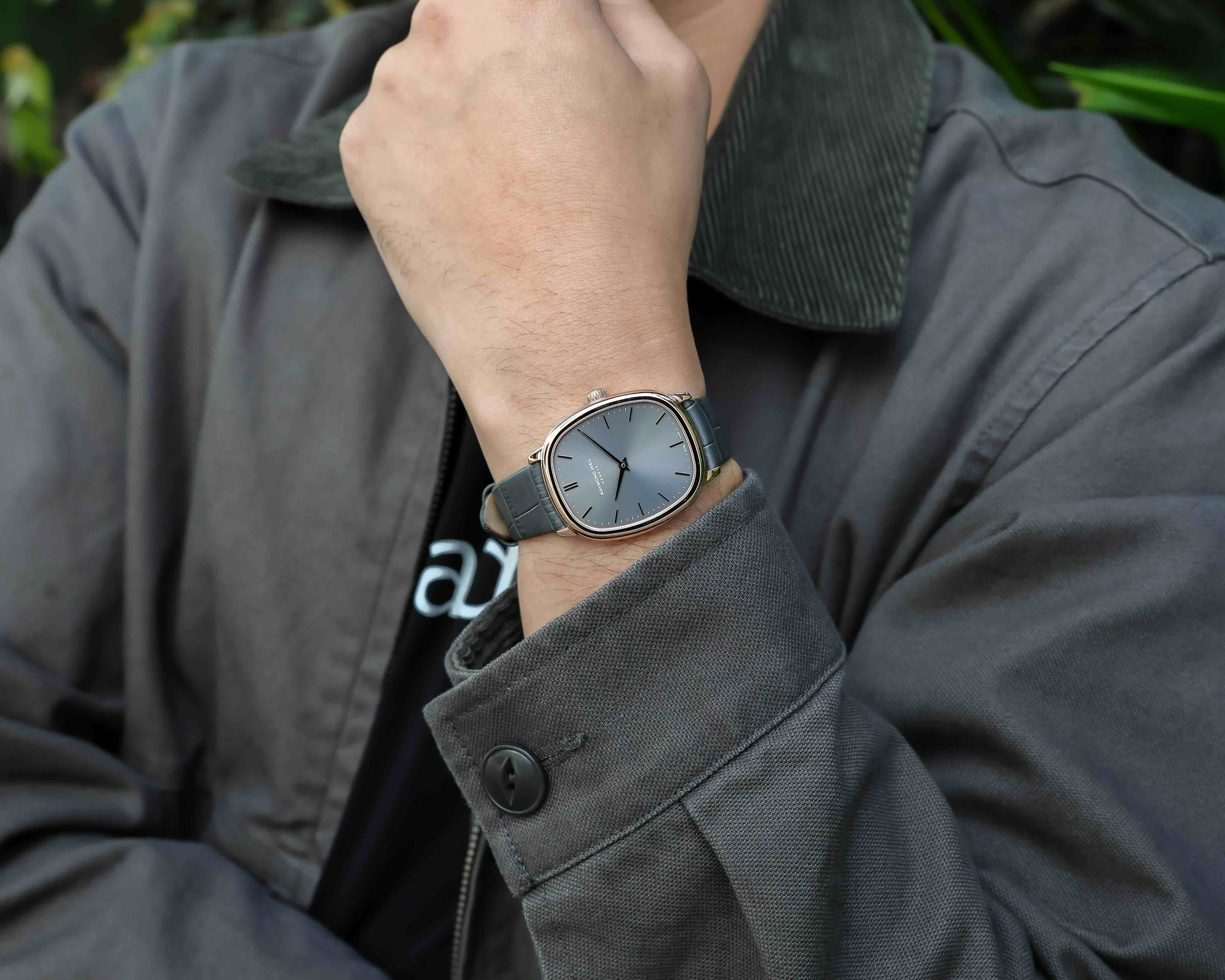
But all three have completely different visual identities. Seiko’s detailed dial feels traditional and classic, while Nomos’ minimalist Bauhaus aesthetic is more function-driven. The Toccata Heritage, on the other hand, looks and feels every bit as luxurious as a dress watch should.
With that, it absolutely qualifies as an answer to the ever-persistent question: can luxury still be attainable? And looking at the Toccata Heritage as a whole I say “Yes, it absolutely can.”
Reference & Specifications
| Feature | Specification |
|---|---|
| Reference | 2280-PC5-60001 |
| Dimensions | 33mm case diameter x 38mm lug-to-lug x 6.95mm thickness |
| Case | Rose gold PVD steel |
| Dial | Sunray brushed grey with gold PVD accents |
| Crystal | Sapphire |
| Caseback | Open, sapphire |
| Movement | Manual wind Cal. RW4100 |
| Power Reserve | 45h |
| Beat Rate | 4Hz (28,800VpH) |
| Water Resistance | 30m / 3bar |
| Strap/Bracelet | Grey calfskin leather strap with rose gold PVD steel pin buckle |
Australian Retail Price: $2,995
Availability: Available now, from Raymond Weil authorised retailers or online at Raymond-Weil.com
Image Gallery