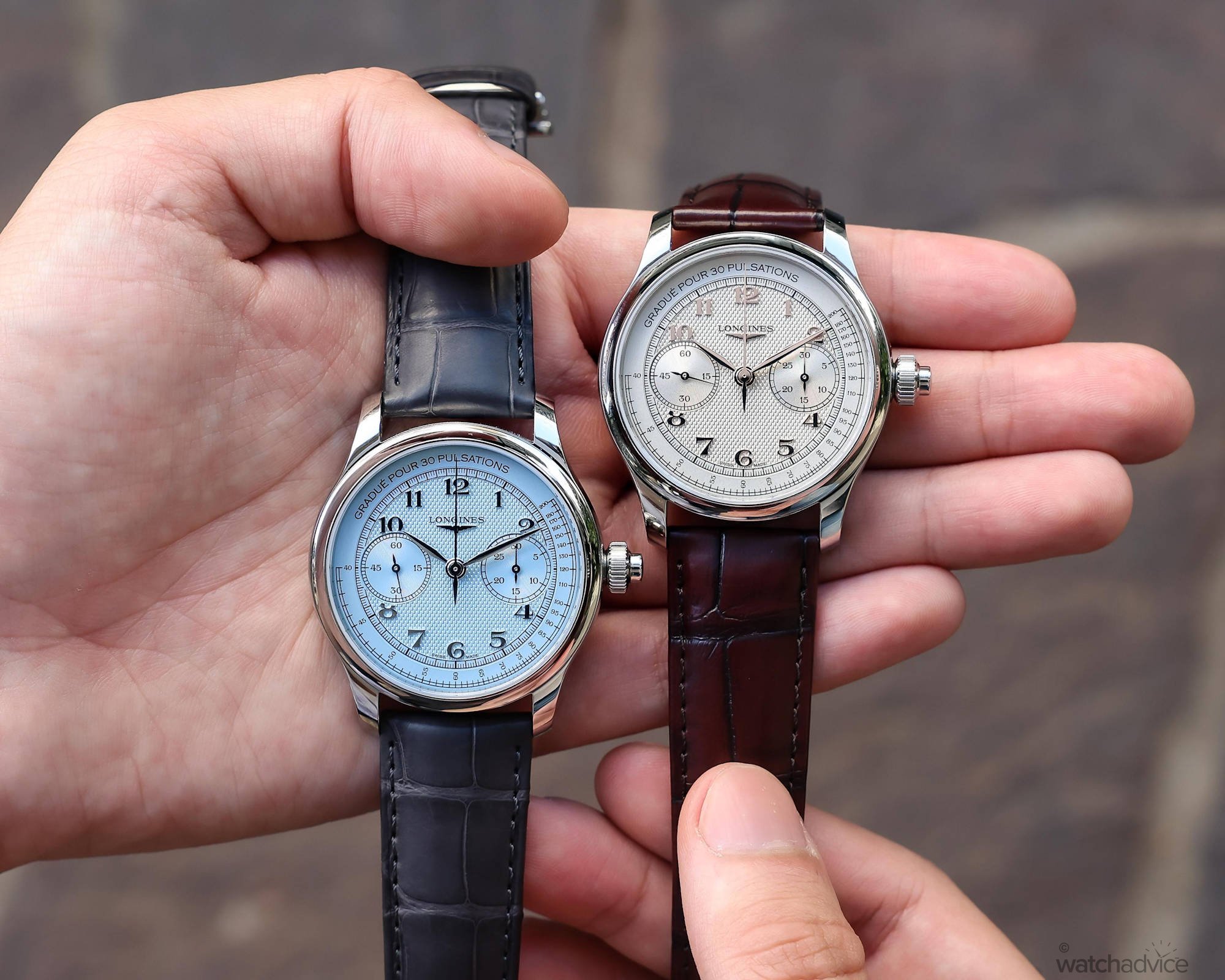

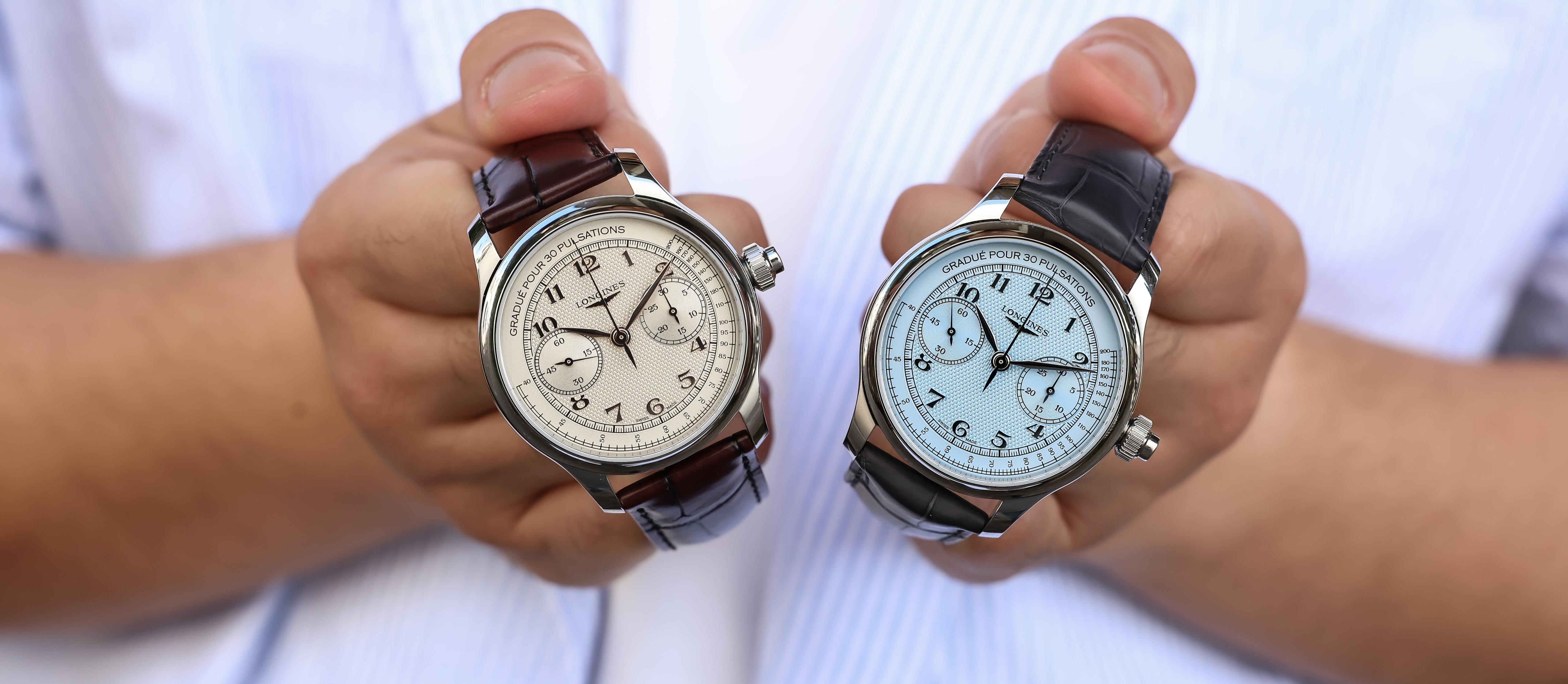
Longines has put a new spin on another classic complication, but does the function translate to form? Let’s find out!
What We Love:
- Modernised take on heritage design
- Big but easy to wear
- Ludicrous value proposition
What We Don’t:
- Dial feels slightly shrunken
- Unusual clasp system
- Is a manual wind chrono still the way to go?
Overall Rating: 9.25/10
- Value for Money: 10/10
- Wearability: 9/10
- Design: 9/10
- Build Quality: 9/10
Watch brands pay tribute to their heritage in different ways. Some do this by way of lineage, where iconic aspects of their design or craftsmanship are carried forward into the modern day. Others do this through innovation, respecting their history of disruptive advancement by introducing new technical breakthroughs with every consecutive piece. However, esteemed watch brand Longines takes a different route: reviving and overhauling watches from its exhaustive archives.
Even a slight glance towards its catalogue is indicative of such dedication. Almost all of Longines’ watches, through both design and engineering, uphold what is nearing two centuries’ worth of tradition. But for as often as it loves to resurrect archival pieces, it does so in a way that feels organic to the brand’s longstanding philosophies.
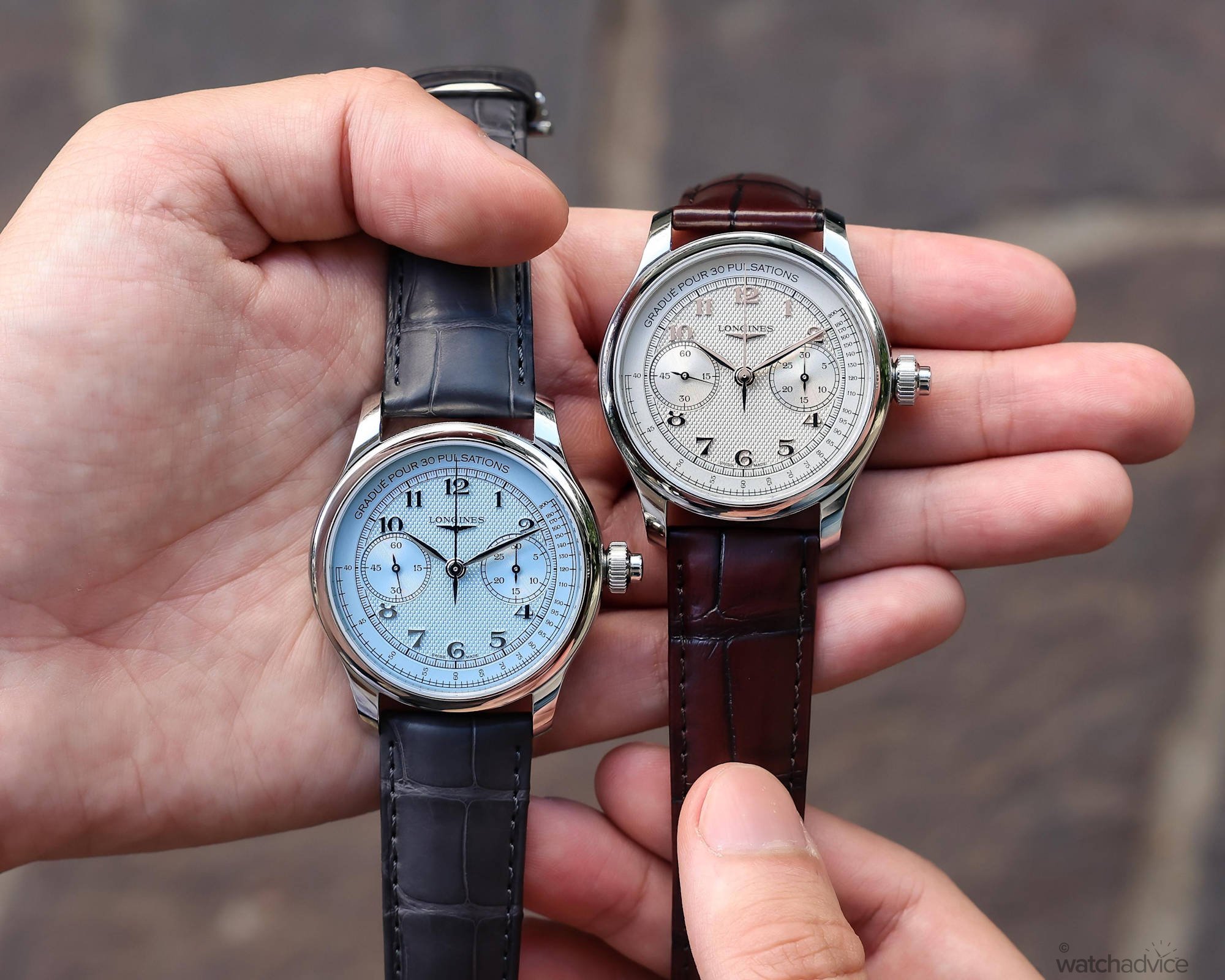
Earlier this year, that ethos manifested itself in the Conquest Heritage Central Power Reserve, a reintroduction of a timepiece from the lesser-known horological history of the 1950s. This time, they’ve gone even further back to the early 20th century, but arguably face an even greater challenge than the previous esoteric complication. I am, of course, talking about the new Master Chrono Monopusher duo released earlier this year.
So, have they managed to outdo themselves? Well, that’s what I wanted to find out when I was able to take both watches out and about for review.
First Impressions
Despite having viewed the 1950s-era Conquest Heritage Central Power Reserve earlier this year, I somehow wasn’t expecting Longines to go even further into their bag of tricks, so to speak. While I’d become more acutely aware of how deep they’re willing to dive into their rich back catalogue, an accessible monopusher chronograph never even crossed my mind. Well, here we are, and I still really can’t believe it.
Even after some time removed from the watch, recalling my time with it still comes back to me so clearly. It’s like the first time you tried your favourite food, or the first time you travelled to your dream destination. Sure, it was a while ago, but you’re still caught up in the rapture of nostalgia.
That final word, nostalgia, is what I believe is really important for watches like these to balance. Leveraging heritage is one thing, but bringing it back in a modern context is another beast entirely. It’s important not to just regurgitate the designs of old, but to show an inclination towards forward progression whilst looking backwards. Thankfully, I think Longines has handled that balancing act quite well with the Chrono Monopusher models, and I should know: I got to wear both of them!
The Design
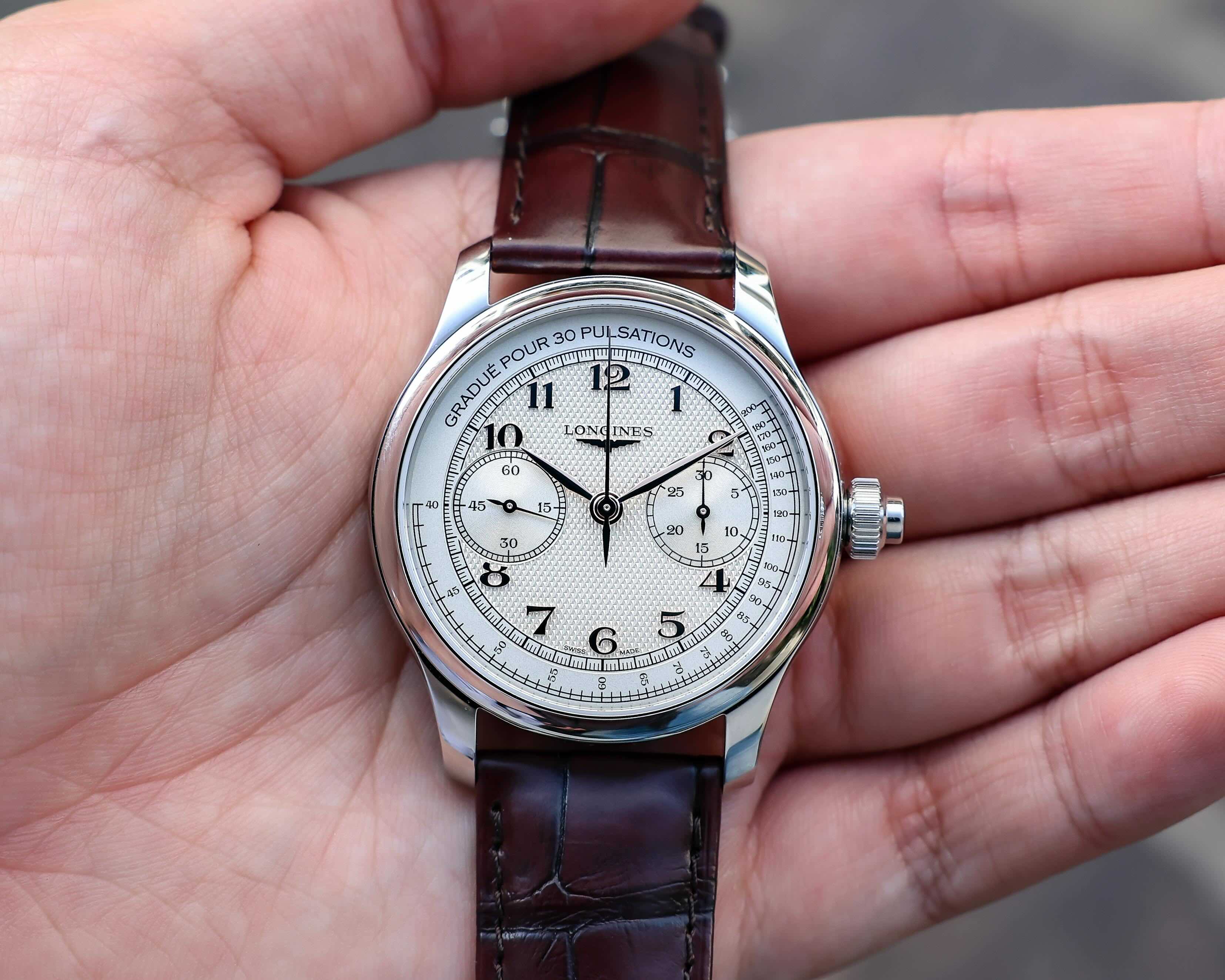
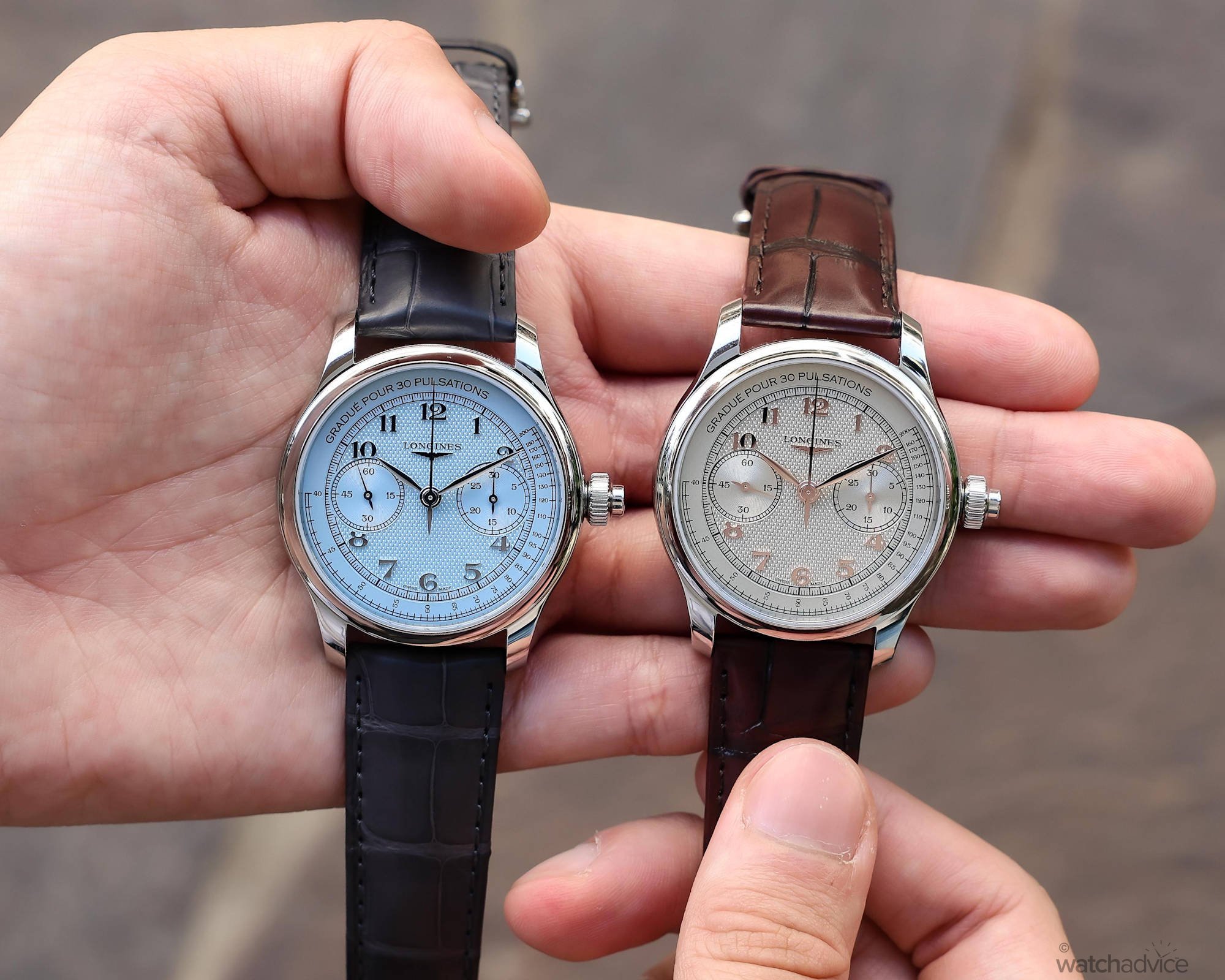
The design of the Longines Chrono Monopusher duo manages to fit the bill as both an old-fashioned yet forward-thinking timepiece. As always, we begin with the dial, which is available in one of two different colourways. The first is a more modern-focused frosted blue which, like the Conquest Central Power Reserve, sits somewhere between baby blue and ice blue.
Though the latter has very much become the ‘flavour of the month’ colour in the watch industry, lighter blue tones tend to strike a good balance between modest luxury and fresh style. On a watch as heritage-leaning as the Chrono Monopusher, this is especially important, making it feel a lot more present-day than the rest of the layout might suggest.
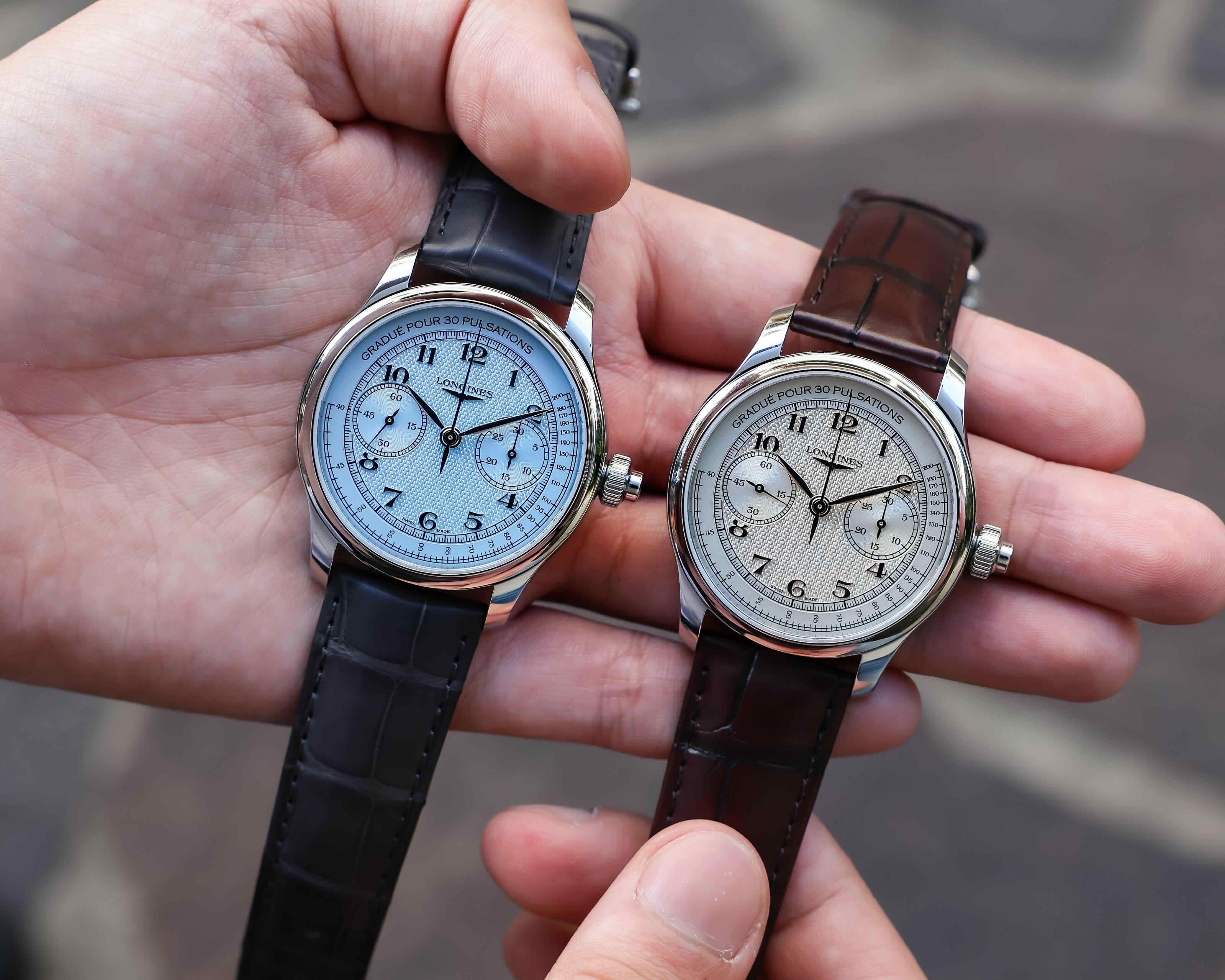
If you’re feeling a tad more old-school, however, that’s what the silvery opaline dial tone is for. But I find both are versatile; I suppose it depends on whether you want your style to work more around the cooler tones of the frosted blue or the warmer tones of the silvery opaline.
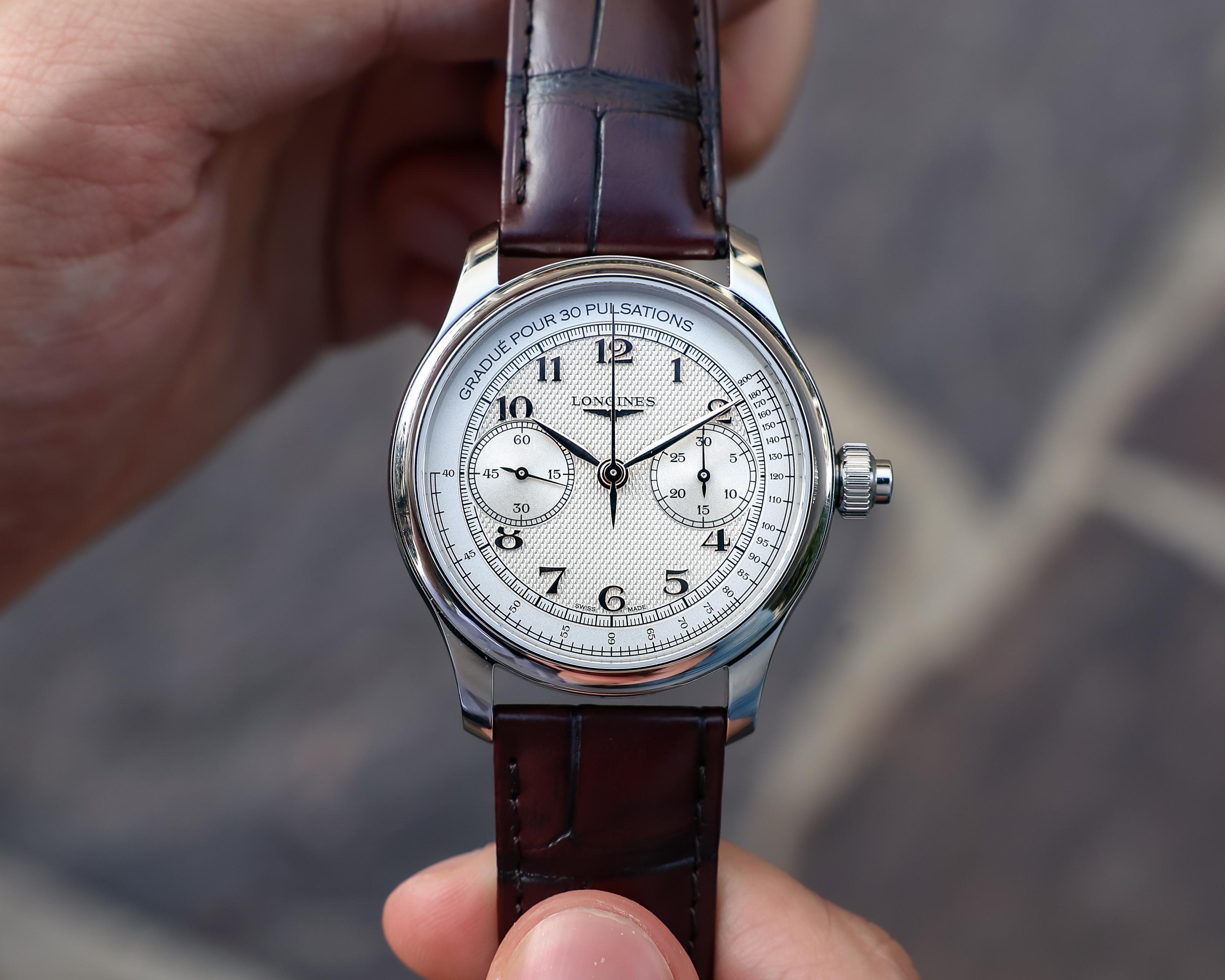
Either way, the watch comes with a textured barleycorn, or grains d’orge, finish in its centre. A hallmark of the Master Collection since day one in 2005, the pattern offers a distinctive level of depth and dimensionality. You often see far-upscale brands like Parmigiani Fleurier using a similar finish, though theirs are usually hand-cut guilloché instead of embossed or stamped. Regardless, it provides more visual intrigue on the Master Chrono Monopusher duo from afar, and can still be appreciated up close.
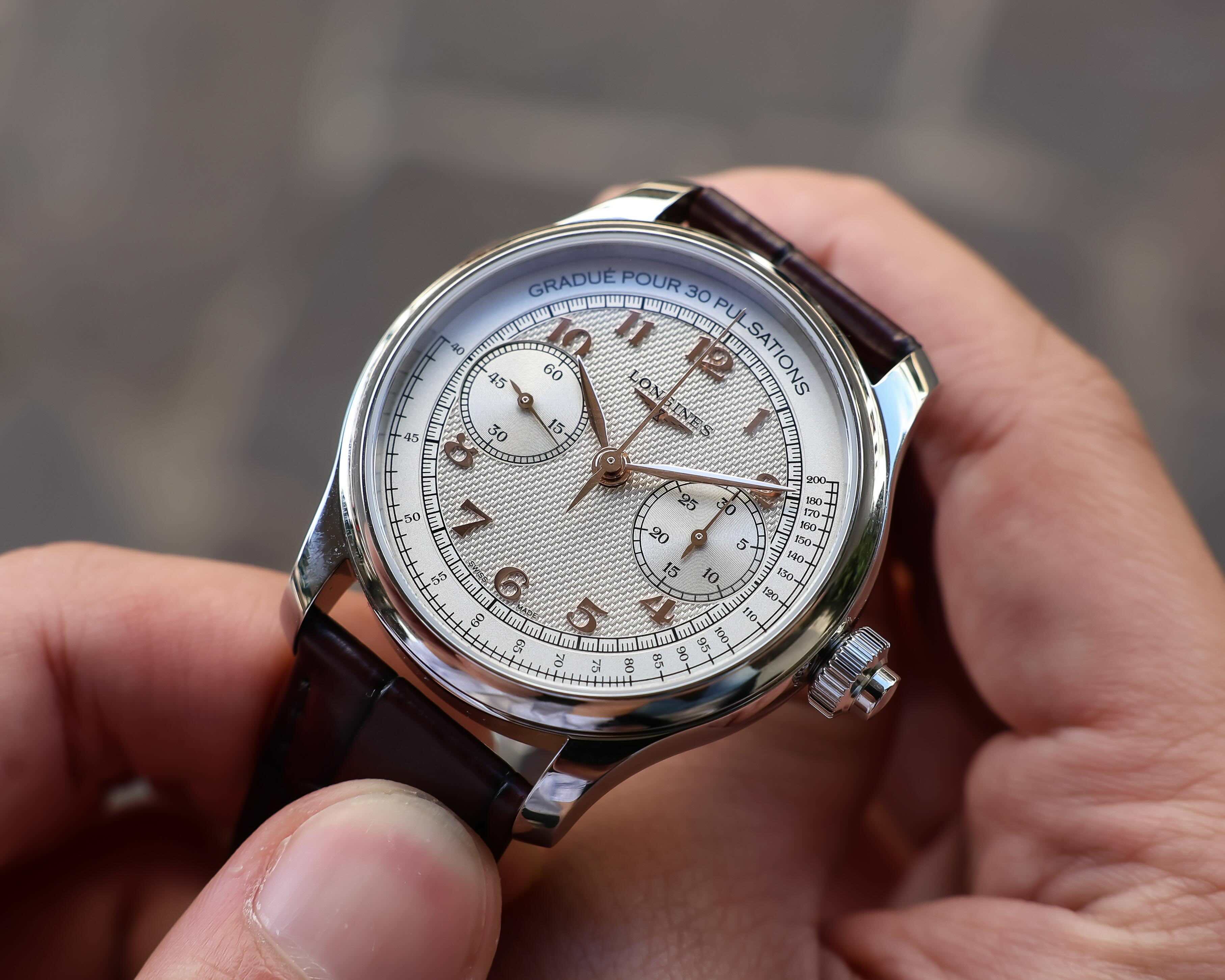
Within the barleycorn arena come other cornerstones of the Master Chrono Monopusher design, those being the leaf hands and Breguet-style Arabic numerals. Where most previous Master models have printed numerals, these indexes are applied instead, finished in rhodium for the frosted blue and rose gold tones for the silvery opaline. Slightly sunken into the barleycorn finish are two subdials, which provide the small seconds and 30-minute registers of the chronograph layout. Both have their own finish unique to the dial, those being classic concentric vinyl lines with subtle brushing for added light play.
After moving beyond the black printed minutes/seconds track, much of the periphery is taken up by a flat-finished ring that sits just above the centre and subdials. This is mostly to make way for the pulsometer track, which before heart-rate monitors helped doctors and athletes track a person’s pulse. The text across ten to 12 o’clock reads ‘Gradue pour 30 pulsations’ (‘Graduated for 30 pulsations’), which indicates how the pulsometer can be used.
Start the chronograph function, count 30 heartbeats, and then stop; the seconds hand should point towards one of the numbers on the outer scale. It’s a useful meter that has helped save lives in times before electricity, and having it here can perhaps end up saving someone else down the line, too. Let’s face it: it probably won’t, but you can tell your friends that it can when they ask you why you bought it!
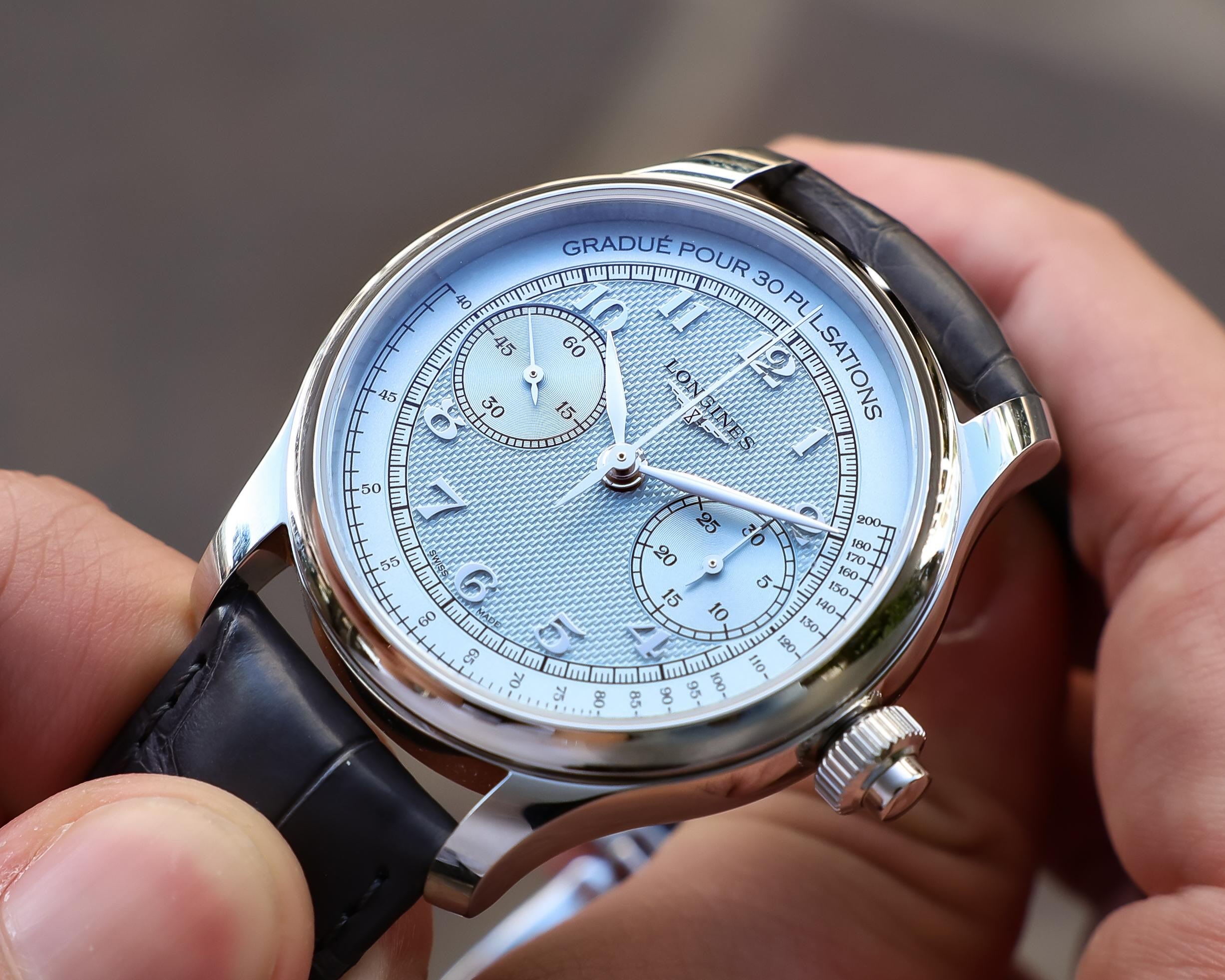
As much as I like the pulsometer, though, it does take up a significant amount of real estate on the dial. Sure, it’s legible, but it feels like the other components of the dial shrink to make room for the pulsometer. I suppose the trade-off in legibility is far more palatable for the time-telling aspects themselves rather than the pulsometer, which uses a scale that’s small enough as it is.
Beyond the dial is fairly simplistic, with the Master Chrono Monopusher duo coming on a rounded, all-polished case. I think it’s appropriate for a dress watch, but I can’t help but feel like brushed case flanks and polished chamfers could have really made this design stand out a lot more. That would also make it a little less of a smudge magnet. But where the polishing really excels is in the watch’s concave bezel. A defining element of the new Master Collection, Longines has made a concerted effort to give the watch a more unique look compared to its peers within the catalogue and the wider dress watch industry, drawing the eyes naturally back into the dial.
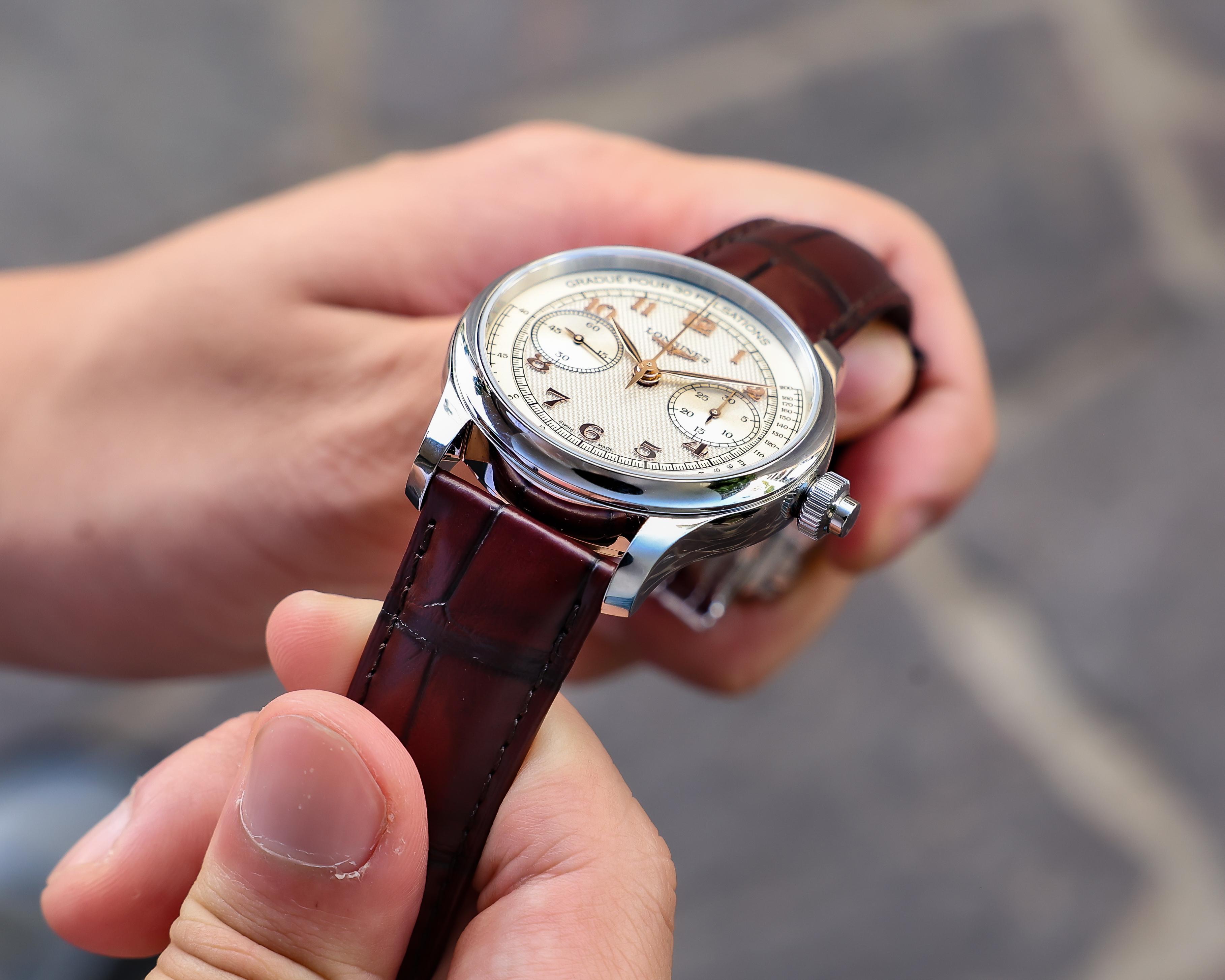
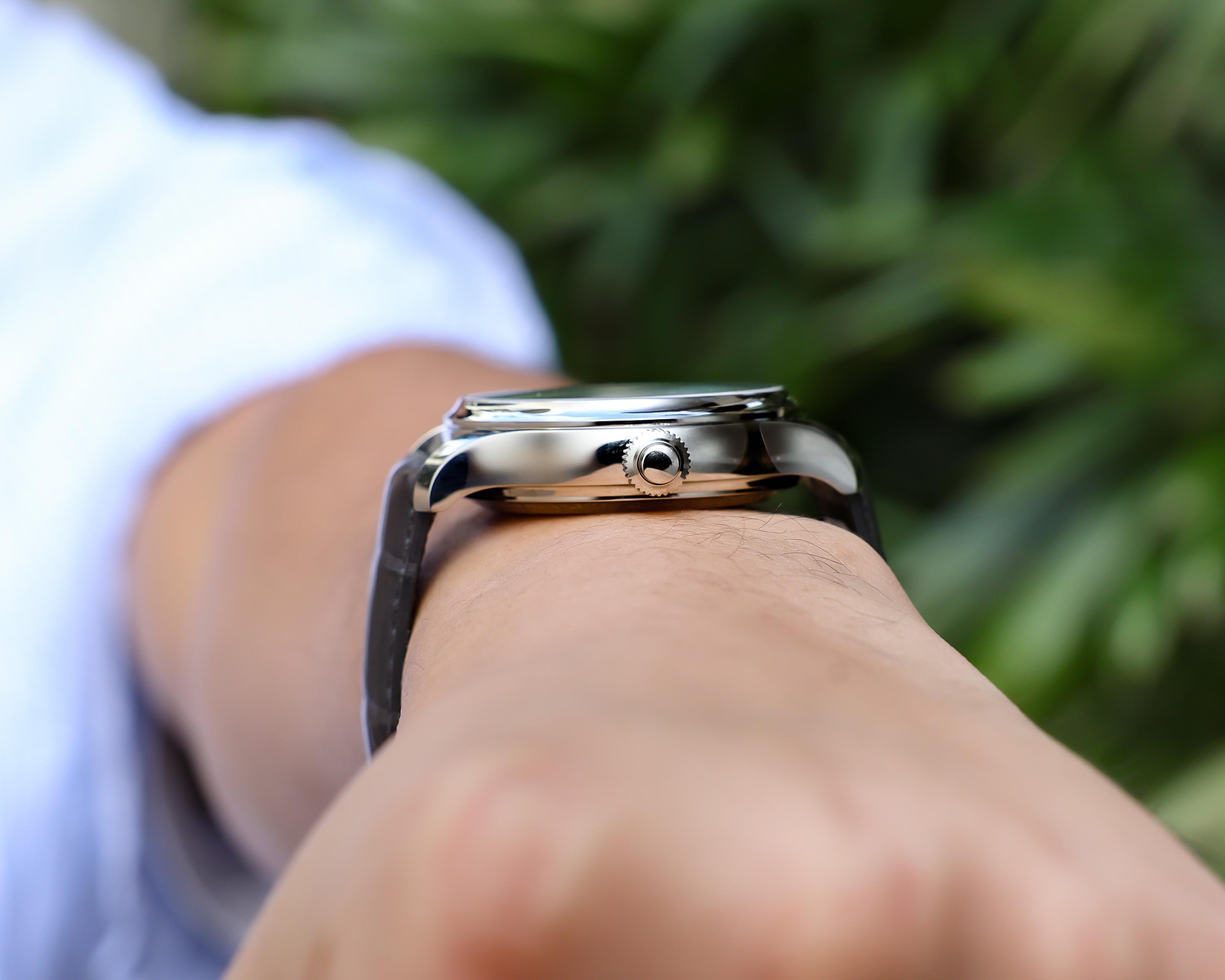
The bezel, case and lugs flow elegantly into one another, interrupted only by the fluted crown with its protruding monopusher button. While some monopusher chronograph designs often separate crown and complication, I love that Longines has gone the extra mile to maintain the symmetry and understatedness of the watch.
Finally, each piece is attached to an alligator leather strap, complementing each dial tone in either a grey-blue or deep brown colour. Both straps terminate in a unique butterfly clasp and buckle system, which I’ll be talking more about very shortly.
Overall, while there are some opportunities for general improvement, the Longines Master Chrono Monopusher does exactly what it needs to do extremely well. With dress watches on somewhat of a comeback tour, adding unique complications that still play within the often-stringent rules of the subgenre is the best way to progress. Personally, I lean towards the frosted blue, but the silvery opaline with rose gold accents is absolutely worth a try as well.
How It Wears
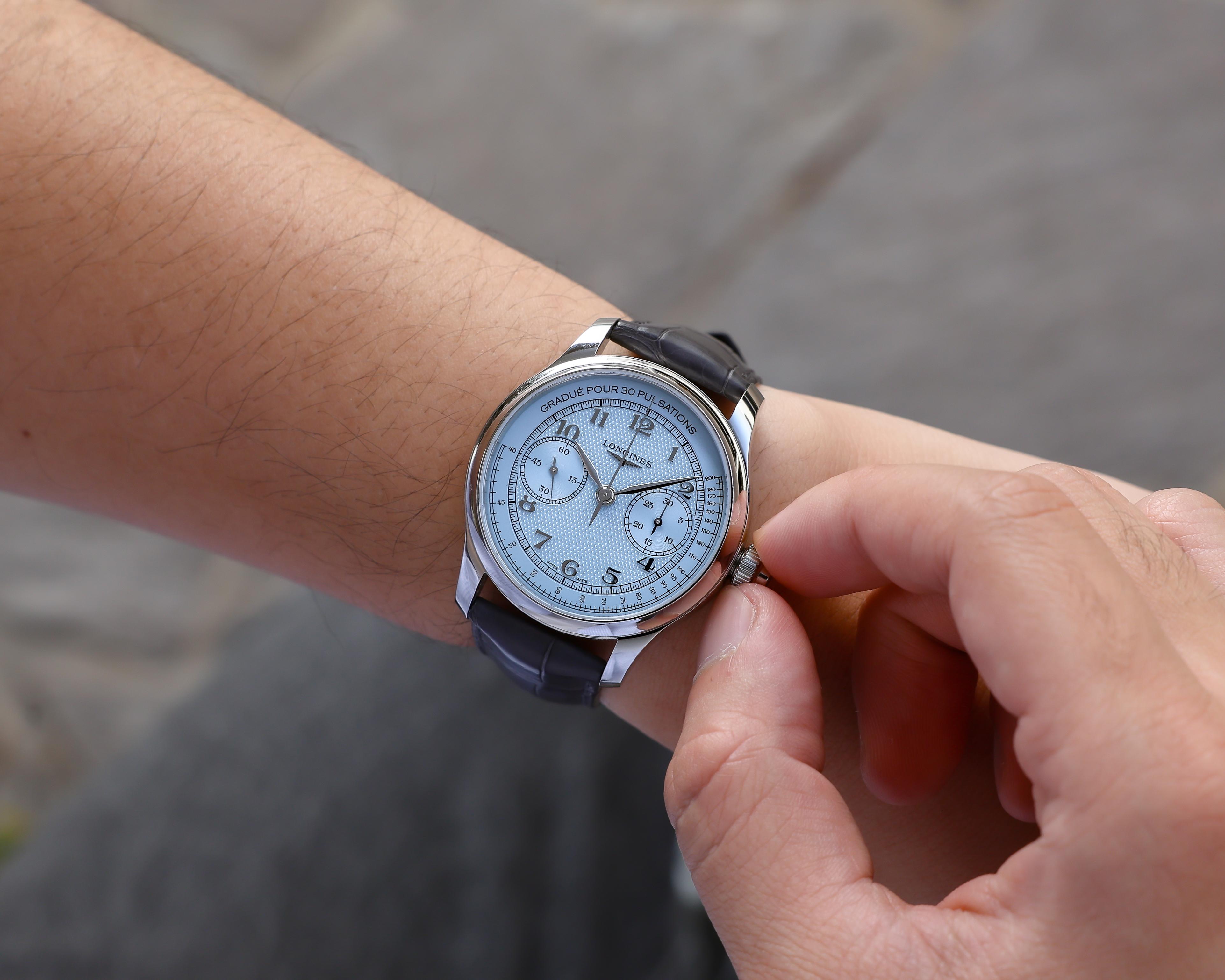
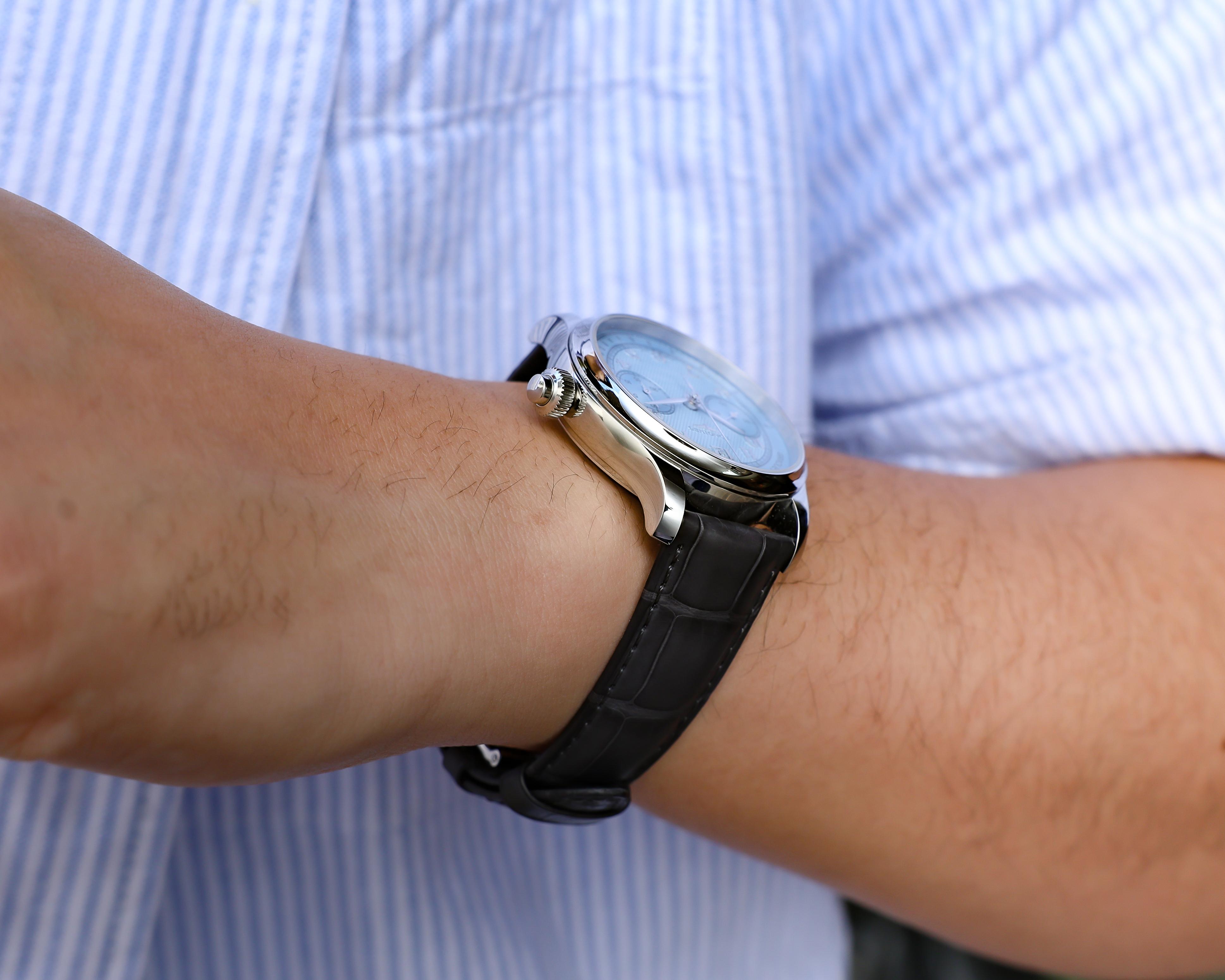
While you might expect a vintage-inspired watch to have similarly vintage dimensions, you’d be mistaken. Measuring 41mm in case diameter, 48.6mm lug-to-lug and 12.6mm thick, the Longines Chrono Monopusher is certainly a long way away from the 35–36mm sizes of yore.
But I wouldn’t say that immediately disqualifies it, as it reflects much of the current industry’s wearing sensibilities. We all know the generally agreed ‘sweet spot’ is 39mm, but 41mm works just fine on most wrists. With its rounded and tall case, the watch is bold from both the top-down and the side. The lugs curve down to the wrist, enhancing wearability, while the alligator leather strap wraps naturally around as it typically does.
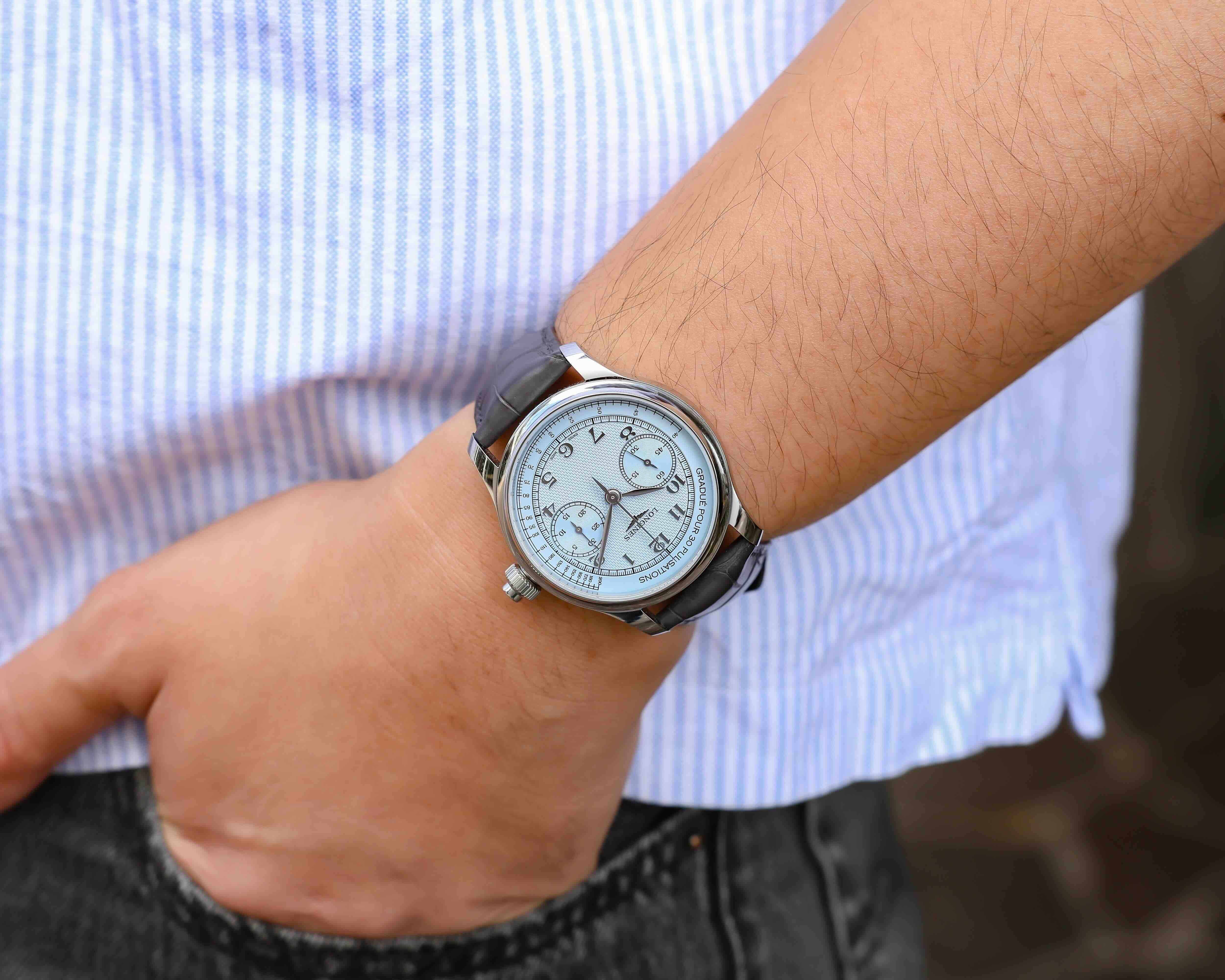
Even with a 12.6mm case thickness, the watch certainly feels quite big on the wrist. So, I’d highly advise seeking one out to see how it fits on you. It’s definitely into the upper threshold of what I would wear with a 6.4in (16.3cm) wrist, but I never noticed any major heaviness or discomfort.
I have to give praise once more to the monopusher chronograph layout, which definitely helps wearability by not adding too much funkiness with a separated pusher. The extension of the crown does take some getting used to, but thankfully, I never ended up accidentally activating the chronograph when I didn’t want to.
This brings us to the clasp system that Longines has introduced with the Master Chrono Monopusher. From the outset, it was quite the headscratcher, made up of a two-part release across the clasp and buckle. First, pressing the deployant button naturally releases the watch from the wrist by way of the butterfly clasp.
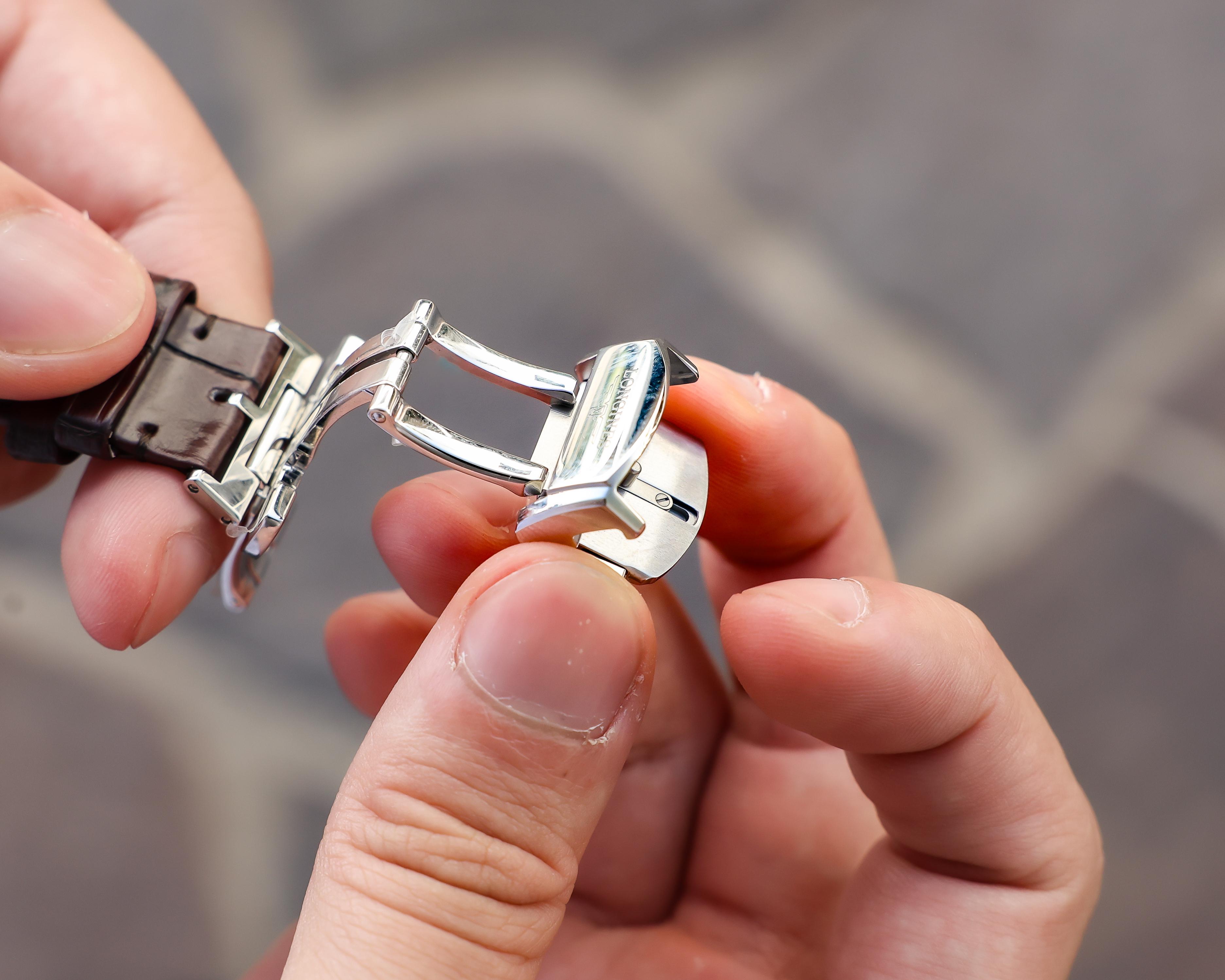
However, should you need to adjust the tightness of the strap, a second release needs to be activated for the buckle itself. This opens the clasp like a set of mechanical jaws, which allow you to reposition it to any of the strap’s associated holes.
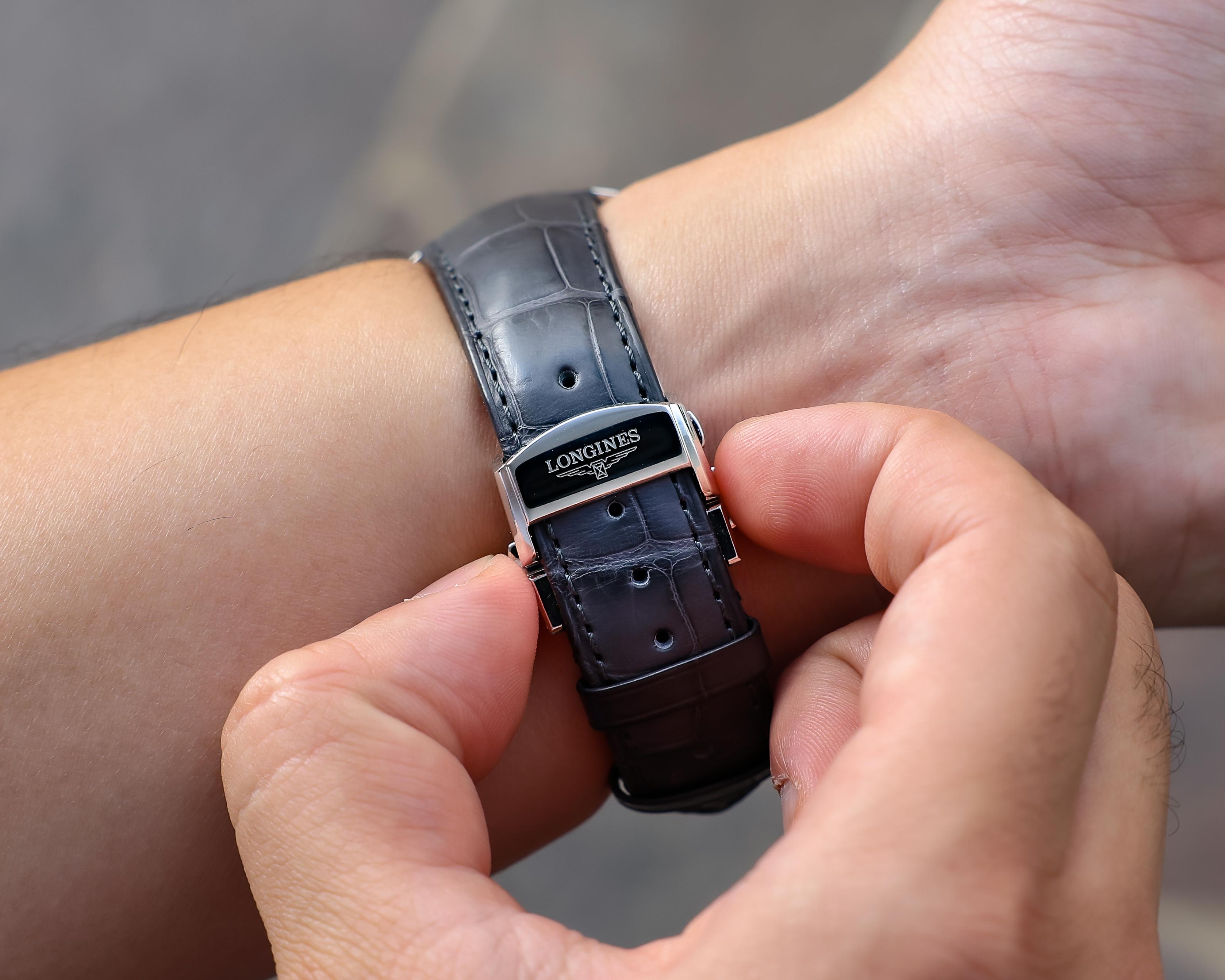
While this, in theory, helps maintain the aesthetic and flush wear of the Master Chrono Monopusher, I do wonder why Longines has opted to use it. It took a while for me to get the hang of, which is just fine, but I don’t think a classic pin buckle would have been out of the question at all. However, the new system does come with its own micro-adjustment, which in a leather strap is an insanely rare feat for household name brands like Longines. If you’re in for a fairly comfortably-wearing dress watch, and you don’t mind learning something new, these models will still serve you well enough.
The Movement
From the outset, knowing nothing about this watch, you might think that Longines’ biggest challenge with the Master Chrono Monopusher is in the development and implementation of the movement. However, with the manufacturing might of sister brand ETA under the Swatch Group, alongside their own craftsmanship capabilities, such R&D is actually a lot easier than you might think.
Through the display caseback, Longines presents the Cal. L799.5, a manual-wind movement with a 4Hz (28,800VpH) beat rate and a 68-hour power reserve. A 4Hz beat rate is a rarity for Longines, as they often use their signature 3.5Hz (25,200VpH) across many of their watches.
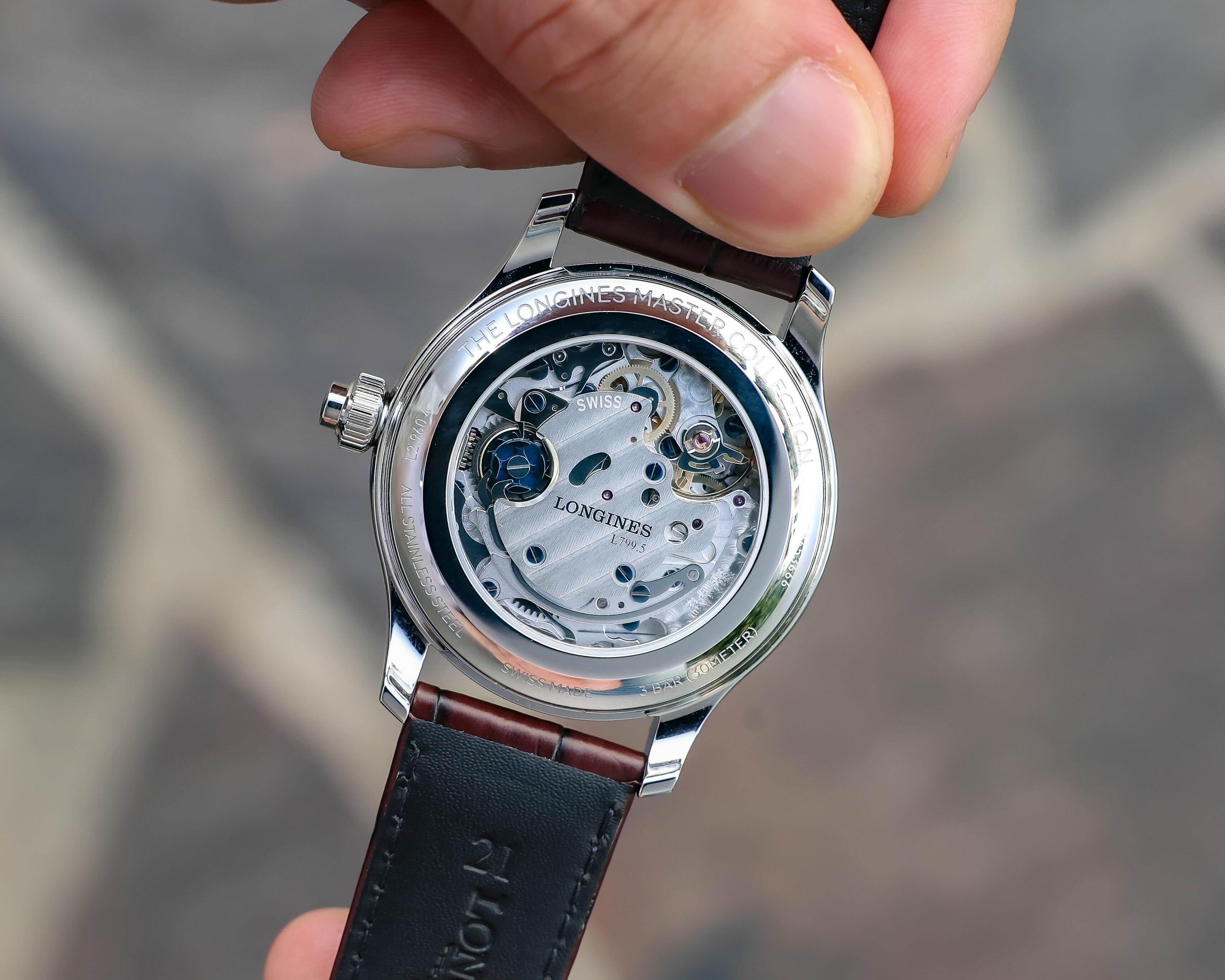
Aside from timekeeping, the Cal. L799.5 only serves one complex function, which by the name of the watch has become quite obvious. Locally controlled through a button protruding from the crown, the chronograph can be started, stopped and reset all from the same push. While you do lose the ability to pause the chronograph, with each action happening in sequence rather than as isolated functions, it massively declutters the space around the case and hearkens back to pocket chronographs of old.
While the creation of such a movement might sound extremely complex, this is neither Longines nor ETA’s first time doing so. In fact, this entire exercise started when Longines released the Single Push-Piece 180th Anniversary Limited Edition all the way back in 2012. Since then, they have released several references using the brand’s previous monopusher chronograph iteration, the Cal. L788, itself based on the legendary ETA/Valjoux 7750 series of movements.
Perhaps the most important change that occurred between the Cal. L788 and L799.5, beyond the removal of the date window, is the move from automatic to manual-wind. While some might lament the loss of a practical function in automatic winding, the move has three distinct benefits: the power reserve has been upped from 54 to 68 hours, the overall case thickness gets dragged from about 14mm down to 12.6mm, and the movement finishing is far more visible.
To that final point, Longines and ETA have done well to make the movement look as good as possible. Blued screws, Côtes de Genève (Geneva stripes) and perlage can be seen throughout the movement, helping distinguish each layer with dimensionality and subtle pops of colour.
Final Thoughts
The common sentiment with heritage re-releases and remasters is that if you can’t bring them back better, don’t bring them back at all. Though Longines does remain one of few brands that has consistently done them well, many of their heritage-inspired releases in the past have felt gratuitous more than they have felt progressive. So, when the brand elected to not only revive the Chrono Monopusher layout but reposition it as part of the Master Collection, I felt that it was a stroke of genius.
Despite all its old-world leanings, the Master Collection is not inherently ‘vintage’, only being introduced in 2005. So, by name alone, they had already challenged the stigma that often comes with heritage remasters. But after getting hands-on with both watches, it’s easy to see that through form and function, they’ve eschewed it entirely.
The Longines Master Chrono Monopusher does not feel like a watch made 100 years ago. Instead, it feels exactly as it should: a brand-new watch inspired by an older time, the ideal synthesis of watchmaking’s past and present. And given the optionality between the frosted blue and silvery opaline/rose gold, Longines has given prospects the freedom of choice to go further down one path or the other.
Which brings me to the price: AU$5,825. When I first heard that, I genuinely had to ask Chamath several times if we were provided the correct price, in the correct currency. Every single time, he assured me it was correct. Even then, I still can’t believe it. Literally no other watch of a similar calibre exists where this one does.
The most direct comparisons either exist much lower, with predominantly out-of-house manufacturing, or in the upper echelons of haute horlogerie. Even broadly expanding the definition of ‘competition’ to all chronographs, it’s hard to find close comparisons. Baume & Mercier’s Riviera Chronograph comes in at AU$6,300, while Longines’ own Conquest Chronograph slots in at AU$6,550. But when you’re there, it’s more so about the difference between a dress-leaning and sports-leaning watch, and whether you prefer automatic duopusher chronographs instead of manual-wind monopusher chronographs.
But for the most part, I believe if you’ve clicked on this article and read this far, you’re not interested in a sporty duopusher chronograph right now. In that respect, the Longines Master Chrono Monopusher Duo remains singular in the industry, a feat which becomes harder and harder to achieve with each release. I don’t know how they keep doing it, but they do, thanks to their exacting standards in aesthetics, mechanics, accessibility, and the overall wearing experience. Longines remains the most consistent watch brand of all time.
References & Specifications
| Feature | Specification |
|---|---|
| Reference | L2.960.4.78.2 (Silver Opaline) L2.960.4.93.2 (Frosted Blue) |
| Dimensions | 41mm case diameter x 48.6mm lug-to-lug x 12.6mm thickness |
| Case | Stainless steel |
| Dial | Barleycorn patterned silver opaline / frosted blue with rose gold / rhodium accents |
| Crystal | Sapphire |
| Caseback | Open, sapphire |
| Movement | Manual wind Cal. L799.5 with small seconds & monopusher chronograph (30min register, pulsometer) complications |
| Power Reserve | 68h |
| Beat Rate | 4Hz / 28,800 VpH |
| Water Resistance | 30m / 3bar |
| Strap/Bracelet | Brown / grey-blue alligator leather strap with steel deployant clasp & buckle combo |
Australian Retail Price: $5,825
Availability: Available now, from Longines boutiques, authorised retailers, or online at Longines.com
Image Gallery