

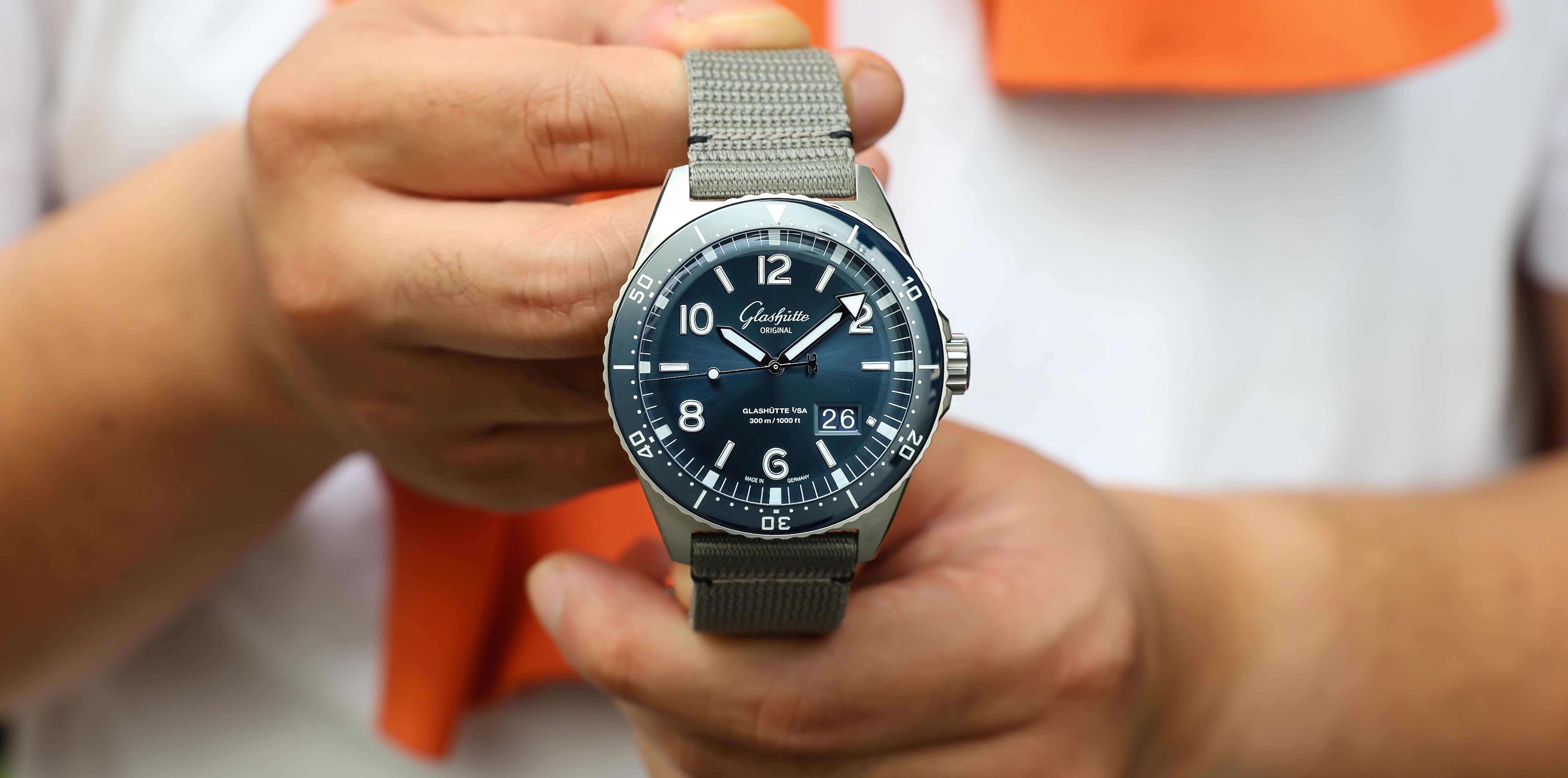
Glashütte Original’s SeaQ is certainly a luxury dive watch, but how luxurious can a dive watch get? Let’s find out!
What We Love:
- An extremely bold, tough build
- Incredible legibility
- Beautiful movement & open caseback
What We Don’t:
- Mobile but hulking presence nonetheless
- Unidirectional bezel feels too tight
- Is there such thing as overkill?
Overall Rating: 8.75/10
- Value for Money: 9/10
- Wearability: 8/10
- Design: 9/10
- Build Quality: 9/10
Of all the archetypes of German culture, perhaps none is as universally recognised as its knack for over-engineering. Everything from Mercedes-Benz to Mettbrötchen is carefully considered, measured and executed in a manner as precise as it is complex. It’s become so quintessentially German that it’s also an international stereotype, with the intricacies of the country’s industry worshipped just as readily as they are playfully mocked.
One industry that constantly walks the line between precision and complexity is horology, where brands like Glashütte Original uphold the values of German watchmaking through their timepieces. Typically, this leans towards the artistic side of things, as seen in recent Senator releases like the Aventurine and Cherry Blossom models from the Atelierauftrag line. But that doesn’t mean Glashütte Original has forgotten its engineering identity – not by a long shot.
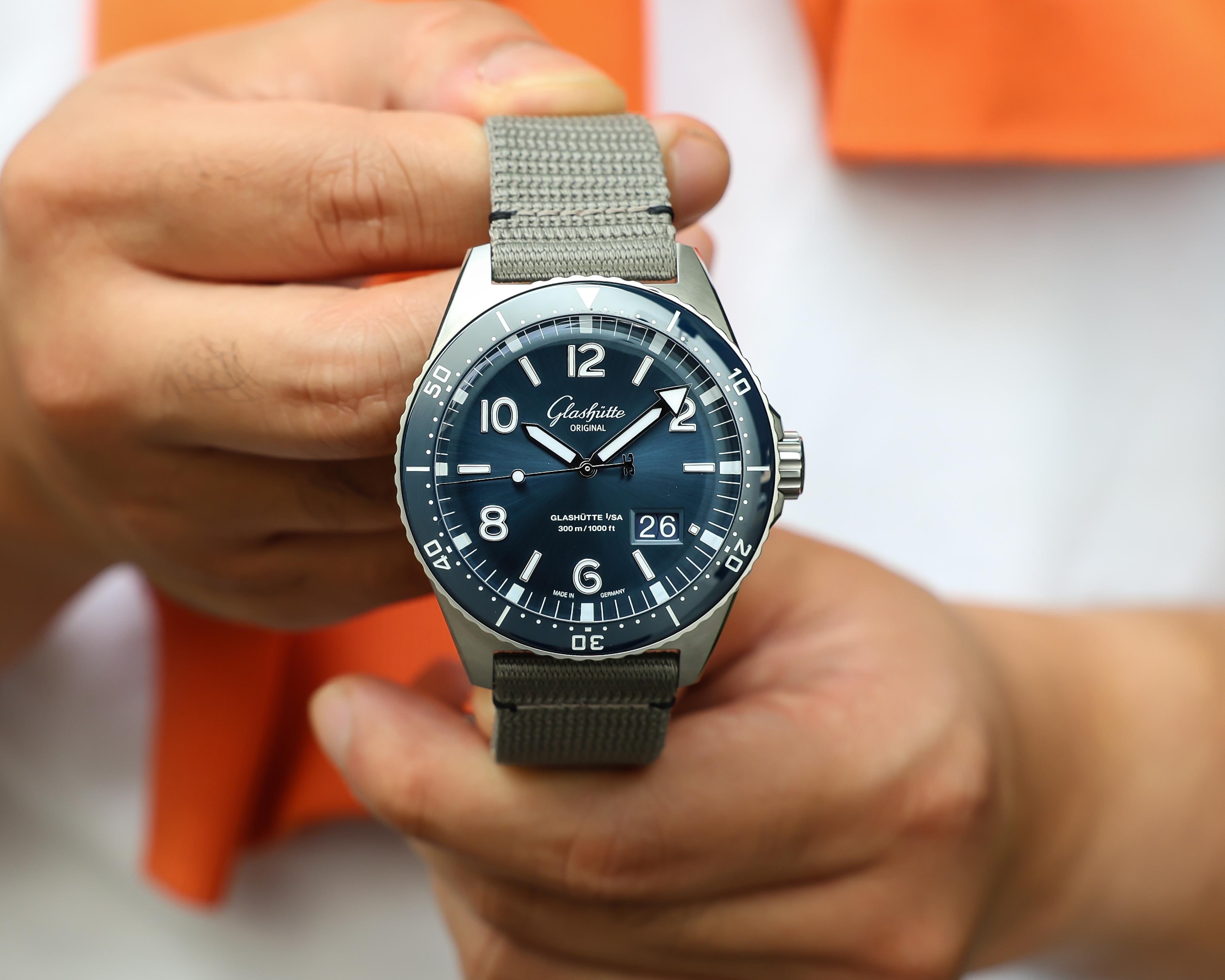
Meet the Glashütte Original SeaQ Panorama Date, the brand’s premier dive watch. A feature-laden, robust timepiece, you might be inclined to believe that this watch upholds the more practical side of things.
And while that’s true, it’s still categorically a luxury timepiece. But should a dive watch really be that way? Well, that’s what I wanted to find out when I was given the privilege of taking one of their models for a spin.
First Impressions
At first glance, Glashütte Original’s SeaQ Panorama Date looks the part of a typical dive watch. Reading into its specifications, this becomes abundantly clear: high water resistance, rigorous movement testing and a bold frame are all part of the classic dive watch package.
But what also makes it interesting is its commitment to a skin diver aesthetic. Emerging in the mid-20th century as an alternative to larger, professional dive watches, the SeaQ Panorama Date’s hulking frame makes it something of an anomaly within the subgenre.
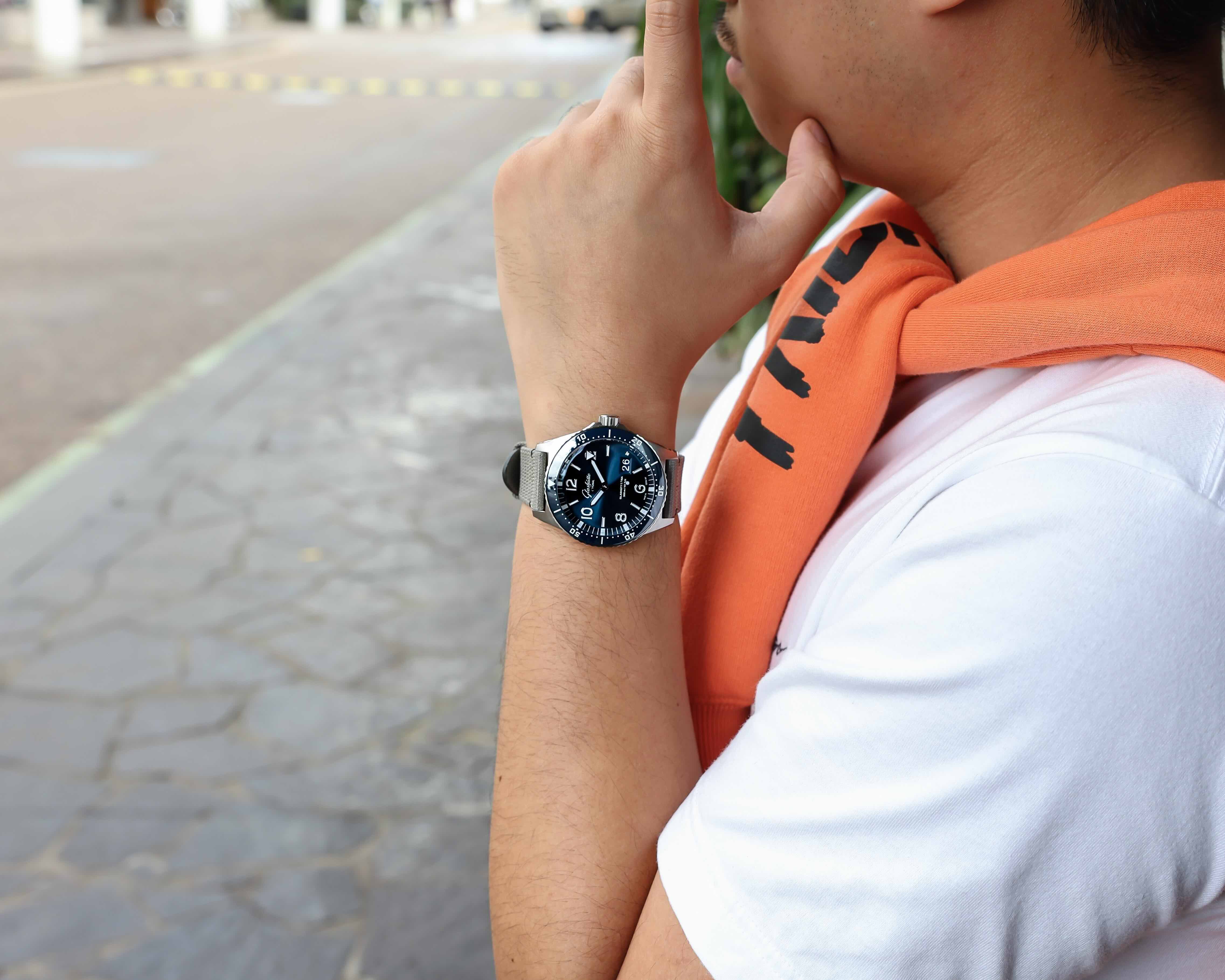
This wasn’t the only subversion I noticed, either, as Glashütte Original’s dive offering is clearly a highly refined piece. With its open caseback, remarkably finished movement and brilliant dial, the level of elegance on display is far removed from its external impression as a weekday warrior. It’s like watching an M1 Abrams rumble down the road, only to reveal the driver is Keira Knightley.
That dichotomy of identities is what makes the Glashütte Original SeaQ Panorama Date so compelling to watch enthusiasts. By extension, it’s what makes it so compelling to me, too. A singular blend of historical cues and contemporary philosophies, I, no pun intended, eagerly dove into what research I could find about this watch to better inform how I felt about it.
The Design
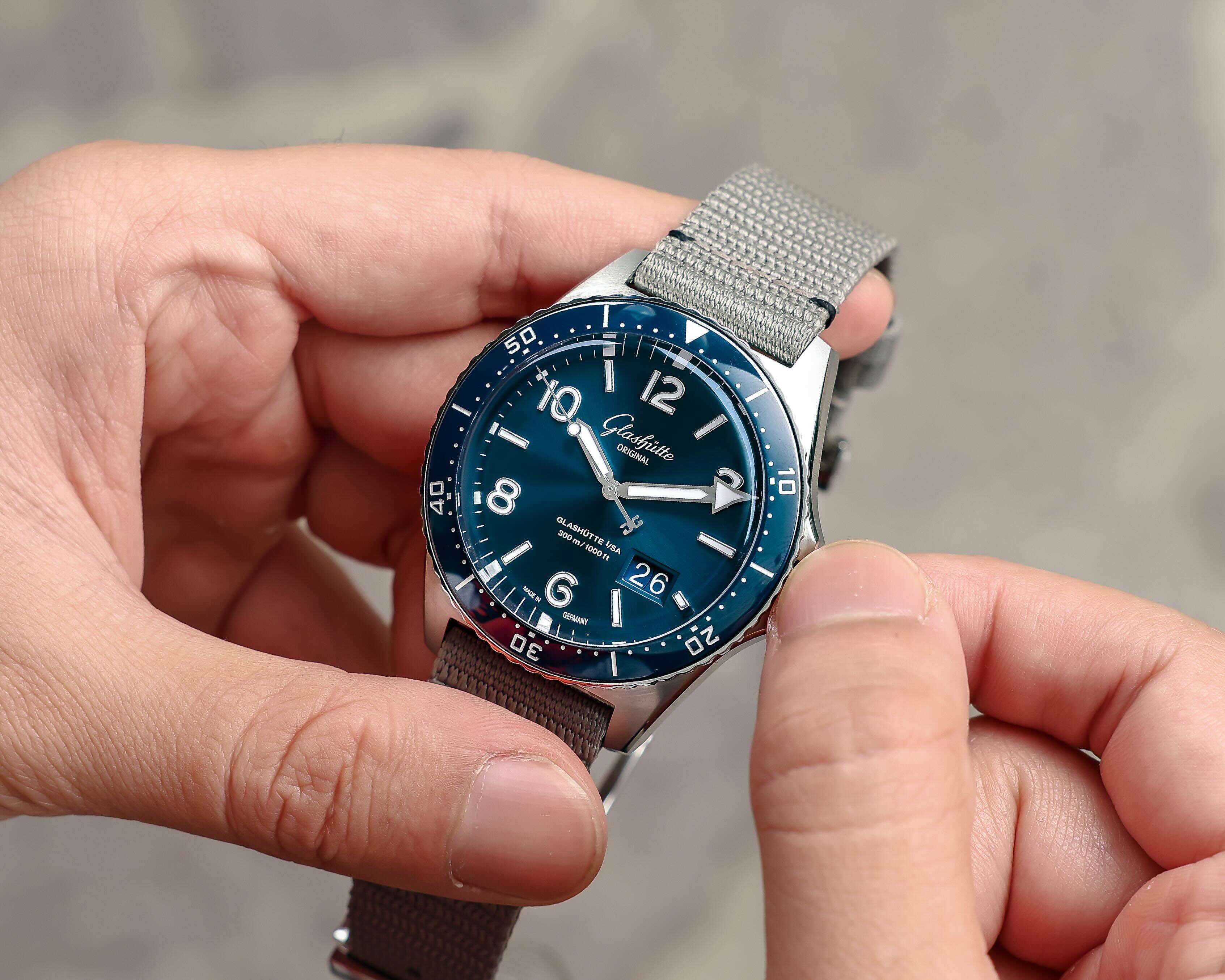
As mentioned, the design of the Glashütte Original SeaQ takes much of its inspiration from the mid-century skin diver aesthetic, particularly the brand’s own 1969 GUB Glashütte Spezimatic Type RP TS 200. Looking at archival photographs of that watch alongside the modern SeaQ, they’re almost one-to-one lookalikes, though the SeaQ Panorama Date comes with a few contemporary German twists of its own.
This is immediately apparent in the dial’s colour and finish, presented here in sunray-brushed blue. A universally versatile tone in modern watchmaking, it sets the stage for the wider modernisation of the piece. They haven’t forgotten the watch’s past, though, as Glashütte Original also offers the model in several other dial options.
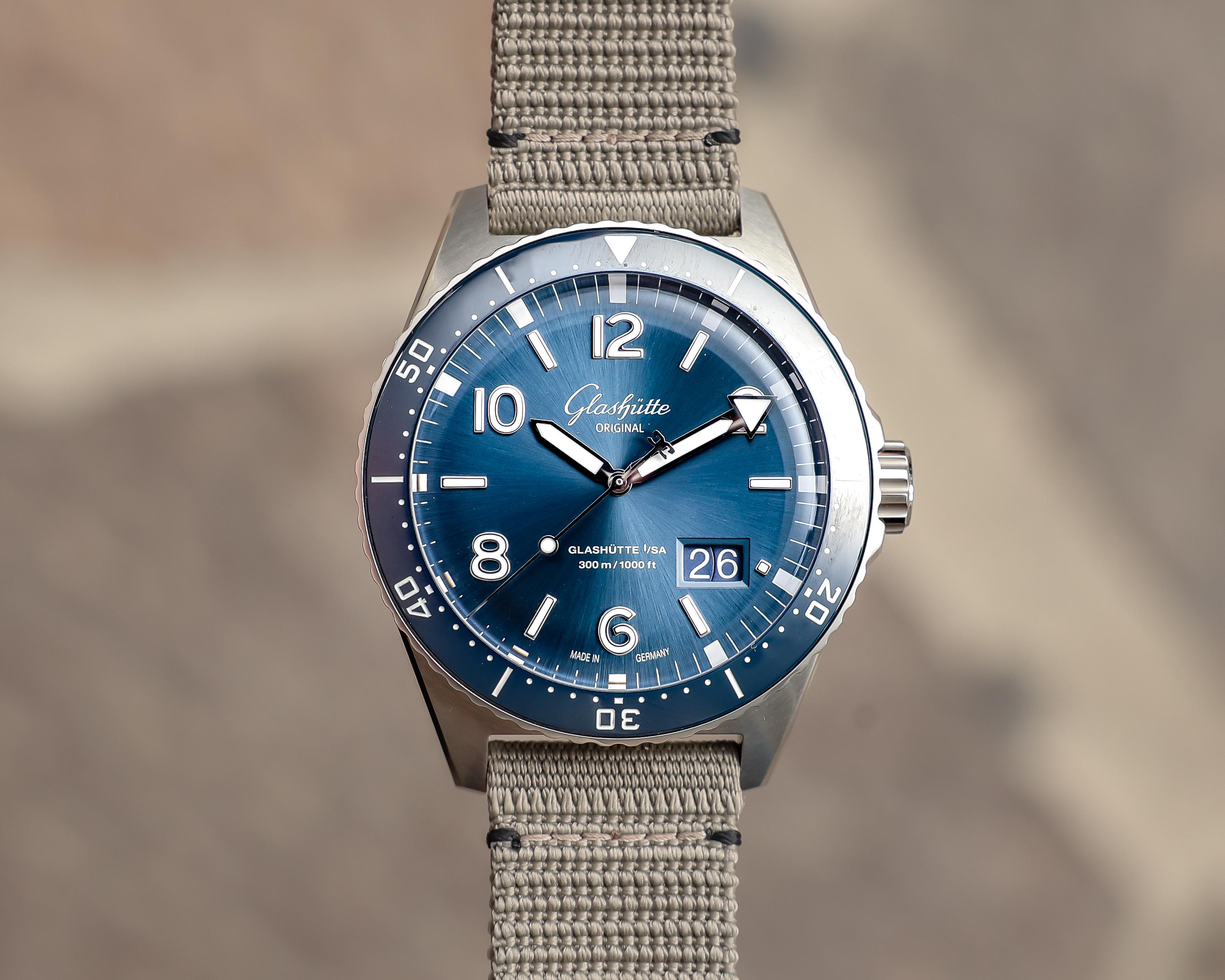
You can still get classic black, alongside a matte green, sunray-brushed grey, or even a limited-edition Northern Tide turquoise fumé. But as interesting as the other options are, my heart still lies with the blue. The sunray effect, inset with deeper grooves than usual, gives the watch a brilliant radiance, even more so than some of the dress and sports watches I’ve seen in the past.
In line with its inspiration, the dial layout uses a combination of baton indexes and Arabic numerals marking every second hour. The hands remain unchanged from the source material, using a set of heavily lumed sword hands complete with an arrow-shaped attachment for the minute hand. Perhaps the only change can be seen in the seconds hand, which now sports Glashütte Original’s double-G insignia on its counterbalance.
Between the old and current models, two more differences can be found dial-side. First, the four o’clock numeral is gone, replaced with Glashütte Original’s signature Panorama Date complication. Colour-matched to the dial and featuring contrasting white sans-serif numerals, it’s just as easy to read as the rest of the numerals.
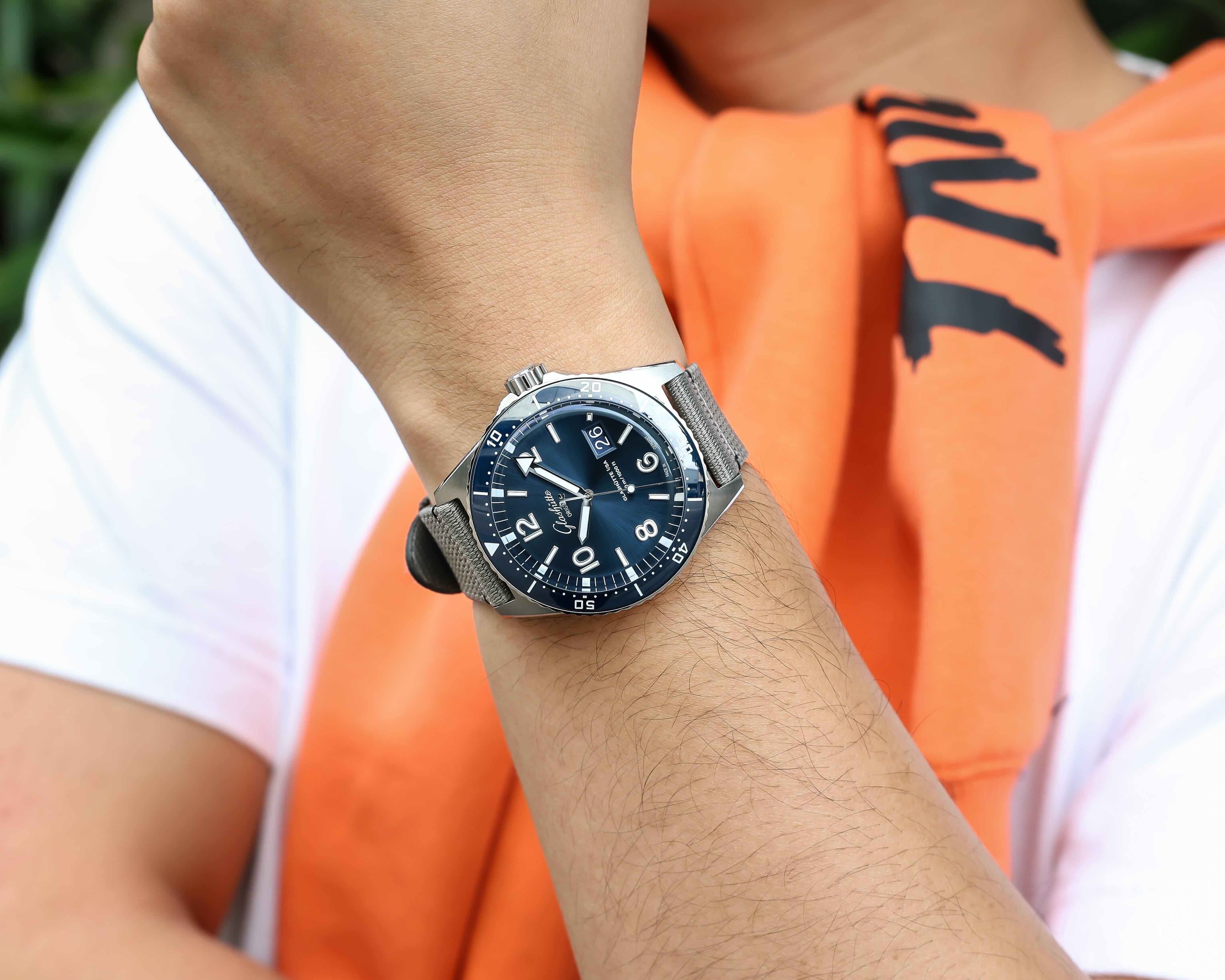
Speaking of which, the entire arrangement of indexes and numerals is applied rather than printed atop the dial. I much prefer this over the classic look, as you get the added depth and dimensionality of the appliqués sitting above the surface without disrupting the sunray-brushed blue. Still, they’re set with generous amounts of lume, refusing to compromise on the bold legibility the Type RP TS 200 first championed.
Moving outwards, the minute track has also fundamentally changed since 1969. Instead of being set atop an angled rehaut, it’s printed flat around the indexes and handset. While this might seem like a bit of a downgrade, it’s an intentional choice that interacts perfectly with the sapphire crystal.
The box crystal’s distortion magnifies the minute track when viewed front-on, subtly integrating even more legibility into the design. Such a feature is just one of many that, while perhaps unnecessary, add considerably to the watch’s visual intrigue and overall quality-of-life.
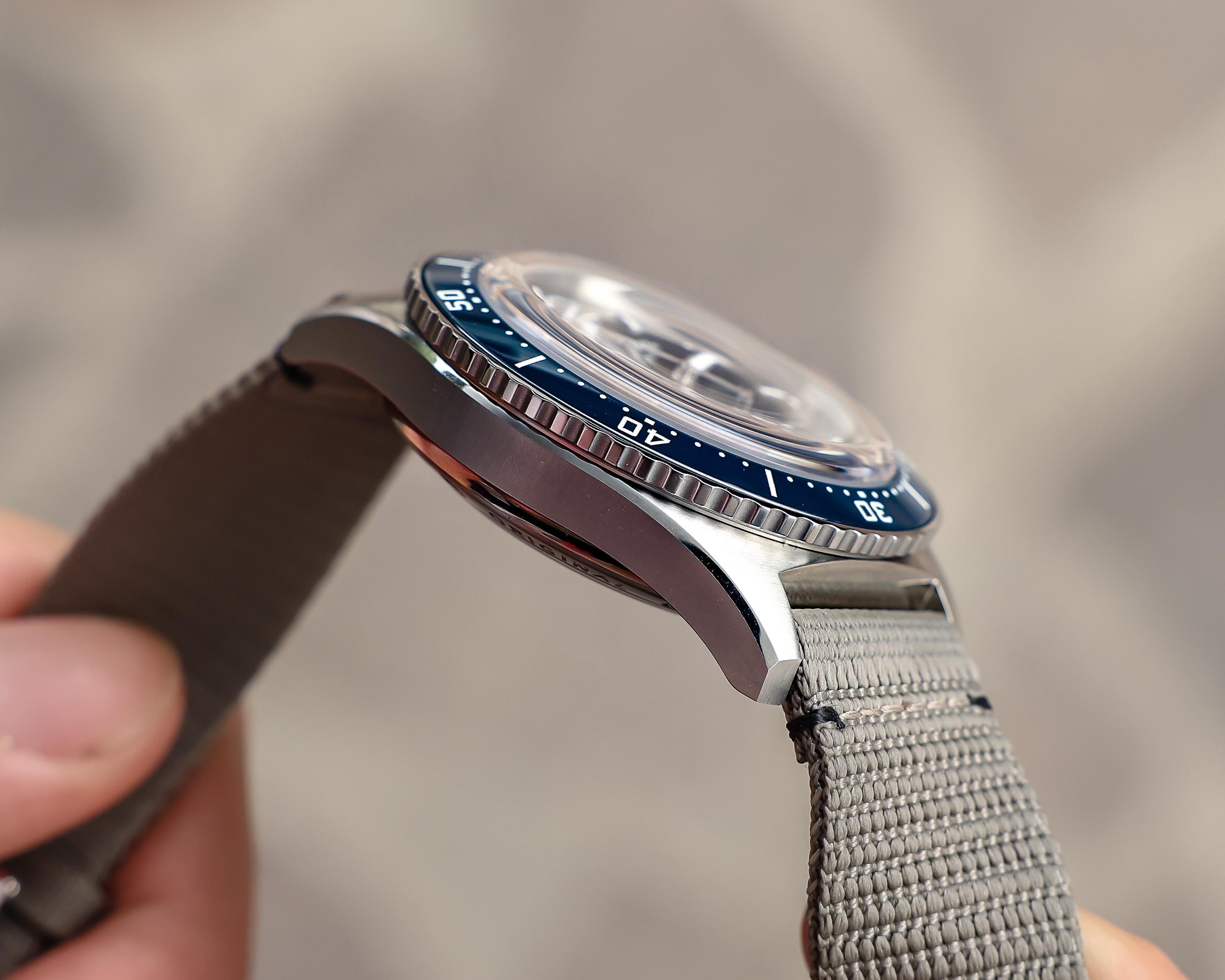
The crystal and dial give way to a unidirectional bezel, engraved with its own minute track and fitted with a blue ceramic insert. The triangular marker at twelve o’clock, like most of the features on the dial, is also lumed, completing Glashütte Original’s commitment to timekeeping in any low-light environment.
The bezel itself sits atop a large, classic stainless steel case, topped with radial brushing that keeps the eye centred on the dial. The signed crown and crown guards occupy the classic three o’clock position, the only interruption to a set of vertically brushed case flanks. Small, polished chamfers run the length of each pair of lugs, which drop off sharply to make way for the strap.
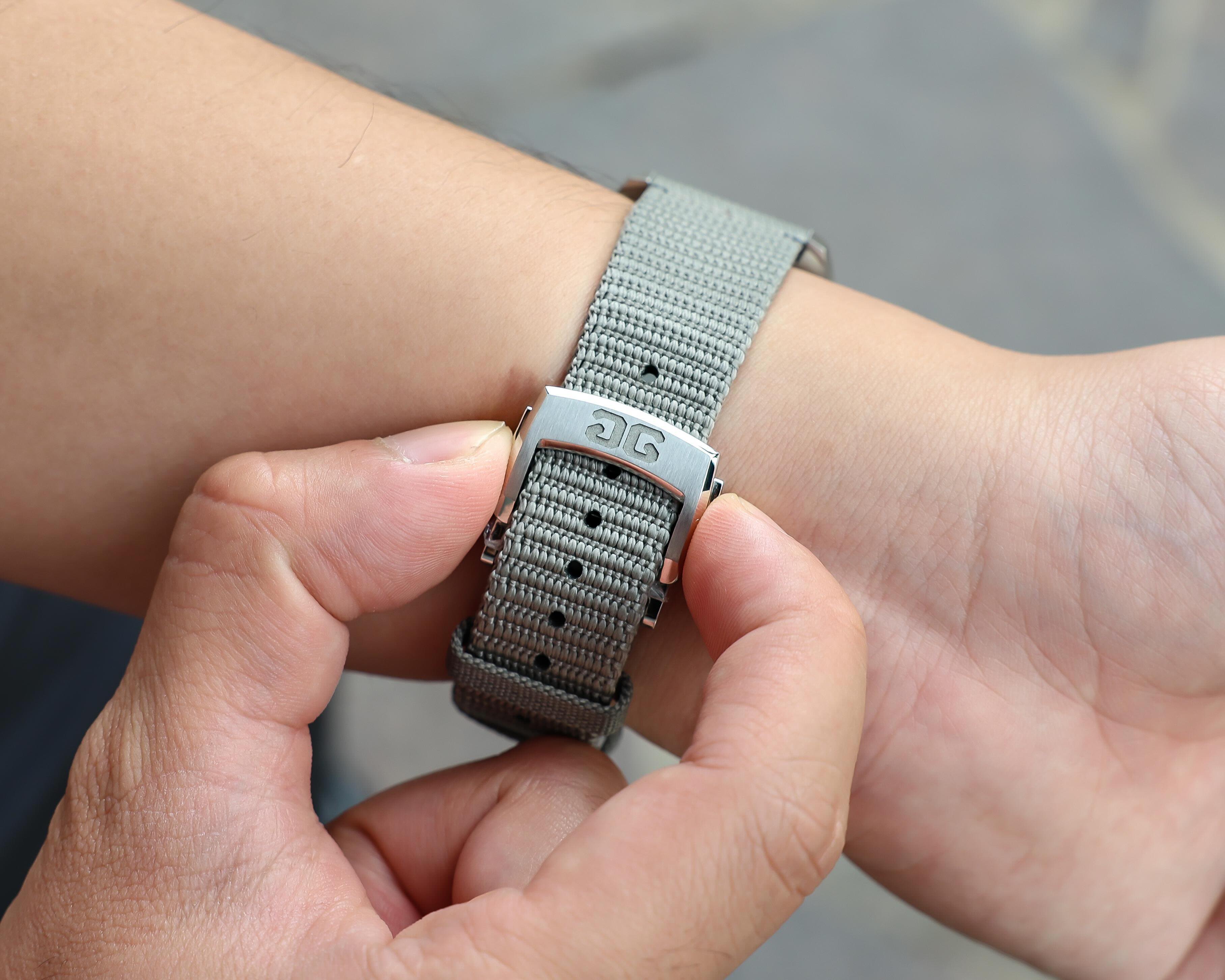
Glashütte Original offers several different strap options, and the model I have here comes with a grey synthetic fabric strap. Similar to the one seen on the Senator Chronographs I reviewed, it runs down to the same butterfly deployant clasp as before. Finally, the watch is finished with an open caseback featuring brushing, polishing and all the typical serial engravings.
Though that’s typical of most watches these days, the open caseback is yet another oddity in the SeaQ Panorama Date’s design. Dive watches rarely, if ever, showcase their movements. But Glashütte Original, it seems, believes its movements are too good to be covered up.
Overall, Glashütte Original has dressed up its dive watch in a way very few others would. I’ll expand further on the puritan’s debate of the SeaQ later, there’s no denying that the presentation is exceptional for a watch so unapologetically boisterous.
How It Wears
Both within Glashütte Original’s catalogue and the wider German watch industry, the size of their watches remains a concern. Even with a growing global trend towards smaller watches, Germany has taken a little longer to get the ball rolling. The good news is that we’ve seen evidence of a shift towards more compact, wearable dimensions, such as with the aforementioned Senator Chronographs.
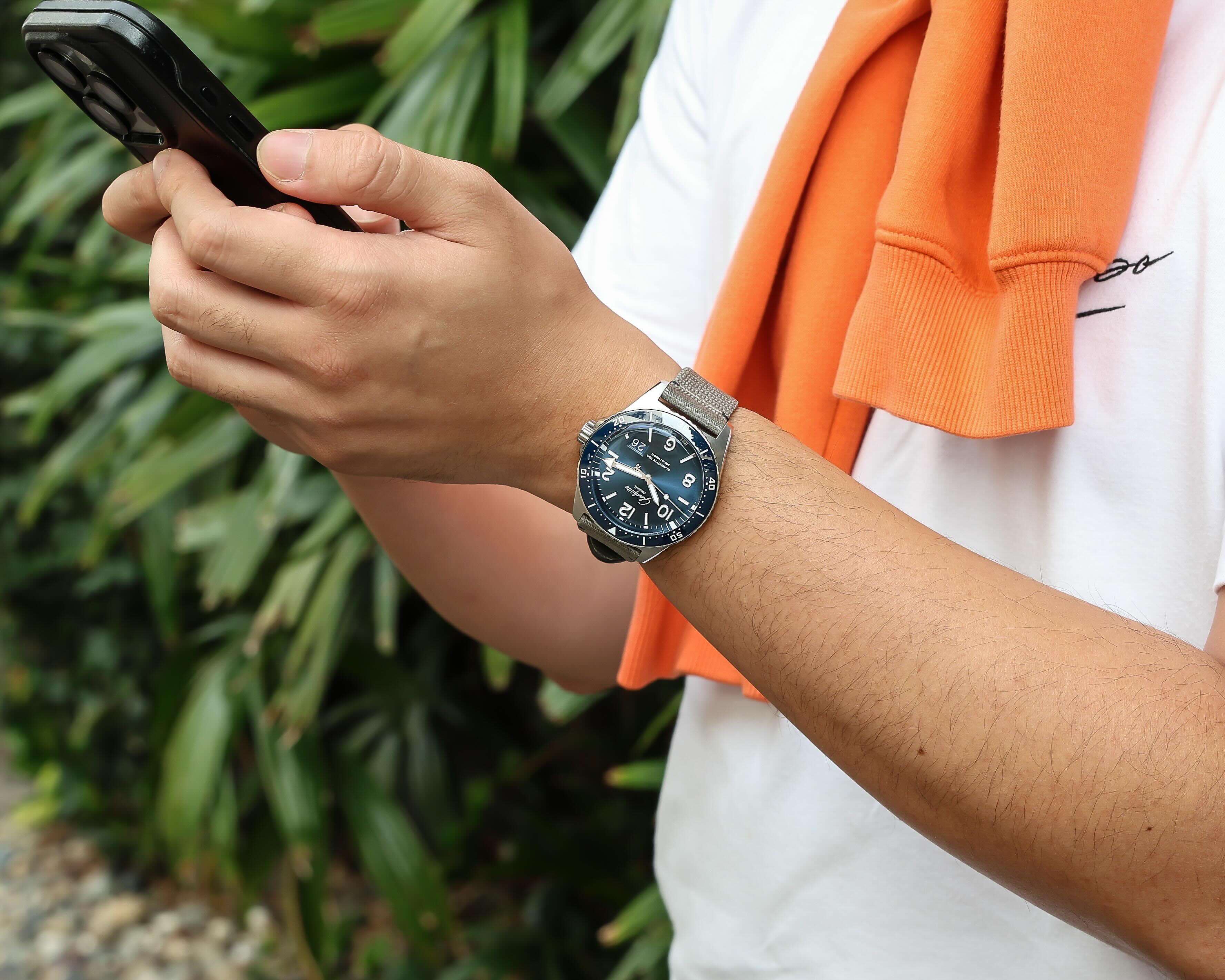
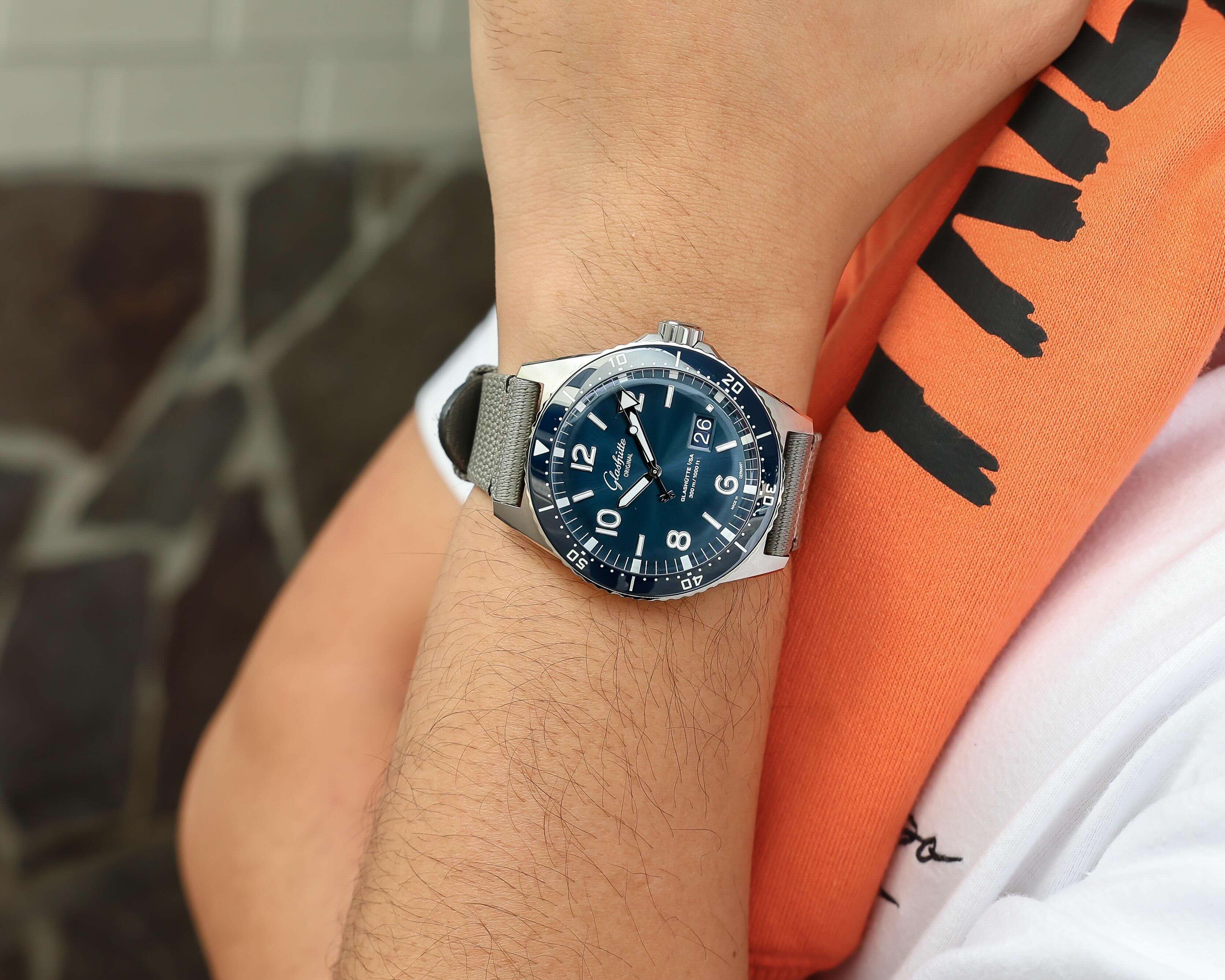
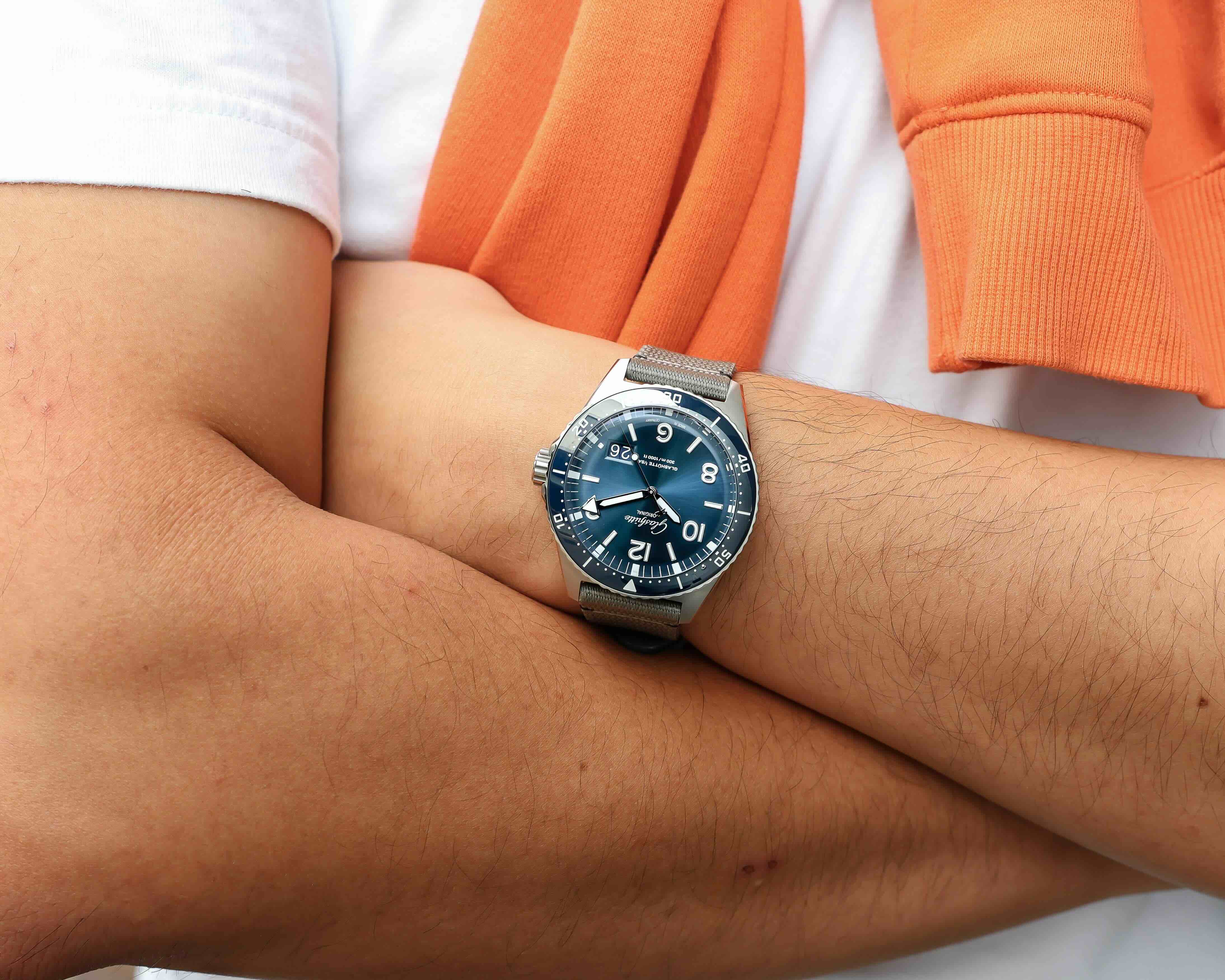
Measuring 43.2mm in diameter, 51.5mm lug-to-lug and 15.65mm thick, however, the SeaQ Panorama Date is certainly not for the faint of wrist. Tall, wide and long, the watch takes up a significant amount of real estate on my 6.4-inch (16.4cm) wrist, though its bulkiness would remain apparent even on someone with a larger frame.
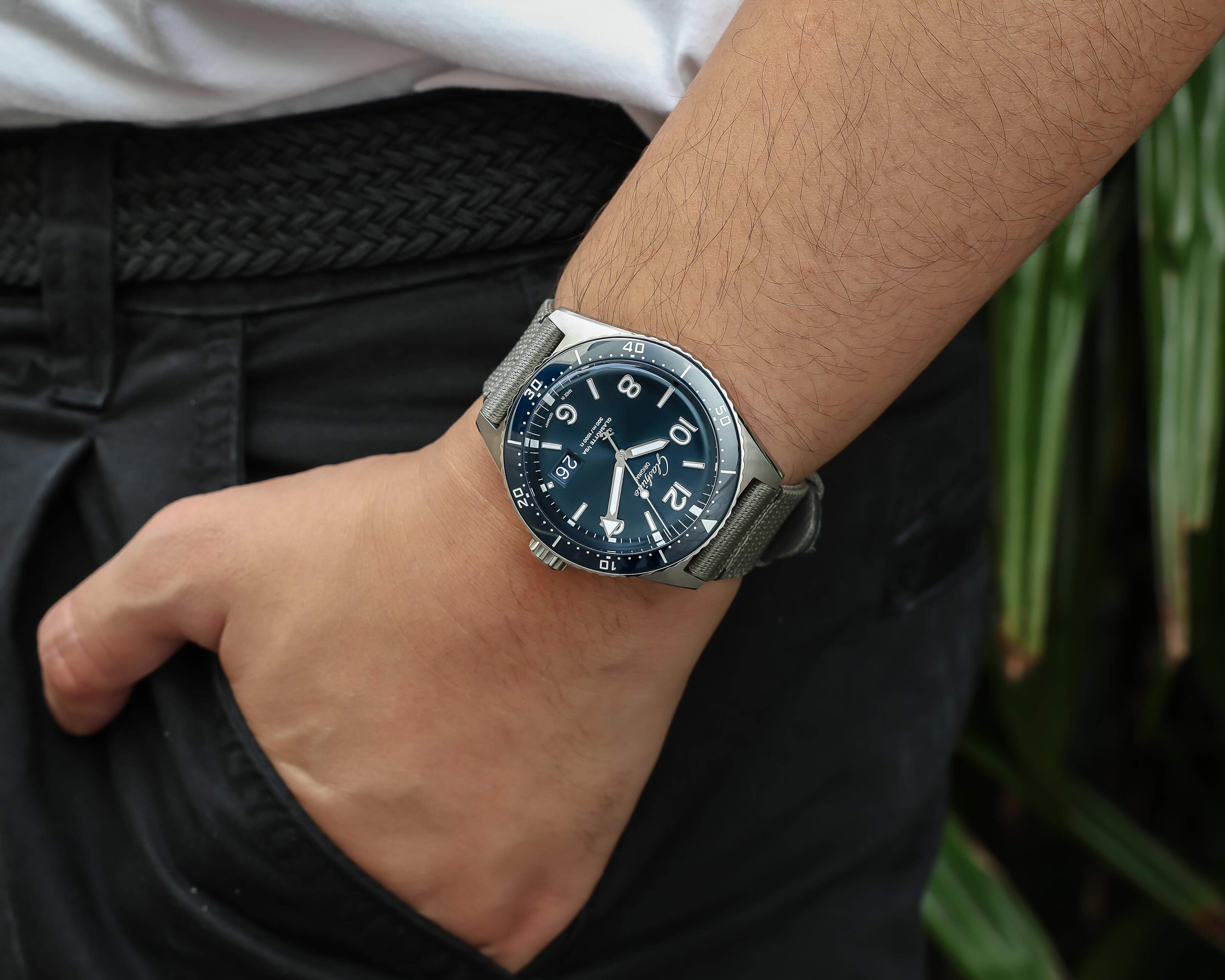
While you might consider this a glaring oversight, Glashütte Original is acutely aware of the SeaQ Panorama Date’s muscular appearance. As such, the brand has worked hard to offset it wherever possible. From the side, it’s clear that the watch still stands tall, yet the curvature of the lugs, alongside their sudden drop, helps keep things close to the wrist. The sloping bezel and crystal are also apparent from a side-on perspective, further mitigating any blockiness.
But the biggest contributing factor to its wearability is the choice of strap. The grey synthetic textile is as good as ever, which, in conjunction with the butterfly deployant clasp, allowed me to keep the watch sitting flush and tight against my wrist. I wouldn’t expect it to fit under a cuff or sleeve anytime soon, at least not without difficulty, but the actual wearing experience betrays what its intimidating spec sheet might suggest.
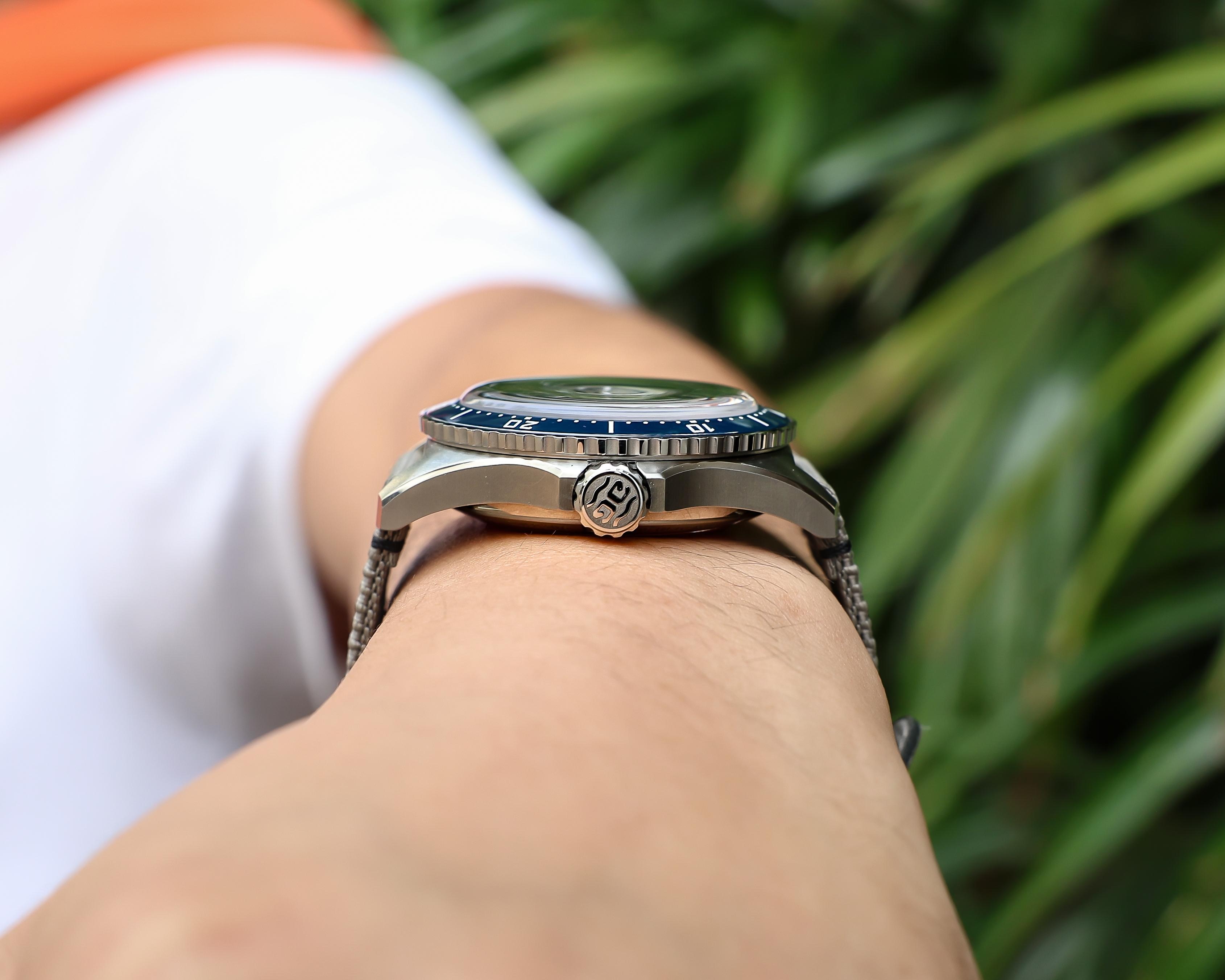
The main reason the SeaQ Panorama Date is so buff, however, is its water resistance rating. While 300m of water resistance might sound like standard fare for most dive watches these days, Glashütte Original has gone significantly further to essentially guarantee the watch’s robustness.
This can be seen in one of the serial engravings, where “DIN 8306” appears alongside the other inscriptions. Short for Deutsches Institut für Normung (German Institute for Standardisation), this indicates that the SeaQ’s water resistance conforms to the technical standard DIN 8306, Germany’s equivalent of ISO (International Organisation for Standardisation) 6425.
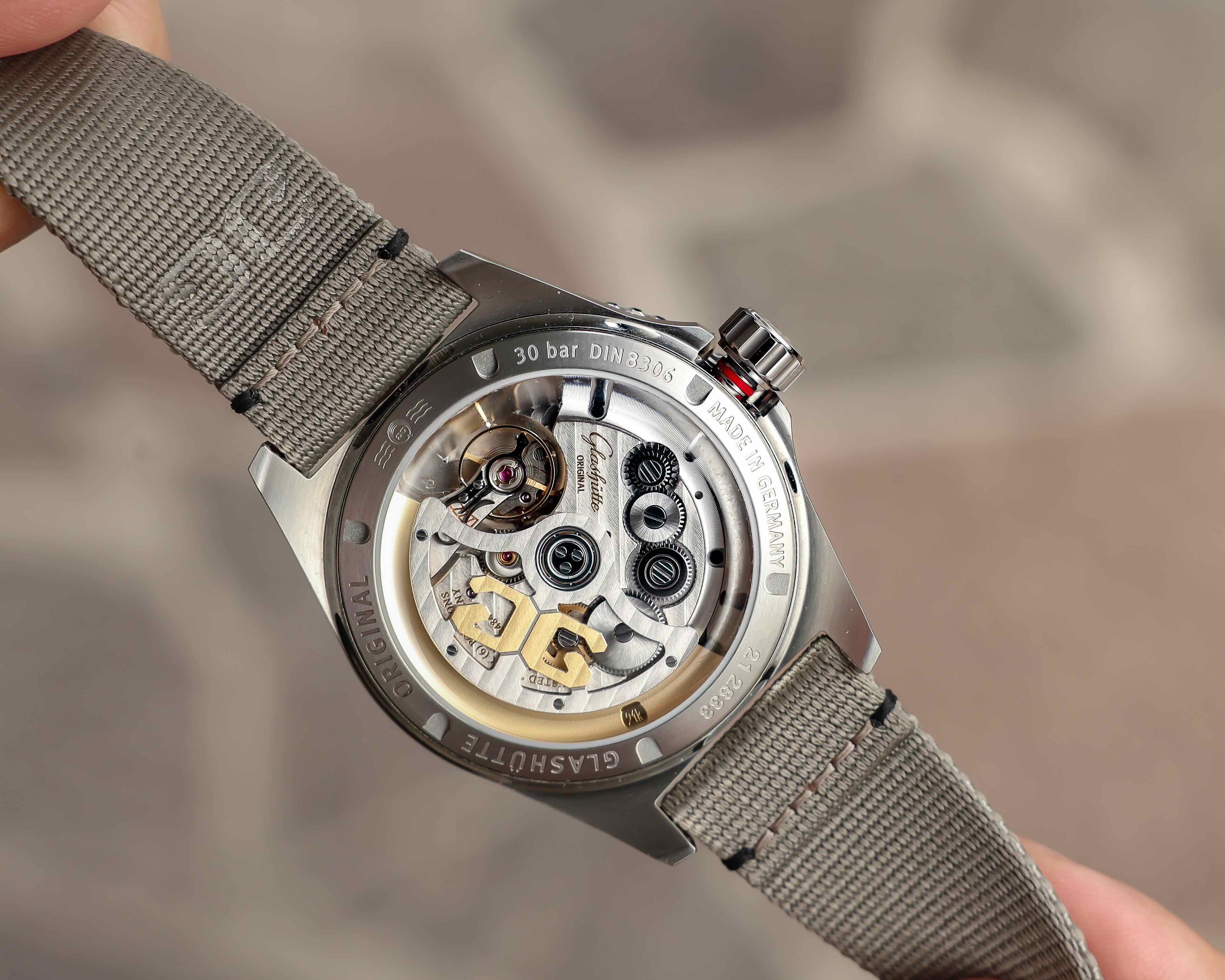
This goes beyond the simple depth-rating tests most watch brands use for their timepieces, with the SeaQ tested at 125 per cent of its rated pressure (375m instead of 300m). Alongside a thick screw-down crown, case, and crystal, it’s a professionally built dive watch made to last in extreme environments, inhospitable to all other than saturation divers. In a sentence, the DIN 8306 certification places the watch a few degrees of separation away from bulletproof, with classic diving accoutrements – like the red warning ring and legible display – serving as the cherry on top.
Does the DIN certification matter to the average collector? Not really, but it’s there when it otherwise didn’t have to be. That’s how seriously Glashütte Original takes its watchmaking. Few things that look this fancy can take an absolute beating quite like this one.
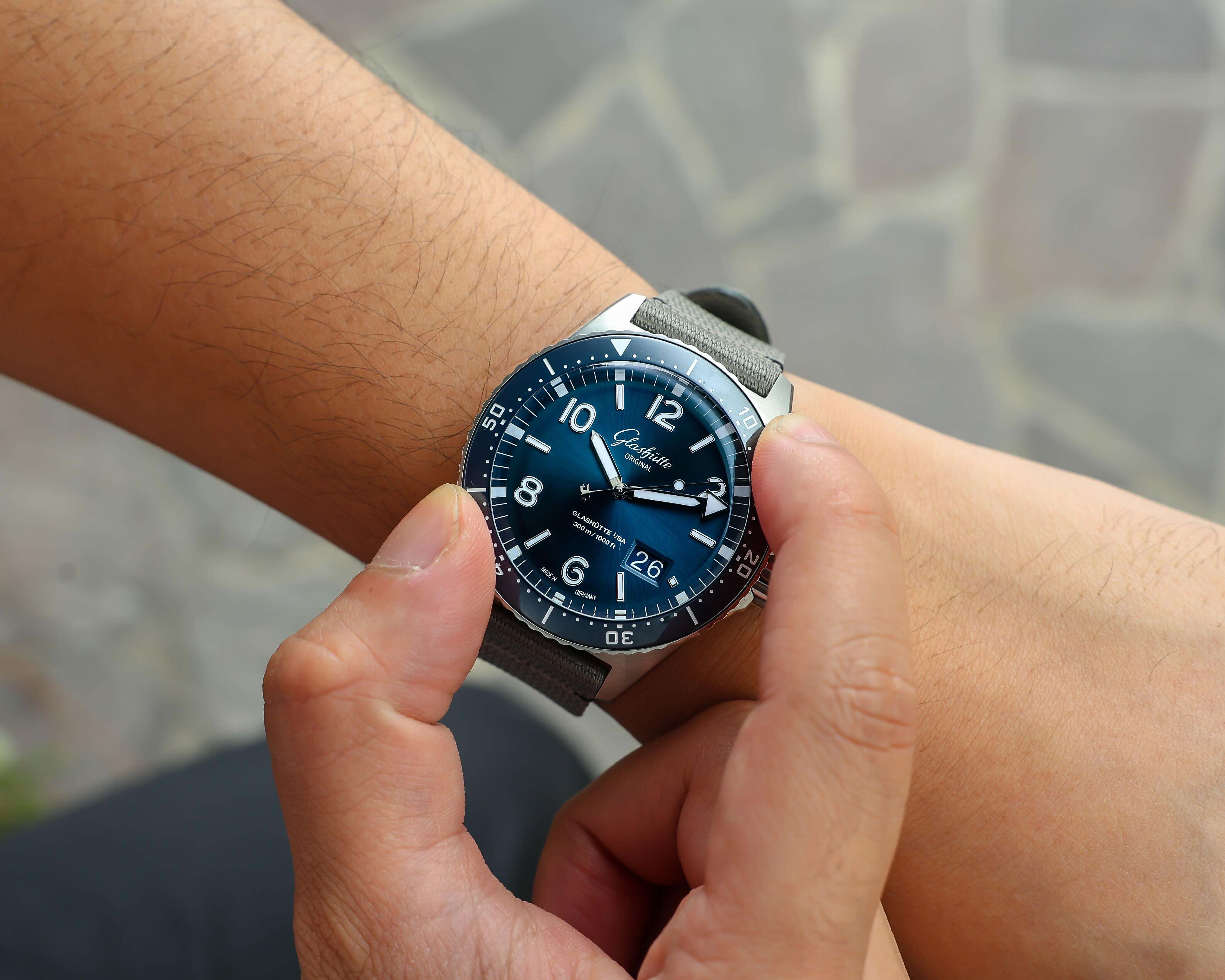
And besides its size, nothing really impedes its general operation. The strap is easy to use and wear, while the crown feels smooth and effortless to screw and unscrew.
The only challenge I noticed during my time with it was the bezel action. The 120-click unidirectional bezel felt like it needed a little extra juice to rotate. Otherwise, few aspects of the wearing experience raise any major red flags, not even the size. If it’s still an issue, Glashütte Original also has a 39.5mm version of the SeaQ readily available. You will miss out on that Panorama Date, though, and the movement is a slight step behind the one found in here.
The Movement
And speaking of the movement, it’s time to talk about the movement! Through the open caseback is the automatic Cal. 36-13, introduced alongside the SeaQ Panorama Date’s launch in 2019. Like the rest of the watch, it’s extremely capable, running at the luxury standard of 4Hz (28,800VpH) with a staggering 100-hour power reserve.
If this sounds familiar, you might recognise the specifications from the newer Cal. 36-16, seen in recent Senator releases. Visually, the only differences between the two are the Cal. 36-16’s new skeletonised rotor and the hand-engraved balance cock, often reserved for Senator movements.
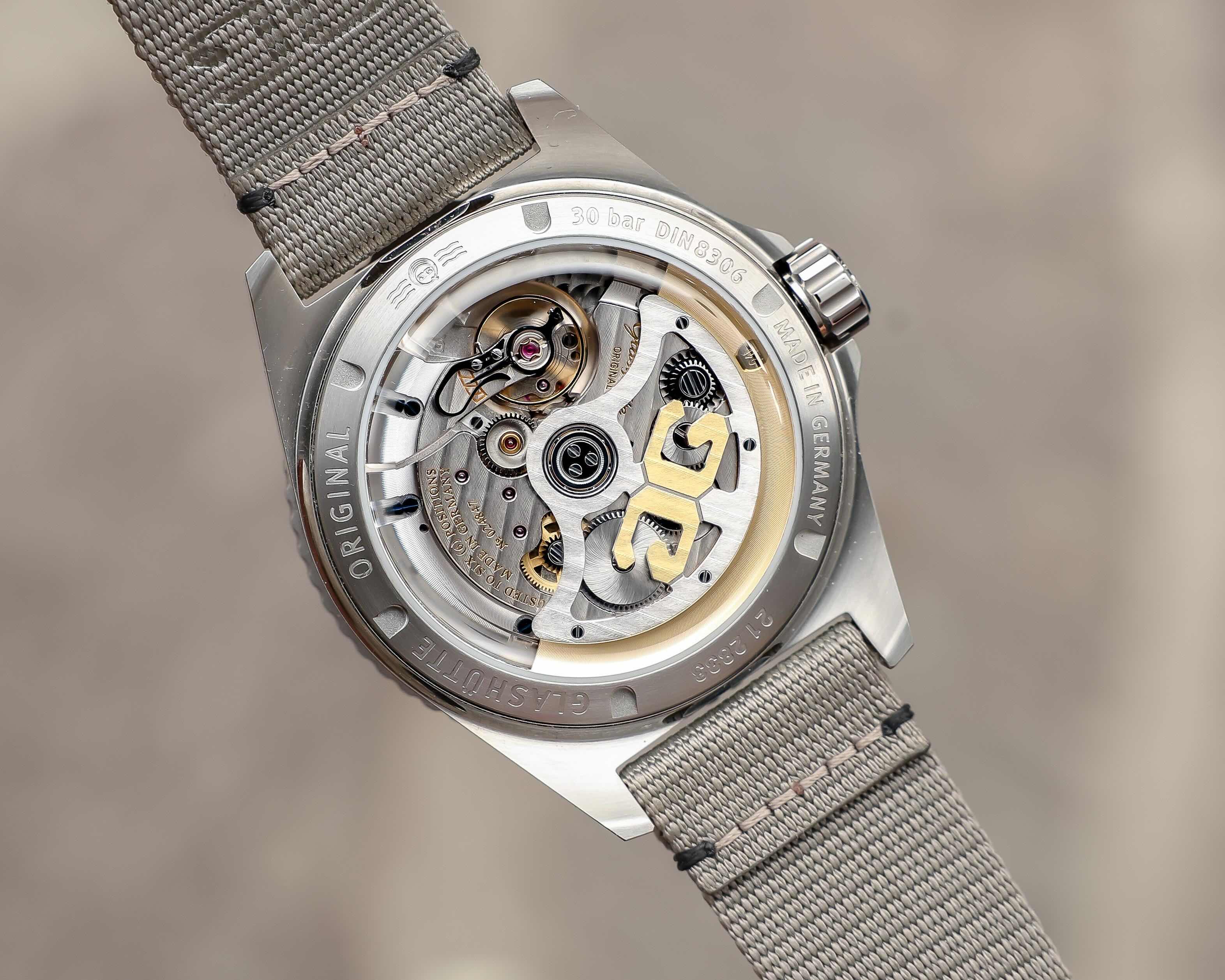
What makes the Cal. 36-13 so compelling is that it’s undergone Glashütte Original’s 24-day Excellence test. Subjected to a litany of positional, rate, water resistance, temperature and performance tests, the Excellence test is said to be even more rigorous than the German Chronometer test (DIN 8319).
This comes on top of the DIN 8306 / ISO 6425 water resistance certifications, further demonstrating the watch’s long-term reliability. Though a DIN 8319 Chronometer certification would certainly give it more clout, the in-house Excellence test is no comparative walk in the park.
Outfitted with the iconic Panorama Date complication, this watch is, in a word, a monster. Its certifications, alongside its specifications, build an excellent on-paper résumé, which translates to my lack of problems with the Cal. 36-13.
Even without the embellishments afforded to the Cal. 36-16 and the Senator lineup, the movement looks great, far beyond what might be necessary for a bulky diver. Glashütte Original has decorated the three-quarter plate and rotor with Glashütte striping and a two-tone finish, as seen in the double-G rotor.
Intuitive, reliable and presentable, the only thing that trumps how well the Cal. 36-13 works is how good it looks doing it. And yet, presentation remains a core topic of discussion when it comes to the watch’s general appeal…
Final Thoughts
Watch purists argue that a dive watch is supposed to look, function or be built a certain way, and that anything beyond those conventions is sacrilege. It’s why some are surprisingly vocal in their opinions of the SeaQ Panorama Date, and honestly, some of those opinions are somewhat valid.
The presence of the Panorama Date, display caseback and refined finishing are decidedly upscale elements, rarely seen in the dive watch category, let alone all together in a single timepiece. That line of thinking paints the watch in a negative light, as something too over-engineered to be a proper dive watch. In doing so, however, it also dismisses the actual level of craftsmanship on display.
Glashütte Original clearly hasn’t added these features needlessly. The Panorama Date makes sense from a practical standpoint, as it builds upon the blueprint for legibility established by the Type RP TS 200 back in 1969. The open caseback showcases the brand’s beautifully finished Cal. 36-13, while the watch also proudly carries the rare DIN 8306 and ISO 6425 certifications.
It matches, and in some respects exceeds, the capabilities of some of the best dive watches in the world, all without having to conceal its movement. As for the refined finishing… well, it’s a luxury watch, after all. Why pretend that it isn’t?
With a price point of AU$19,000, it’s certainly positioned itself within a powerful circle of luxury dive watches. Above, you’ll find pieces like the AU$21,700 Panerai PAM01526 Luminor Marina Quaranta Carbotech™, while at AU$17,700 sits the remarkably accurate and ISO-certified Grand Seiko Evolution 9 Spring Drive U.F.A. Ushio 300 Diver.
And, of course, adjacent to it is the ever-elusive benchmark, the Rolex Submariner Date, at AU$18,950. All three watches are extremely strong in their respective fields: Rolex is iconic, Grand Seiko has extraordinary technical credentials, and the Panerai is remarkably lightweight.
Where does that leave the SeaQ Panorama Date? Well, I think its greatest strength is that it doesn’t need to compete on any of the same terms. Its unusual combination of aesthetics, complexity and robustness makes it difficult to compare pound for pound. Everything it does, it does in excess, but without ever feeling as though it’s gone completely off its rocker.
It’s a perfect exercise in German over-engineering. Other dive watches pride themselves on individual technical achievements: Superlative Chronometer, U.F.A., Carbotech™ and so forth. But Glashütte Original turns every element up to 11, simply because it can. Sure, it might be overkill to some, but the brand sees it as reaffirming what it already knows: the watch works exceptionally well, and it can still look good while doing so.
To that end, the Glashütte Original SeaQ Panorama Date is a luxury watch that just happens to be a fully specced diver, rather than the other way around. And that’s what makes it so compelling, effectively bridging the gap between white-gloved haute horlogerie and the tool-oriented pragmatism of an everyday bruiser.
Reference & Specifications
| Feature | Specification |
|---|---|
| Reference | 1-36-13-02-81-34 |
| Dimensions | 43.2mm case diameter x 51.5mm lug-to-lug x 15.65mm thickness |
| Case | Stainless steel |
| Dial | Sunray brushed blue with white accents |
| Crystal | Sapphire |
| Caseback | Open, sapphire |
| Movement | Automatic Cal. 36-13 with date complication |
| Power Reserve | 100h |
| Beat Rate | 4Hz (28,800VpH) |
| Water Resistance | 300m / 30bar |
| Strap/Bracelet | Grey synthetic fabric strap with butterfly deployant clasp |
Australian Retail Price: $19,000
Availability: Available now, from Glashütte Original boutiques, authorised retailers, or online at Glashuette-Original.com
Image Gallery