

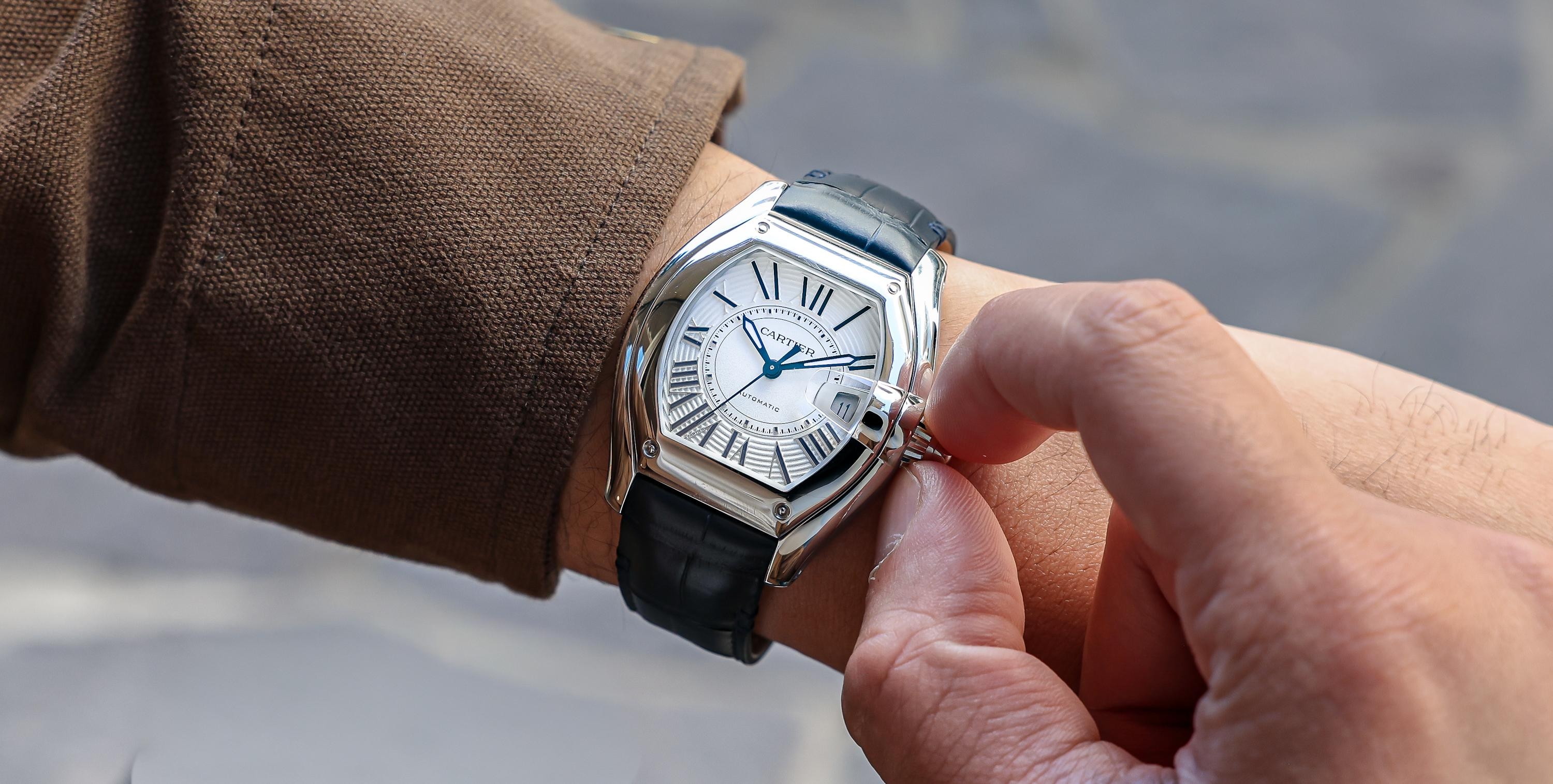
Cartier’s Y2K darling has returned to the fold, but has it done enough to pick up from where it left off? Let’s find out!
What We Love:
- Unique, shapely case
- Seamless wearability
- Fun, quirky aesthetic
What We Don’t:
- Lack of lume for a sports watch
- Slippery, hard-to-operate crown
- Did the Roadster deserve a comeback?
Overall Rating: 8.25/10
- Value for Money: 8/10
- Wearability: 9/10
- Design: 8/10
- Build Quality: 8/10
Of all the watch brands that have broken through into popular culture, Cartier stands as one of the most significant. Ever the champions and pioneers of quiet luxury, the French jeweller-watchmakers have built up a remarkable reputation over the course of 179 years. As part of that esteemed legacy are some of the most iconic silhouettes in watchmaking. Truly, models like the Tank, Santos, and Panthère are easily recognisable from their shadows alone!
But while these collections possess obvious cultural cachet, perhaps equally as interesting are the designs that are no longer with us. The archival graveyard of Cartier is surprisingly rich, decorated with references as beautiful as they are unconventional. Model lines like the Pasha, the Calibre, and the criminally underrated Drive still maintain cult followings, with dedicated fans praying for their beloved collections’ return even years after their discontinuation.
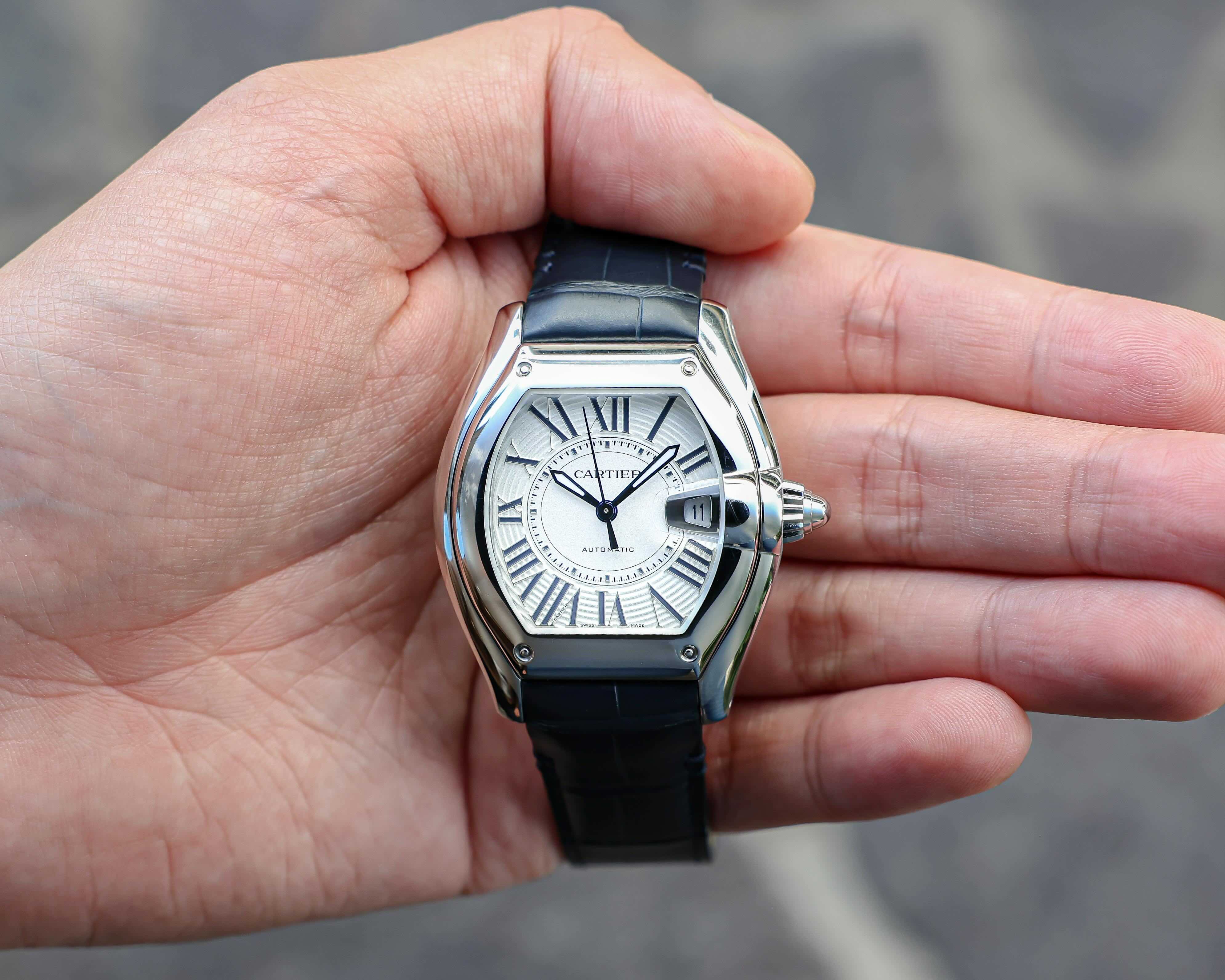
This year did see one such design finally escape the Shadow Realm. Of course, I am talking about the remastered Cartier Roadster, which held a spot in the catalogue from 2001 to 2012. Unveiled at Watches & Wonders 2026, the returning Roadster blends Cartier’s signature visual cues with a completely different period of inspiration. This aesthetic, taking moreso from mid-century automotives than Art Deco, immediately made the Roadster singular in Cartier history.
But now that it’s reentering a watch world completely changed in its absence, can the Roadster find a way to belong? Well, that’s what I wanted to find out when I got to review the Roadster for myself.
First Impressions
Admittedly, my first question upon the Cartier Roadster’s return was, “Why?” Don’t worry, I mean that as a good thing. Let me explain.
I’m a massive fan of the bold, maximalist designs of the Y2K era. In the original press release, I cited other items like the original Xbox, the Motorola Razr V3, and the Sony Walkman as cornerstones of this period of design. In the luxury world, the Cartier Roadster was much the same.
More outlandish in its looks than its peers, this is perhaps the most out-of-the-box Cartier has ever gone in its standard lineup. Never in the brand’s history has an automotive theme so definitively shaped a design, and it effectively strapped the Roadster to a rocket ship.
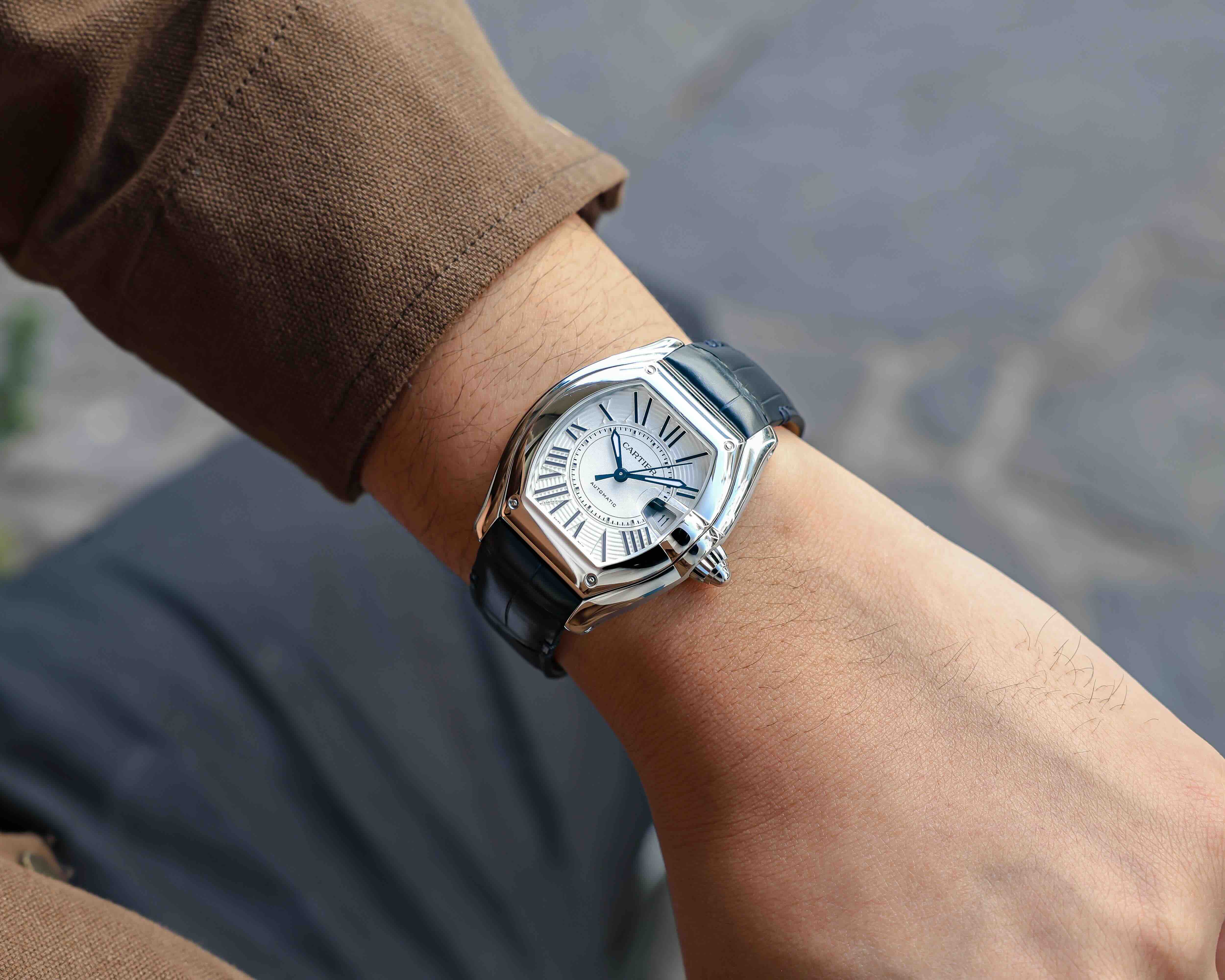
But what goes up must also come down. As watch tastes got even bigger and bolder in the 2010s, the collection quickly became overshadowed by the rest of the industry. The pendulum swung back around in the 2020s, with conservative, smaller watches becoming the norm. Now, there’s an escalating trend of synthesis between the two eras, where daring looks and practical ergonomics are fused to create the best watch possible.
This is perhaps the “why” behind the Roadster’s return. Not only was the watch incredibly ambitious for the brand, but it also had a unique, almost prophetic take on wearability and ergonomics for its time. With that in mind, I approached the Roadster with as much enthusiasm as curiosity, eager to see if it could still keep pace with the new generation.
The Design
For those familiar with the Cartier Roadster, not much has changed about the core design. But for any budding enthusiasts or Cartier puritans, the bold design may come as a bit of a shock. However, the new watch does well to gently introduce its quirky features without overly compromising Cartier’s DNA.
This can immediately be seen in the dial, where the watch certainly looks the part of a Cartier, but with some significant changes. Set atop a white backdrop, the printed minute track precedes the outer indexes, but opts out of using the classic railroad minute track. Previous models in the Roadster collection did so, but the changed track instead opts for subtle dimensionality, with raised blue indications for each five-minute marker.
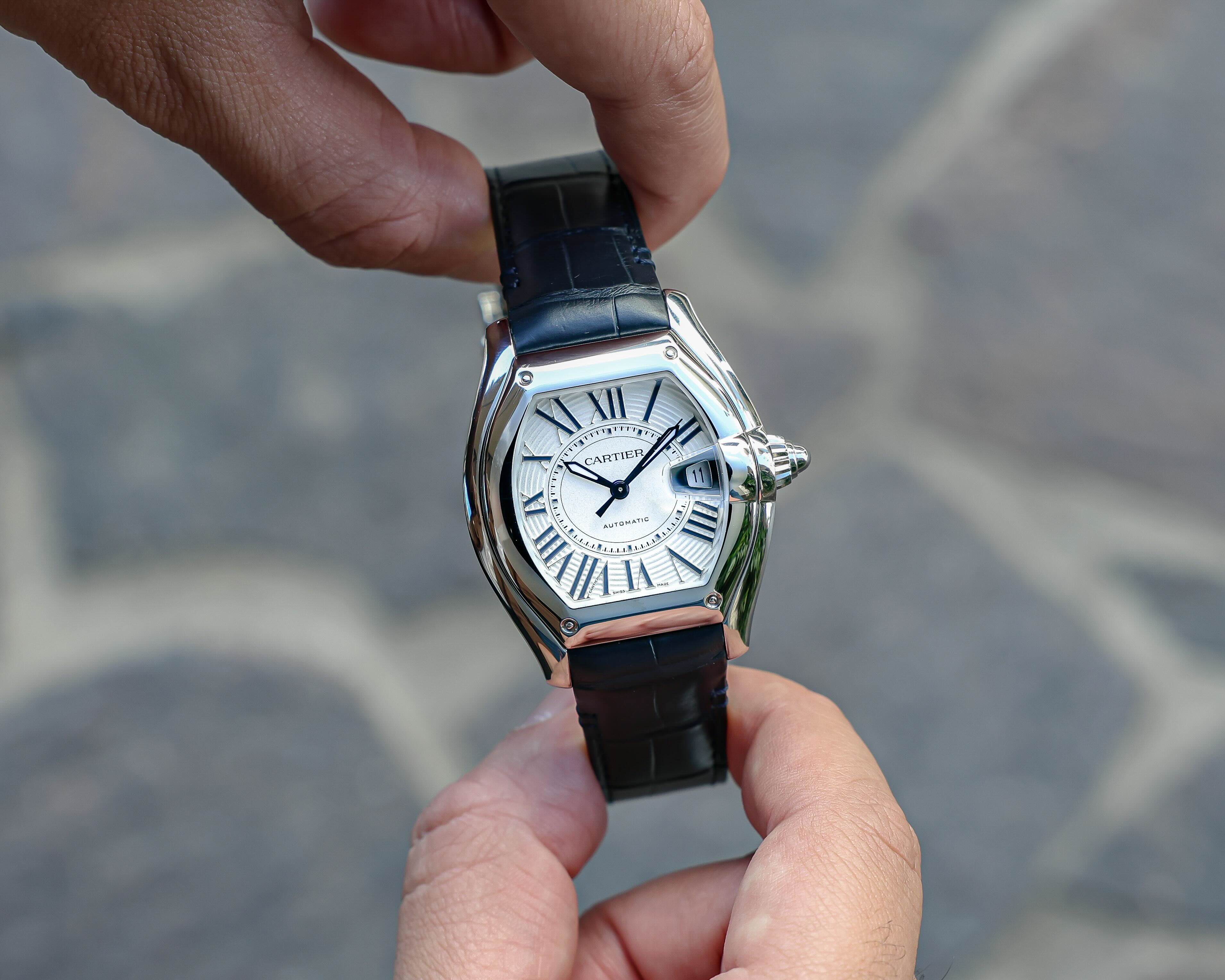
Moving briefly inwards, the minute track is sectioned off by a black oval surrounding the Cartier typeface and Automatic classification. This inner section and the minute track make up the lower dial, slightly inset in comparison to the outer periphery. This is where the Roadster’s dial shows the first evidence of its mid-century automotive inspiration.
The upper dial uses a grooved, concentric vinyl finish, as seen on the speedometers of popular period cars like the Mercedes-Benz 300SL or the Buick Riviera. This also changes the Roadster’s formula significantly from the original recipe, which merely consisted of printed Roman numerals atop a similarly printed set of concentric lines. The use of an actual grooved pattern, alongside stretched, applied and blued Roman numerals, is inspired, adding a real sense of depth and dimensionality that the previous models simply lacked.
One thing I wish they had revised is how each numeral lines up with each groove, where some of the numerals terminate exactly on the last line while others go slightly over. It’s not the worst thing in the world by a long shot, but it’s kind of hard to unsee once you notice it.
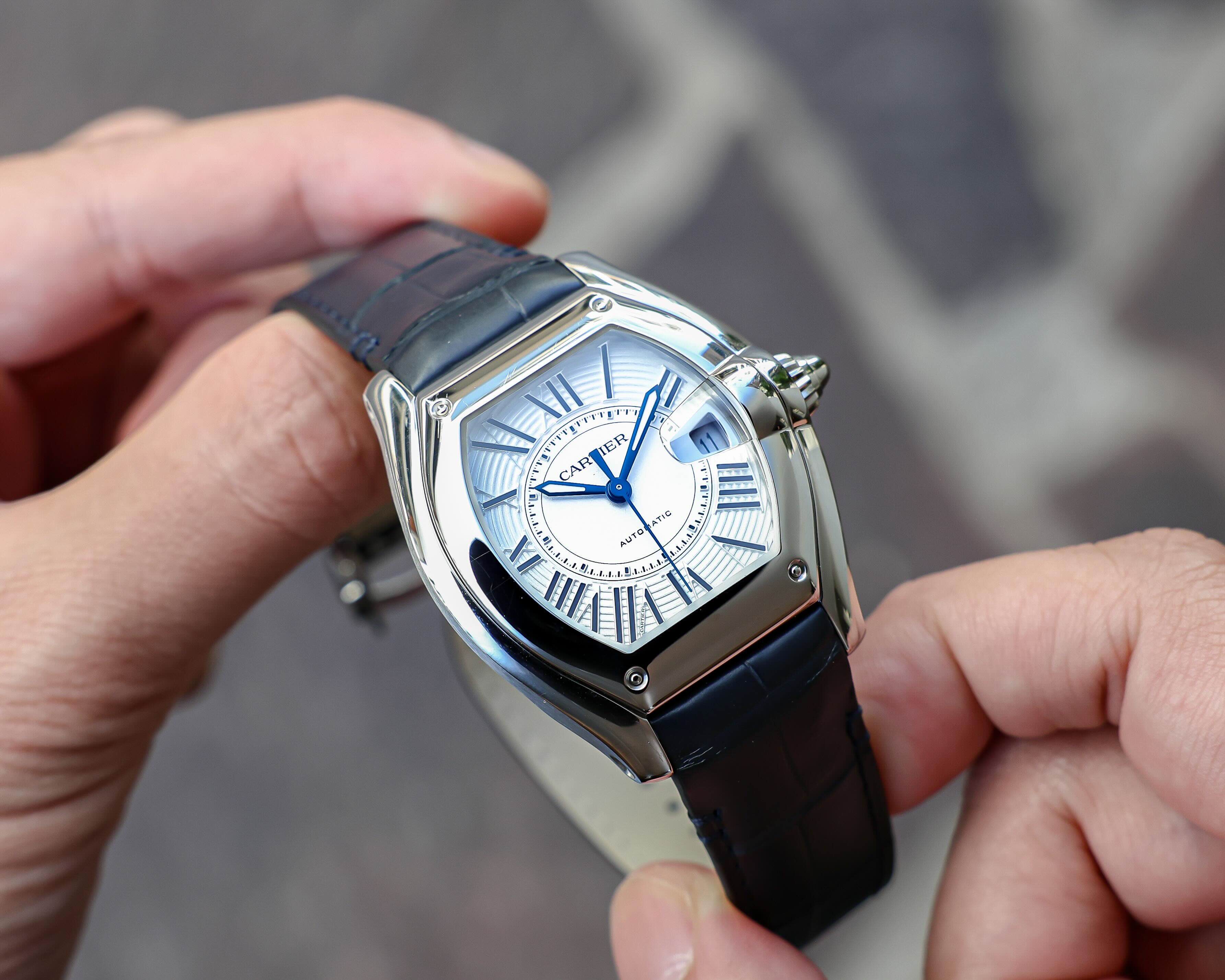
The only interruption to the vinyl upper dial is the date window, which has been shaped to follow the lines of the associated magnifier. The blue tone filling the Roman numerals is echoed in the hands, which are heat-blued and filled with lume. This would perhaps indicate that the Roadster is leaning towards a sportier aesthetic, as the case would perhaps sell you on.
But unfortunately, that’s not the case. Lume only exists on the small hour and minute hands, and is nowhere else to be found on the watch. Though I enjoy the blue tone within the Roman numerals, not filling them with lume feels like a majorly missed opportunity by Cartier.
At this point, I’m unsure why Cartier includes lume at all on its models. Perhaps they should consider omitting lume from their catalogue entirely, as in its current state it feels more like an afterthought than a real feature. Instead, I would like to see polished, faceted sword hands to complement the blue of the numerals and contrast the stark white backdrop.
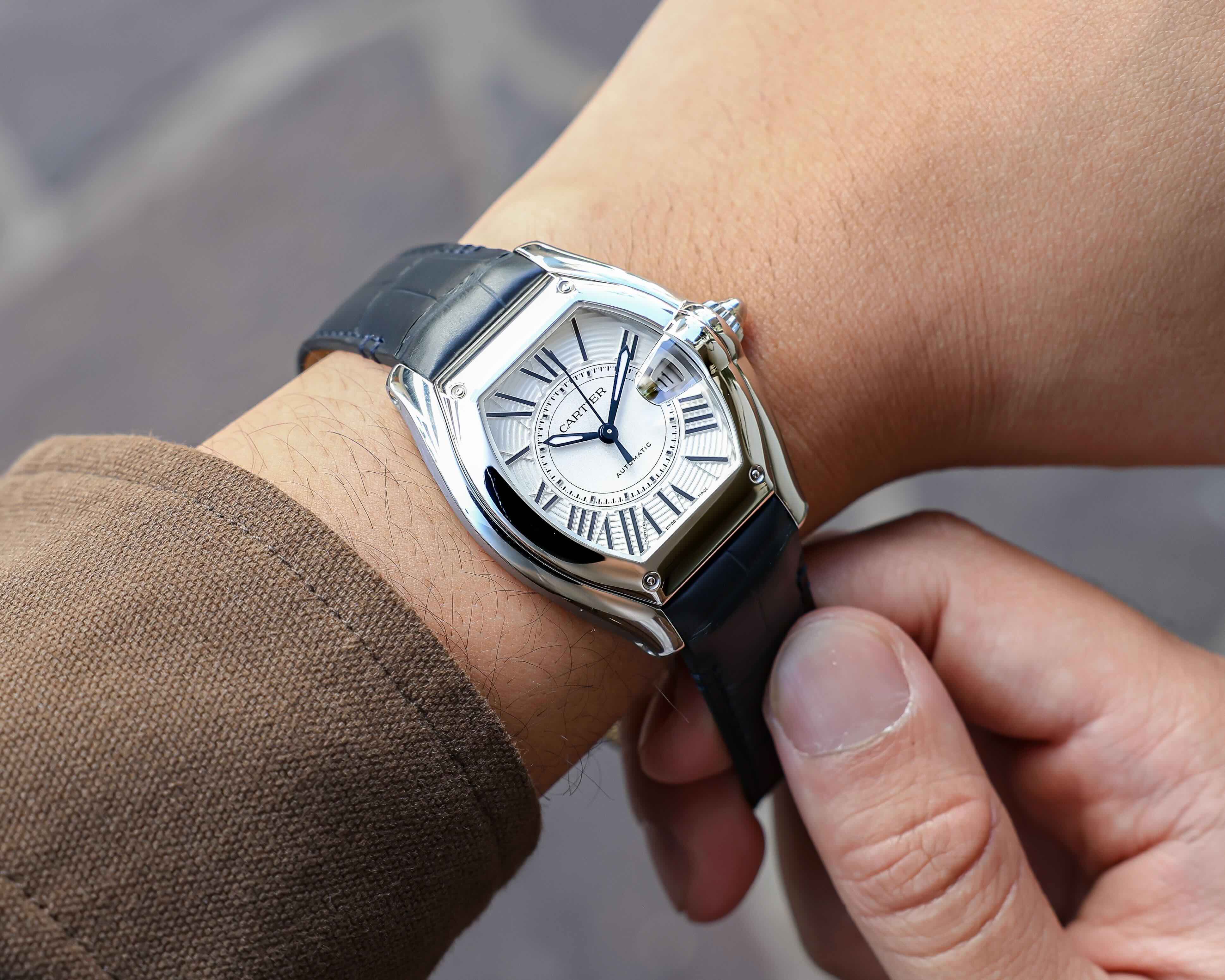
Moving outwards, the Roadster is sat in its classic tonneau (barrel-shaped) case, with a stepped bezel following parallel with its flowing lines. Cartier has also moved the old Roadster’s exposed screw elements from the tops of the lugs to the bezel, which gives the watch a subtler yet distinctively industrial appearance. It’s important to note, though, exposed screws are still hidden flush to the sides of each lug.
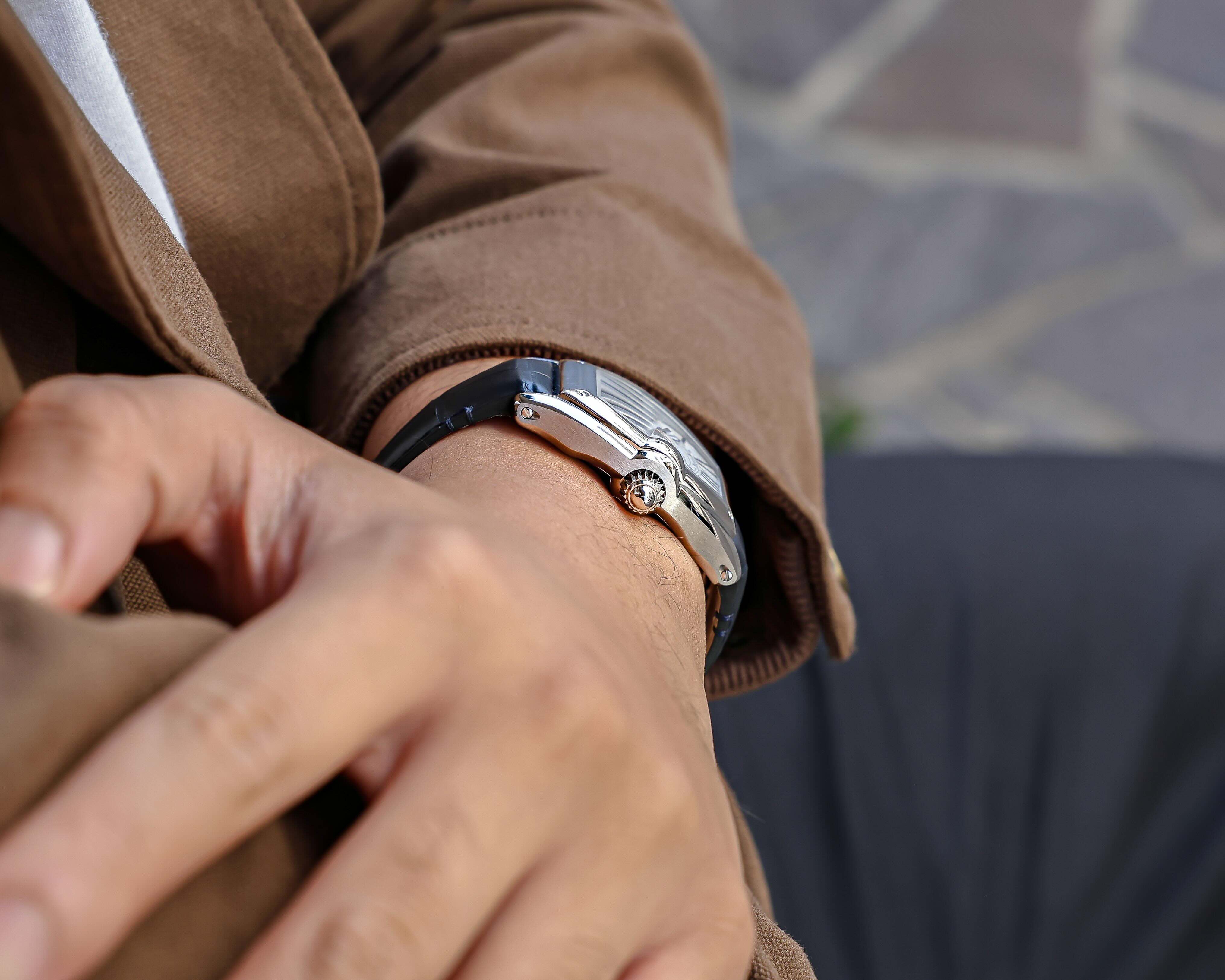
This industrial look directly contrasts the case, with nary a brushed surface in sight. This includes the crown and date magnifier setup, where the former is as reflective as the case it’s attached to. Both elements continue the automotive theme, with the magnifier resembling a car headlight and the crown a conical tailfin light.
The origin of the tailfin light has its own interesting history, inspired by the Lockheed P-38 Lightning and introduced in the 1948 Cadillac by General Motors. But while doing research for this article, I came across a level of lore so ludicrously expansive that it’s impossible to do it justice here. In your free time, Google “Automotive Tailfin Wars”, but be warned: this may open a rabbit hole deeper than watch collecting itself.
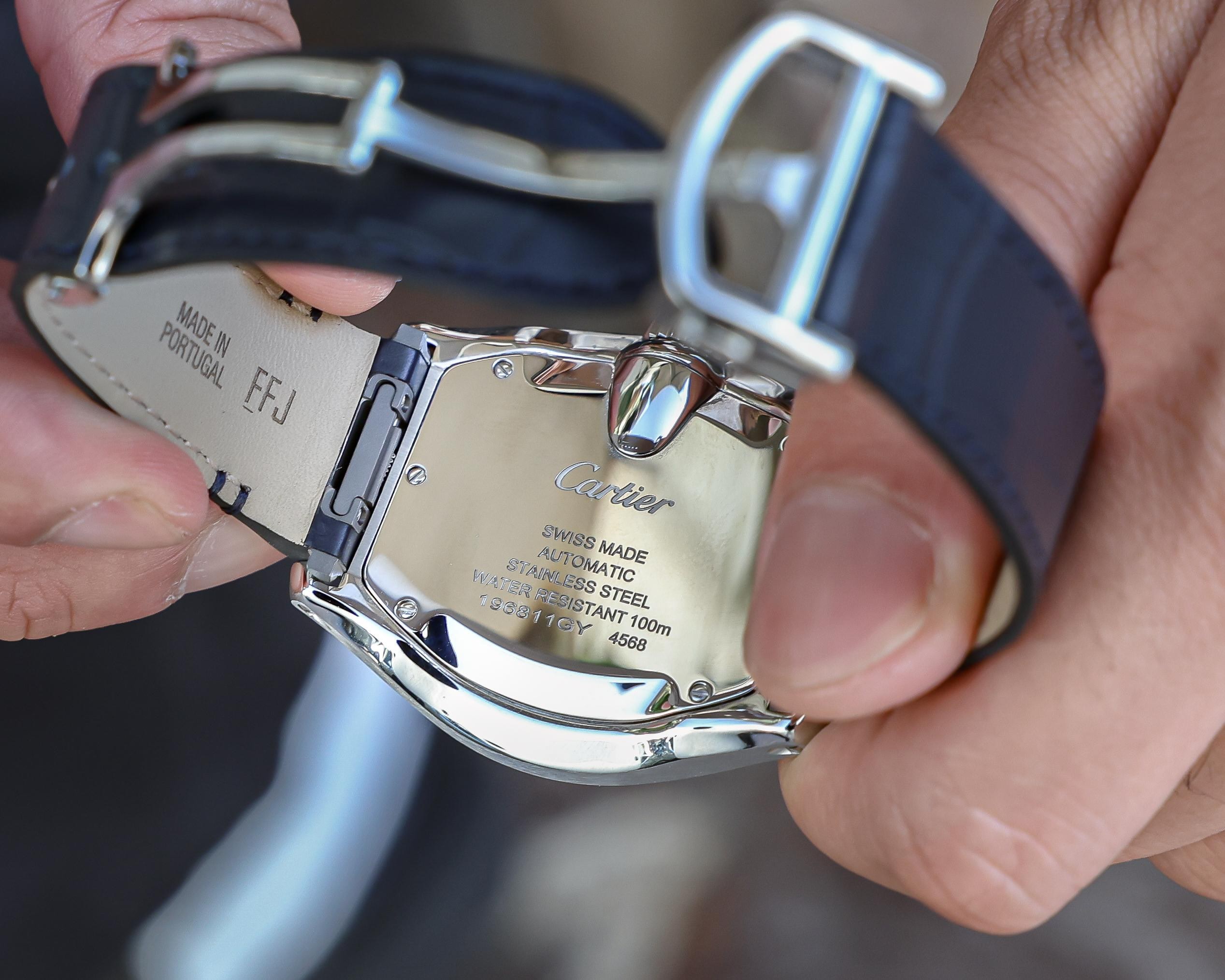
With virtually no sharp edges, the case flows down to a series of polished concave impressions on the rear, ending at a solid caseback with the typical serial engravings. Typically, the watch comes on a steel bracelet that mixes the finishing with brushed outer links, but for most of the review I wore it on the complimentary blue alligator strap with a deployant buckle.
Overall, the returning Roadster does well to enhance every reason why it was so beloved in its initial run. But in doing so, it also shows which elements have fallen out of favour with time. Still, the core design remains incredibly provocative and compelling, itself remaining a dual-purpose visual time machine into mid-century automotive and 2000s fashion history.
How It Wears
For as geometric as most Cartiers lean, ergonomics has surprisingly almost never been an issue. The brand is more often than not class-leading in its wearability, despite using shapes that often wear larger than their standard rounded counterparts. To that effect, the Cartier Roadster is the same, but better, delivering ergonomics without the unavoidable realities of rectangular or square cases.
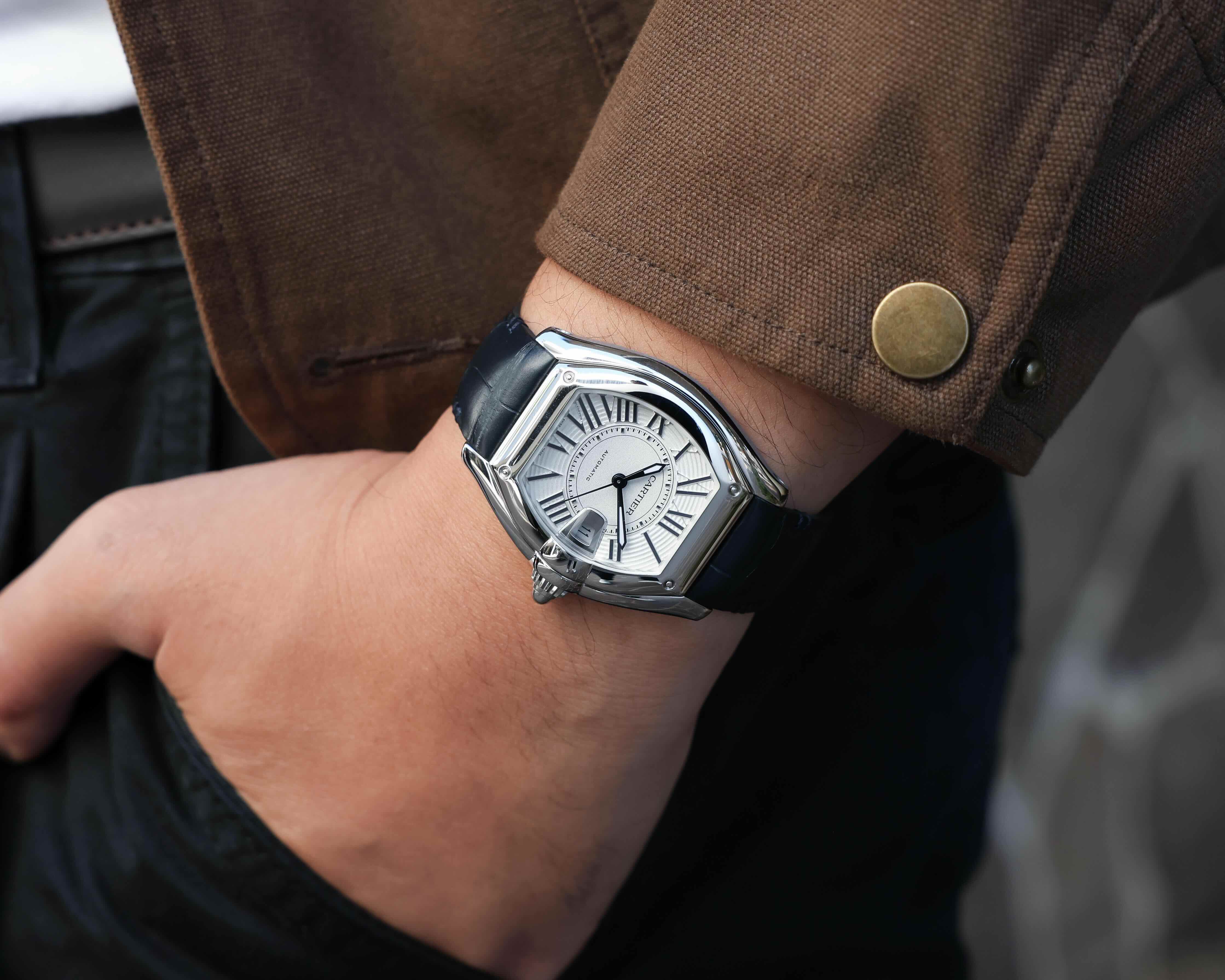
Measuring 38mm in case diameter at its widest point, 47mm lug-to-lug, and 10.06mm thick, the watch flows in stainless steel. Normally, when I’m given pieces to review, the watches either feel too tight or too loose, especially when they’re put on leather. I was surprised to encounter neither problem here, as the Roadster’s curvaceous figure and strap wrapped seamlessly around my 6.4in (16.4cm) wrist.
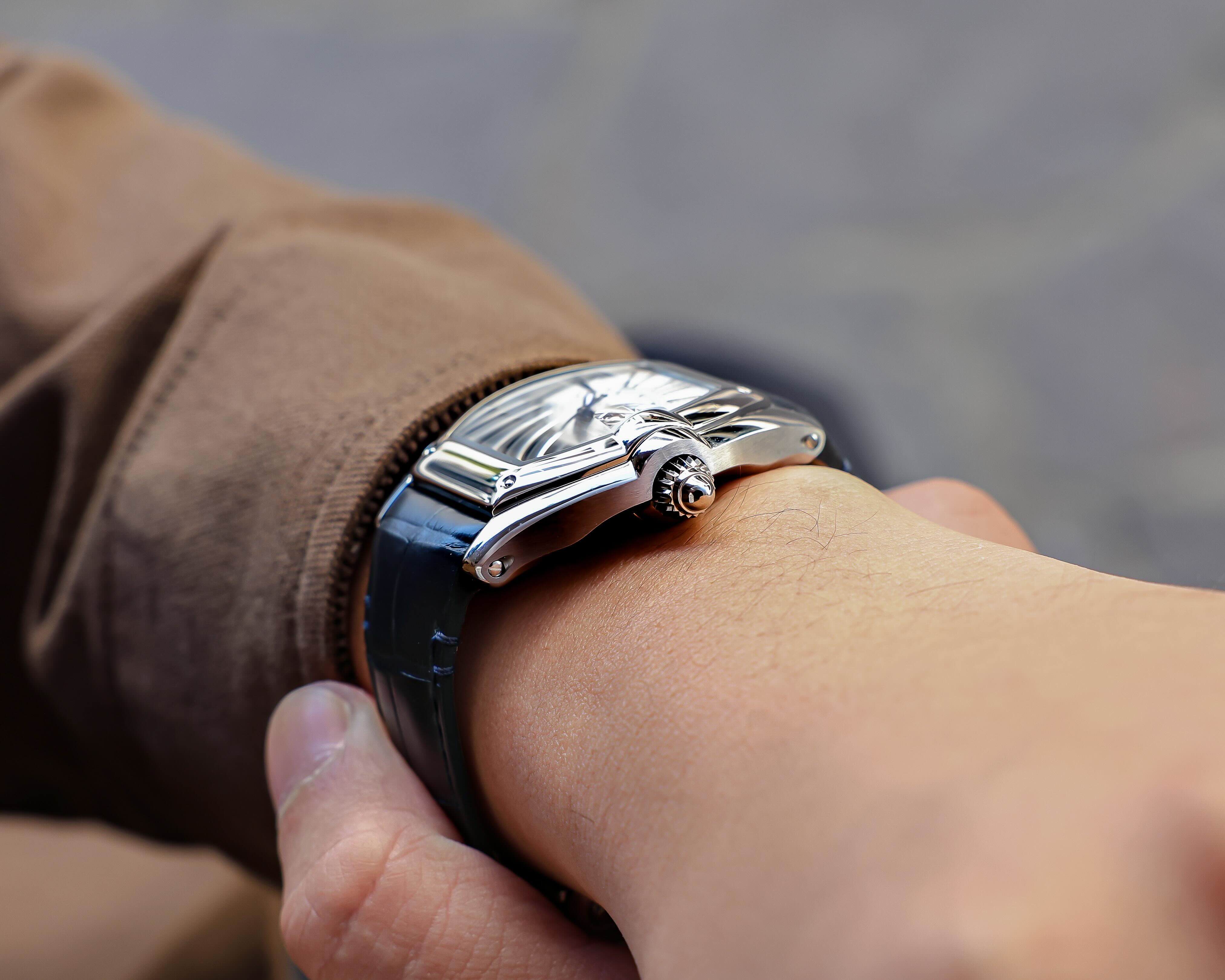
It does still wear a little larger than you’d think, especially with the side-swelling tonneau case, but not so much that it should dissuade the smaller-wristed among us. The flatter, broader profile on the wrist allows for enhanced legibility, as each of the stretched Roman numerals makes itself easily visible when telling the time.
What’s even better is that date magnifier, which I’m often against but is integrated nicely into the overall design. The shapely nature of the magnifier gives it a life of its own, and it doesn’t feel like an added attachment just because, as most magnifiers often do.
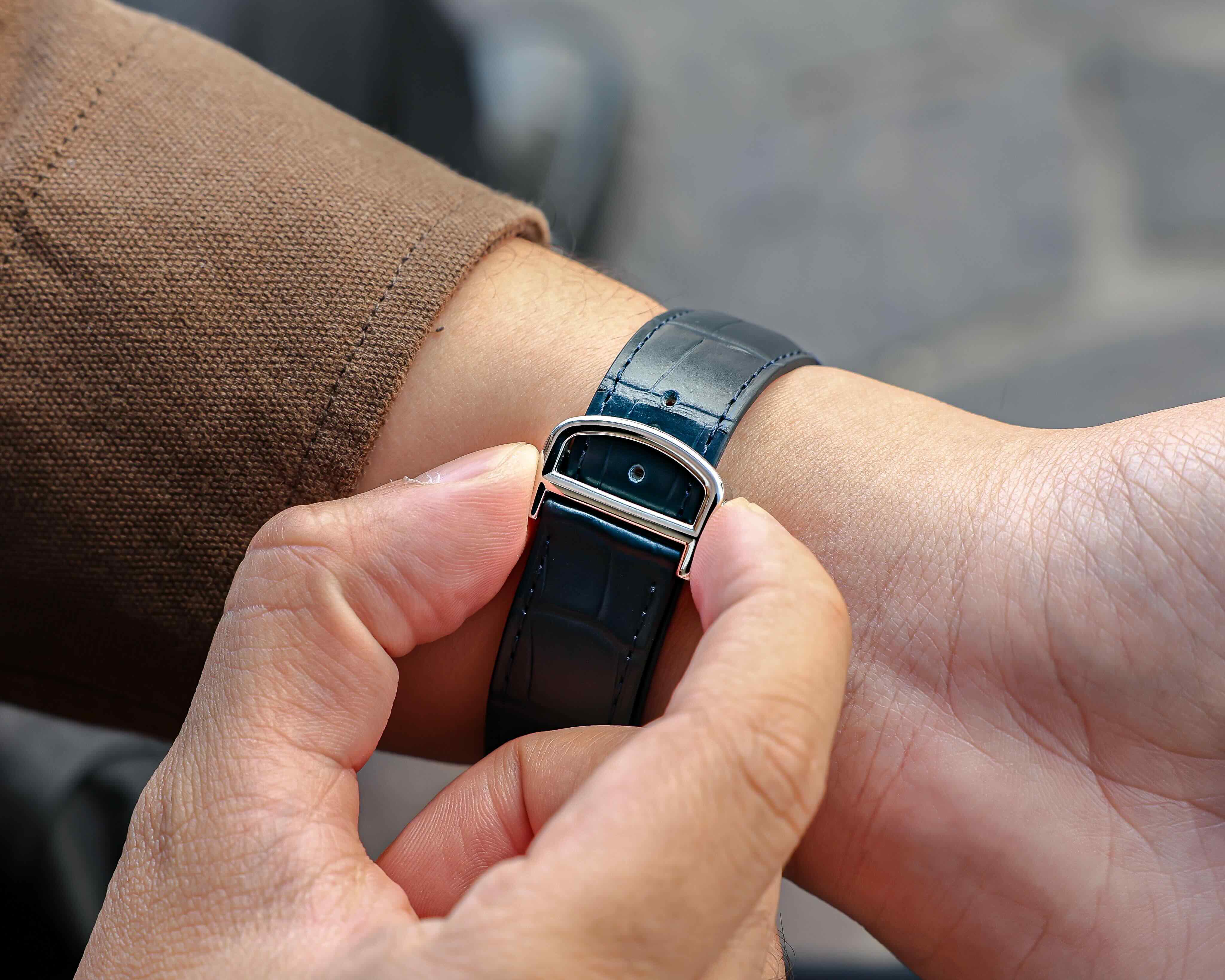
As for the strap, the Cartier Roadster was surprisingly forward-thinking for its time. While we might expect tool-less interchangeability now, the brand made significant strides in customer convenience with the Roadster’s own unique system.
This time around, though, Cartier has ditched it in favour of the modernised QuickSwitch, introduced in 2018 at SIHH (Salon International de la Haute Horlogerie, now called Watches & Wonders). With seamless switching depending on the occasion, compounded by 100m of water resistance, the Roadster feels like the most adaptable watch in the current catalogue, even more so than the Santos.
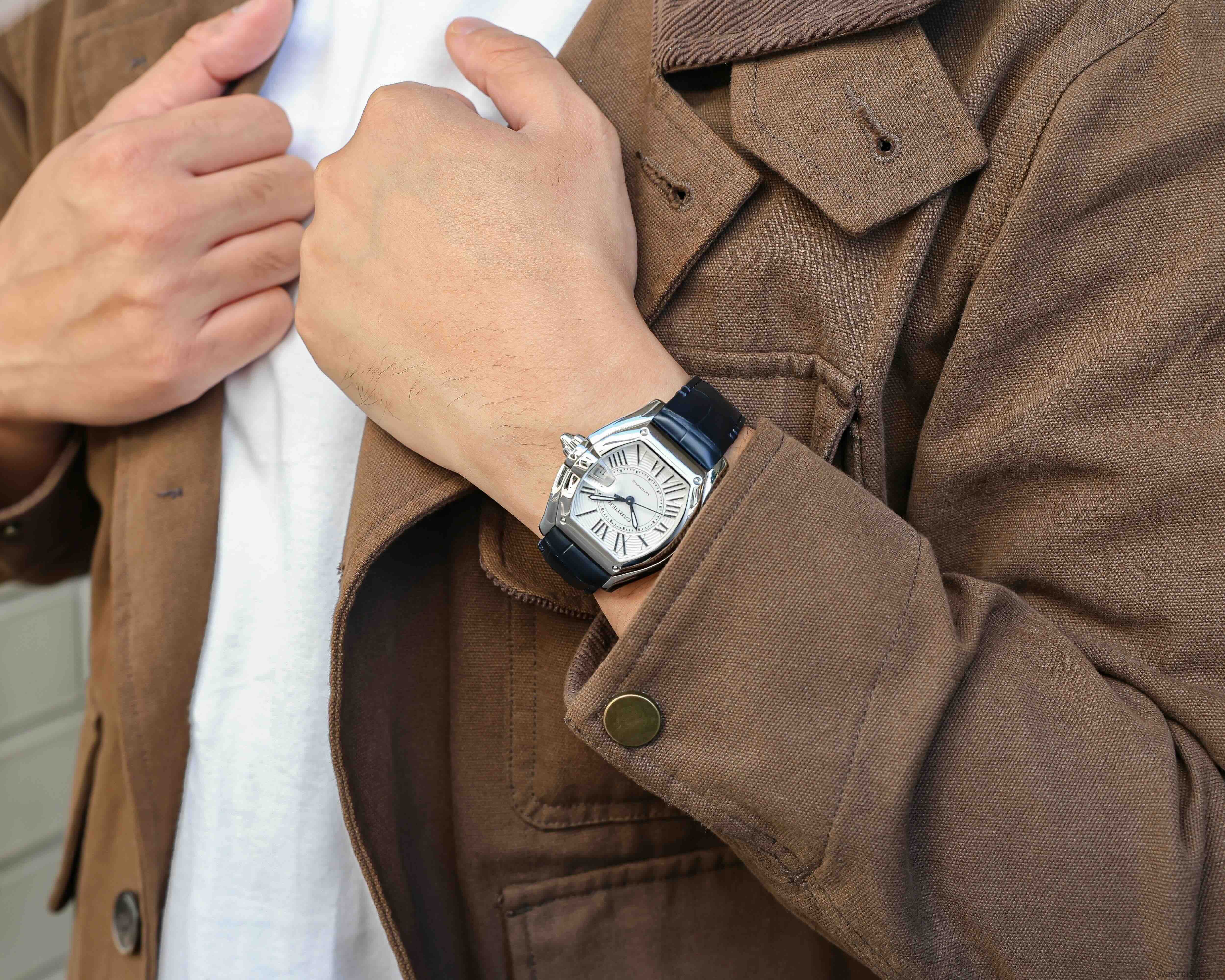
I really don’t have much new to say about the wearability, as it’s always been one of Cartier’s strongest points. The steel bracelet was fine enough with its butterfly clasp, and the leather strap and deployant clasp was one I’d familiarised myself with during my time with the Tank Américaine. Unlike that watch, though, I didn’t notice the bulge of the strap, perhaps due to the proportionality of the case to said strap.
The Movement
As for the movement of the returning Roadster, Cartier has reached back for the Cal. 1847 MC. A staple of the roster since being introduced with the Clé de Cartier in 2015, the 1847 beats at the luxury standard of 4Hz (28,800vph), atop a reasonable 42-hour power reserve. It’s a reliable movement that fills an in-house role previously occupied by ETA/Sellita-based calibres.
Again, another issue I have with the Cartier catalogue rears its head here, which is the lack of a display caseback for the Roadster. I suppose it’s more acceptable for automatic movements, as rolling the watch around should indicate that it’s functioning, as should the second hand. Still, with a spartan yet handsome movement such as the Cal. 1847 MC, you’d think that Cartier would be proud to show off even its baseline craftsmanship.
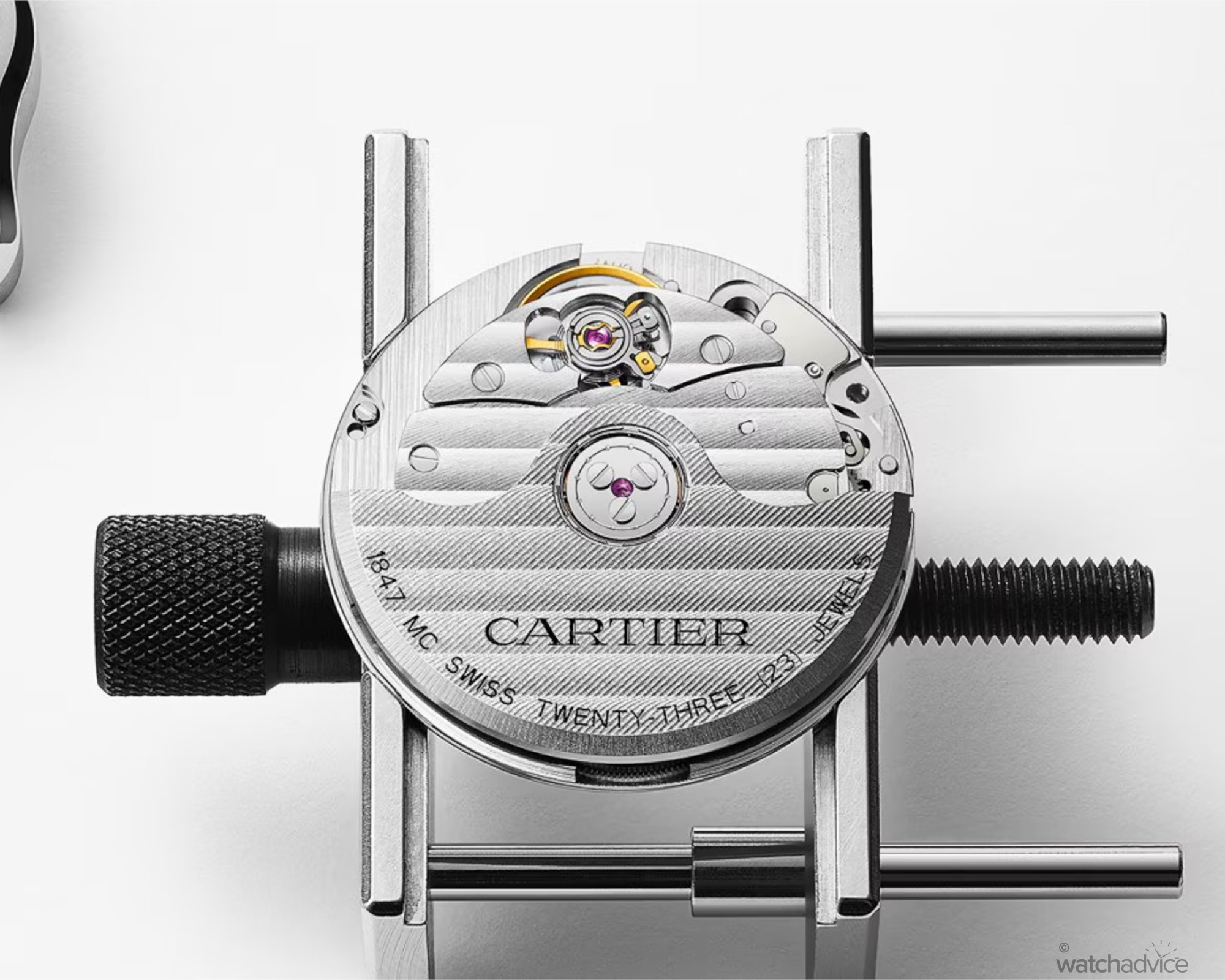
Like the wearability, there’s not much to say about the movement itself. It’s been the old reliable dance partner of many a reference, including the recently released Santos Large in titanium. However, operating the movement is made somewhat more complicated thanks to the design of the crown.
Though Cartier has allowed for a small amount of space beneath the crown to help pull it out, the slipperiness of the tailfin light shape certainly doesn’t help. Personally, it operated just fine before I trimmed my fingernails, as the added length helped add a bit of leverage to the operation. But after I had cut and filed my nails, many attempts were made before I was able to use the crown.
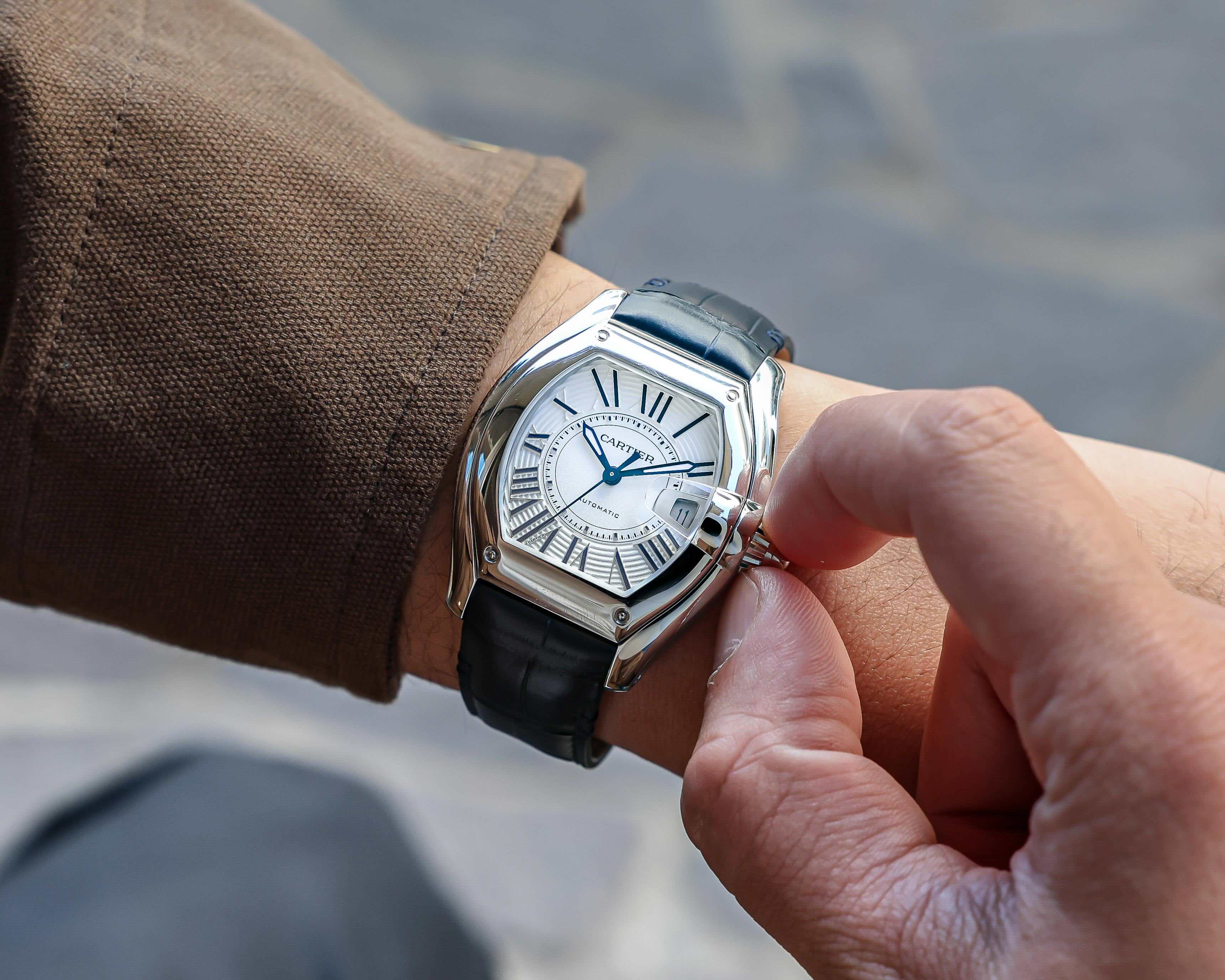
I think this is more a by-product of the design than a genuine fault in the movement, but it’s still something that could prove irksome to a prospective buyer. Regardless of operation, the Cal. 1847 MC still does what it does best: offering fair and dependable performance on a daily basis.
Final Thoughts
There’s something fitting about discussing a resurrection from Cartier’s archival graveyard. Many of its discontinued references have maintained a level of desirability long after they left the catalogue; The decision to bring one back into the fold couldn’t have been easy. Yet, among its equally unconventional and creative competition, the Roadster came out on top.
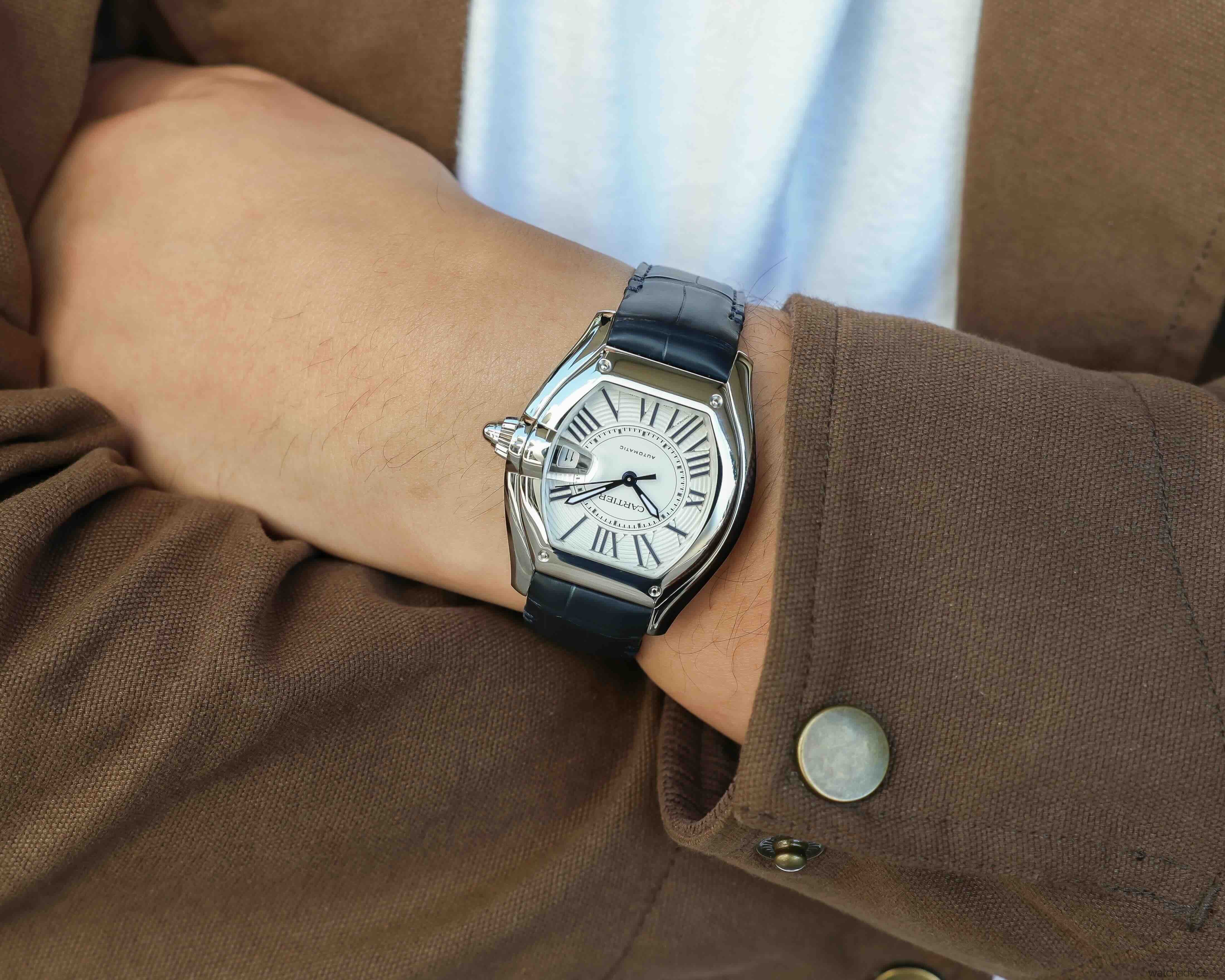
Is this return deserved? After the time I’ve spent with the watch, I think so. Though parts of the design and function show the watch’s age, its comeback couldn’t have been timed any better. The watch world is beginning to turn back towards maximalist watchmaking, but now with ergonomic principles in mind. To that effect, the Roadster fits the bill.
At AU$15,400, however, the Roadster has an uphill battle ahead of it. As is the case with Cartier’s roster, its biggest competition remains internal. The Santos Large comes in at around AU$14,300, making it roughly AU$1,100 cheaper. In the wider industry, the Grand Seiko Evo 9 UFA SLGB003 sits at AU$16,300, just AU$900 more.
That puts the Roadster in an awkward middle ground: it costs meaningfully more than the Santos while sitting close enough to the Grand Seiko to invite a very different kind of comparison. Yet, if ergonomics and comfort are your biggest priorities, the Roadster makes a compelling case for that premium.
Its flowing tonneau case is both unique and a delight to wear. When combined with its interchangeable strap system and quirky aesthetic, it makes for one of the most distinctive timepieces of its generation and the current one.
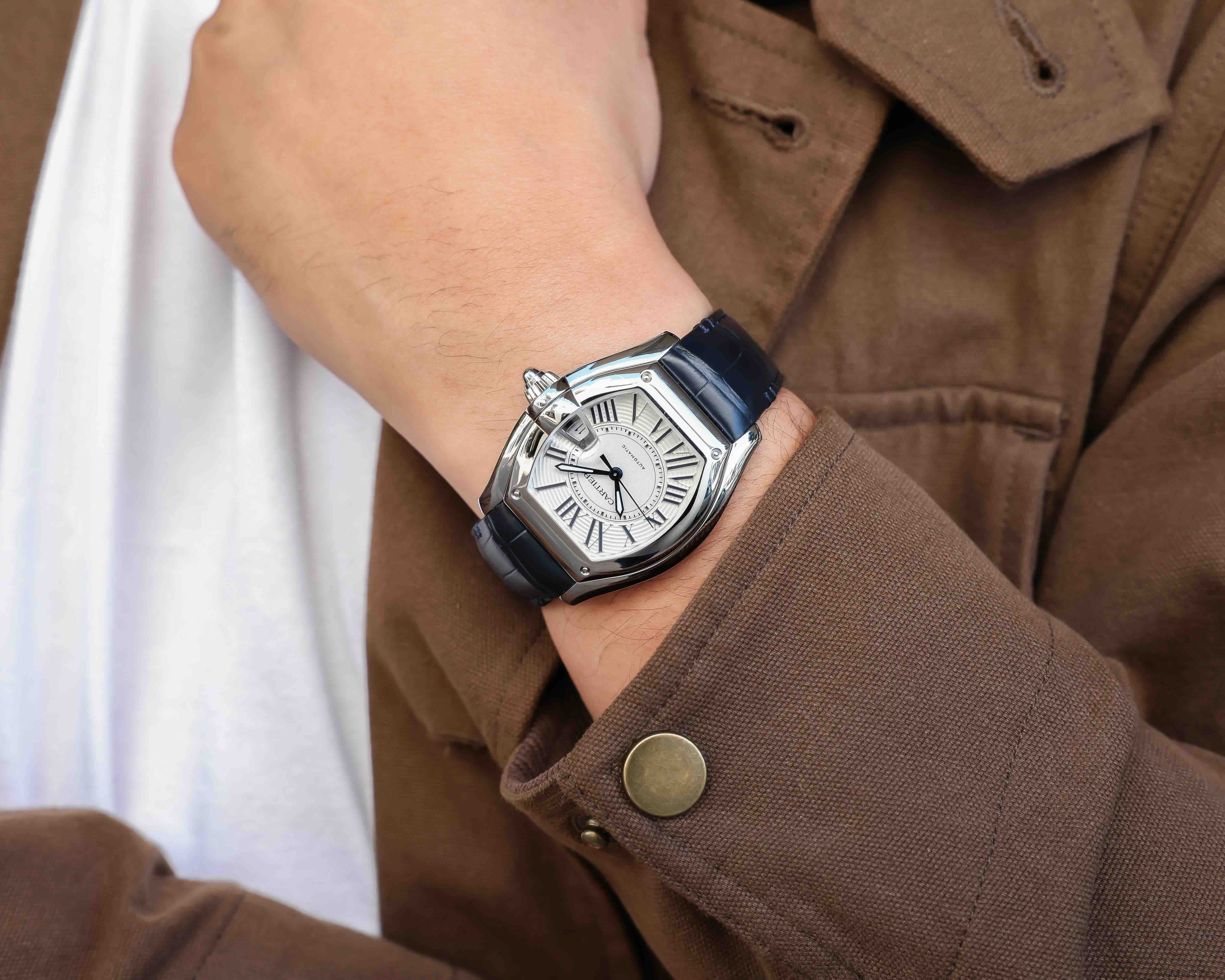
More than just the man out of time or the cult classic, the returning Roadster should perhaps remind audiences and prospective buyers of its ultimate purpose. It doesn’t quite fit into the Cartier canon we’re all familiar with, but exists next to it as the rowdy but good-natured cousin.
Imagine each Cartier collection was a person. The Santos would be an aviator, the Panthère the aristocrat, and the Tank a model, or businessman. To that effect, the Roadster is Danny Zuko from Grease. It’s striking, charismatic, and unapologetically so. Yet beneath the mid-century swagger, it remains true to Cartier’s romantic DNA. And perhaps that’s why, with enough time and refinement, what once seemed passé has become part of the Roadster’s charm.
Reference & Specifications
| Feature | Specification |
|---|---|
| Reference | CRWSRD0020 |
| Dimensions | 38mm case diameter x 47mm lug-to-lug x 10.06mm thickness |
| Case | Stainless steel |
| Dial | White with blue accents |
| Crystal | Sapphire |
| Caseback | Closed, polished |
| Movement | Automatic Cal. 1847 MC with date complication |
| Power Reserve | 42h |
| Beat Rate | 4Hz / 28,800 VpH |
| Water Resistance | 100m / 10bar |
| Strap/Bracelet | Interchangeable Stainless steel bracelet with butterfly clasp Complementary interchangeable alligator leather strap in matte navy blue with steel deployant buckle |
Australian Retail Price: $15,400
Availability: Available now, from Cartier boutiques, authorised retailers, or online at Cartier.com
Image Gallery