
I go hands-on with the Louis Moinet Memoris Spirit to discover whether its exposed chronograph is as rewarding to operate as it is to admire.
What We Love:
- Watching the chronograph mechanism respond in real time.
- Balanced openworked dial with striking blue and red accents.
- Detailed finishing across the case and movement.
What We Don’t:
- Substantial thickness limits its broader appeal.
- Long lug-to-lug measurement can restrict the ideal fit for wrists smaller than 16cm.
- White counter markings can blend into the mechanics.
Overall Rating: 8.9/10
- Value for Money: 9/10
- Wearability: 8.5/10
- Design: 8.7/10
- Build Quality: 9/10
Louis Moinet has long been one of my favourite watchmakers, and spending time with the Memoris Spirit gave me the chance to explore one of the things I love most about mechanical watchmaking. Seeing the engine behind the watch at work, straight from the dial!
Louis Moinet’s connection to the chronograph stretches all the way back to 1816, when the watchmaker completed his Compteur de Tierces. He developed this instrument for astronomical observations, allowing him to measure the movement of stars through a telescope. Today, it holds two Guinness World Records, recognised as the world’s first chronograph and the first high-frequency stopwatch.
While Louis Moinet’s name has an extensive history in watchmaking, the modern company, Les Ateliers Louis Moinet, was founded in 2004, with the ambition of restoring attention to the watchmaker’s historic achievements. A major moment came in 2013, when the company publicly unveiled the historical instrument, highlighting its significance to chronograph history.
This heritage helped shape Louis Moinet’s modern approach to the chronograph complication, leading to the creation of the Memoris collection in 2015. The name certainly feels fitting for a collection that honours the memory of the watchmaker and his pioneering work on the chronograph. The collection had a distinctive visual identity, with Louis Moinet building the watch around the chronograph mechanism. Its components were displayed on the dial side, allowing the wearer to see the mechanism come to life when the chronograph was engaged.
Louis Moinet introduced the Memoris Spirit as a unique piece for Only Watch in 2021, marking the debut of a more compact interpretation of the Memoris collection. Its 40.7 mm titanium case offered a first look at the proportions that would carry through to the Memoris Spirit collection in 2022.
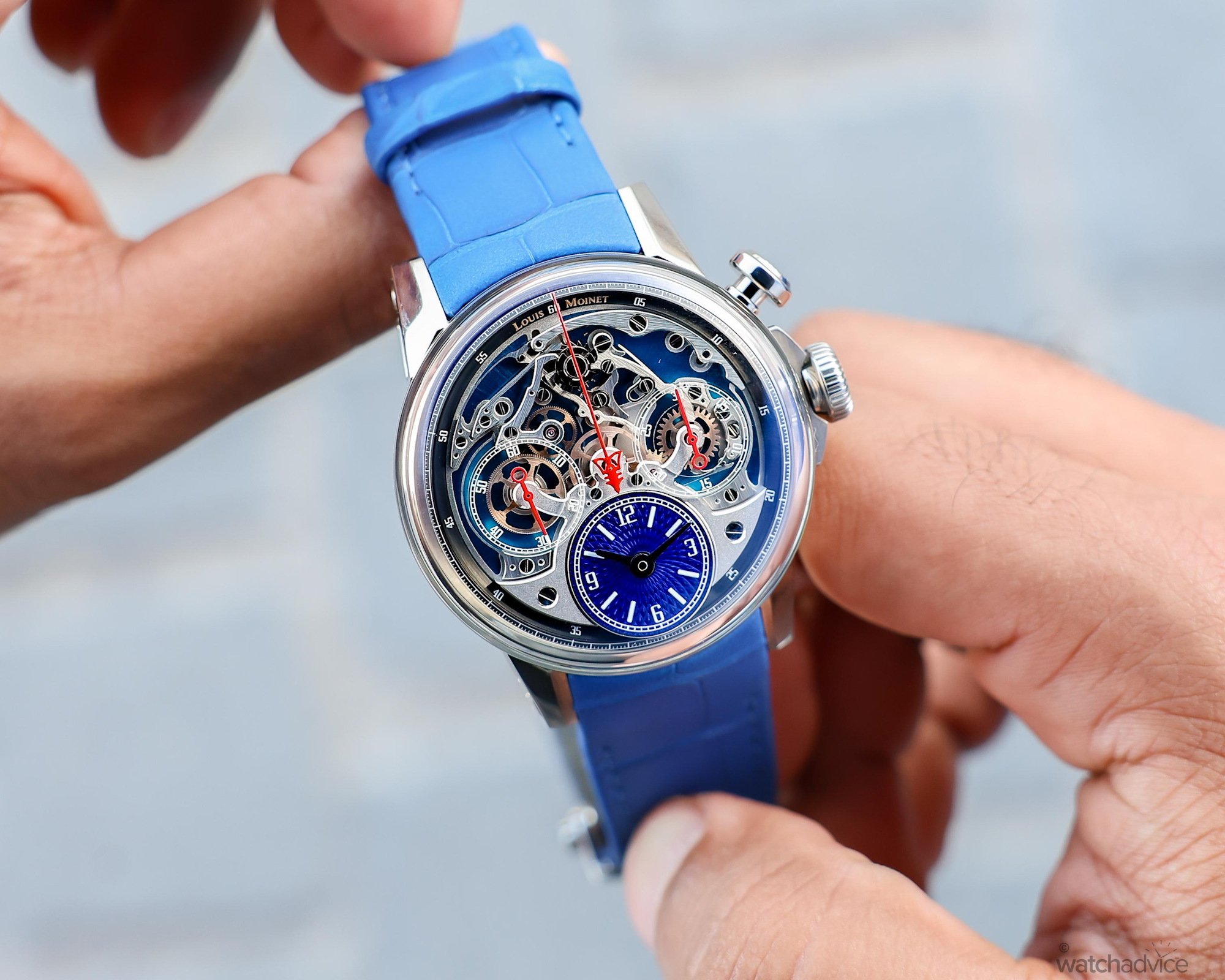
The model I have for review, the LM-84.20.22, was part of that original 2022 collection. It features a grade 5 titanium case with the same 40.7 mm diameter and is limited to 60 pieces. With its blue accents, red chronograph hands, and exposed mechanism, this was a watch I was particularly excited to review. It was also my first opportunity to go hands-on with a Louis Moinet, making the experience even more special!
While I was certainly excited to spend time with this watch, I wanted to see how that enthusiasm held up once I started using it. Would seeing the chronograph mechanism at work make the Memoris Spirit just as enjoyable to use as it is to admire on the wrist?
Initial Impressions Of The Louis Moinet Memoris Spirit
My engineering background has always drawn me towards the technical side of watchmaking, especially being able to see the various components working together to operate the different complications in a watch. This plays a big part in why I love skeletonised watches and openworked dials so much, and also why watchmakers like Louis Moinet have long appealed to me. Louis Moinet has a variety of mechanically expressive designs, from the Time To Race models, Tempograph Neo, Astronef and Impulsion, alongside the extensive Memoris collection.
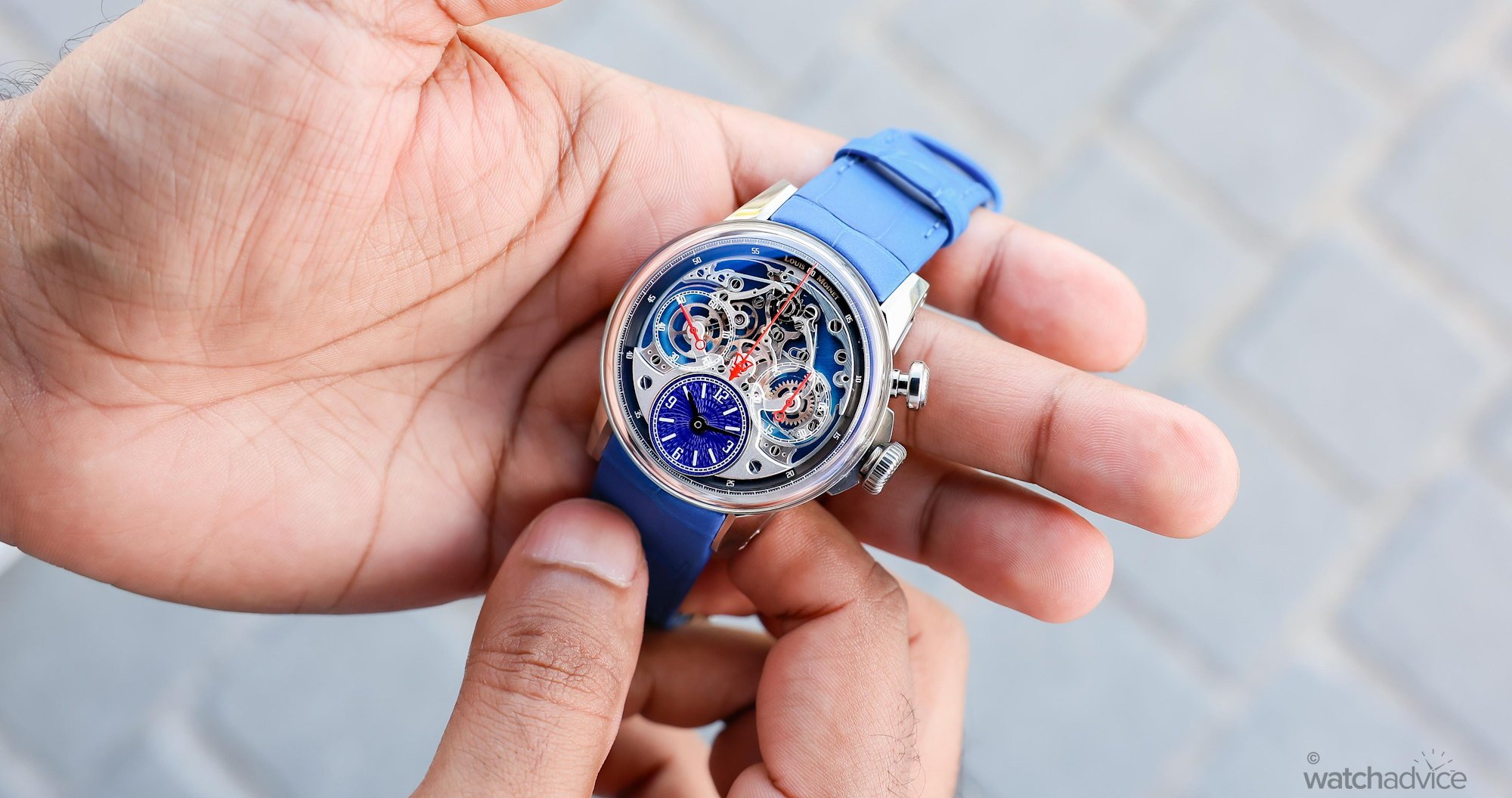
The Memoris Spirit immediately caught my attention because the chronograph mechanism occupies so much of the dial, giving me plenty of watchmaking engineering to explore at first glance. What interested me most was being able to follow the mechanism responsible for the chronograph’s operation, including the column wheel. Pressing the pusher gave me the opportunity to watch those components respond directly to my input.
With this being my first hands-on experience with Louis Moinet, it was certainly a fitting watch given my admiration for mechanics visible through the dial. Having the opportunity to spend time with the watch after admiring it in photos online certainly made the whole experience quite special. I already admired the brand, and those first moments on the wrist gave me even more reason to explore what the Memoris Spirit had to offer.
Traditional Curves Meet Industrial Detail
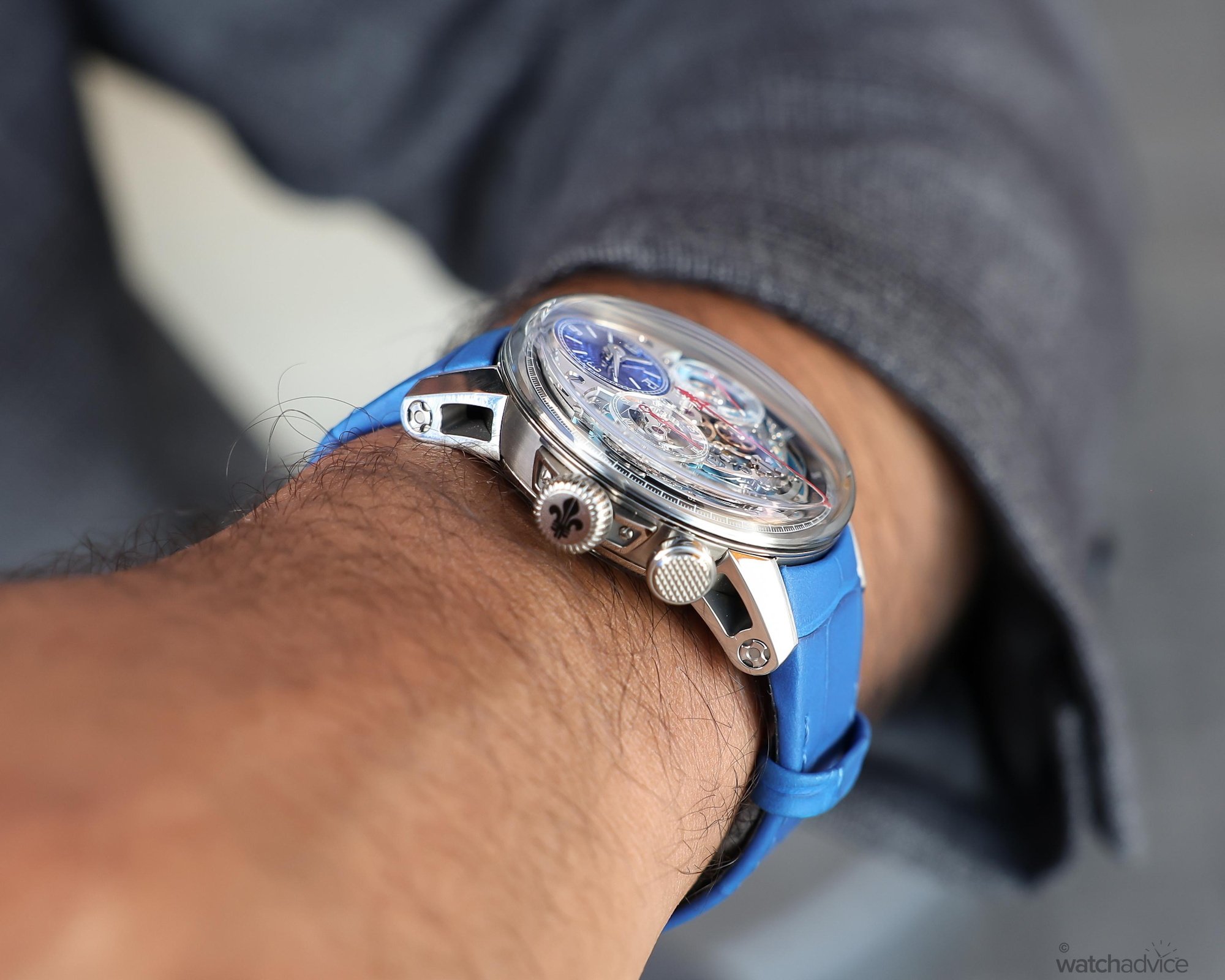
The Louis Moinet Memoris Spirit features a rounded grade 5 titanium case measuring 40.7mm in diameter, with a thickness of approximately 18.1mm and an approximate lug-to-lug measurement of 48.6mm. While the diameter is relatively restrained, the height and length make this a substantial watch.
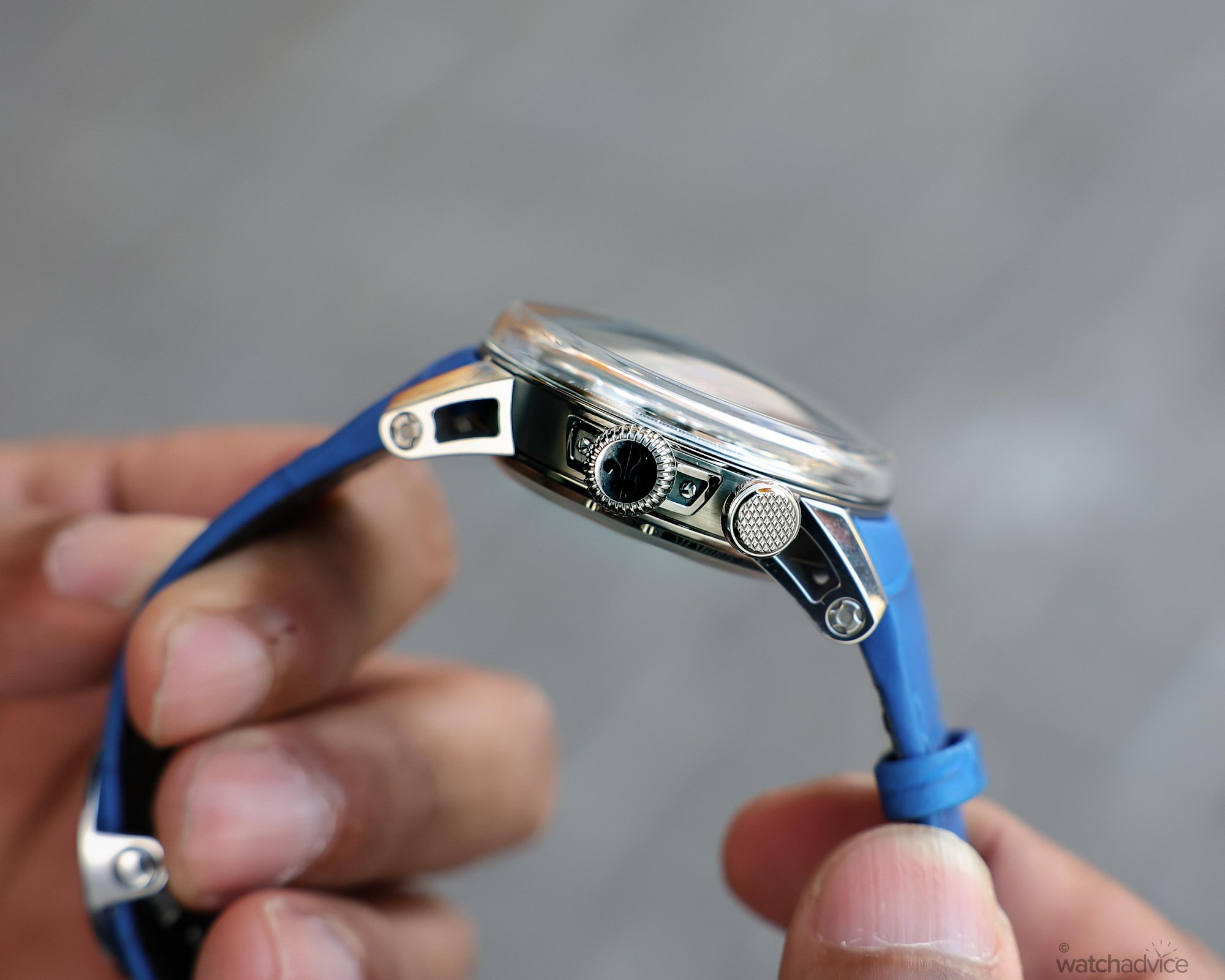
The thickness in particular needs some context: the strongly domed sapphire crystal rises well above the metal case, contributing to the overall height while also giving the watch its traditional character at first glance. This creates a very different profile from a watch with tall, solid case flanks, although how these proportions translate onto the wrist is something I’ll come back to in the wearing section.
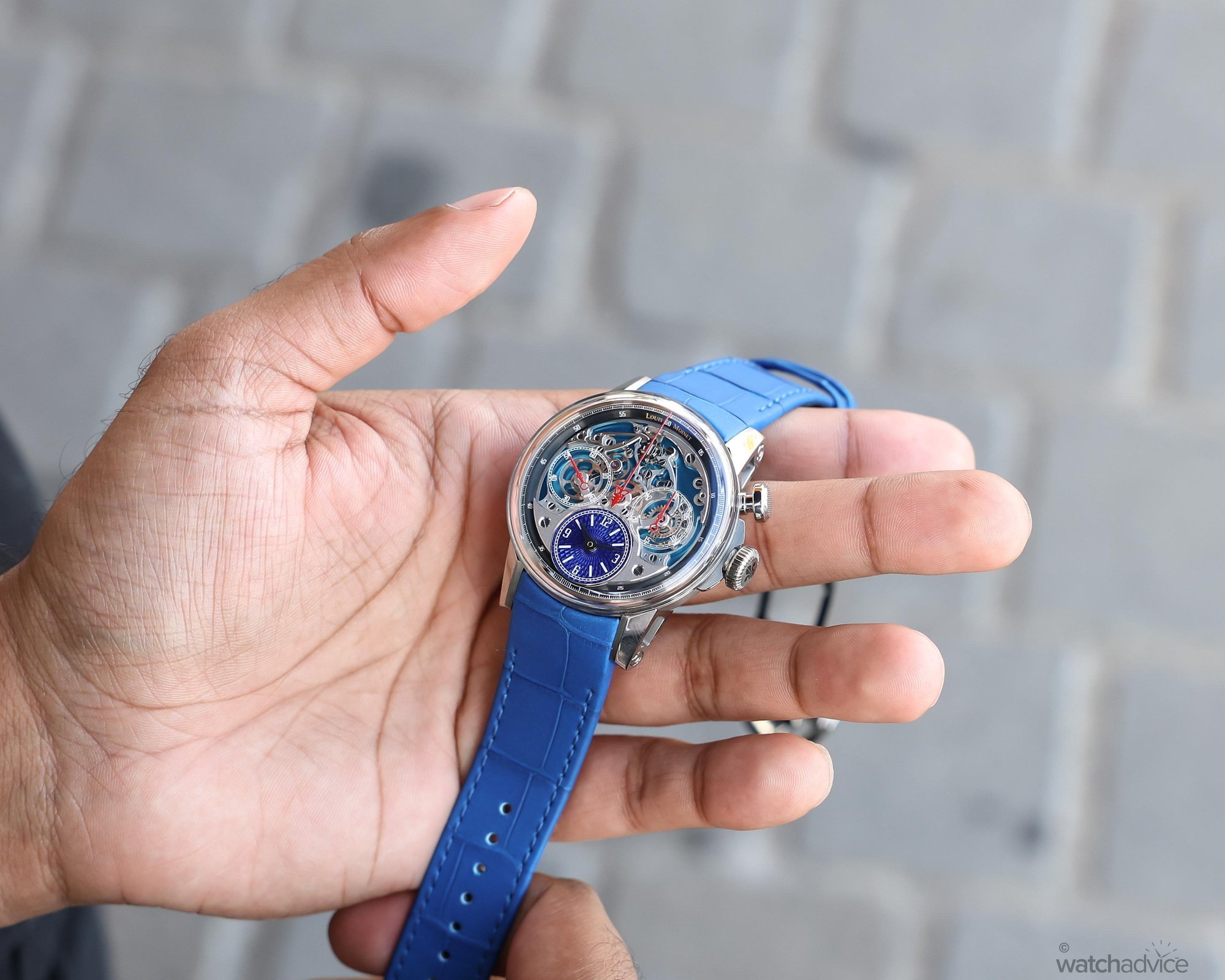
For me, it’s the circular profile of the watch that connects visually with the historical chronograph instrument behind the Louis Moinet Memoris story, while the surrounding architectural details bring the design into the present. Developing this case involved designer Fabrice Gonet and case-making artisan Bertrand Crevoisier, who worked on the challenge of housing the chronograph mechanism in a more compact exterior.
The solution was to combine a strongly domed sapphire crystal with a flange mounted independently of the crystal’s seating, preserving space for the display around the mechanism. From the angles captured in the photographs, the outer graduated track is particularly prominent beneath the crystal itself. Positioned around the perimeter of the dial, it gives the exposed chronograph mechanism a clearly defined frame, which stands out even when viewing the watch from an angle.
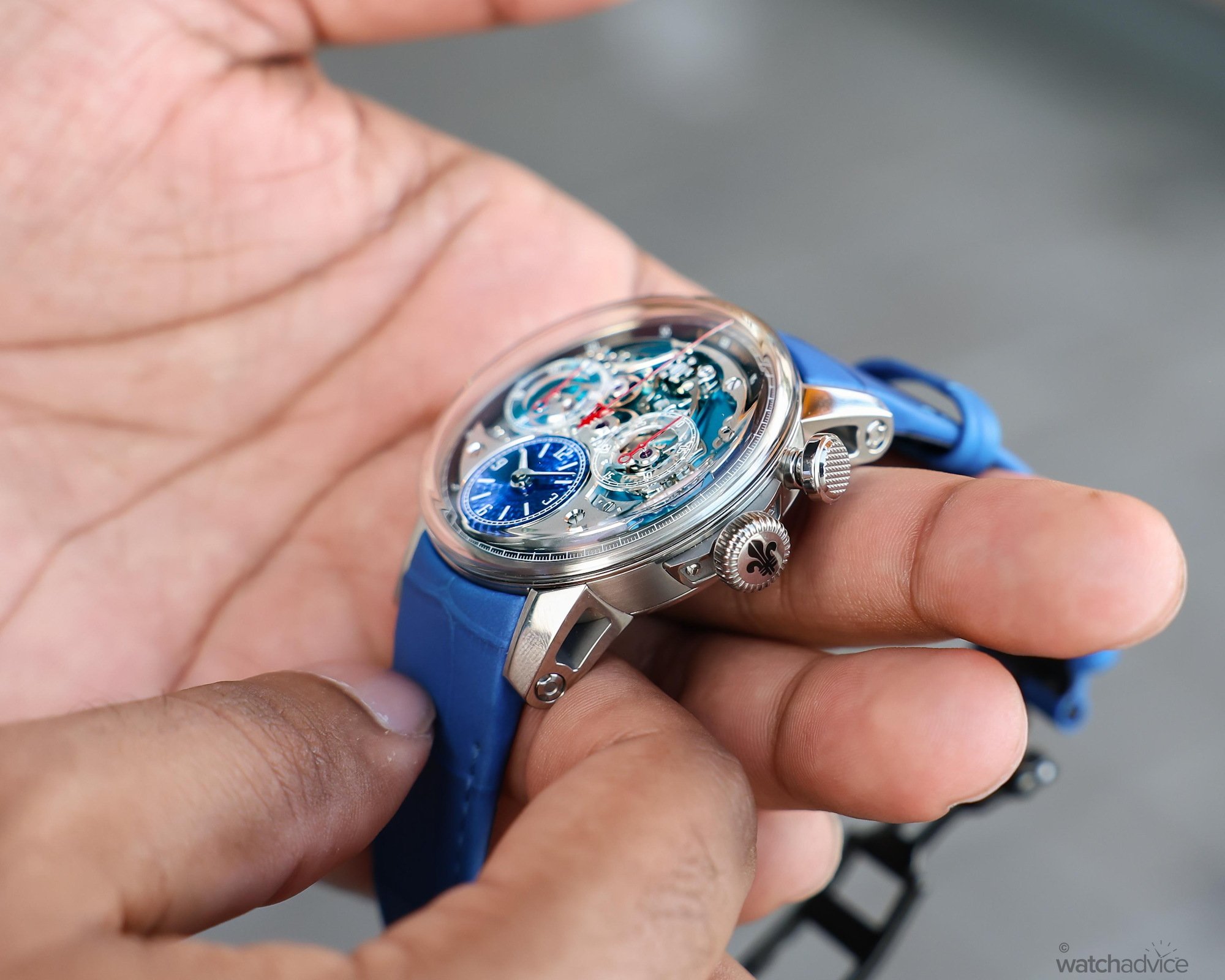
The openworked lugs are where that contemporary character becomes particularly noticeable, with cutouts breaking up the solid metal around the strap. What I particularly loved about this design is how it carries the dial’s openworked aesthetic onto the case itself, giving the exterior of this Louis Moinet timepiece a direct visual connection back to the dial.
The case also has a variety of finishes, from the bright polished surfaces around the lugs and bezel to the horizontally satin-brushed case middle. The contrast gives the case a layered design, with the brushed middle introducing an industrial character that is emphasised by the surrounding details.
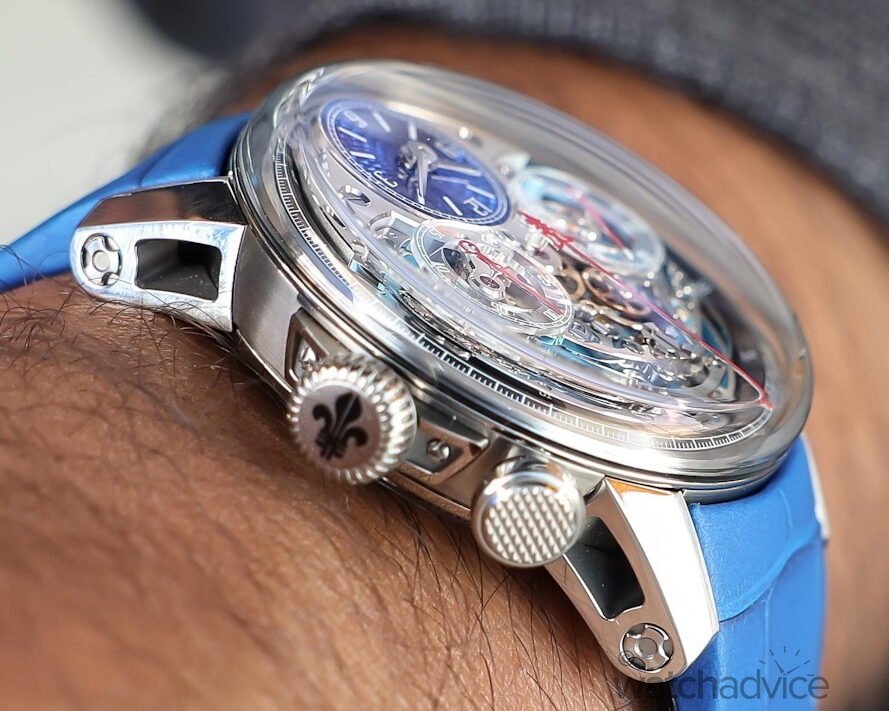
I think it’s safe to say this is no traditional watch case, as there are so many different details that warrant closer inspection! The visible screw heads at the lug ends, for example, reinforce the impression of exposed mechanical construction. The crown support also adds to this visual identity, with its angular outline and visible screws giving it the appearance of a separately attached component.
The crown’s deeply fluted edge brings in another texture, while the single chronograph pusher features a Clous de Paris hobnail surface surrounded by a polished rim. For me, these are the details on the Louis Moinet Memoris Spirit that make the case just as fascinating as the dial itself. The rounded profile gives it a pocket-watch-inspired appearance to my eye, while the openworked lugs, exposed screws, and contrasting finishes give the watch its contemporary industrial aesthetic.
A Beautiful View Of Mechanics In Motion
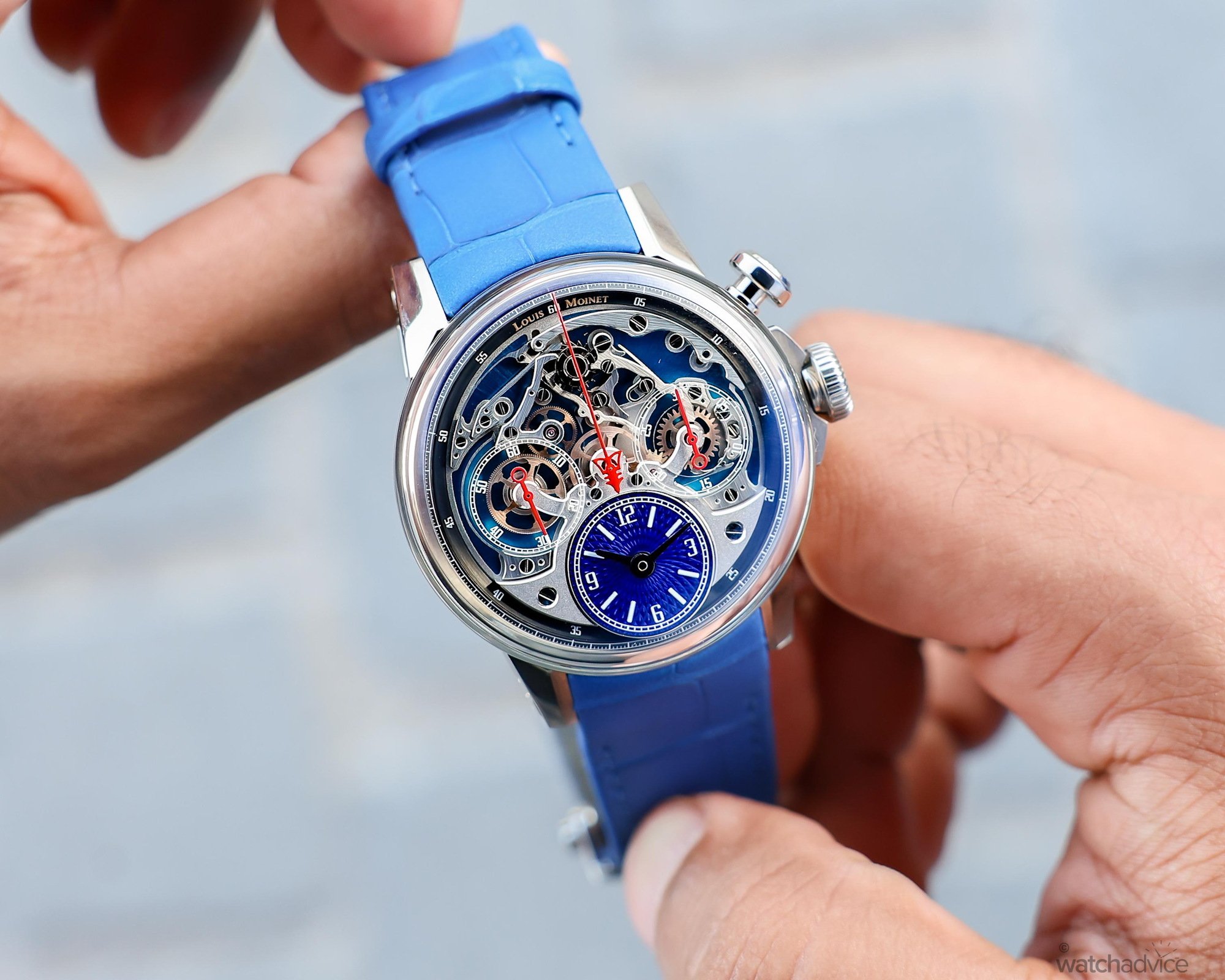
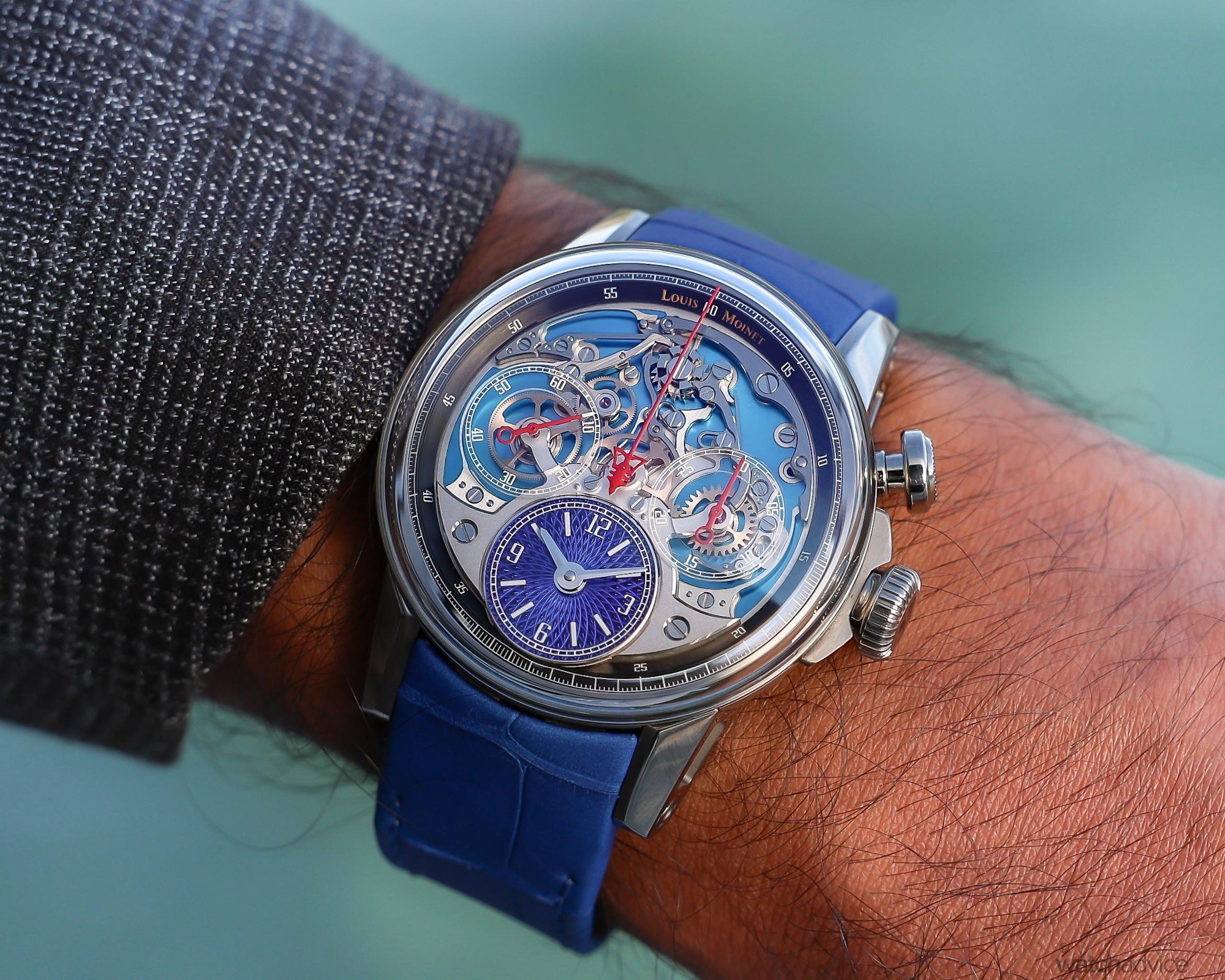
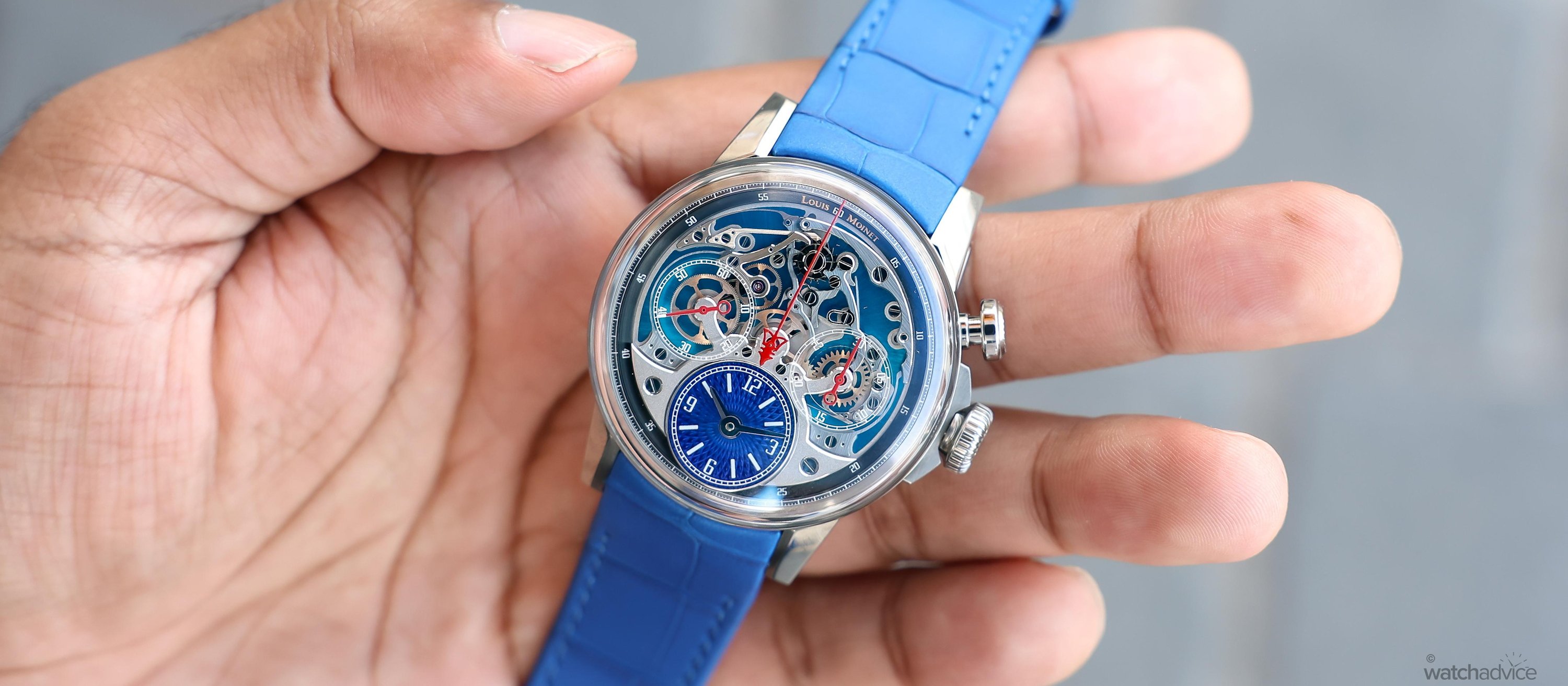
As I mentioned earlier, what initially drew me to this piece was the exposed mechanics of the chronograph movement taking centre stage, with the hours and minutes displayed in a separate deep-blue time dial at 6 o’clock. I think the way that Louis Moinet has designed the Memoris collection keeps in mind that sometimes skeletonized watches can be overly busy and complicated.
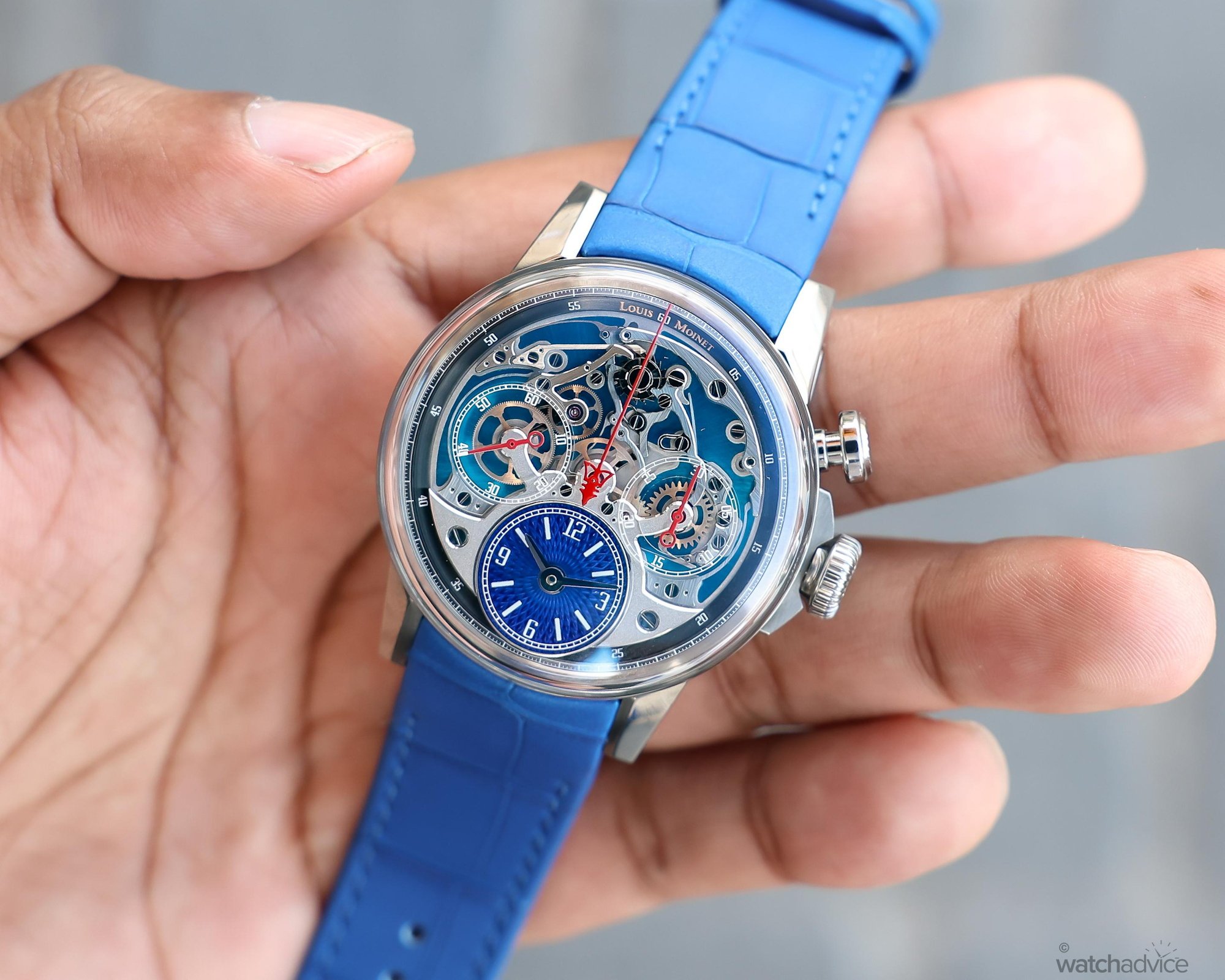
With this Memoris Spirit edition, I think the arrangement of the mechanics and also the subdials is beautifully executed in a way that doesn’t feel overly complex, irrespective of the full chronograph mechanism being on display. For example, we have the running seconds sitting at 9 o’clock, which is balanced on the opposite side by the chronograph’s 30-minute counter sitting at 3 o’clock. With the time dial sitting below the two, it creates a design that is well executed and balanced.
Why I think this arrangement works is that there is open space between the components. The blue background remains visible through the openworked mechanism, which incidentally allows the individual mechanical shapes to stand out. The transparent subcounters also continue this approach, revealing the wheels beneath the markings rather than covering these areas with solid subdials, as the time dial at 6 o’clock.
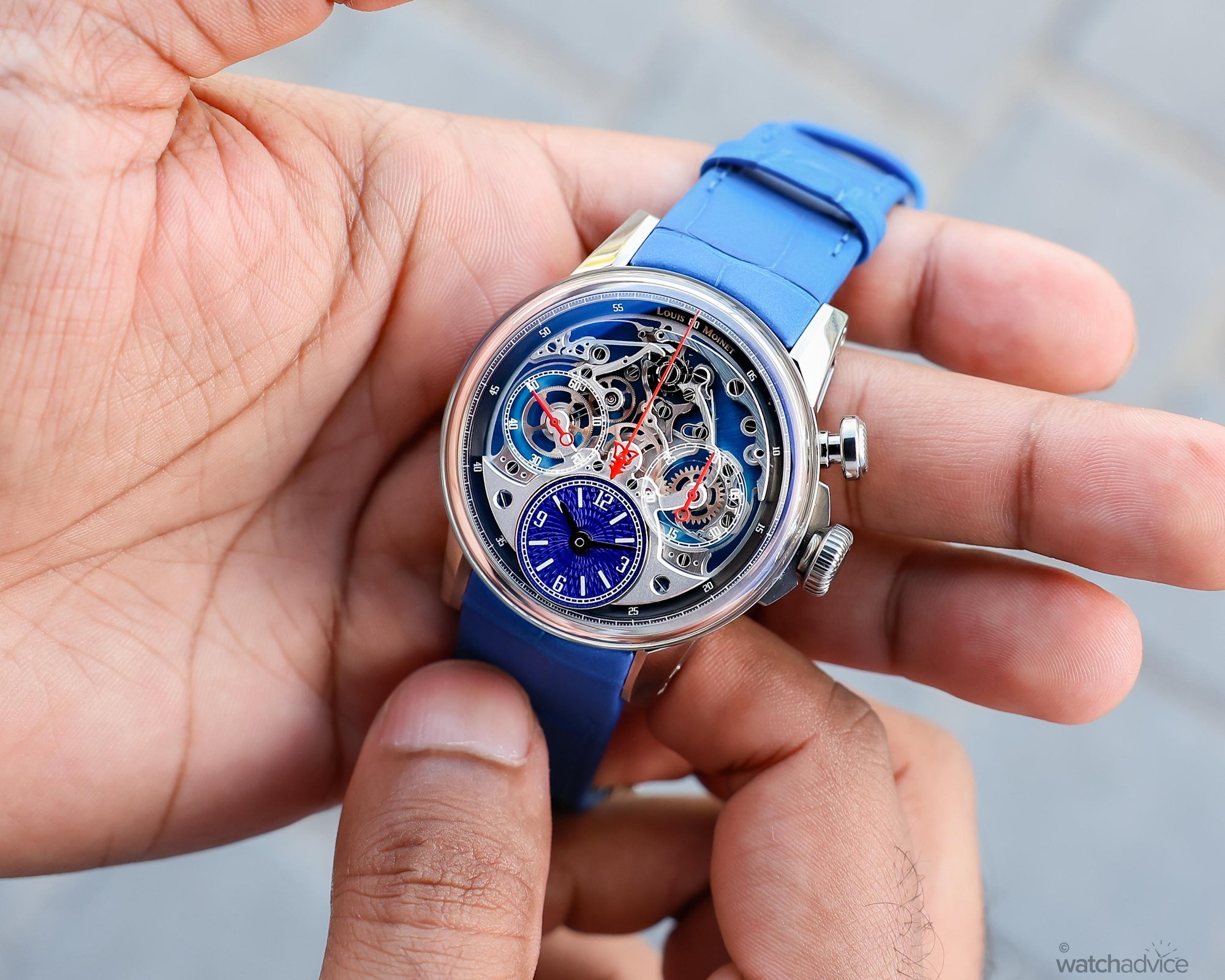
Despite everything on display, it doesn’t feel as visually overwhelming as you might expect from a skeletonized dial. In saying that, it’s not a fully openworked dial either, with the lower portion being closed off, and I feel that creates a visual distinction between the two parts of the dial.
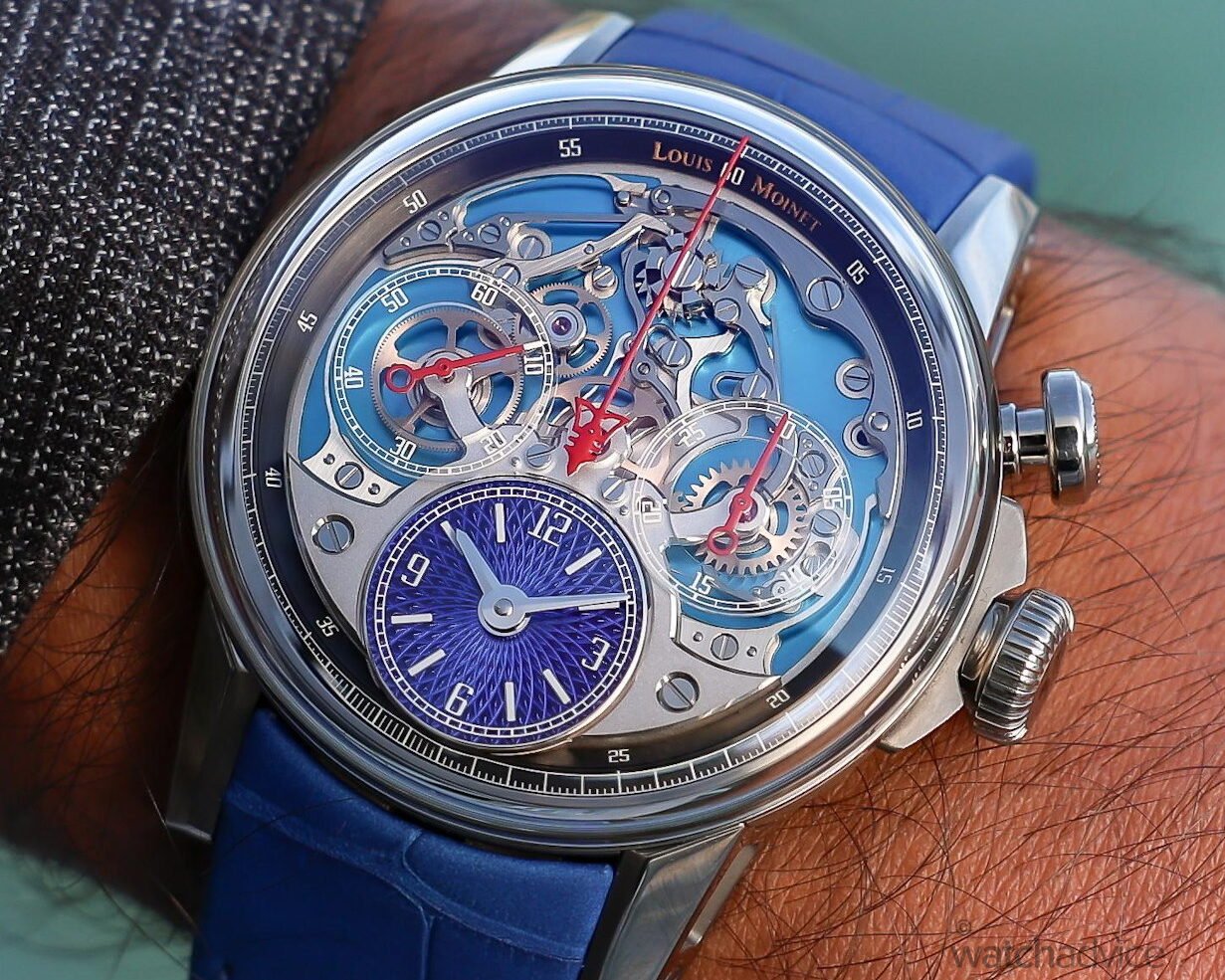
The bottom part purely focuses on the time dial, which also has its own appeal with the distinctive radiating guilloché-style pattern, giving it its own identity. On top of the guilloché pattern, we have a mixture of baton-style hour markers and Arabic hour numerals, executed in white to stand out beautifully against the deep-blue background.
The touch of red for the chronograph seconds hand and the subcounter hands adds another distinctive detail. But not only that; it actually allows the hands to stand out against the exposed mechanics and the light-blue movement background. One thing that you may find with skeletonized watches is that sometimes the indices or the hands can blend in with the exposed mechanics. This is certainly not the case here, with the red colour also adding a touch of aesthetic detail to the dial.
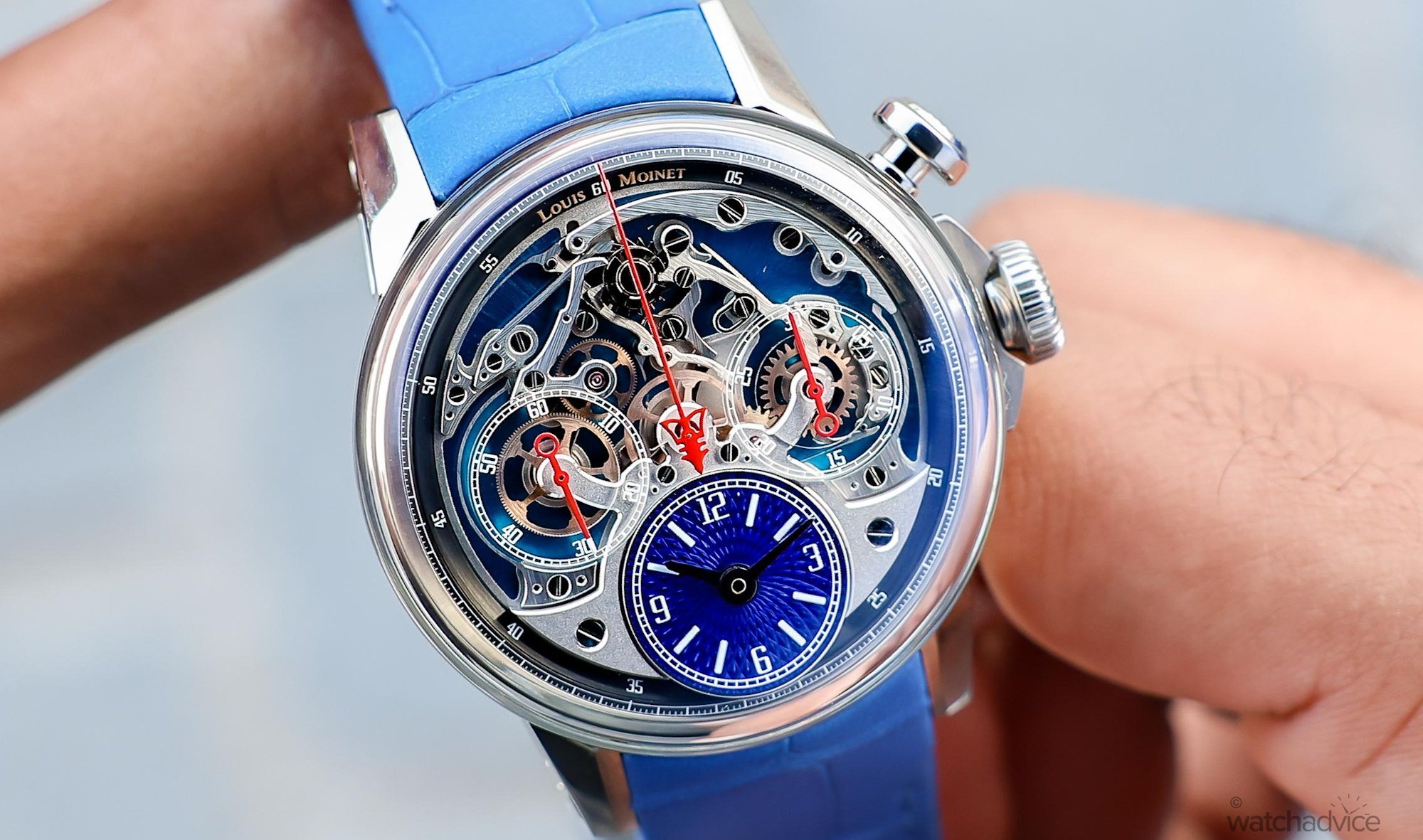
And then, when you look closer, you can see that Louis Moinet has paid attention to finer details, such as the brushed surfaces of the exposed plates and components, which, while adding definition, contrast with the polished details surrounding them. It’s these different finishes and colours that help distinguish the various components of the dial, which certainly gave me more to appreciate the longer I looked.
One area I would personally like to see explored is the counter markings. While the white printing reflects the time dial’s own white elements, I found that it does tend to blend in with the exposed mechanics and the blue background beneath the sub-counters, which can make these displays less immediately readable. If Louis Moinet were to execute these markings in a darker finish, it might improve readability and also add another touch of aesthetic detail. Alternatively, designing the counters like those on the Memoris Life model could also help distinguish them better.
Mechanical Substance With Finishing To Match
The Memoris Spirit is powered by the automatic calibre LM84, which has been developed by Louis Moinet in collaboration with Swiss movement specialist Concepto. This is a proprietary movement created specifically for the brand rather than a standard movement over which Louis Moinet has placed an openworked dial. The movement operates at 4Hz (28,800 VpH), while delivering a modest power reserve of two days (48 hours).
The movement features 311 components, and for this timepiece they have been arranged with 147 dedicated to the chronograph mechanism on the dial side, with the remaining 164 components forming the automatic movement seen through the caseback. This arrangement allows the wearer to see the chronograph in action once the pusher is engaged. The column-wheel monopusher chronograph controls starting, stopping, and resetting through the single pusher, while the architecture on the dial side makes this whole interaction visible.
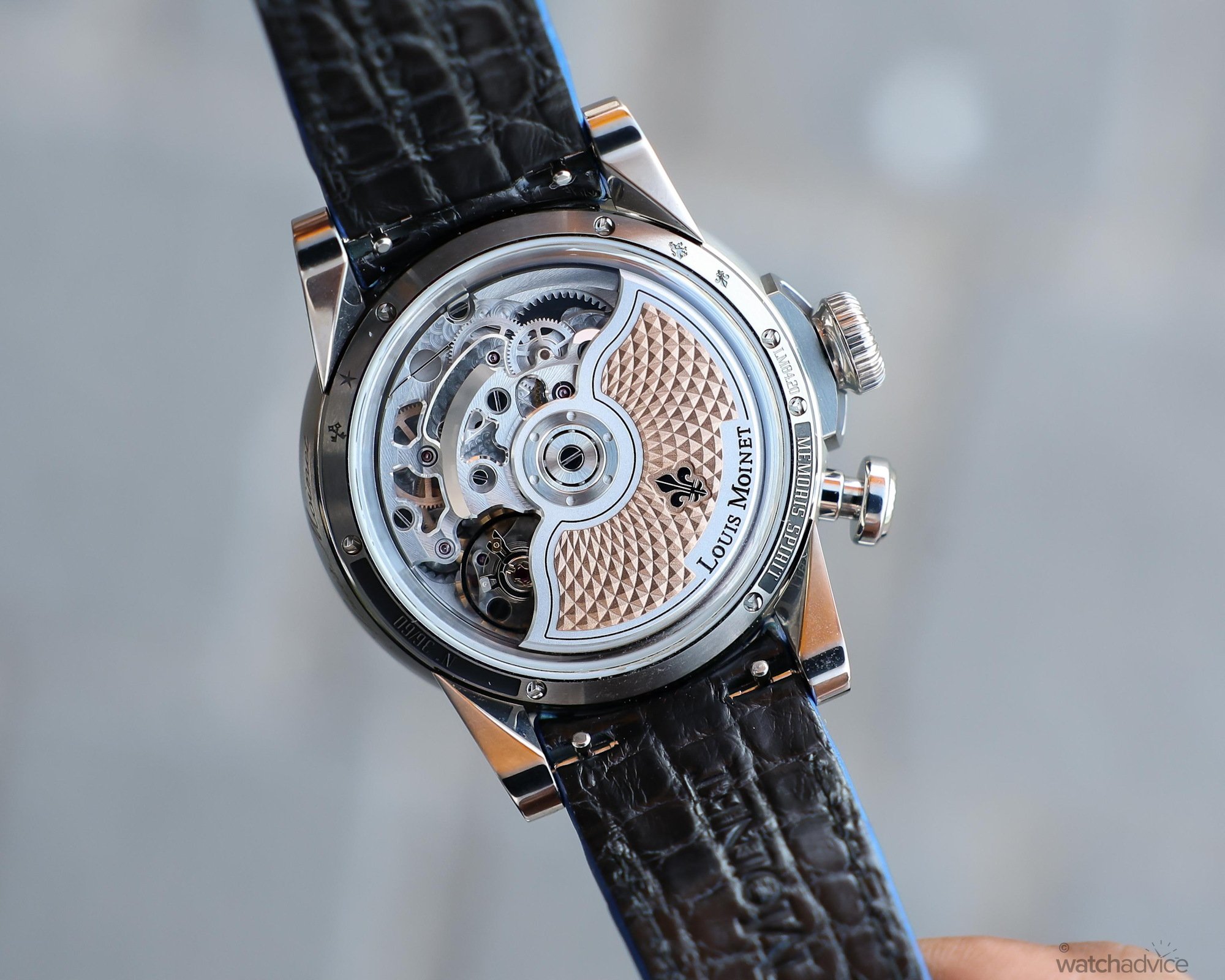
When you turn the watch over, the winding rotor will immediately catch your attention with its rose-gold-toned geometric guilloché-style decoration, contrasting beautifully with the silver-toned border of the rotor. This repeating pattern gives the rotor plenty of visual detail, while Louis Moinet’s fleur-de-lys emblem, as well as the brand’s name, provide distinctive finishing touches.
Another detail I liked was the circular recesses around the rotor’s central hub. To me, they resemble positions for screws, further reinforcing the industrial-like design seen elsewhere throughout the watch. Then, beneath the rotor, we have the overlapping perlage, brushed finishes, and polished details, which give you more to admire, with the visible wheels and balance providing another view of the movement’s mechanics.
How Does The Louis Moinet Memoris Spirit Wear?
With a 40.7mm case diameter and an approximate lug-to-lug measurement of 48.6mm, the Memoris Spirit sits right at the edges of my 16cm wrist. I feel that if the lug-to-lug measurement were any longer, this model would be too large for me. The leather strap certainly helps make these proportions work, as it slopes down from the lugs instantly and wraps around my wrist to provide a snug fit without making the watch look oversized.
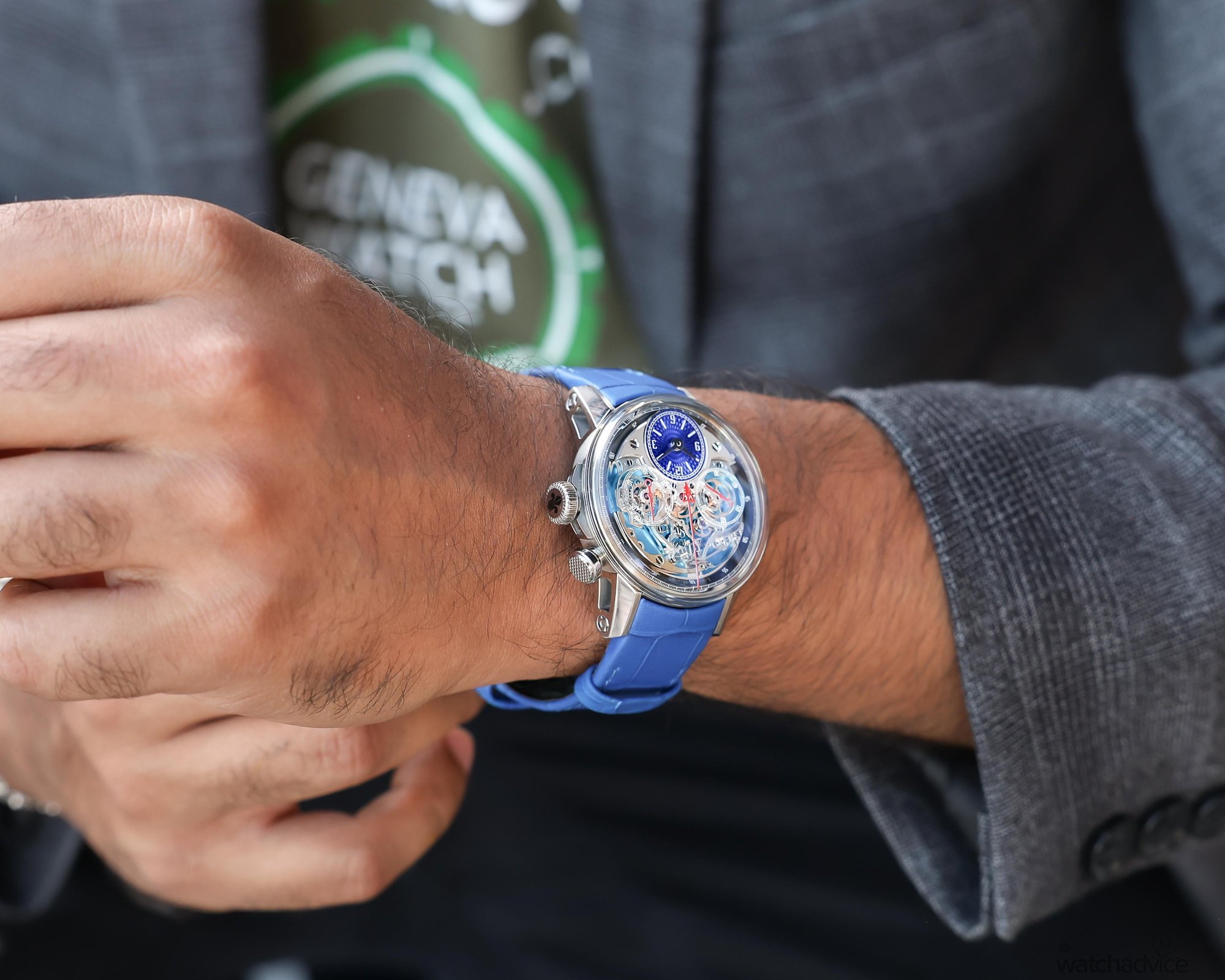
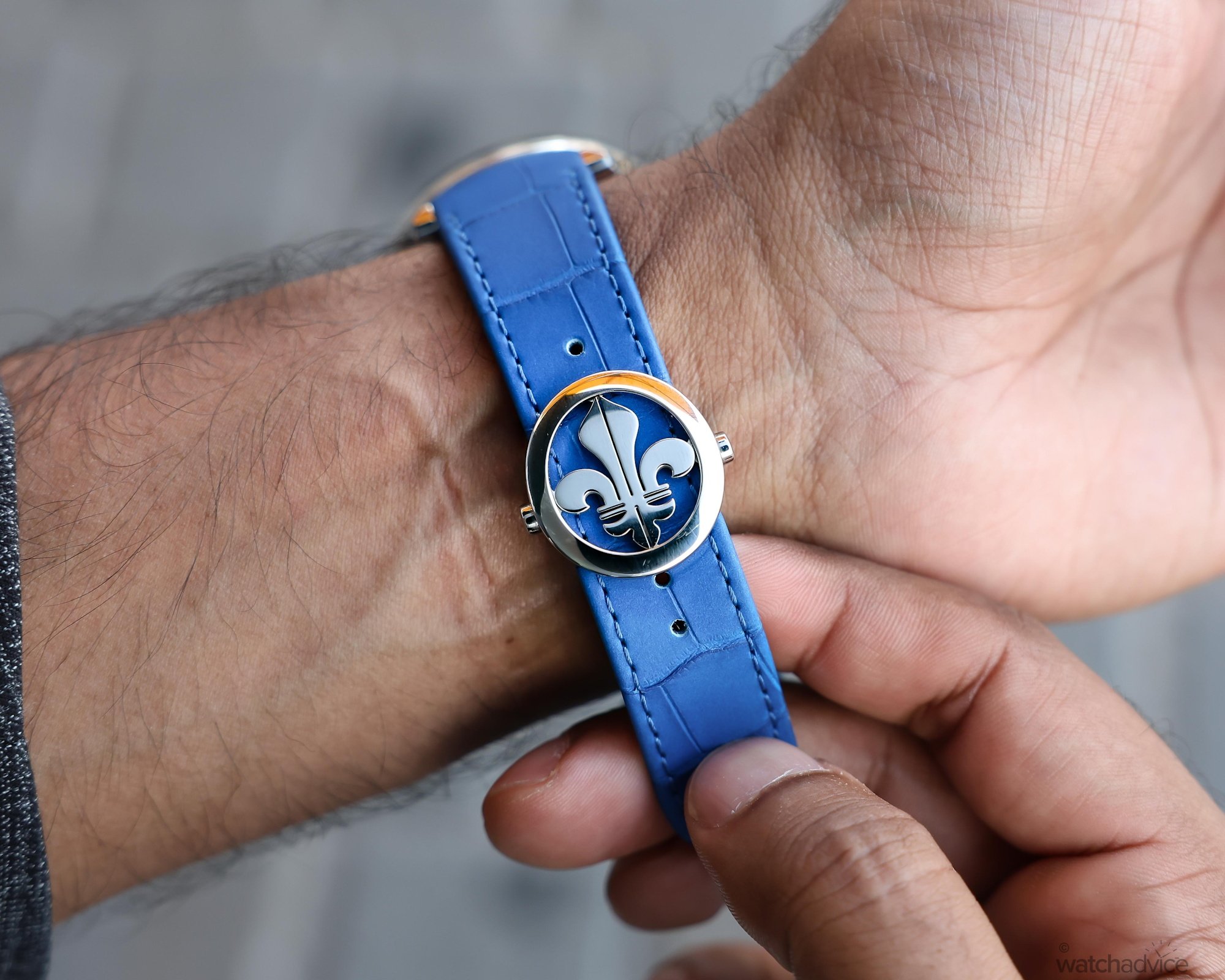
I think if the watch were to feature a bracelet, it could extend further out from the lugs, which would then push the watch beyond what I would comfortably wear, as there would be some overhang on the wrist, especially given how close the lug ends already sit to the edges of my wrist.
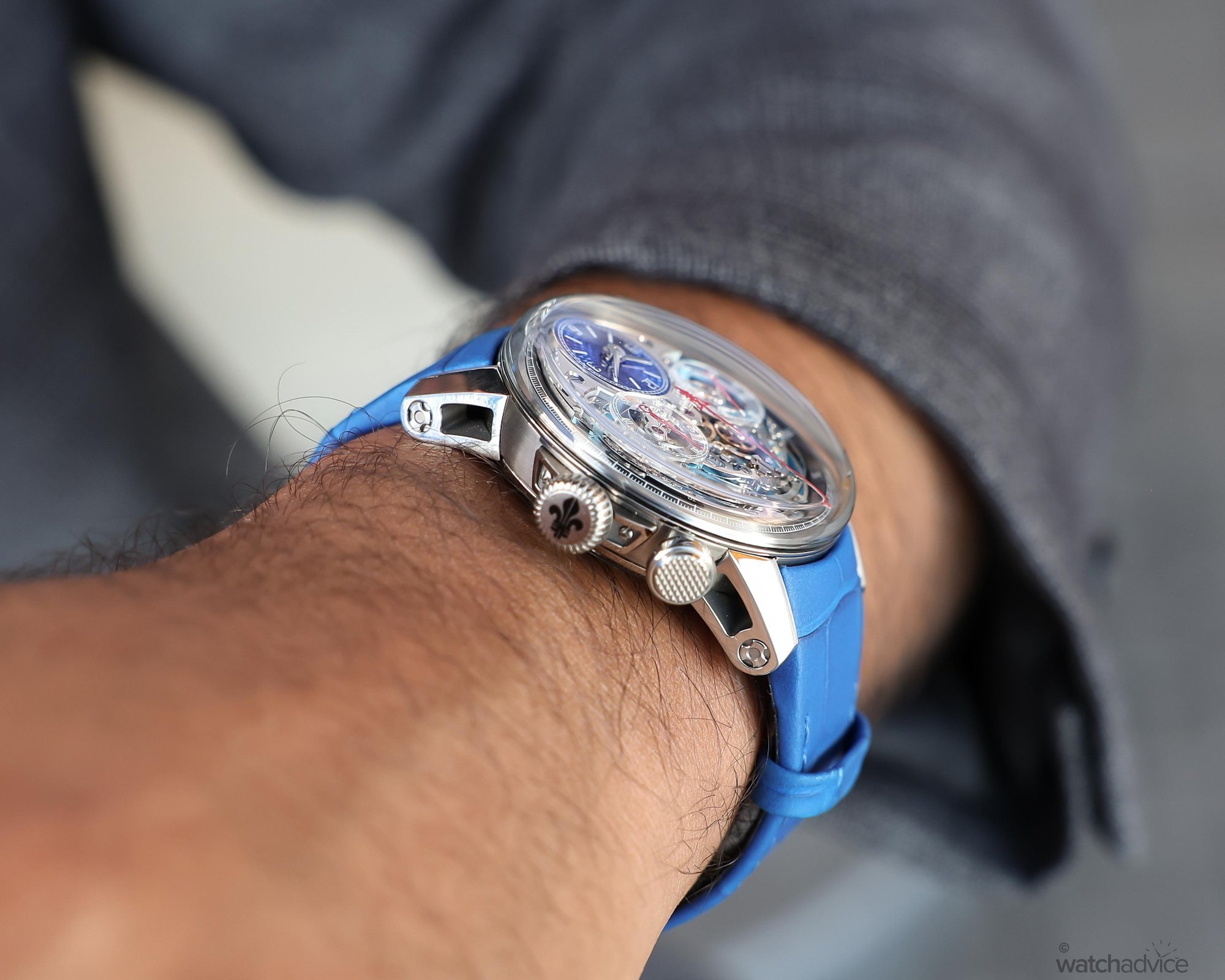
The most noticeable dimension, however, is the approximate 18.1mm thickness. There’s no getting around it: this is a thick watch, and it is one of the drawbacks of the timepiece. The large convex sapphire crystal contributes considerably to that height, which means that the profile looks different from a watch with equally tall, solid metal case sides.
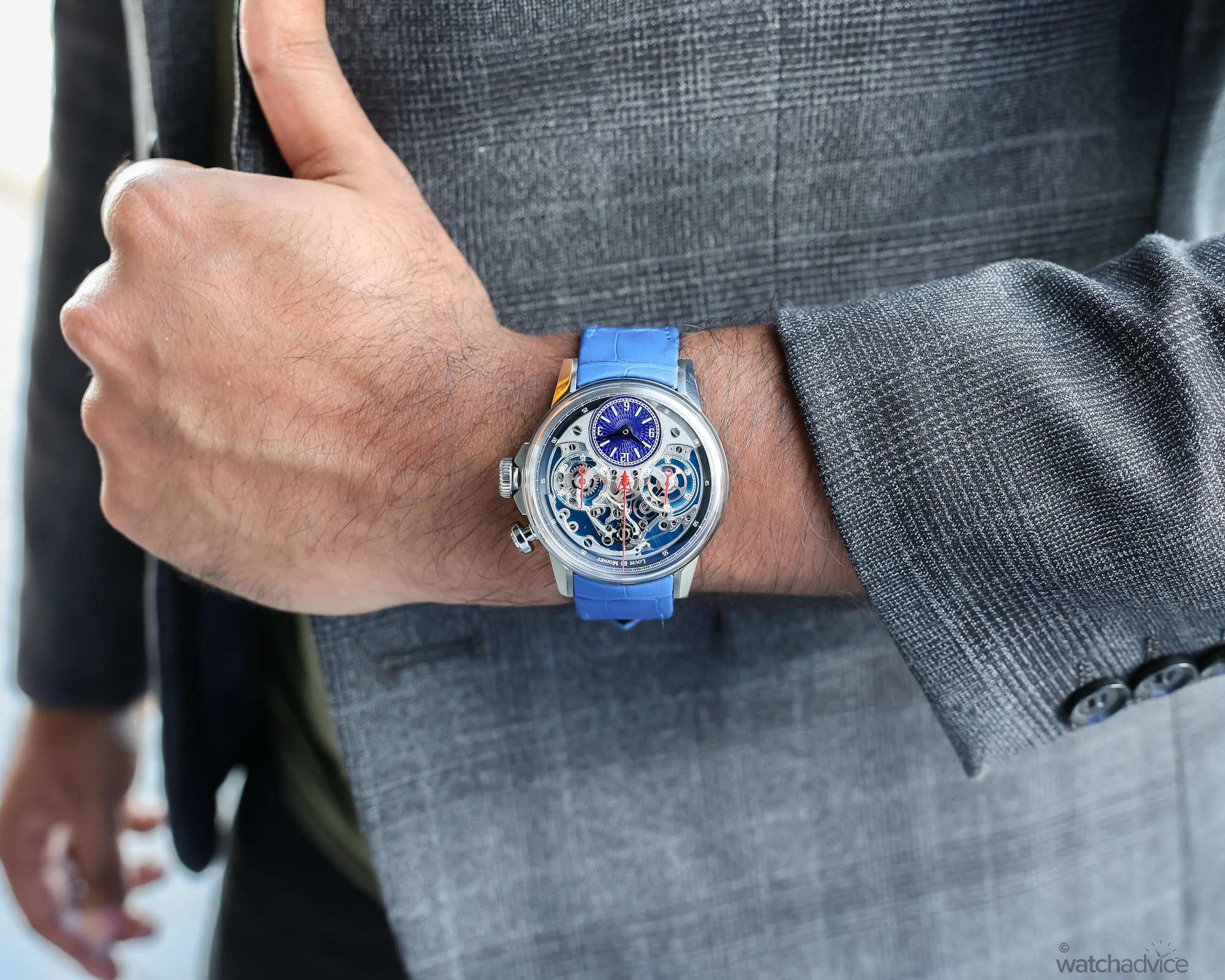
I do expect some bulk from a timepiece with this mechanical complexity, and the layered dial construction is part of the watch’s appeal. In saying that, a thickness closer to 15mm would make it much more appealing. However, despite these proportions, the grade 5 titanium case keeps the watch feeling light on the wrist, making it comfortable to wear for long periods of time. And this, for me, creates an important distinction: the Memoris Spirit is comfortable in terms of weight, but its physical size still places it at the upper limit of what suits my wrist.
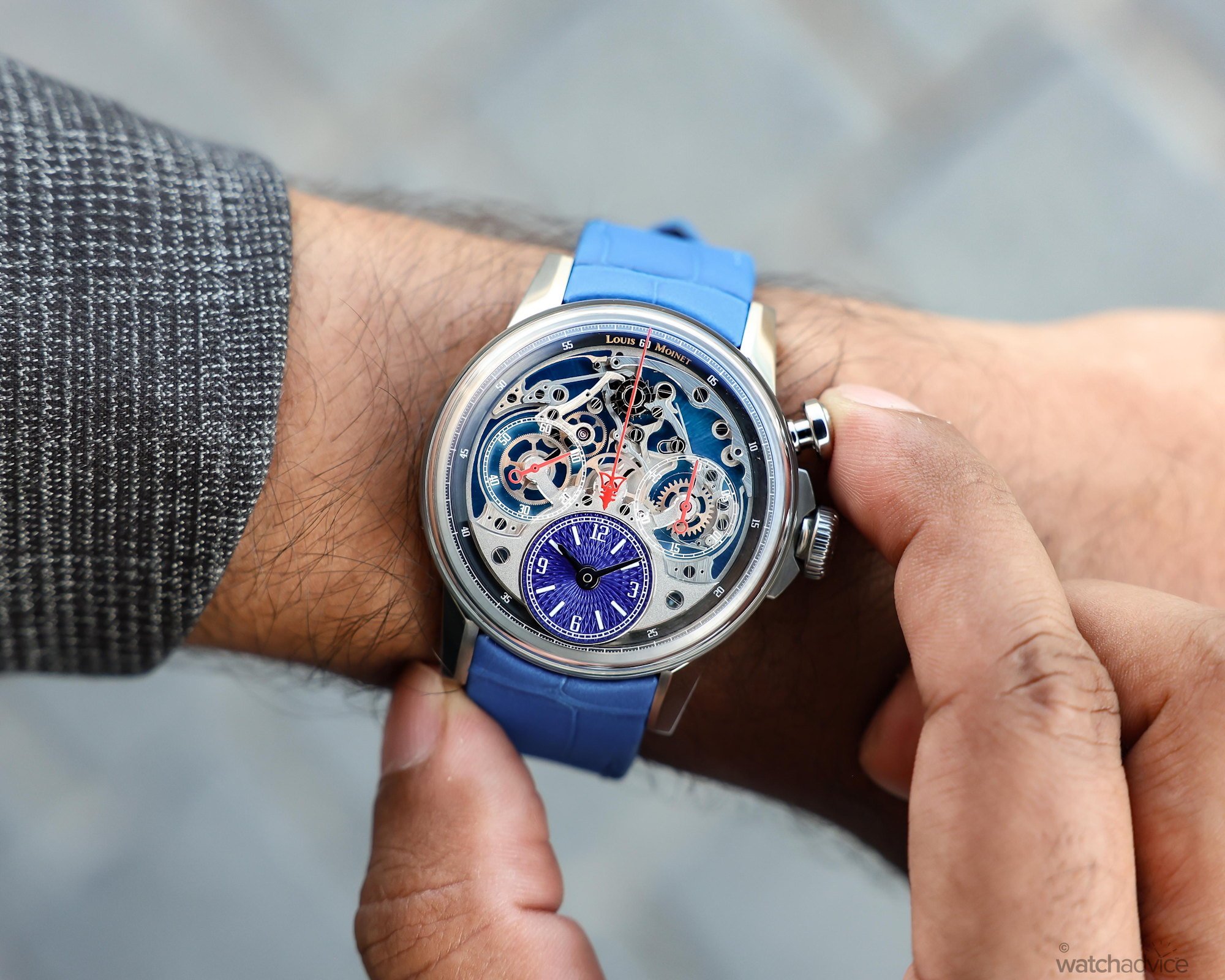
The chronograph was easy to operate, with the single pusher having a large surface area so that even when the watch is worn on the wrist, it’s relatively easy to engage and disengage. The Clous de Paris hobnail surface provides texture beneath the finger, which gives great feedback and helps me engage the pusher with ease. Each press also gives clear feedback through a distinct click, making starting, stopping, and resetting the chronograph a satisfying experience, certainly something you’d expect from a high-end chronograph.
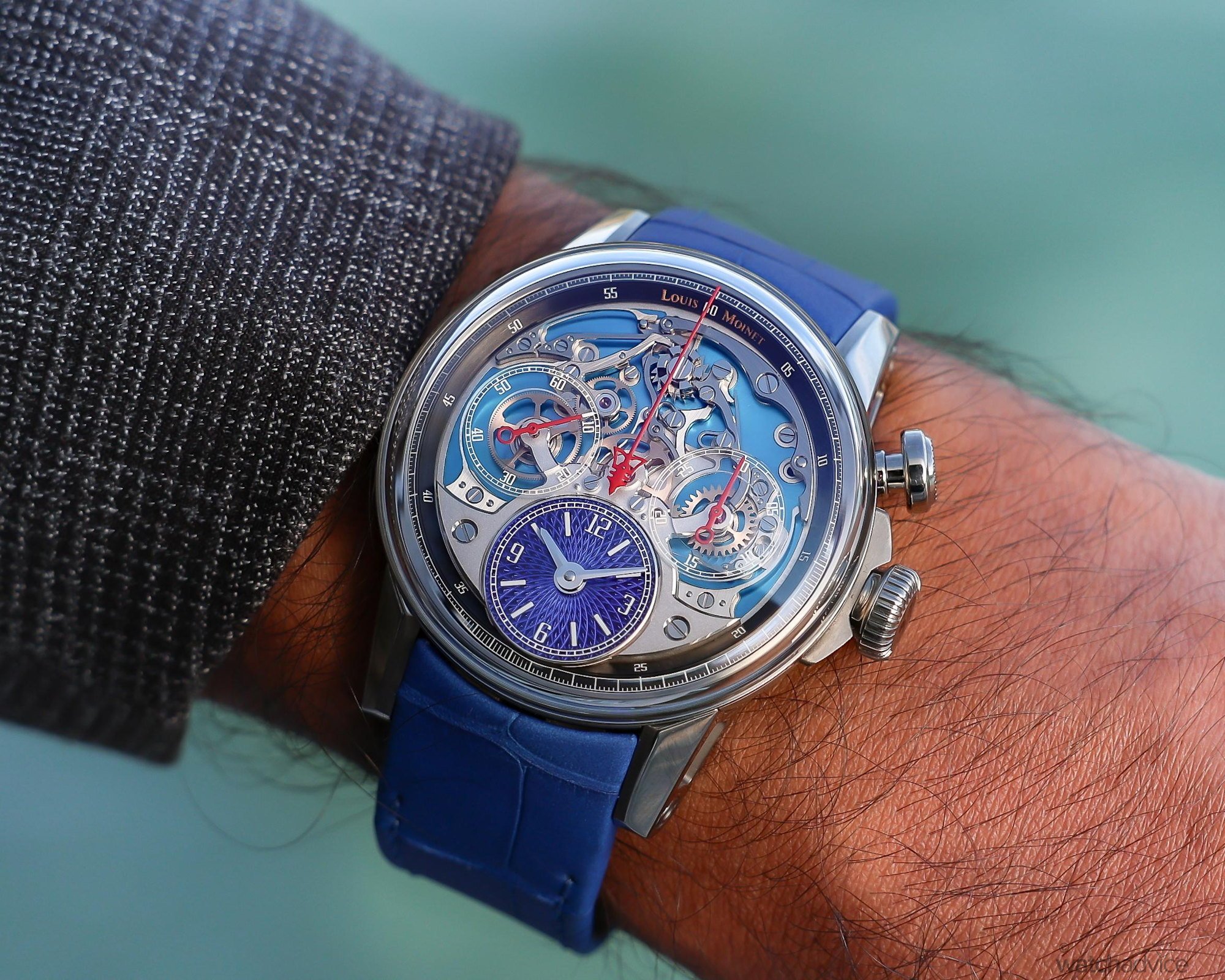
What makes the interaction particularly special is being able to see that mechanism respond immediately from the dial side without having to take the watch off and turn it over. The first time I held this watch in person, I remember clearly just playing with the chronograph and seeing the column wheel engage and the mechanism operate. For someone who loves seeing the mechanics on full display, this is a big part of what makes the Memoris Spirit so rewarding to spend time with!
Aside from the mechanical display of the chronograph, the dial has a lot of visual appeal as well. The transparent counters, deep-blue time dial, and red hands come together beautifully, giving the exposed mechanics colour and a well-balanced display. Due to the proportions of the watch and its extravagant design, I would find it hard to make it a daily-wear timepiece, but I don’t think it was ever designed to be one.
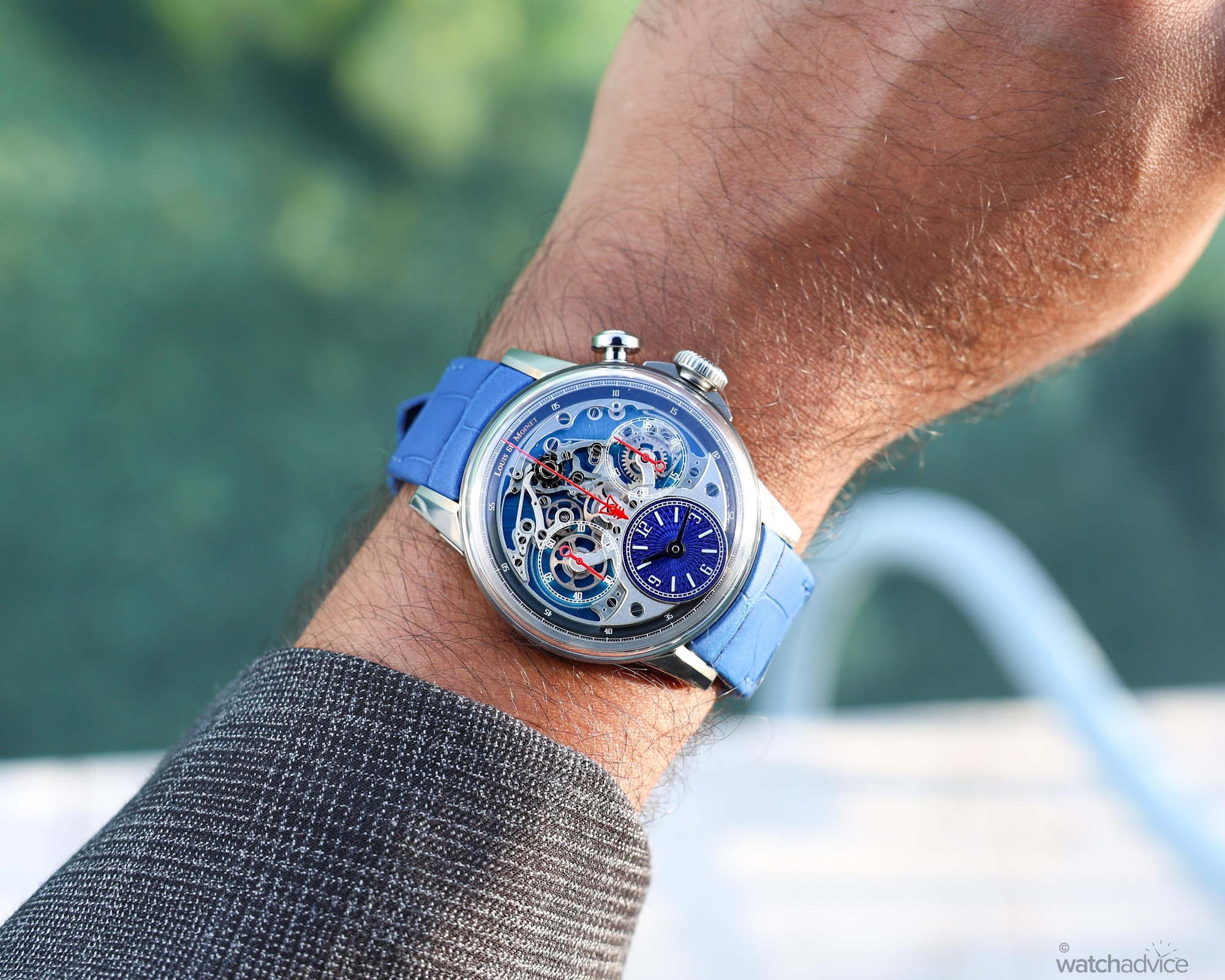
In saying this, however, there aren’t too many skeletonised chronographs on the market that have the same stunning visual appeal as a Louis Moinet. Seeing it on the wrist is already engaging, but pressing the pusher and watching the chronograph work adds something that a static view simply cannot offer. This is where the Memoris Spirit becomes as enjoyable to operate as it is to admire.
Final Thoughts
Having spent time with the Louis Moinet Memoris Spirit, I can say that seeing the chronograph mechanism operate makes it just as enjoyable to use as it is to admire the visual beauty of this timepiece. This was my first hands-on experience with a Louis Moinet watch, and going into this review, I already had a great deal of admiration for the brand. And honestly, this only deepened once I wore the watch.
What I do like about this Louis Moinet is the exposed movement and how well it has been designed so that even though it is a complicated calibre, it doesn’t appear that way on the dial. When you expose the mechanics of a watch, especially a chronograph calibre, it can get quite busy on the dial. However, because of how Louis Moinet has designed the watch, with the chronograph mechanism displayed on the dial side while the rest of the movement sits beneath it, it means that the brand is able to create a well-balanced display that is just beautiful to look at.

One of the highlights of this watch for me was the direct connection between pressing the pusher and watching the column wheel and surrounding components respond. For someone with an engineering background, that interaction makes the craftsmanship feel even more tangible and special.
However, my admiration for the watch doesn’t remove the practical drawbacks: the substantial thickness and lug-to-lug measurement put it at the limit of what I would wear on my 16cm wrist. The lightweight titanium and snug leather strap do, however, help in balancing out the wearability.
While it won’t be an everyday timepiece for me, it would still be a watch that I would love to have in my collection one day. With a beautiful display of openworked mechanics and a balanced design with just the right amount of colour for visual engagement, this Louis Moinet Memoris Spirit is a reminder of why I fell in love with mechanical watchmaking in the first place!
Louis Moinet Memoris Spirit
References & Specifications:
| Feature | Specification |
|---|---|
| References: | LM-84.20.22 |
| Dimensions | 40.7mm diameter × approximately 18.1mm thickness × approximately 48.6mm lug-to-lug* |
| Case Material | Grade 5 titanium with polished and satin-brushed surfaces. Openworked lugs, fluted crown and single chronograph pusher with Clous de Paris decoration |
| Case Back | Sapphire crystal exhibition caseback |
| Dial | Openworked display revealing the chronograph mechanism against a blue background. Deep-blue guilloche-patterned hours-and-minutes subdial at 6 o’clock, running seconds at 9 o’clock and 30-minute chronograph counter at 3 o’clock. Transparent counters with white markings and red hands |
| Crystal | Strongly domed sapphire crystal with anti-reflective treatment on both sides |
| Movement | Automatic calibre LM84 with column-wheel monopusher chronograph; 311 components and 30 jewels. Operating at 4Hz (28,800 vph) |
| Power Reserve | Approximately 48 hours |
| Water Resistance | 50 metres / 5 bar |
| Bracelet | Blue alligator leather strap with folding clasp; 20mm lug width |
Australian Retail Price: AUD $60,500
Availability: Available through Louis Moinet boutiques or authorised retailers (Hardy Brothers in Australia). For more information, please head to Louismoinet.com
Full Image Gallery: