

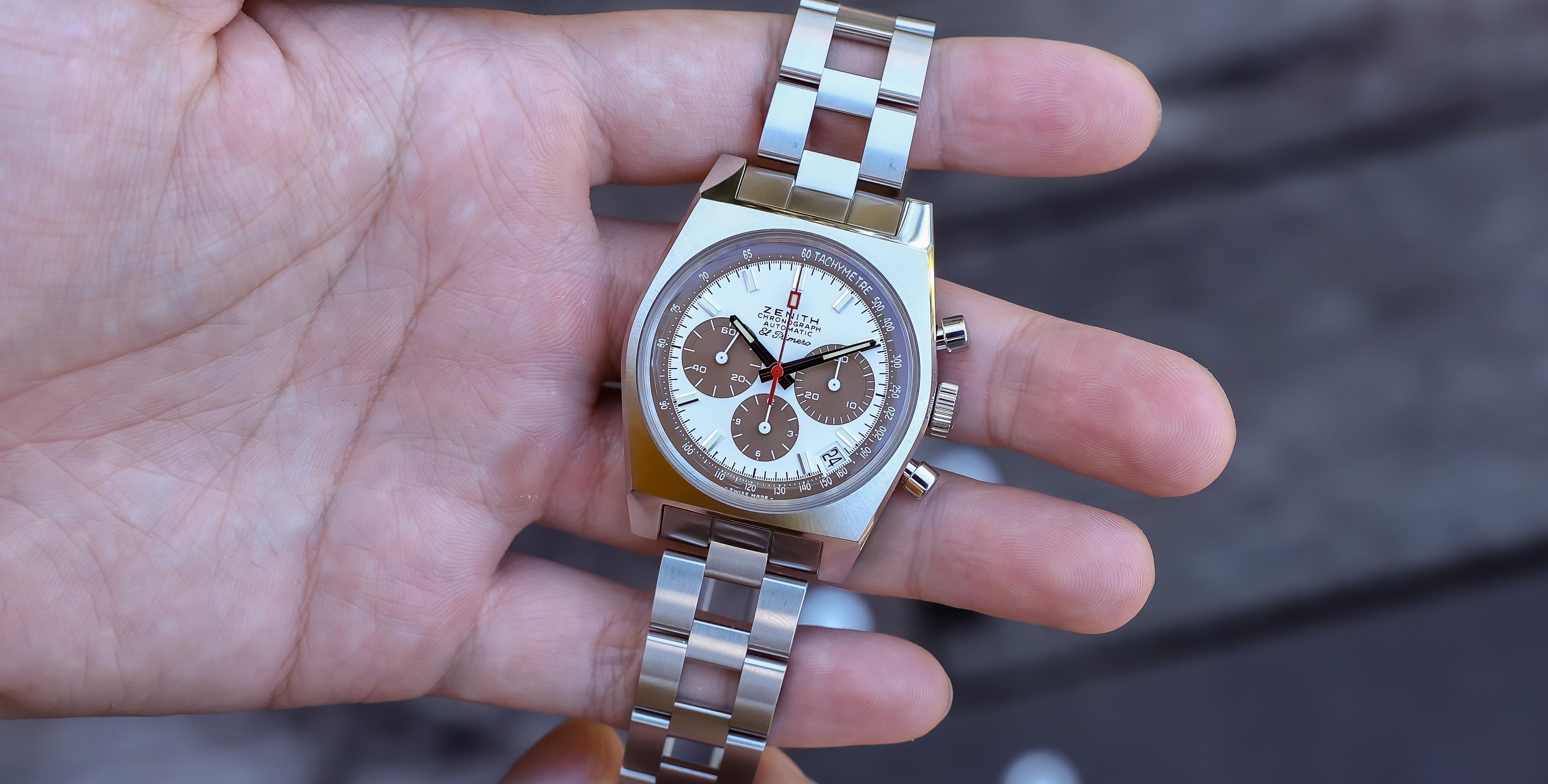
Zenith’s latest addition to the Chronomaster Revival line directly references its heritage models, but can the beauty of age be replicated? Let’s find out!
What We Love:
- Old-world cues in a sepia tone
- Retro yet wearable case profile
- Ladder bracelet perfect for hotter temperatures
What We Don’t:
- Sharp clasp still needs improving
- No hacking seconds
- Be old or look old?
Overall Rating: 7.75/10
- Value for Money: 7.5/10
- Wearability: 8/10
- Design: 8/10
- Build Quality: 7.5/10
Just like us, watches get old. But vintage watches occupy the same space as old cars, Renaissance art, George Clooney and Anne Hathaway, in so far as they’ve aged gracefully. And while everyone wants a piece of that prime beauty, not everyone can get their hands on it.
So too is the case for the original Zenith Ref. A384, first introduced in 1969 as the brand’s first-ever high-beat chronograph. Establishing the foundations for generations of Zenith watches to come, the A384 has since become a legend, rarely seen outside the upper echelons of vintage watch collecting. Getting your hands on one is near-impossible these days, as unfortunately we can’t rewind time to when their price tags was equivalent to peanuts. But what if we could fast-forward?
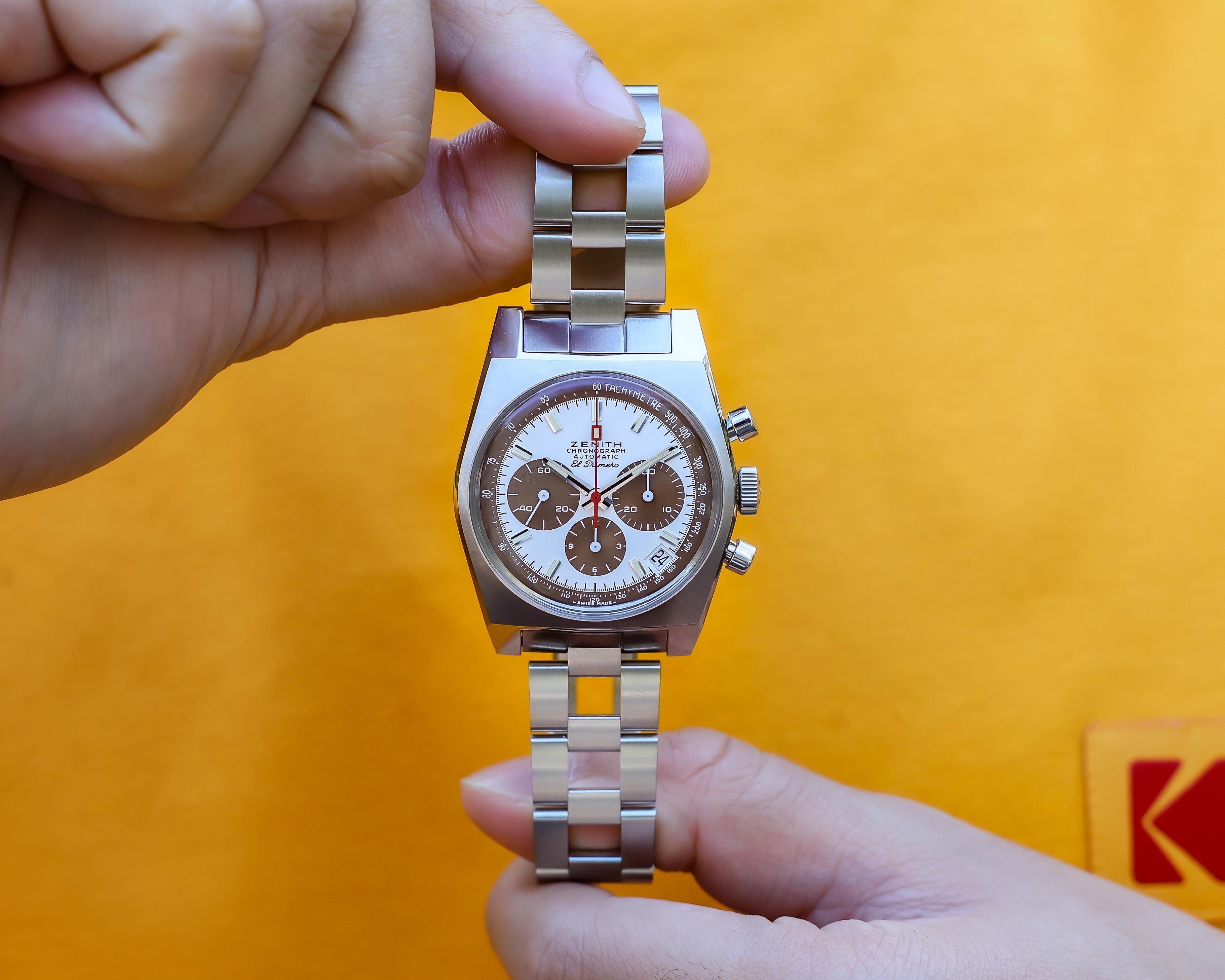
That’s what Zenith asked itself when it introduced the Chronomaster Revival A384 in 2019. The first reference faithfully recreated the original A384 as if it had just rolled off the factory floor, with the iconic ladder bracelet following in 2020. This latest model, on the other hand, introduces a new ‘Tropical’ colourway inspired by the original models’ ageing process. But is it better to be old, or to look old? Well, that’s exactly what I wanted to find out when I was able to take their latest Chronomaster Revival A384 Tropical for a spin.
First Impressions
Contrary to popular belief, I’m not an instantaneous wealth of watch knowledge. Though I can go on the occasional odd rant about whatever interests me horologically, I’m constantly making space in my mind to research as much as I can about whichever timepiece is in front of me. But when it comes to the Zenith Revival series, I always have fun with it, both in learning and relearning its heritage as I spend time with each reference.
Interestingly, the love for this particular Revival collection is one that spans years at Watch Advice. That’s why you can find two reviews of the Chronomaster Revival Shadow on the site: one written by myself in 2024, and another by Chamath all the way back in 2020. You can also find Chamath’s review of the ladder bracelet Revival A384 from that same year, meaning this is technically the second time our passion for the model line has intersected.
It’s almost as if this review is a spiritual continuation of Chamath’s from six years ago, representing how both the Revival A384 and Watch Advice itself have changed over time. For the latter, you can see it in how our formatting and layout has changed; For the former, it’s found in the aged look of this new offering from Zenith, hearkening back to the original watch’s evolution with time.
The Design
Because we’ve reviewed the Zenith Chronomaster Revival collection dozens of times, I won’t get into the nitty-gritty of what we’ve seen before. I will still introduce these features as we go along, though, so if you’re a big Zenith-head, I appreciate your patience. However, we’ll start where every design evaluation begins: the dial.
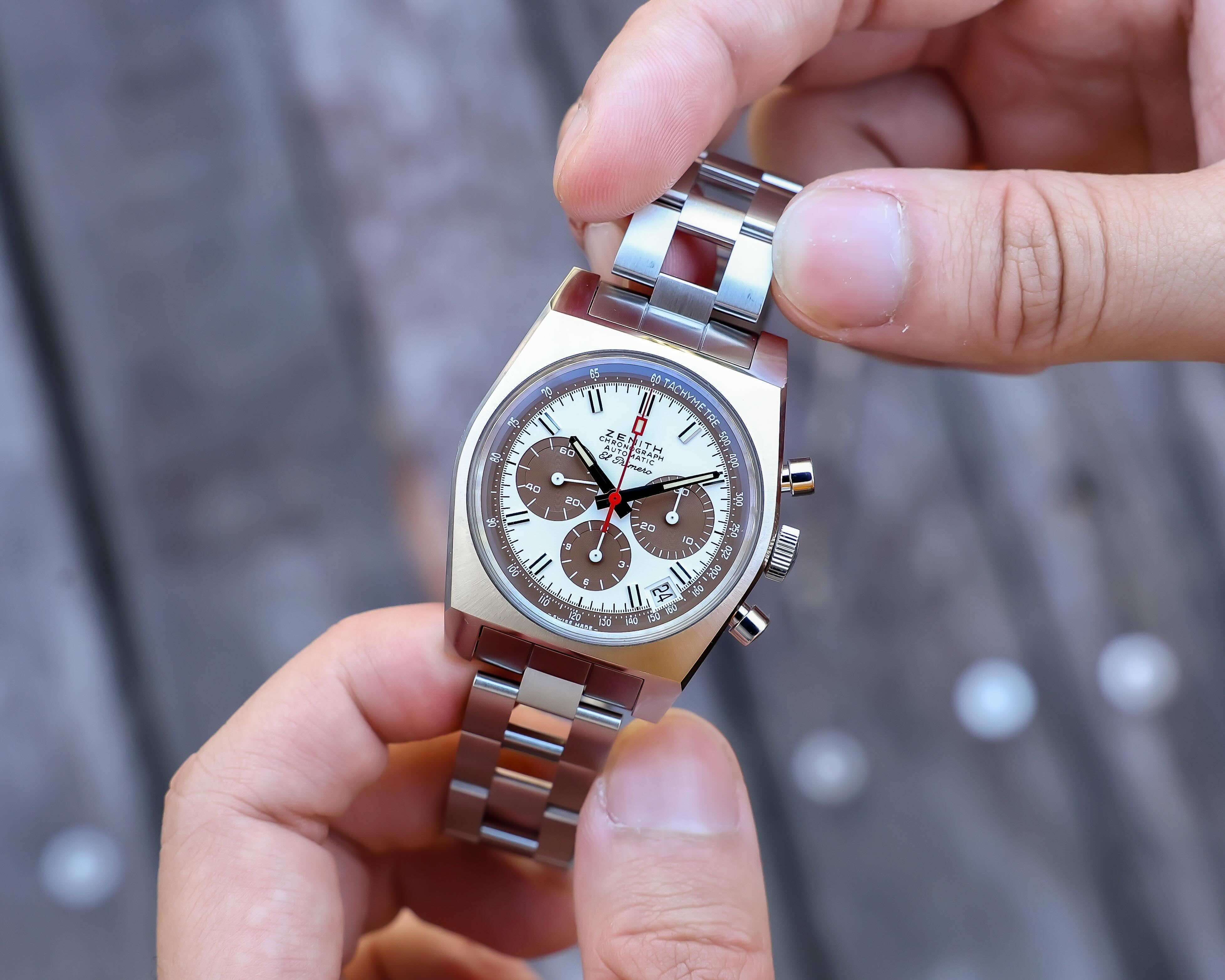
As opposed to the Ref. A384’s original black-and-white panda configuration, which was carried over to subsequent Revival models, the new Chronomaster Revival A384 Tropical uses an off-white dial complemented by shades of dull brown. To understand why Zenith went this route, we first need to understand the concept of a ‘Tropical’ dial.
A naturally occurring phenomenon, tropical dials emerged from an entirely unintentional manufacturing defect in mid-20th-century watchmaking. Manufacturers heavily relied on organic, plant-derived chemical compounds, such as nitrocellulose lacquers and shellac, to coat, colour and protect watch dials from the elements.
But while these finishes were cheaper and more flexible to use, they were highly sensitive to UV light. Over time, they began to degrade, shifting from their original white and black tones to varying shades of amber, brown and caramel. Heat, high humidity and air exposure in warm climates accelerated this process, giving rise to the tropical nickname.
While the idea of your dial degrading and decaying might sound like the ultimate nightmare scenario, tropicalisation was sometimes so severe that it evoked the opposite emotion. Enthusiasts fell in love with the ageing process, but it didn’t take long for watchmakers to catch on to their mistake. Eventually, tropical dials and the chemical compounds responsible for these changes were phased out.
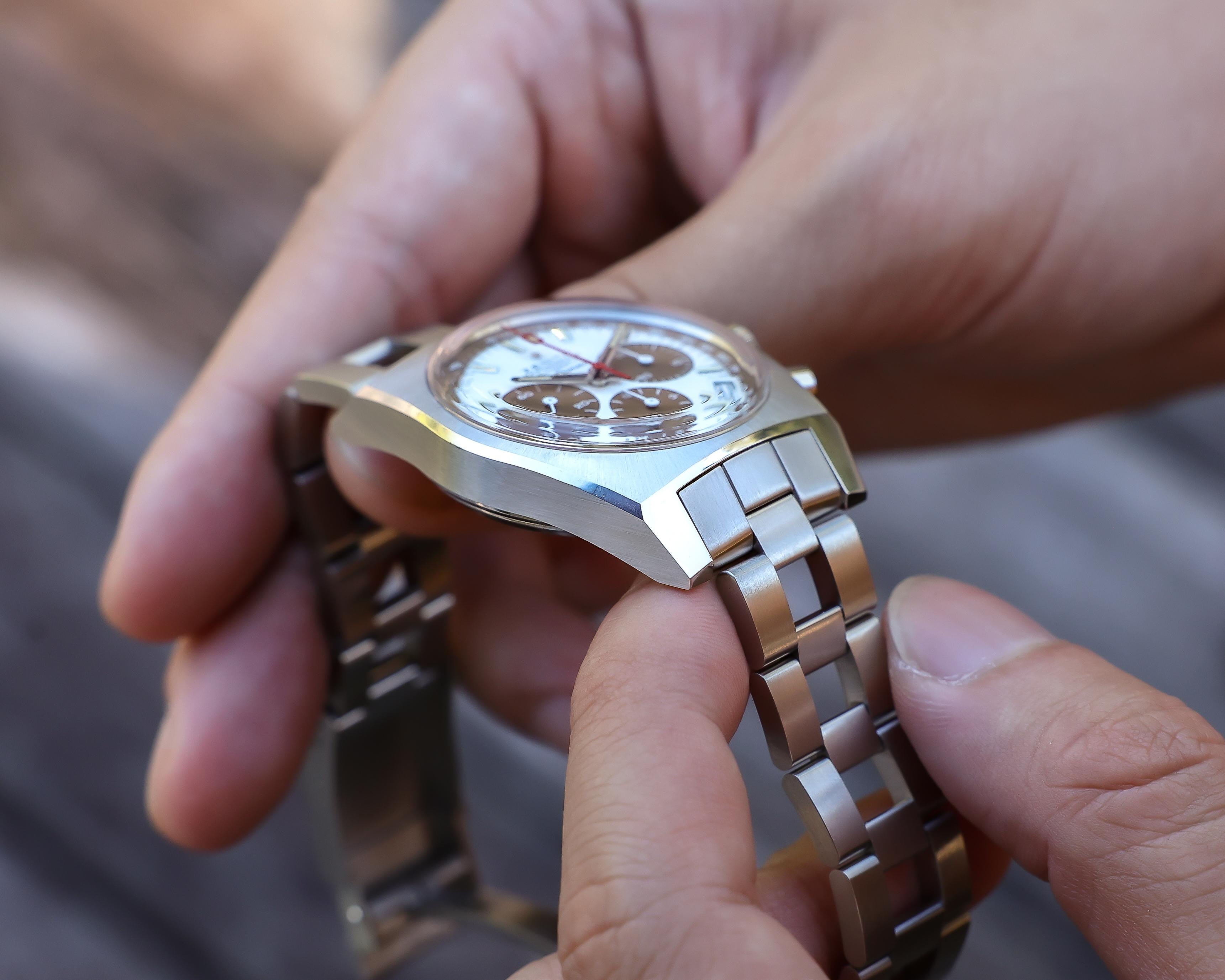
Today, an authentically and uniformly tropical-aged dial is extremely rare, making it a major hallmark of luxury for collectors: evidence of a watch that’s been well-worn and well-lived. The dial of this Zenith Chronomaster Revival A384 hearkens back to that happy accident of the watch world, albeit with more refined compounds and methods that keep its tropical-like finish trapped in time.
The dial’s tones are further complemented by the baton hands and applied indices, all coated in sepia-toned lume. While it’s not a naturally aged dial, it avoids both the inconsistency and exorbitant price point of an original, while offering a warmer contrast to the stark grey of the steel. The only vibrant pop of colour against this muted finish is the bright red chronograph seconds hand, while the white and black printed details provide the branding, designation, tachymeter and minute/second track.
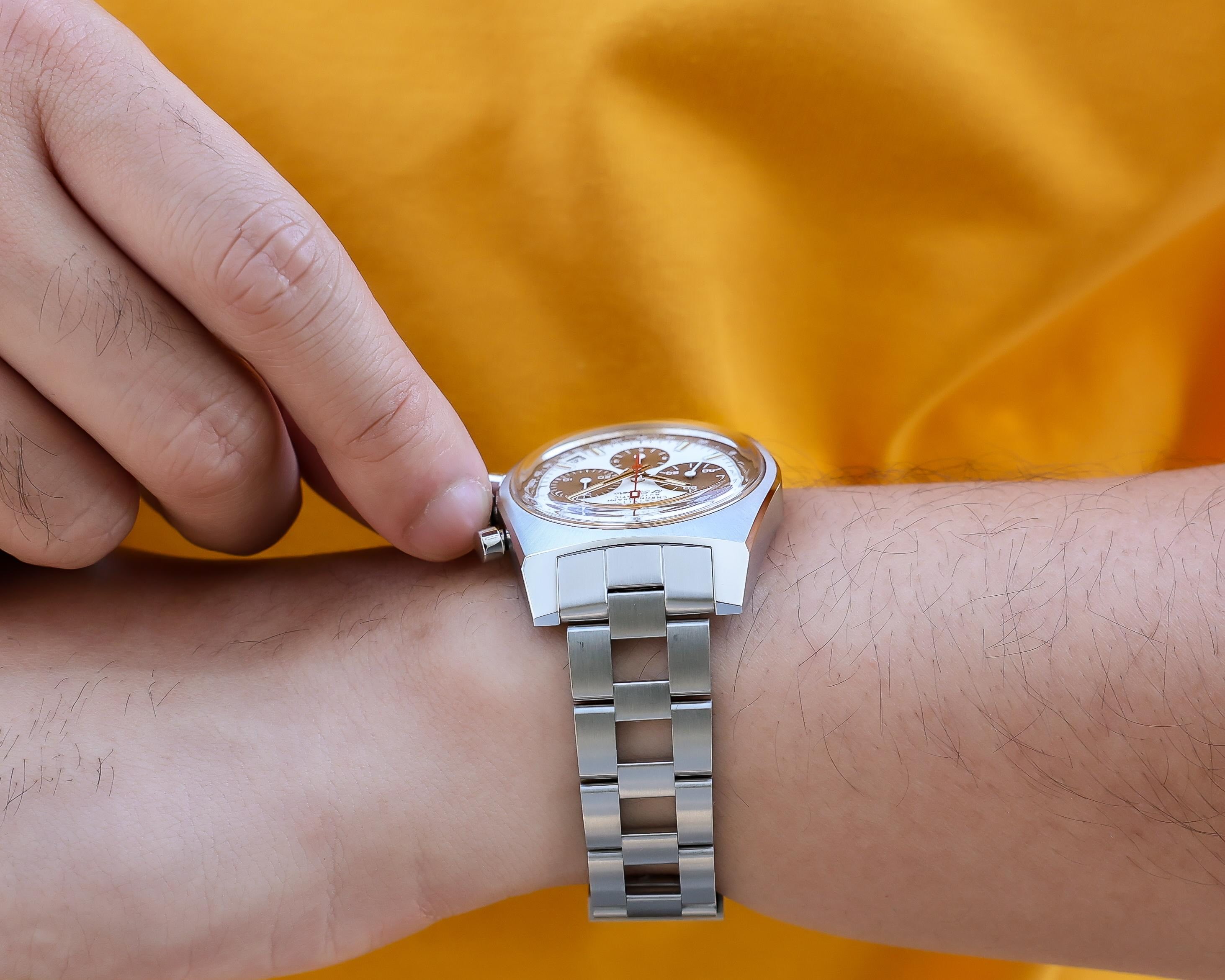
Moving outwards from the dial, there’s no bezel. Instead, a box-shaped sapphire crystal protrudes from the case, bubbling up and above everything else. Though the lack of a bezel, as I mentioned in my Shadow review, can give the impression of “a watch with no eyebrows”, the crystal is subtly stepped to give the watch a better sense of depth and dimensionality.
Speaking of dimensionality, the late-’60s case profile has plenty of it. The design of the Ref. A384 heralded the arrival of the more geometric design principles that would define the 1970s, even beyond the watch world. Just look at cars, for example, where the original watch predates the iconic Lamborghini Countach by two years.
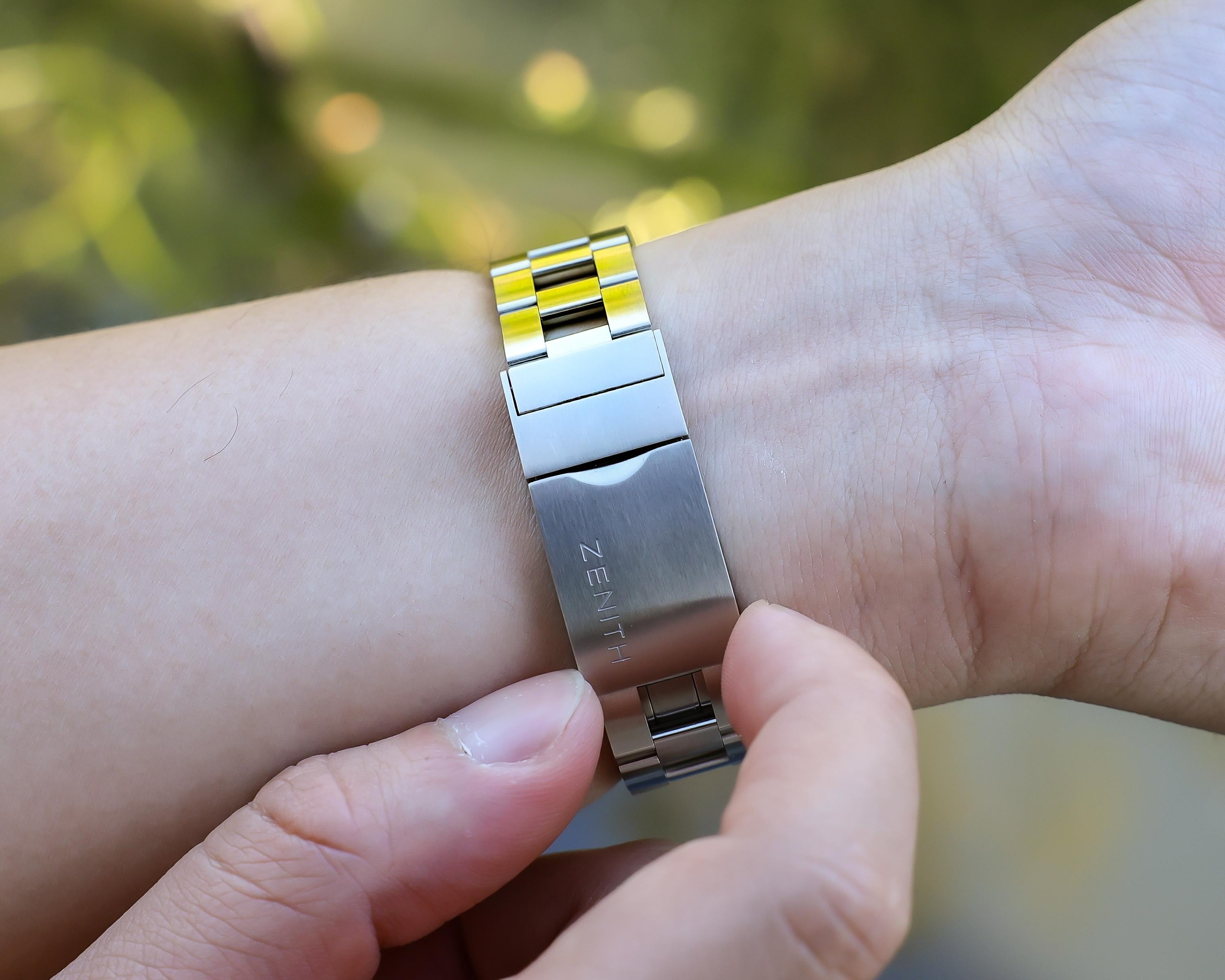
The sharp yet curvaceous tonneau case features a brilliant sunray-brushed upper surface radiating outwards from the dial, while polished chamfers and brushed case flanks accentuate its overall profile. Small piston-style pushers sit alongside the signed crown, while the open caseback features further polishing and the usual serial engravings. Finally, the unmistakable Gay Frères ladder bracelet makes a return, complete with vertical brushing that terminates at Zenith’s classic folding clasp and flip-lock mechanism.
Compared to the first iteration of the Chronomaster Revival A384, this might be my favourite of the two. While the black-and-white panda dial can go with practically anything, the earthier tones of the Tropical dial make it far more welcoming.
Even if you don’t understand the history behind the dial colour, it makes the watch feel less like a luxury product and more like a practical, sentimental timepiece. While technological advancements will preserve the colour for far longer than on its older counterparts, the result is a measured and respectful approach to manufactured nostalgia, preserving the heritage of the original without making a spectacle of it.
How It Wears
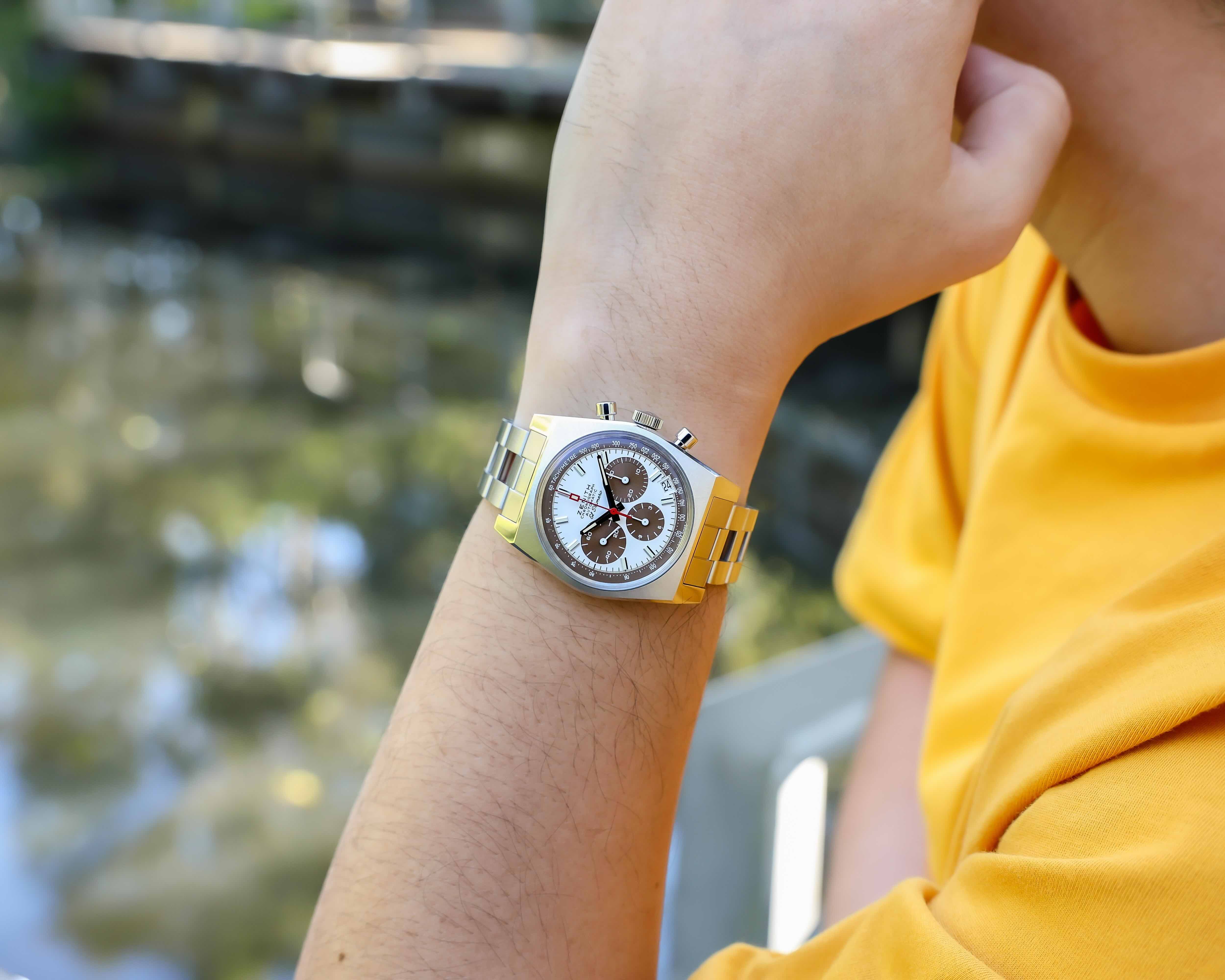
At 37mm in case diameter, 47mm lug-to-lug and 12.6mm thick, the Zenith Chronomaster Revival obviously doesn’t reinvent the wheel compared to its peers. However, it remains a compelling, compact and relatively lightweight offering in the chronograph category. Much of this can be attributed to its unique case shape, which is faithfully recreated from the original Ref. A384’s silhouette.
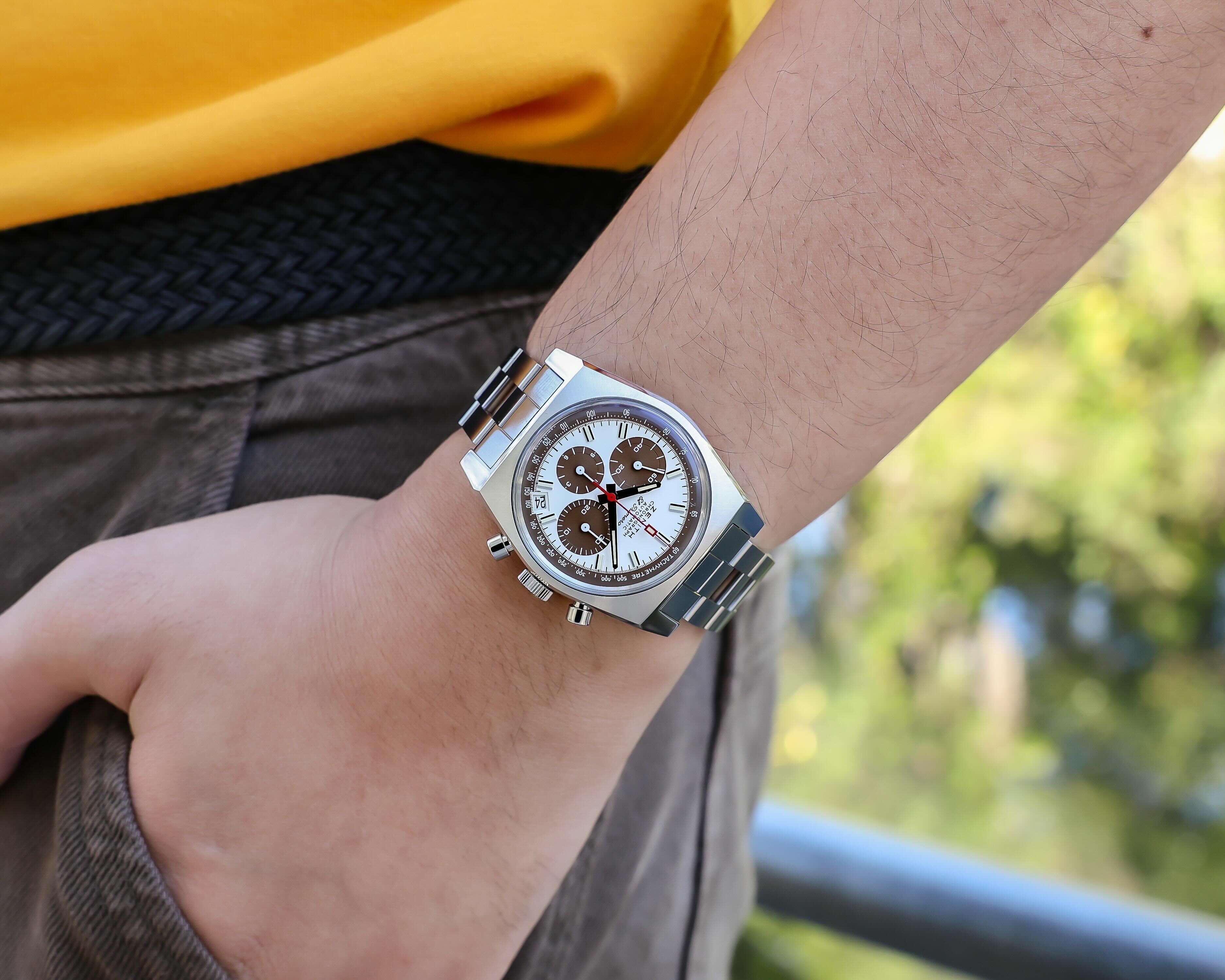
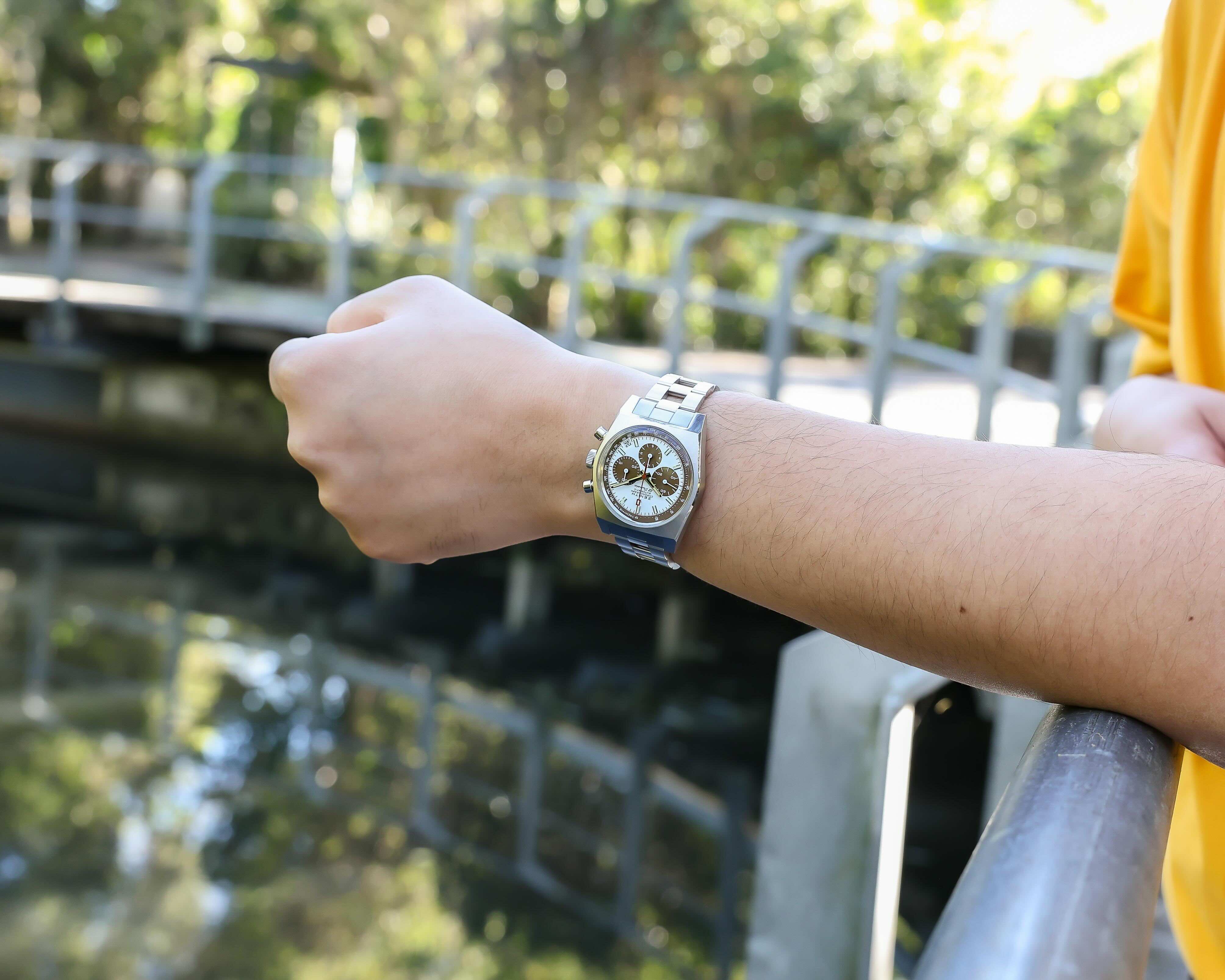
On my 6.4-inch (16.4cm) wrist, the watch wears surprisingly large for its on-paper dimensions, with a presence closer to that of a 39mm TAG Heuer Carrera Glassbox. This makes it a sleek, versatile option for almost any occasion. With water resistance rated to 50 metres, it’s certainly not a daily swimmer, but should prove more than sufficient for the rigours of everyday life above water.
From certain angles, the case profile might look unconventional, but it’s essentially a tonneau-shaped watch with added geometry and intrigue. This is especially apparent in the side profile, where the case rounds away from the crystal and dial, effectively making the display the star attraction.
For a smaller watch, it’s also surprisingly easy to read. One part of the design I didn’t discuss previously is the 4:30 date window, effectively the Turkish Delight of the watch world. Love it or hate it, the placement keeps the date legible, with the added real estate at 4:30 allowing the numerals to stretch to fit the trapezoidal window.
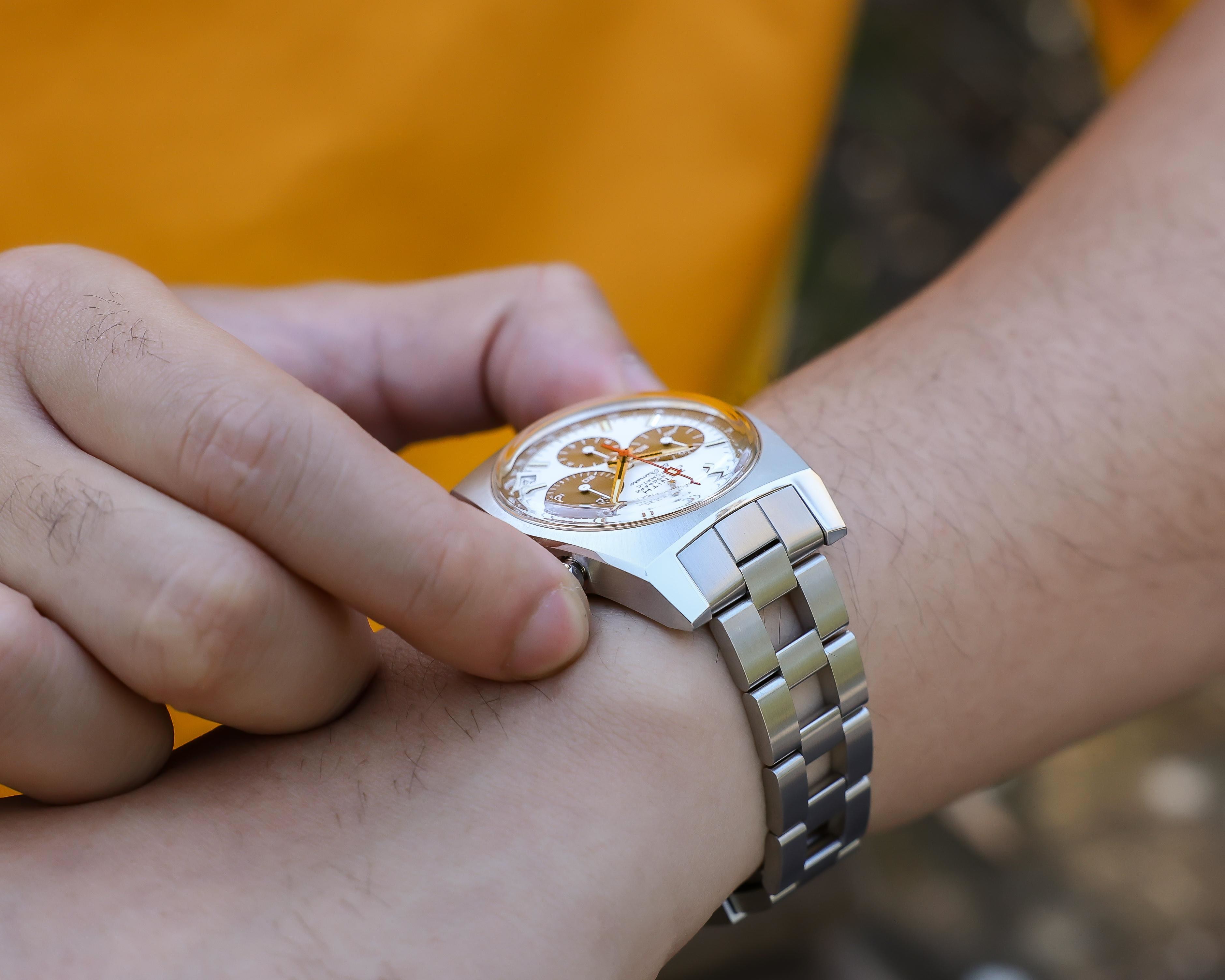
While the Defy Revival Shadow, in my view, earns extra points for its use of titanium, the steel case and bracelet of the Chronomaster Revival A384 Tropical still feel comparatively lightweight. Much of this comes down to the ladder bracelet, which, as always, makes its presence known in the Revival lineup.
As previously mentioned, the bracelet was designed by Gay Frères for Zenith in 1969. Founded by Jean-Pierre Gay and Gaspard Tissot in 1835, the manufacture was to bracelets what Gerald Genta was to watch design, with a portfolio boasting quality endorsements from the likes of Patek Philippe, Audemars Piguet, and even early Rolex.
In any case, the ladder bracelet, featuring alternating openings within a classic H-link design, is a dream to wear. Its reduced weight, combined with enhanced breathability, makes it perfect for hot, humid weather such as that in Queensland. Such an environment further reinforces the tropical narrative, making the Chronomaster Revival A384 Tropical an idyllic companion in summertime.
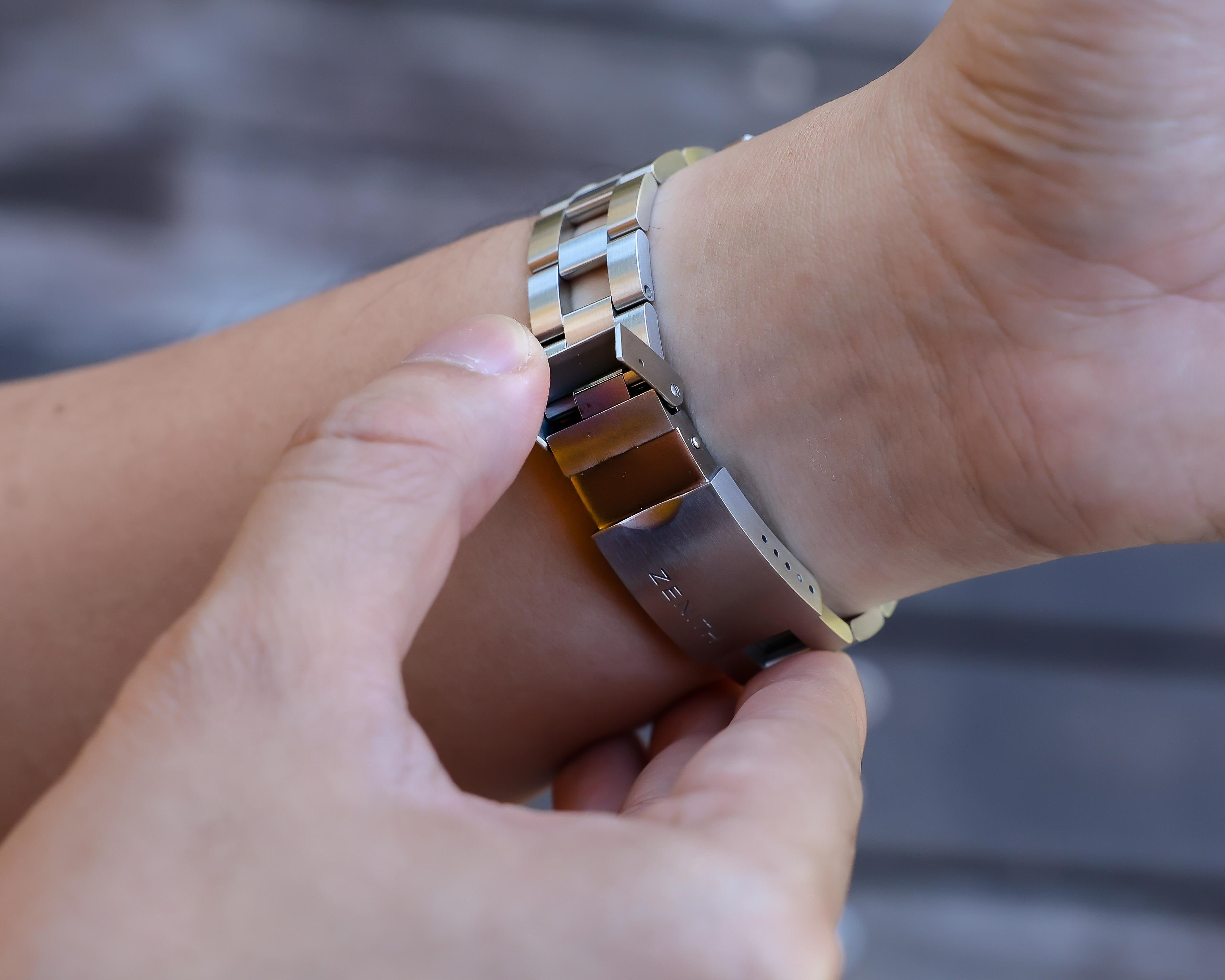
Where it falters, however, is the clasp. While adhering to the original blueprint is all well and good, some things were obviously meant to stay in the past. Over the course of my time with Zenith Revival models, including the Revival A3648 Diver from 2024, I’ve voiced my grievances with the clasp, so I won’t fully rehash them here. Sharp, fiddly, and wanting in refinement, it remains a persistent weak point in an otherwise excellent wearing experience.
I remain hopeful that this will change sooner rather than later. Zenith’s modern lineup has just made huge strides in wearability, particularly with the ZENCLASP introduced at Watches & Wonders and the Chronomaster Solo Sport series. However, given that the ZENCLASP took about three years to develop, we may have to wait a little longer before it makes its way to the Revival collection.
The Movement
As is the case with much of Zenith’s history, the design and wearability are bolstered by a keen eye for movement manufacturing. The Chronomaster Revival A384 Tropical is no exception, using one of Zenith’s most definitive movements in an appropriately old-school package.
Turning the watch around reveals an open caseback, behind which the automatic El Primero Calibre 400 beats. With a 5Hz (36,000VpH) beat rate and a 50-hour power reserve, it’s about as standard as Zenith’s movements come on paper. However, it’s vital to understand why the Cal. 400 was chosen over any other movement in the brand’s repertoire.
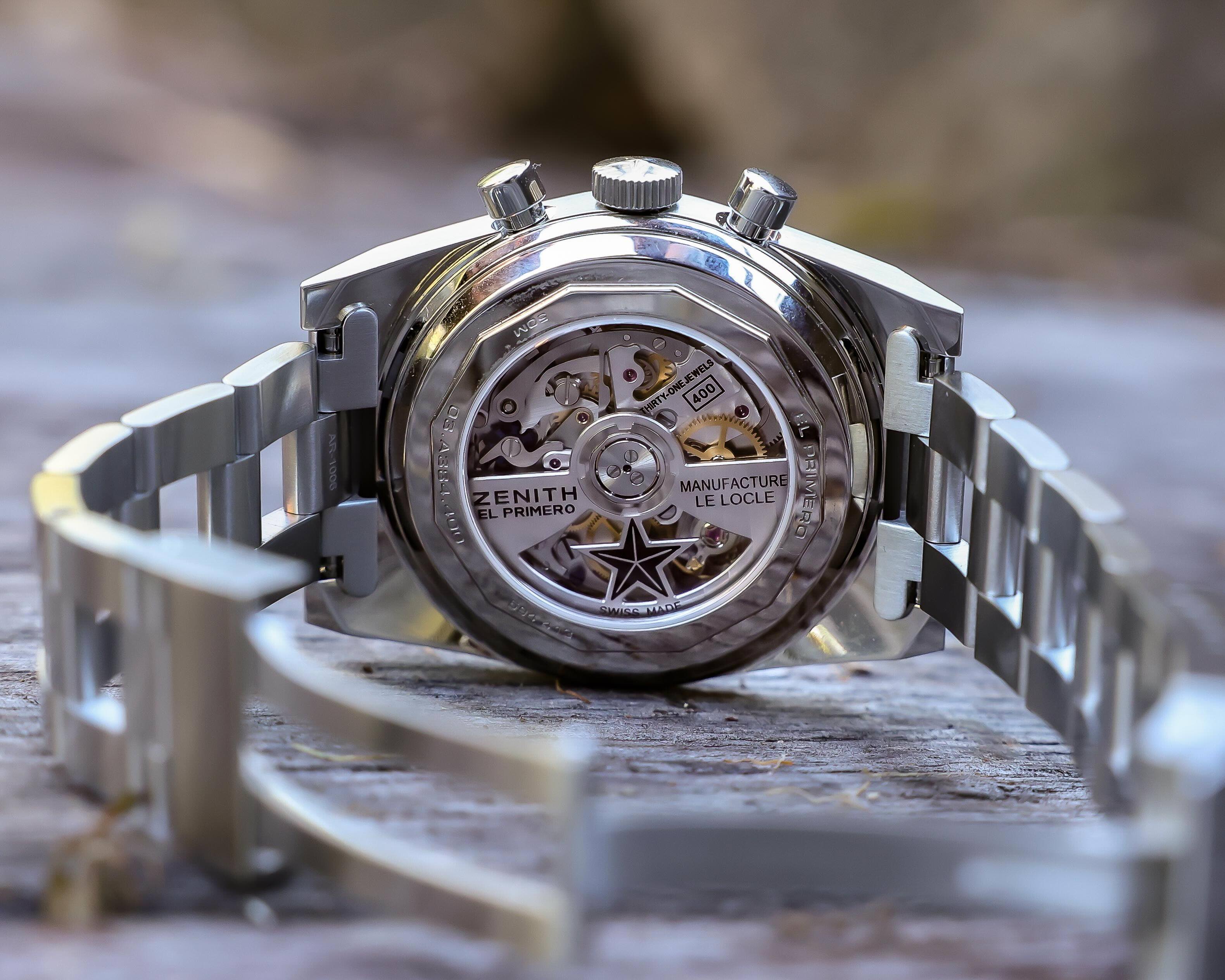
By Zenith’s own admission, the movement is perhaps the latest descendant of the 3019 PHC, the original El Primero movement introduced in 1969. More specifically, the modern Cal. 400 traces its lineage to the tools and blueprints preserved by one Charles Vermot during Zenith’s struggles through the Quartz Crisis. Hidden away in the manufacture’s attic, these materials helped ensure the movement’s survival. While it has been incrementally upgraded over the years, the Cal. 400 remains one of the few chronograph movements in the world to retain such a strong connection to its original DNA.
As iconic as it is within the watch nerd’s vernacular, it certainly doesn’t come without its quirks. For instance, the time and date settings are inverted compared to what we’d typically expect from a modern movement. However, my main gripe is the lack of a hacking seconds hand for the small seconds subdial. As someone who loves syncing his watches to a reference time, the absence of hacking seconds, where the movement stops when setting the time, is a bit of a red flag for me.
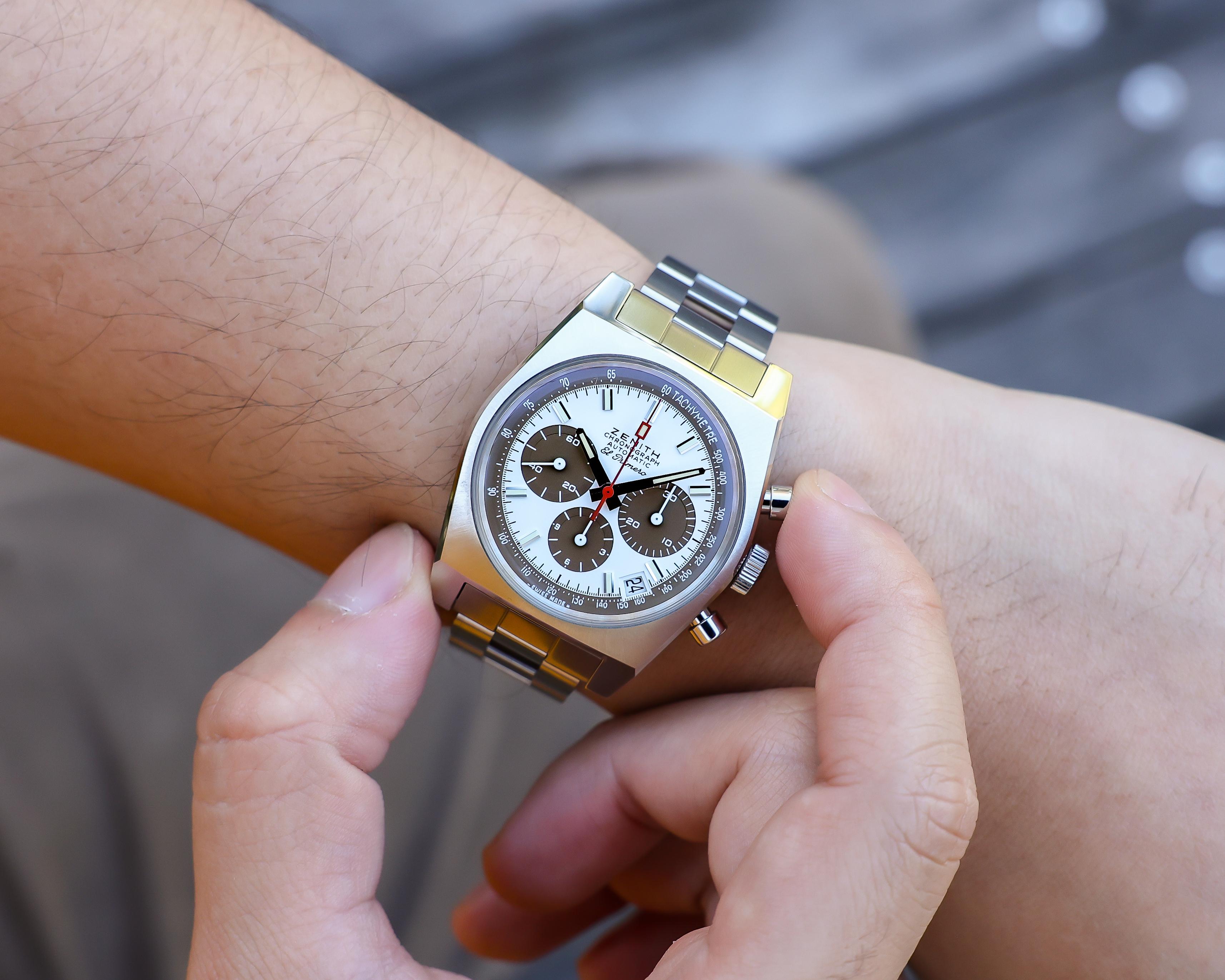
Given the movement’s heritage, though, this omission is understandable. I’m curious whether Zenith will eventually allocate resources to updating it or remain focused on preserving the Cal. 400 as it is. I wouldn’t be surprised either way, as Zenith has made it clear that it’s not above upgrading its movements where necessary; Just look at what they did with the G.F.J. line and its re-engineered Cal. 135. But overall, if you want a capable, handsome and historically significant movement that stays true to its heritage, quirks and all, the El Primero Cal. 400 is definitely up your alley.
Final Thoughts
Nothing is immune to the laws of time, but some watches age gracefully, while others aspire to do so. I believe the Zenith Chronomaster Revival A384 Tropical belongs to the latter category, albeit by association. This is by no means a bad thing; I can’t say the watch itself has ‘aged gracefully’ – this design was only released this year, after all. But in terms of lineage, heritage and the enthusiast’s perspective, it leans into what made the original so beloved without feeling too heavy-handed.
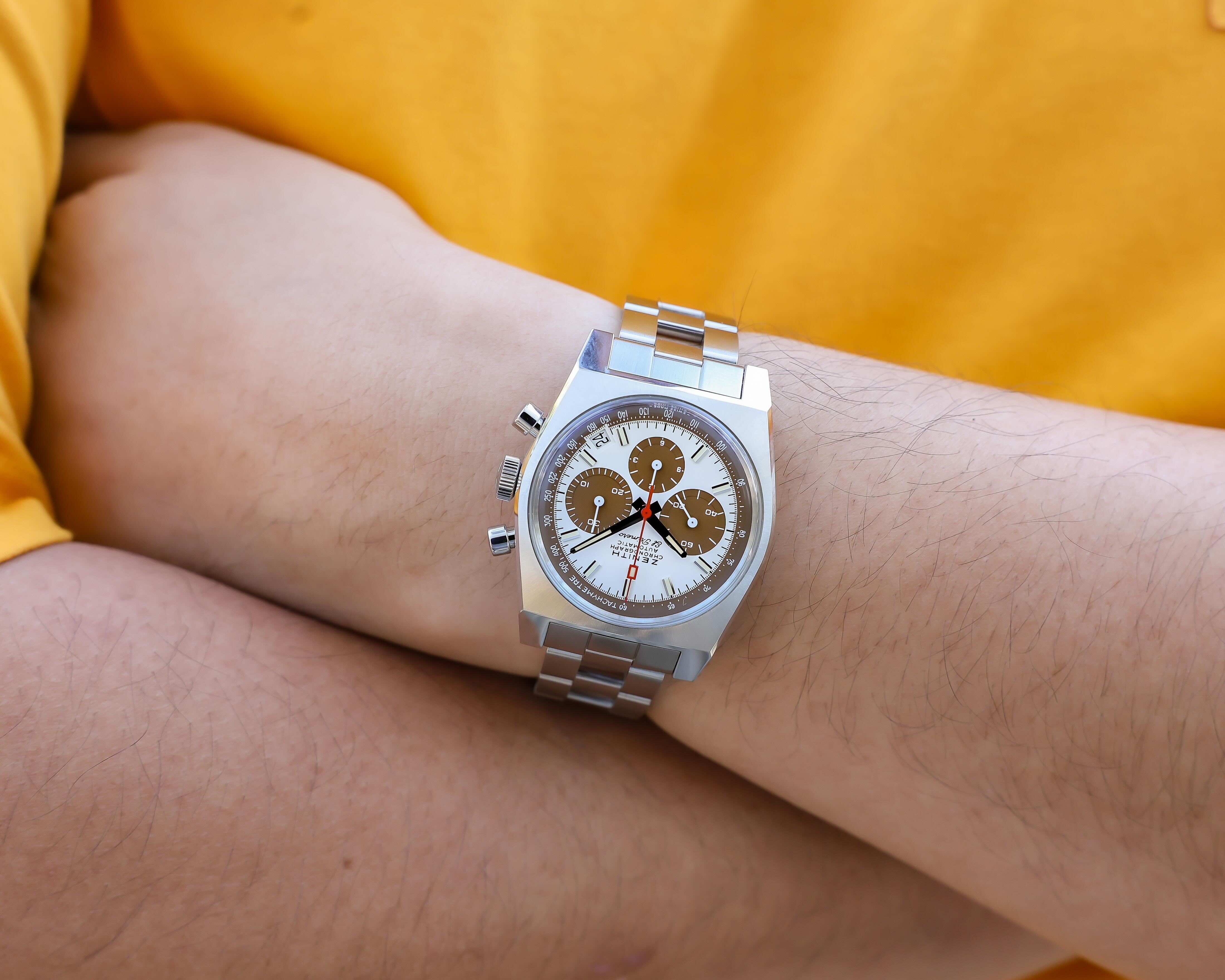
Artificial ageing can often feel disingenuous when taken too far, especially with the growing nostalgia fatigue that the watch world is beginning to face. And though I don’t have a problem with many artificial ageing techniques, such as superficial heat-blistering or intentional distressing, they would have detracted from this design and left me wondering whether I’d be better off leaving a regular watch in a pool of warm, muddy water for a few weeks.
Thankfully, the considered and uniform colourway don’t try to be too in-your-face, which I’m grateful for. The faux-patina lume is enough to signal the heritage inspiration, while the delightfully ’70s silhouette, comfortable wearability and storied movement do the rest of the talking.
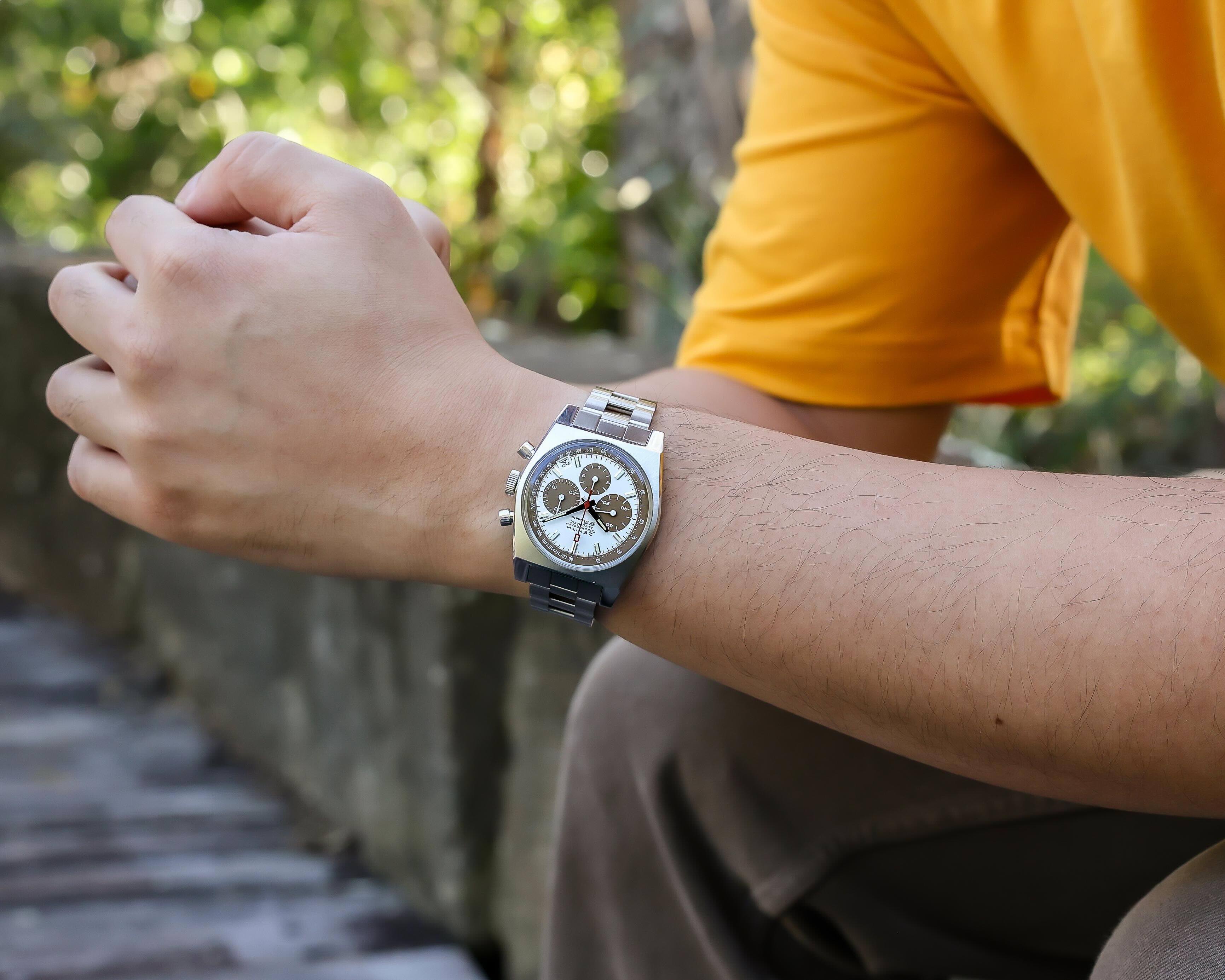
The Zenith Chronomaster Revival A384 Tropical doesn’t ask you to look at it through sepia-coloured glasses, but at AU$15,600, it’s certainly not short on fierce competition. Another industry icon, the TAG Heuer Monaco, comes in at AU$14,050, while just above the Tropical at AU$19,100 sits Zenith’s own present-day darling, the Chronomaster Sport. Both present compelling value propositions.
The Monaco leans into its heritage with its Steve McQueen-inspired dial layout, while its updated Cal. TH20-11 and titanium case offer a thoroughly modern experience. Meanwhile, the Chronomaster Sport remains one of the greatest chronographs of its generation, particularly with its 1/10th-of-a-second chronograph functionality and familiar proportions.
For all their strengths, however, each watch occupies a different place in the industry’s timeline. The Chronomaster Sport belongs to a chapter of its own, while the Monaco has adapted and transformed alongside the industry over time. The Chronomaster Revival A384 Tropical, on the other hand, is its own anachronism, compromising on next to nothing while remaining a compelling and viable option in the chronograph market.
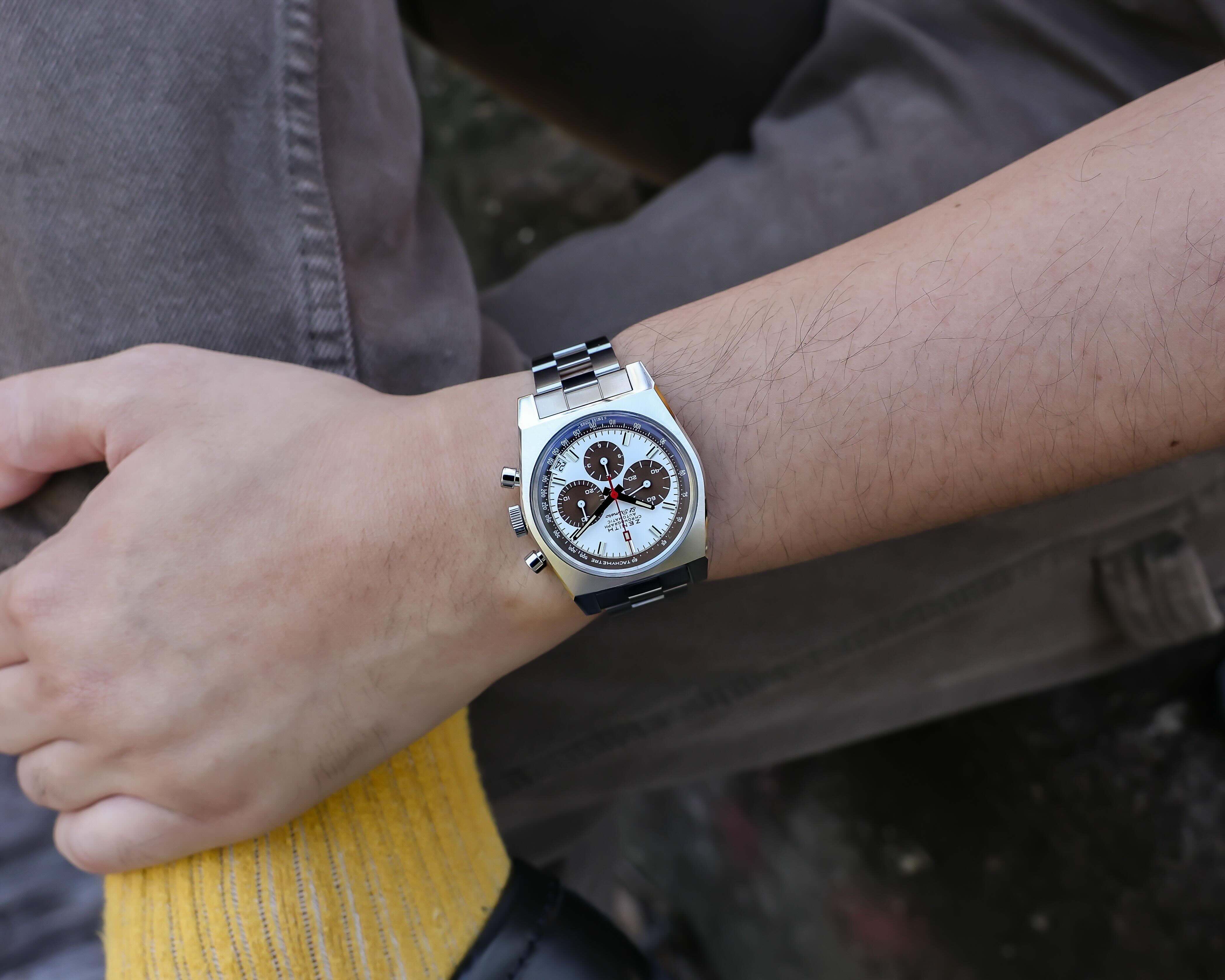
There’s an immutable charm to that – a complete and utter defiance of convention in a rapidly advancing watch industry, in both the good and not-so-good aspects. Such a spirited commitment to its own heritage is perhaps why Zenith fans are such passionate enthusiasts, where a five-second question can easily elicit a 30-minute answer. It also probably explains why we’ve returned to this collection time and again in our reviews.
The Zenith Chronomaster Revival A384 Tropical proves that a watch doesn’t have to look old for old time’s sake. Instead, it uses its aged appearance to invite a closer look into its heritage: A veritable history lesson, all from the comfort of your wrist.
Reference & Specifications
| Feature | Specification |
|---|---|
| Reference | 03.A384.400/69.M384 |
| Dimensions | 37mm case diameter x 47mm lug-to-lug x 12.6mm thickness |
| Case | Stainless steel |
| Dial | Off-white with brown, beige, & red accents |
| Crystal | Sapphire |
| Caseback | Open, sapphire |
| Movement | Automatic El Primero Cal. 400 with chronograph (12h, 30min registers), date, & small seconds complications |
| Power Reserve | 50h |
| Beat Rate | 5Hz / 36,000 VpH |
| Water Resistance | 50m / 5bar |
| Strap/Bracelet | Steel ladder bracelet with folding clasp |
Australian Retail Price: $15,600
Availability: Available now from authorised retailers or online at Zenith-Watches.com
Image Gallery