

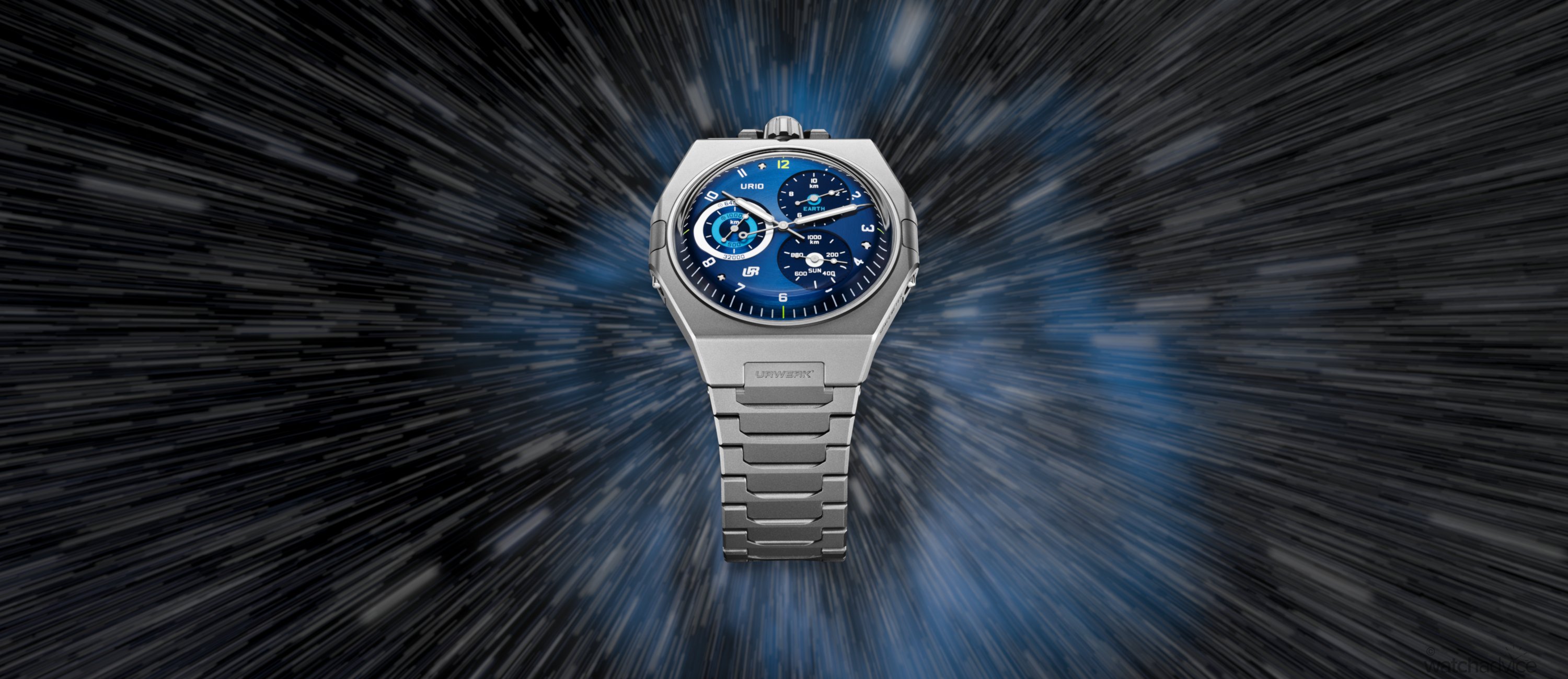
While Urwerk’s UR-10 SpaceMeter was only here for a small amount of time, the brand has still given it one last hurrah with a new version in a blue dial.
If you’re familiar with the world of Urwerk, you’ve probably already got their watches in your mind’s eye. Since their founding in 1997, they’ve been one of the most distinctive haute horlogerie brands, combining a highly conceptual, futuristic aesthetic with refined engineering prowess.

The UR-100 SpaceMeter, initially released last year, was anything but typical. While most Urwerk creations are distinctive in their own ways, the UR-100 SpaceMeter was, by comparison, almost conventional. Centralised hands, a round dial, and concentric sub-dials; to the average watch enthusiast, it still looked quite unique.
Yet to the Urwerk fan, it was highly unusual. It seemed rather simple, perhaps too simple on paper, but as we’ll get into later, it is far more complex than it first appears. Though it has had a relatively short life of just a year across three references, it has been impactful enough for the brand to give it this farewell model in a blue dial.
The Future Is Now
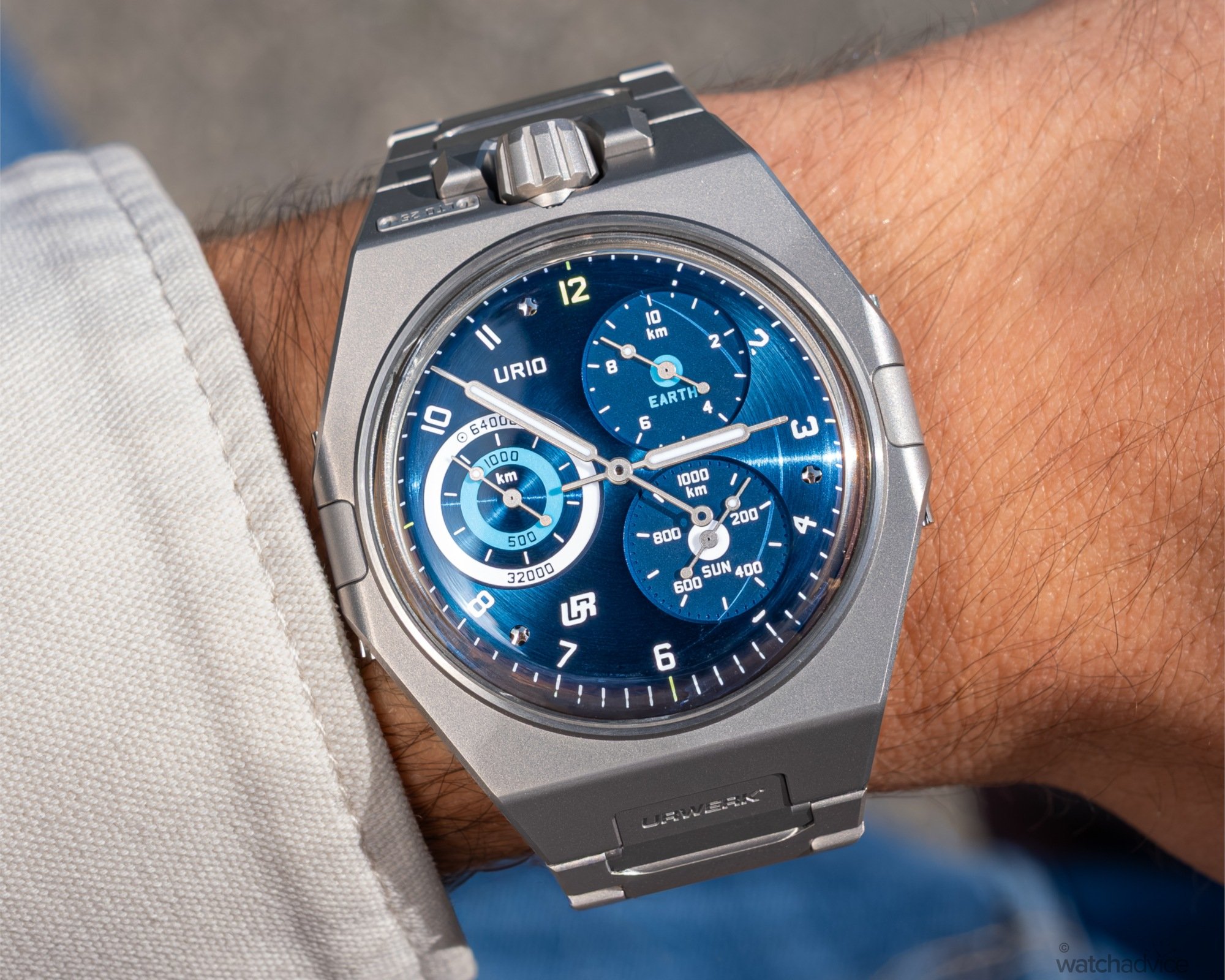
Sized at 45.4mm wide, 44mm long, and 7.13mm thick, the Urwerk UR-100 SpaceMeter is a visually bold yet lightweight timepiece. Combining sandblasted titanium for the upper section with a steel caseback, the watch offers a balanced wearing experience without compromising strength. The lightness of titanium is further enhanced by the ergonomic case design, ensuring the UR-100 wears more comfortably than its dimensions might suggest.

This is especially relevant given the UR-100 is an integrated bracelet watch, which tends to wear larger than a standard piece. Set in titanium, the bracelet tapers elegantly to a butterfly clasp. While some may raise eyebrows at the absence of modern micro-adjustability, the bracelet’s lightweight construction and tightly packed links allow it to conform naturally around the wrist.
Out Of This World
The design of the UR-100 SpaceMeter Blue is primarily informed by co-founder Felix Baumgartner’s past. Describing the UR-100 as an “instrument of cosmic awareness”, the watch draws inspiration from an antique clock with astronomical indications restored by Baumgartner’s father.
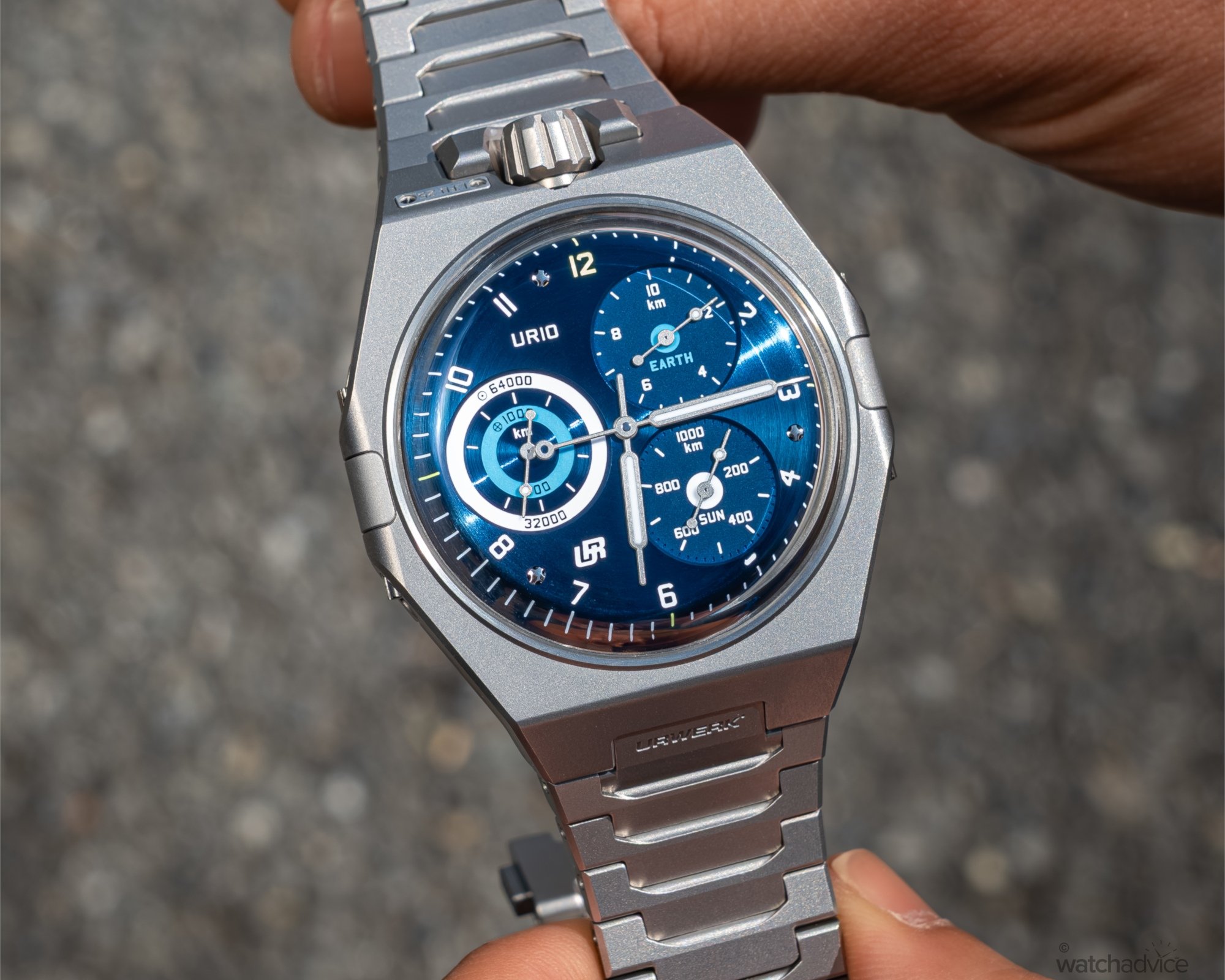
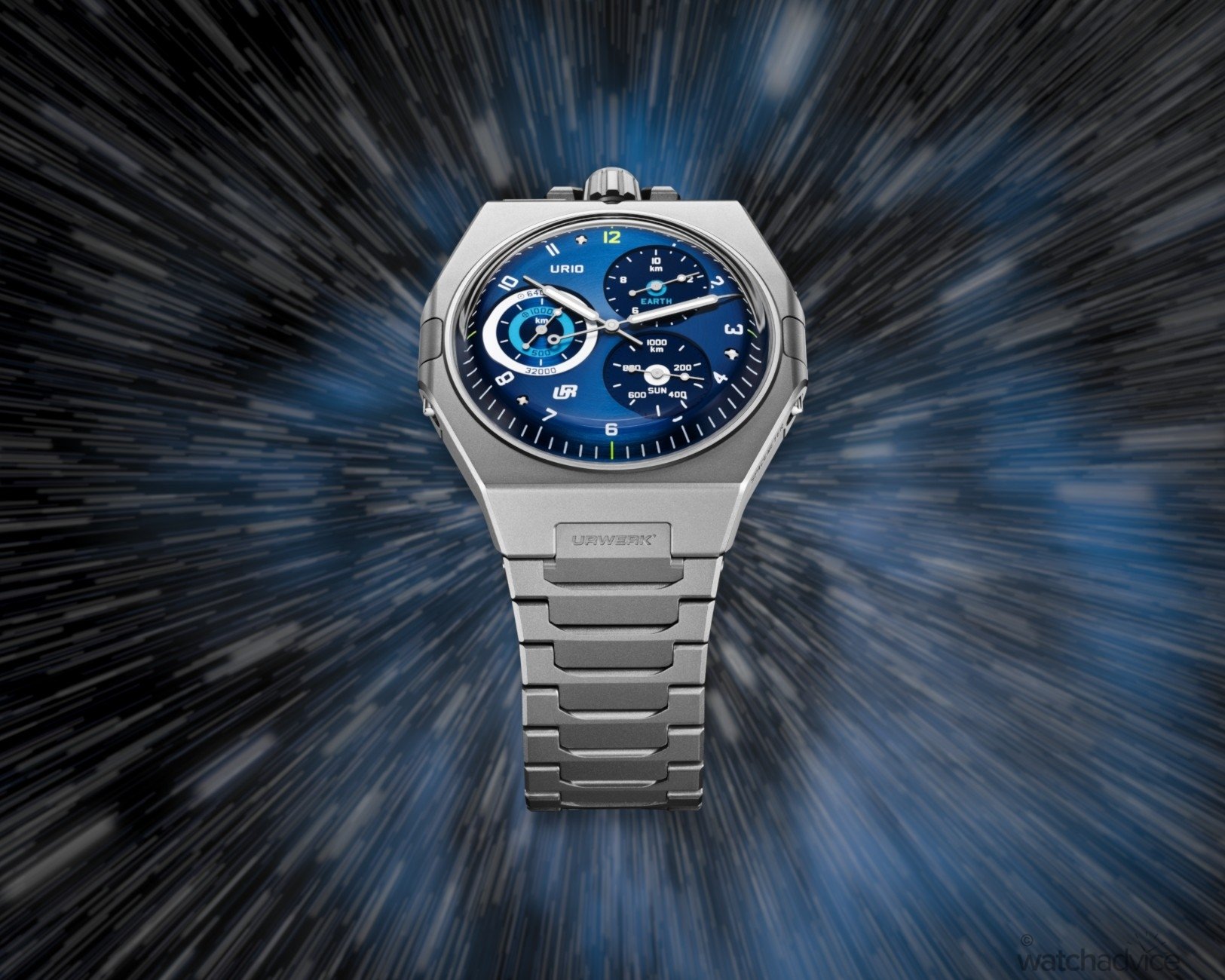
The round blue dial features circular brushing, while lumed syringe hands are centralised, making this watch more familiar-looking than most Urwerk pieces. Still, the devil is in the details. The crown is positioned at 12 o’clock instead of the usual three, but it is the functions of the sub-dials that truly set it apart.
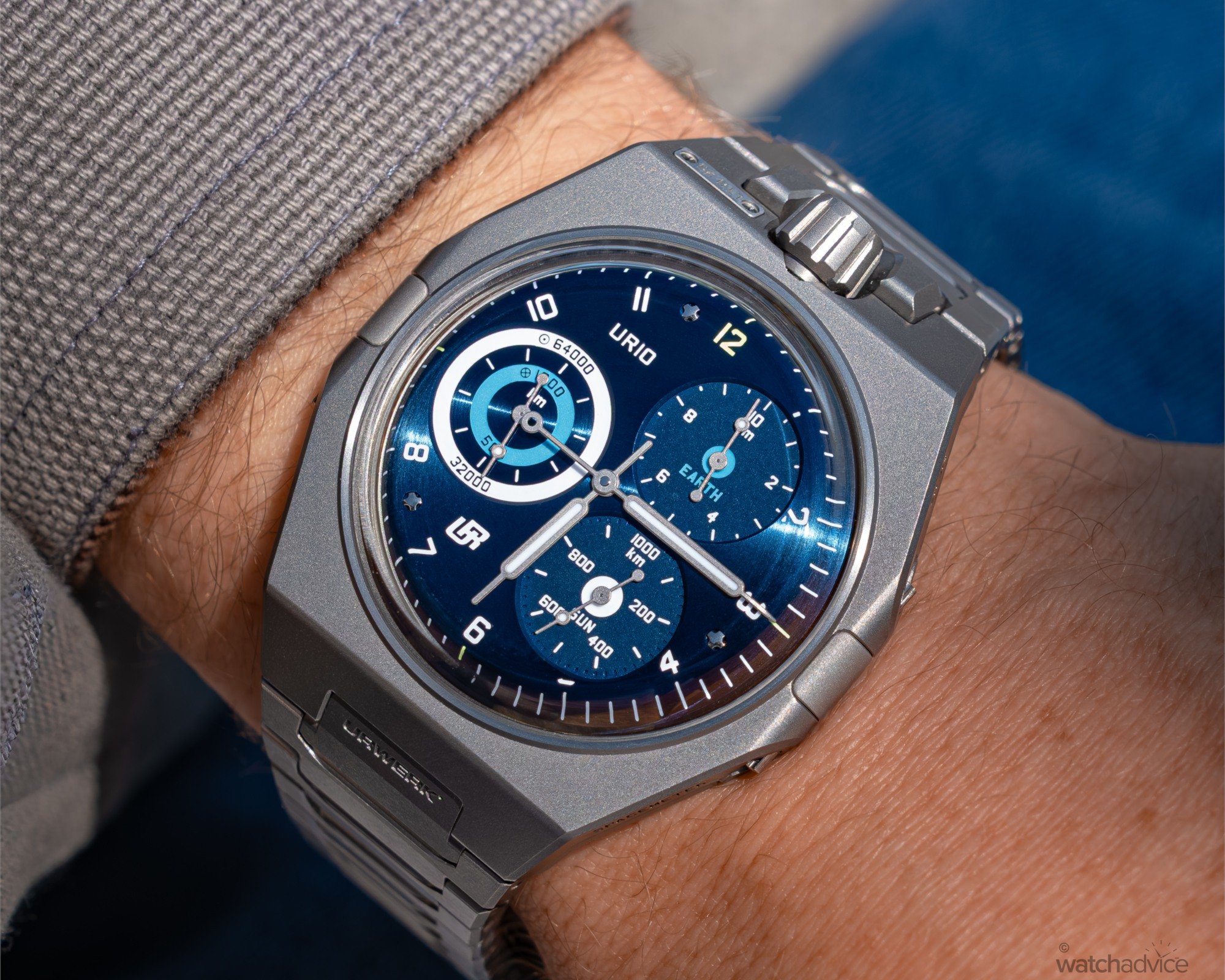
Each of the three sub-dials is dedicated to visualising a different aspect of the Earth’s motion. At 2 o’clock, the Earth counter measures the planet’s rotation in 10-kilometre increments, while at 4 o’clock, the Sun counter tracks the Earth’s orbital journey in 1,000-kilometre steps.
At 9 o’clock, a combined Orbit counter synchronises these trajectories, offering a broader perspective on our planet’s movement through space. Tonally matched for legibility and cohesion, the UR-100 SpaceMeter presents a compelling display of both time and space.
Turbine Carbine
Also visible through the exhibition caseback is the automatic Calibre UR-10.01, developed in collaboration with Vaucher Manufacture Fleurier. Operating at 4Hz (28,800VpH) with a 43-hour power reserve, the movement has been extensively modified with Urwerk’s Dual Flow Turbine System. Rather than a conventional rotor, the calibre uses two counter-rotating propellers to regulate rotor speed through air resistance.
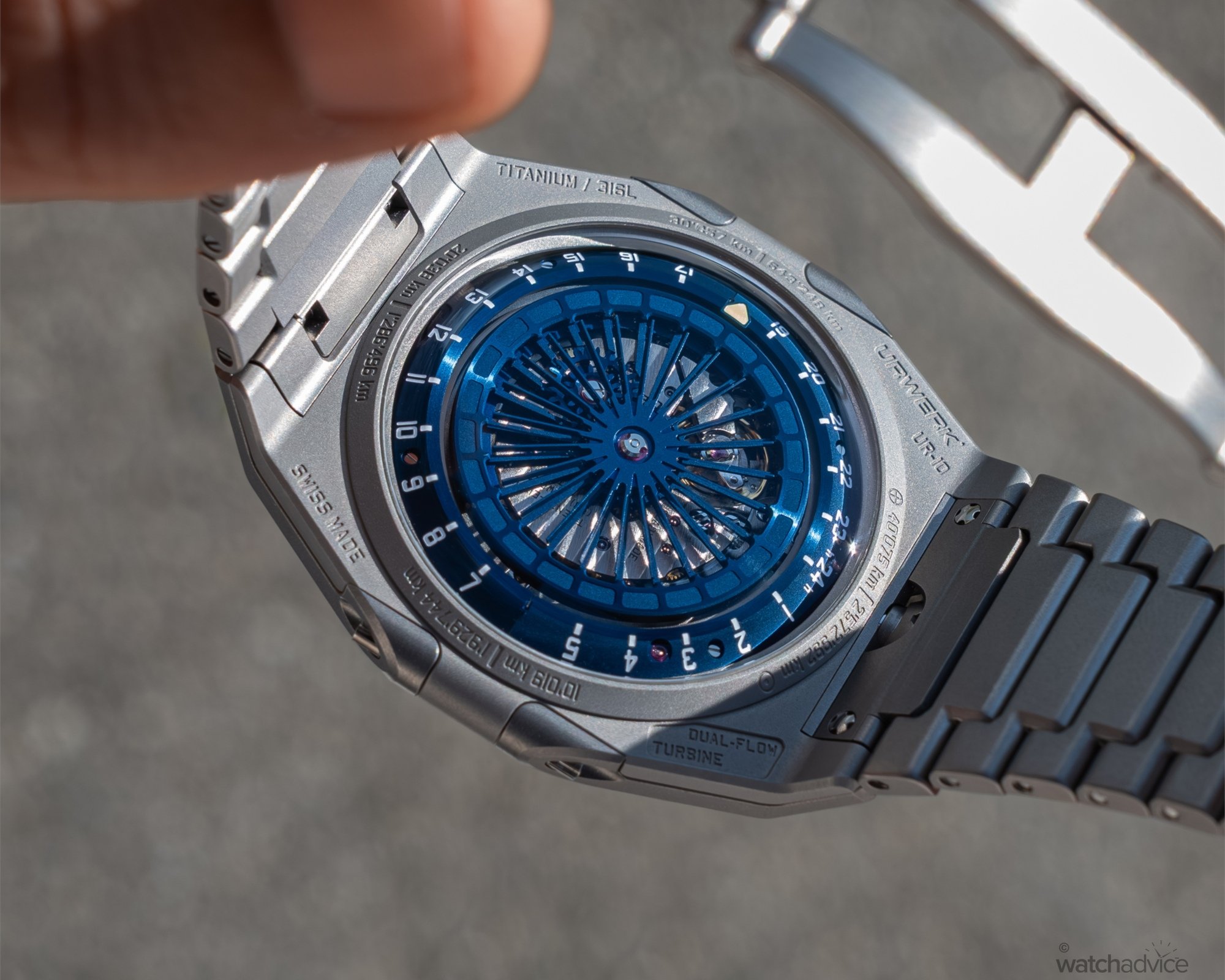
As implied, the Calibre UR-10.01 also powers its associated complications, while adding a discreet 24-hour indicator on the caseback, symbolising a full rotation of the Earth. Engraved pictograms further reinforce the themes of rotation and revolution, making both sides true expressions of portable cosmography.
Initial Thoughts
For a brand that constantly strives to define the future of haute horlogerie, it’s understandable that some Urwerk fans were initially puzzled by this release. By all accounts, the UR-100 SpaceMeter is relatively conventional and restrained. Yet it remains an important part of the catalogue, as it tells the story of Baumgartner’s own inspiration drawn from his father.
That may explain why this watch feels more traditional than most Urwerk designs. It serves as both a look back at the origins of watchmaking and a step beyond both horology and Earth itself.
With a limited production of 25 pieces and a retail price of CHF 70,000, the SpaceMeter Blue is certainly not going to be for, or on, everyone. However, its combination of conceptual depth, innovative engineering, and distinctive design secures its place as a meaningful chapter in Urwerk’s ongoing journey.
As the UR-100 collection draws to a close, it leaves behind not just a trio of watches, but a lasting impression of what independent watchmaking can achieve when it dares to look beyond the boundaries of time.
Reference & Specifications
| Feature | Specification |
|---|---|
| Reference | N/A (Urwerk UR-10 SpaceMeter Blue – Final Edition) |
| Dimensions | 45.4mm case diameter x 44mm lug-to-lug x 7.13mm thickness |
| Case | Sandblasted titanium |
| Dial | Circular brushed blue dial with white accents & Arabic numerals |
| Crystal | Sapphire |
| Caseback | Open sapphire |
| Movement | Automatic Cal. UR-10.01 with Dual Flow Turbine winding & Earth tracker (Earth Rotation over 10 km and 1000km, Earth Revolution over 1000km and 64000km, Rotation and Revolution on a 24h-scale) complications |
| Power Reserve | 43h |
| Beat Rate | 4Hz / 28,800VpH |
| Water Resistance | 30m / 3bar |
| Strap/Bracelet | Integrated titanium bracelet with butterfly clasp |