

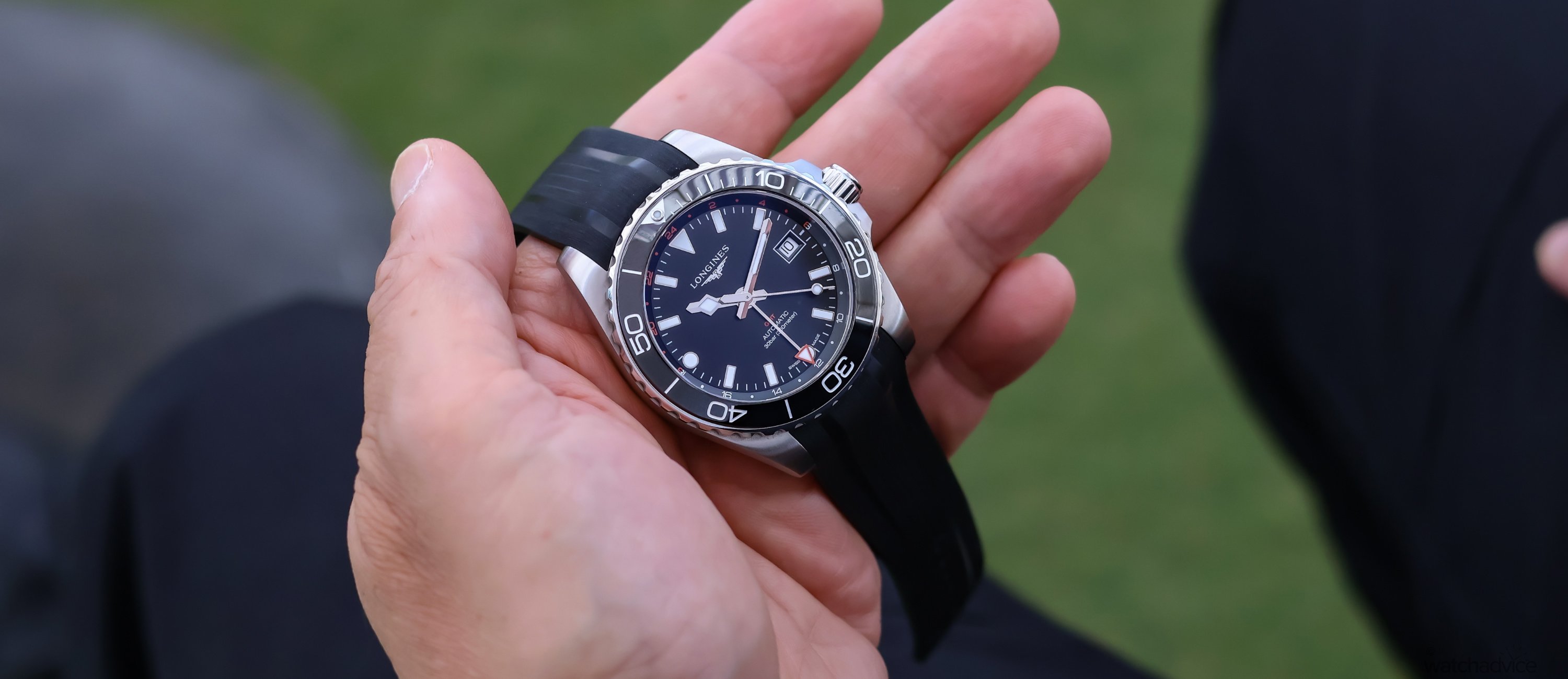
The Longines HydroConquest GMT is one of Longines’ most modern references, but has it stood up to two years’ worth of my father’s ownership standards? Let’s ask him!
Purchasing Expectations:
- A utilitarian watch, fit for my dad’s lifestyle
- Clever micro-adjustment system
- A Flyer-style GMT, helpful for international travel
Ownership Reality:
- Some design elements we disagree with
- Durability of the rubber strap
- Can you see the date?
Overall Rating: 8.5/10
- Value for Money: 9/10
- Wearability: 9/10
- Design: 8/10
- Build Quality: 8/10
When it comes to dive watches, very few can genuinely be called underrated. It’s a thoroughly complete subgenre of horology, filled with some of the most iconic collections in watchmaking history. Submariner, Fifty Fathoms, Seamaster, Aquaracer, Black Bay… these are just a few names that define the dive watch enthusiast’s vocabulary.
But more often than not, the price-to-performance ratio is heavily skewed. These collections carry not only cultural weight but a sense of luxury as well, and their prices rarely reflect their intended purpose. Tangentially, I told a friend earlier this year that I believed Submariners are the most mistreated watches in history: built to withstand extreme pressures, yet typically left to gather dust in a safe.
One dive watch that avoids this fate is the Longines HydroConquest. Luxurious yet fairly priced, high-performance without pretension, it has consistently proven itself as a staple of Longines’ modern lineup. In 2023, the brand released the HydroConquest GMT, a more modern evolution of the collection fitted with a flyer-style (or ‘true’) GMT.
Instead of the usual review, though, this is an owner’s-perspective article. If you’re new, that means we’re reviewing a HydroConquest GMT that was purchased first hand. This time, though, it’s a little different. While I was there on the day it was bought, the watch isn’t mine. It’s my dad’s.
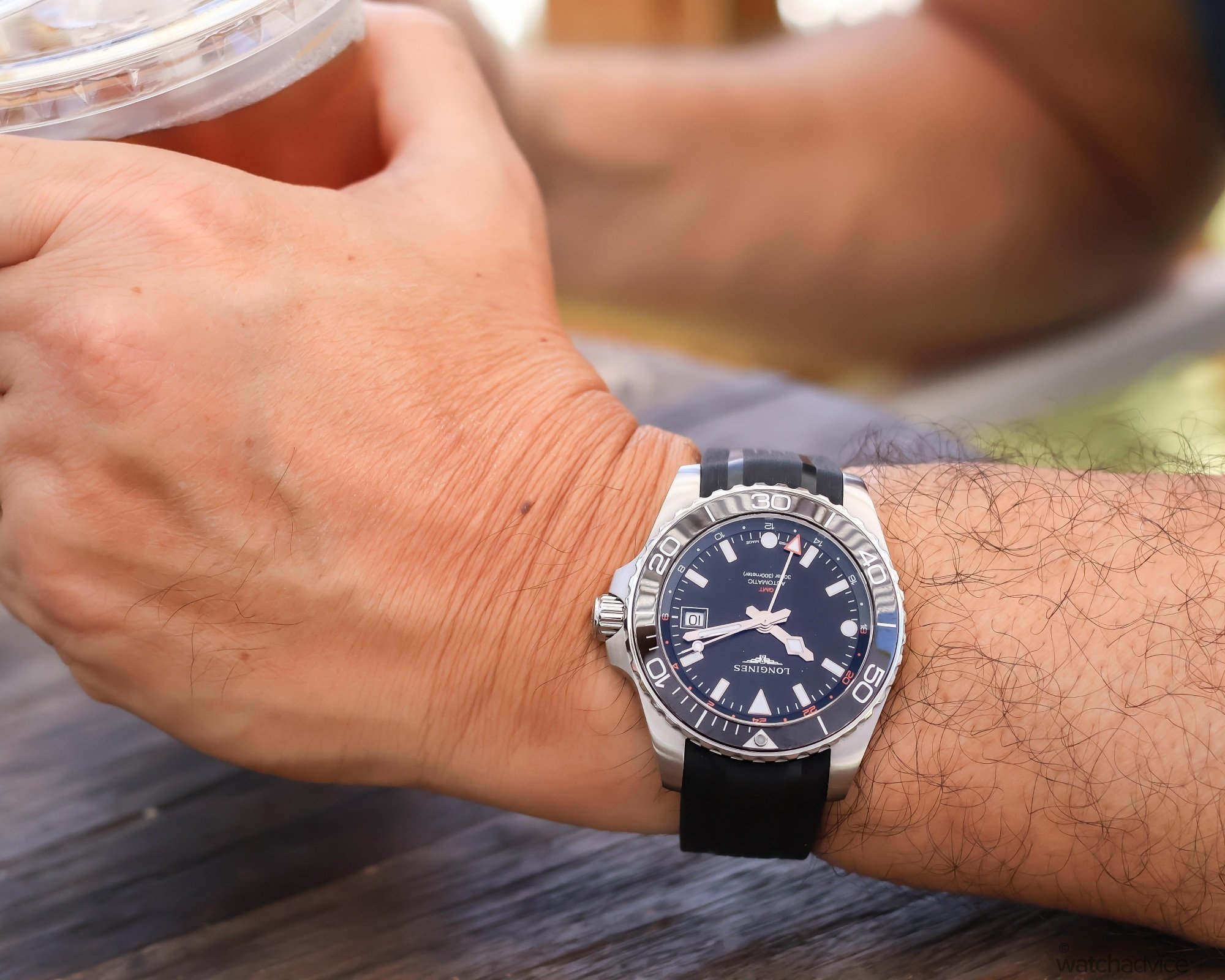
As someone who has been fascinated by watches since before I was born — and was the catalyst for my own descent into the hobby — my father is particular about his tastes. He’s also quite vocal about it, which makes him the ideal candidate to review his own timepiece! So let’s take a closer look at what influenced him to buy the HydroConquest GMT, and how it has served him over the past two years of ownership.
Reader’s note: Any spoken words within this format of text are my father’s, taken from a conversation about his Longines HydroConquest GMT.
First Impressions
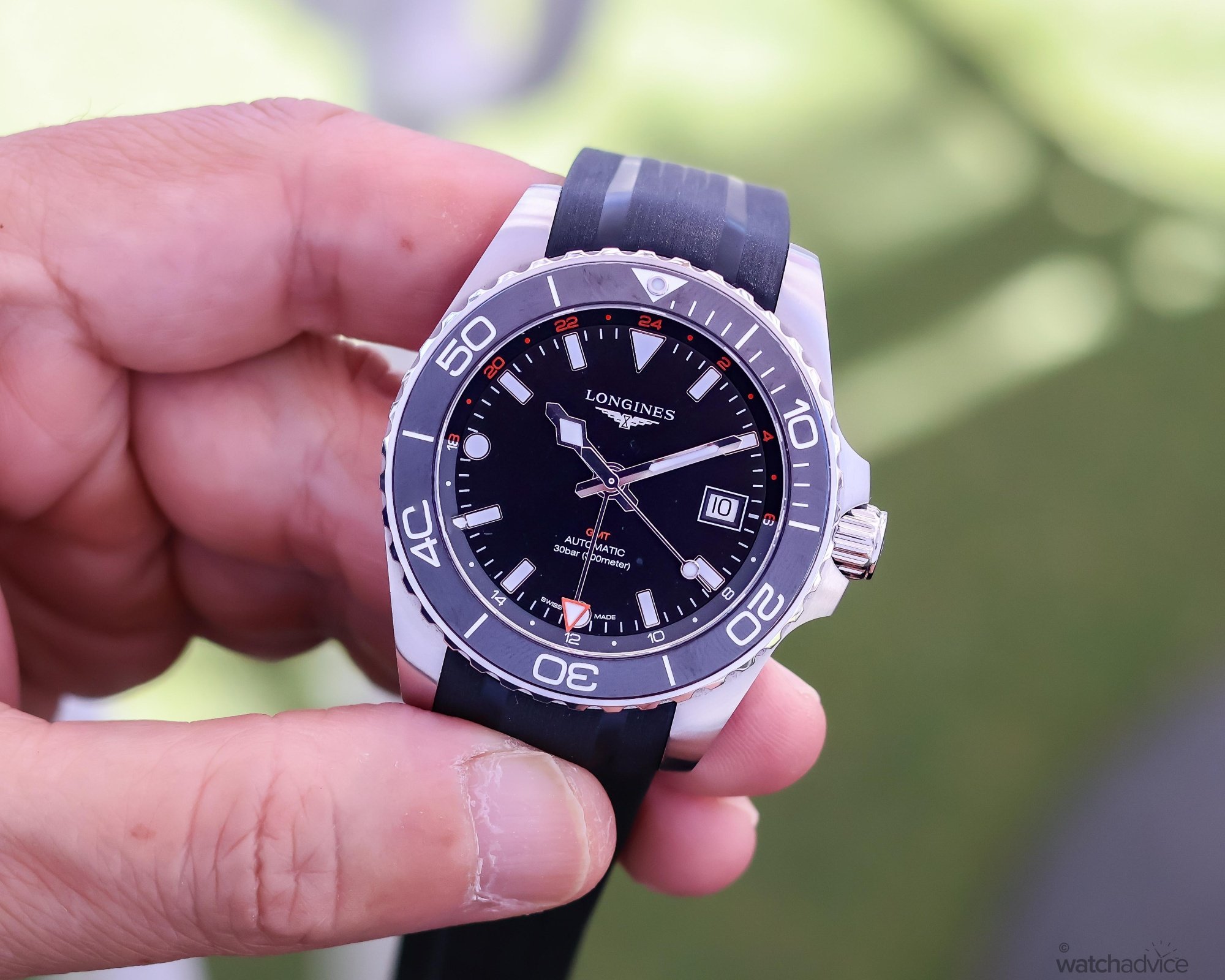
“To be honest, the Longines [HydroConquest GMT] wasn’t my first choice. But what attracted me to it was the fact that it has both the diving bezel and the GMT.“
His first comments about the Longines HydroConquest GMT is perhaps the best summary of his collecting habits. He has an eye for pragmatic design and engineering in the timepieces he collects, with a particular interest in diver-focussed watches.
This stems from the time he spent SCUBA diving in his twenties. His watch box includes an old, 150m water resistant Seiko Kinetic Sports model – a wedding present from my mum. Also in his possession is a 2000s-era Omega Seamaster, à la Pierce Brosnan in 1995’s Goldeneye. It seems that his enthusiasm for divers lines up harmoniously with his love for James Bond.
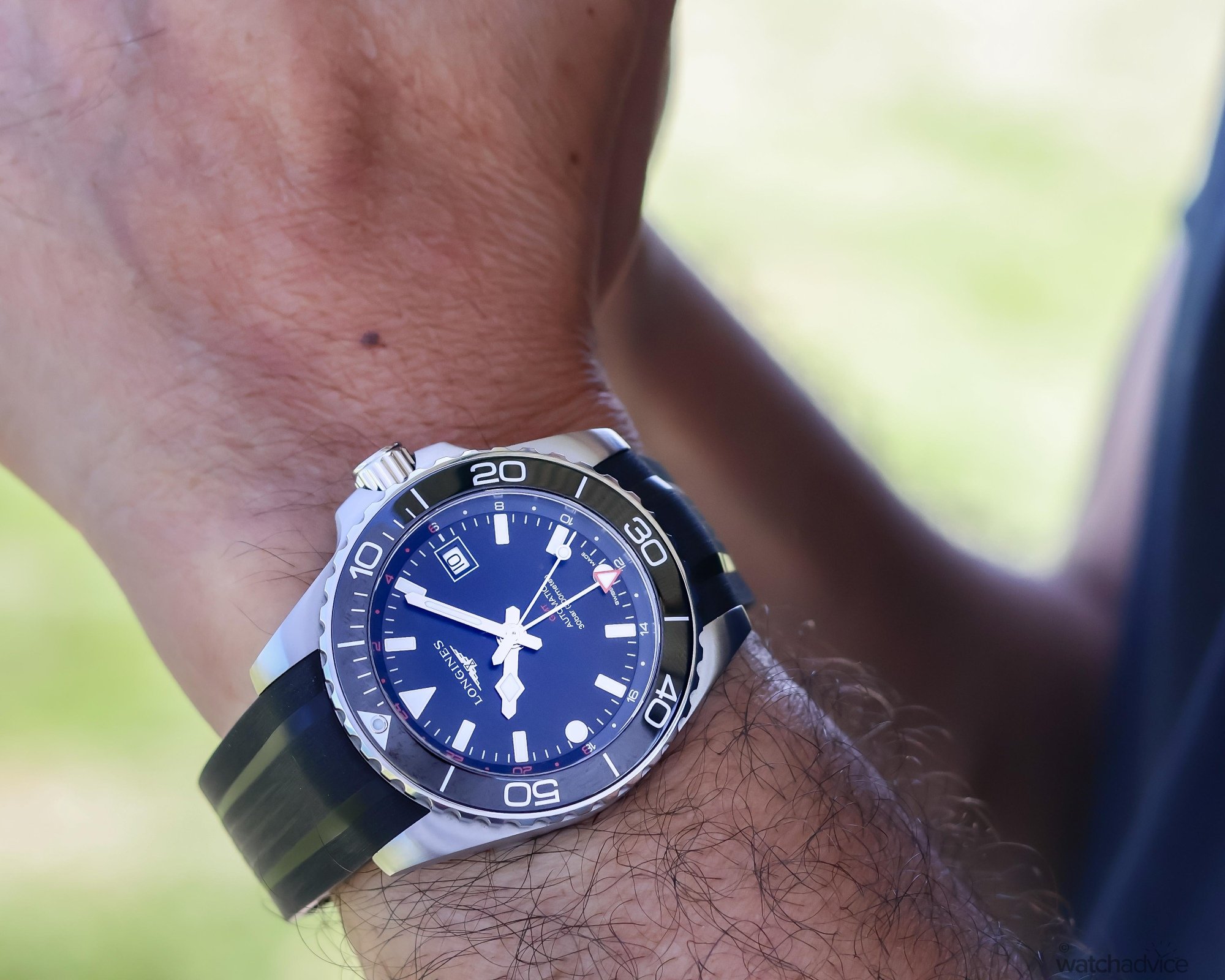
Attaching a flyer-style GMT to a diver watch was simply the cherry on top for my dad. Though his home timezone of the Philippines is only two hours behind Brisbane, it assists him in dynamically changing between the two when he visits family.
However, he chose the HydroConquest GMT over the much-beloved Spirit Zulu Time series as the former felt comparatively sturdier and more tool-like. That doesn’t mean he didn’t like the Spirit Zulu Time at all, though:
“It was the Spirit Zulu time that was my preferred one, until the HydroConquest GMT came up… I like [the Longines Spirit Zulu Time], but it doesn’t feel utilitarian. It doesn’t appeal as a ‘tool watch’ to me; More for someone who simply travels around a lot. A diver is more like a tool. It’s not going to be a formal watch, but I haven’t worn much formal wear in a while… but I find it suits my lifestyle more than the Zulu Time. “
The Design
When placed in a lineup with other Longines HydroConquest models, the HydroConquest GMT feels more in line with the brand’s design language. The collection has always seemed comparatively modern for Longines, but the GMT reference leans into the same contemporary, heritage-inspired silhouette touched on by the new Conquest series.
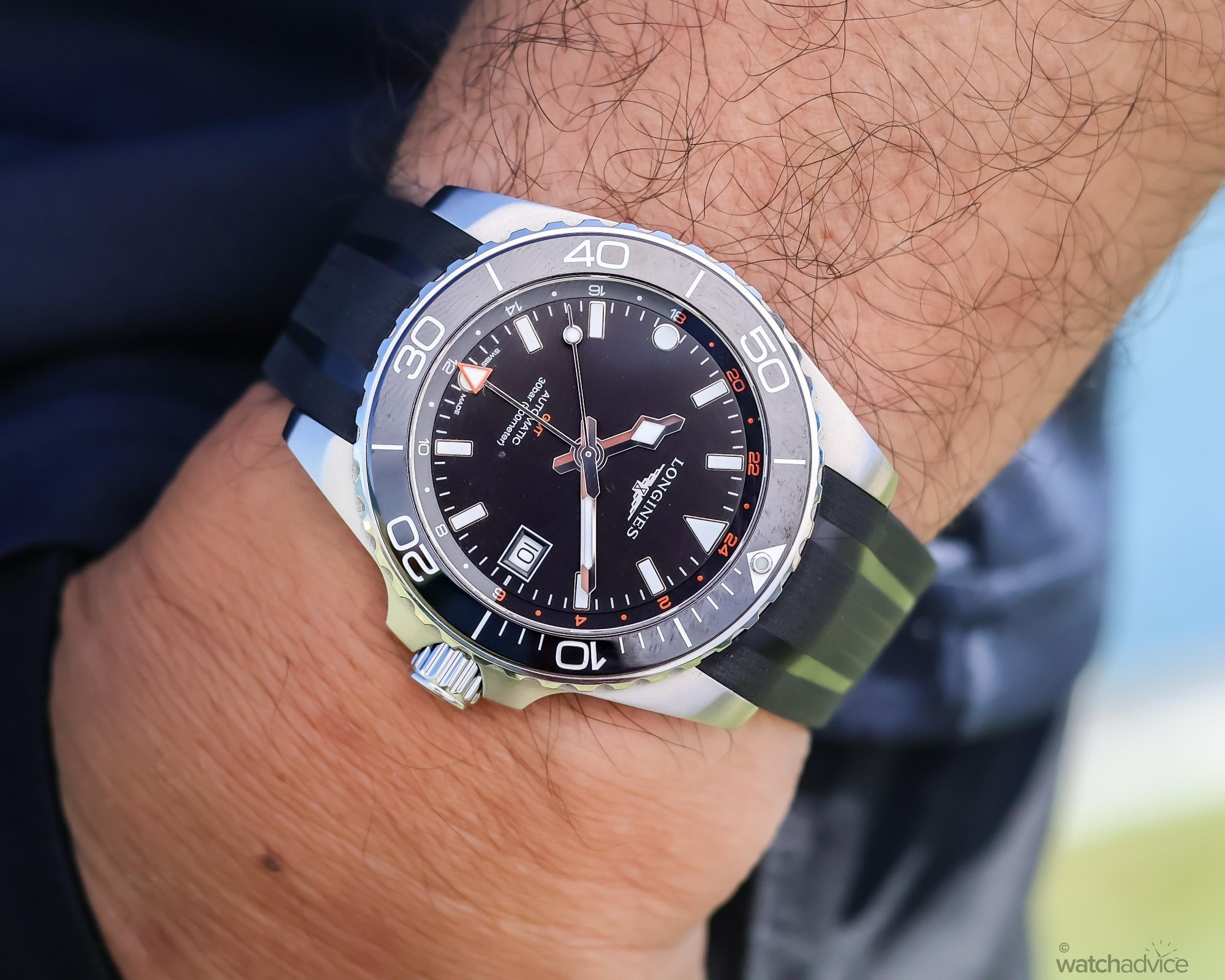
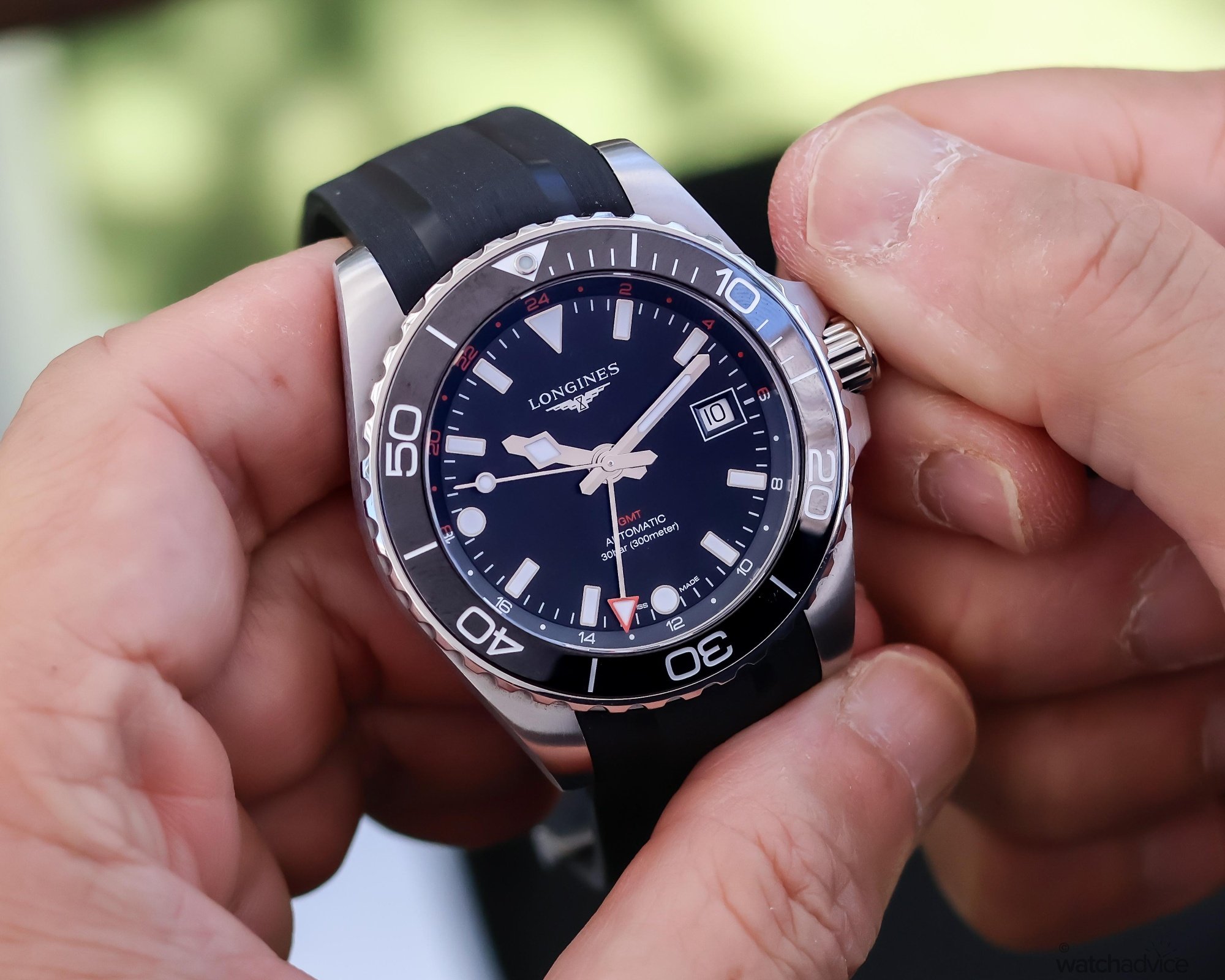
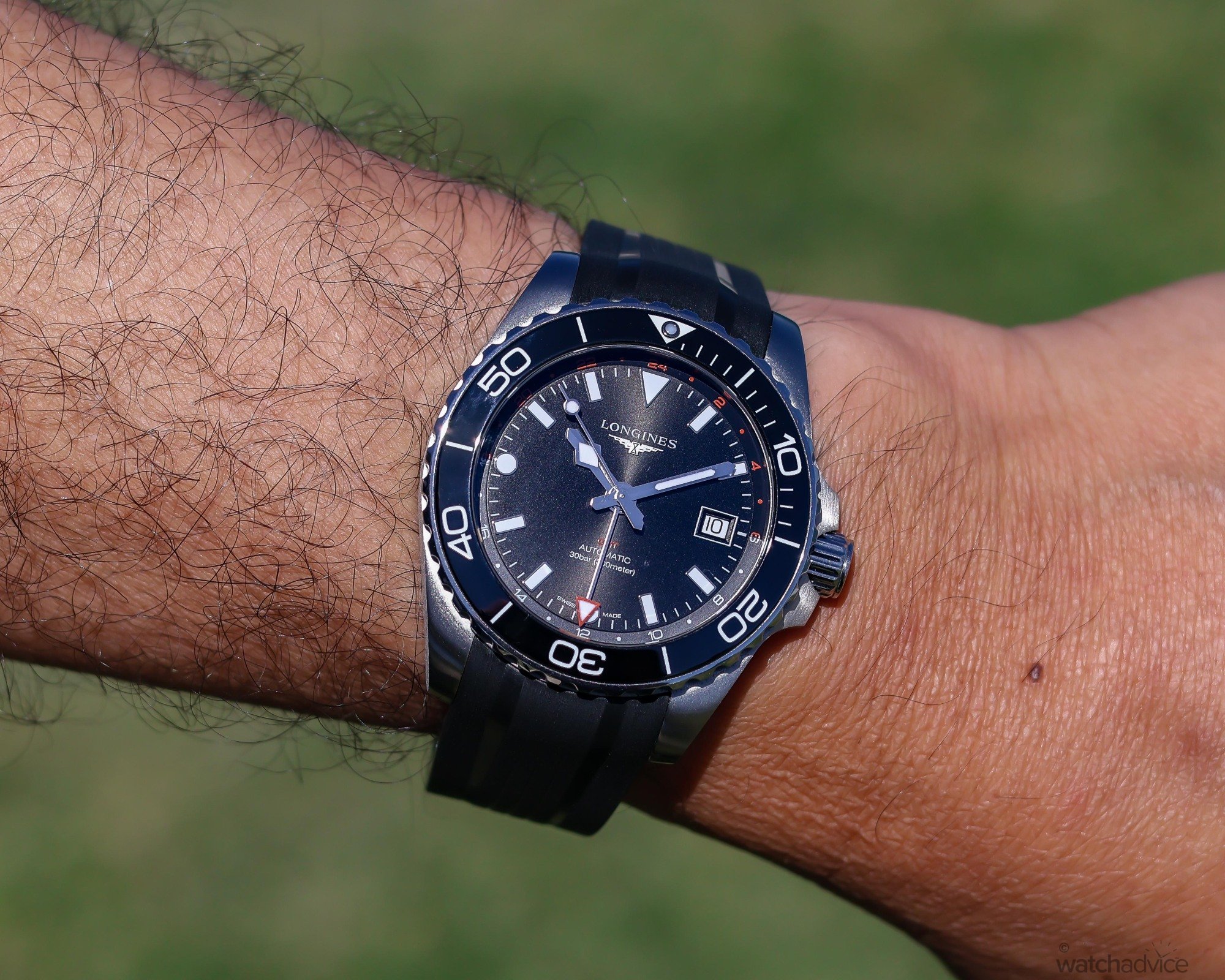
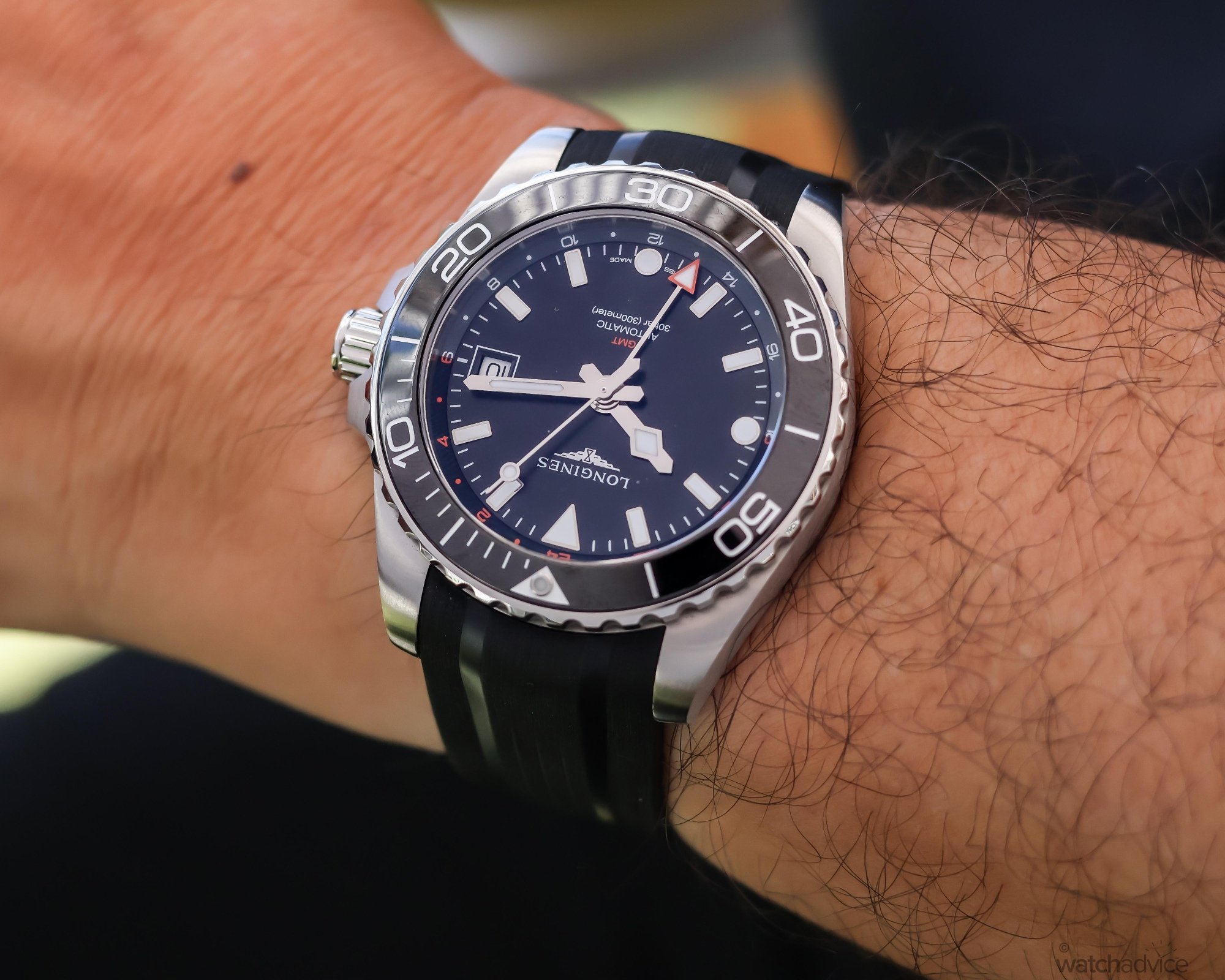
Starting with the dial, my dad’s black iteration of the HydroConquest GMT features a sunray-brushed black finish. Applied stick indexes filled with lume run throughout, contrasting with the traditionally round markers found in the standard HydroConquest collection.
They still appear here at six and nine o’clock, while the 12 o’clock marker is a large inverted triangle topped with lume. It doesn’t harm legibility in any meaningful way, but both my father and I feel it makes the design seem a tad inconsistent.
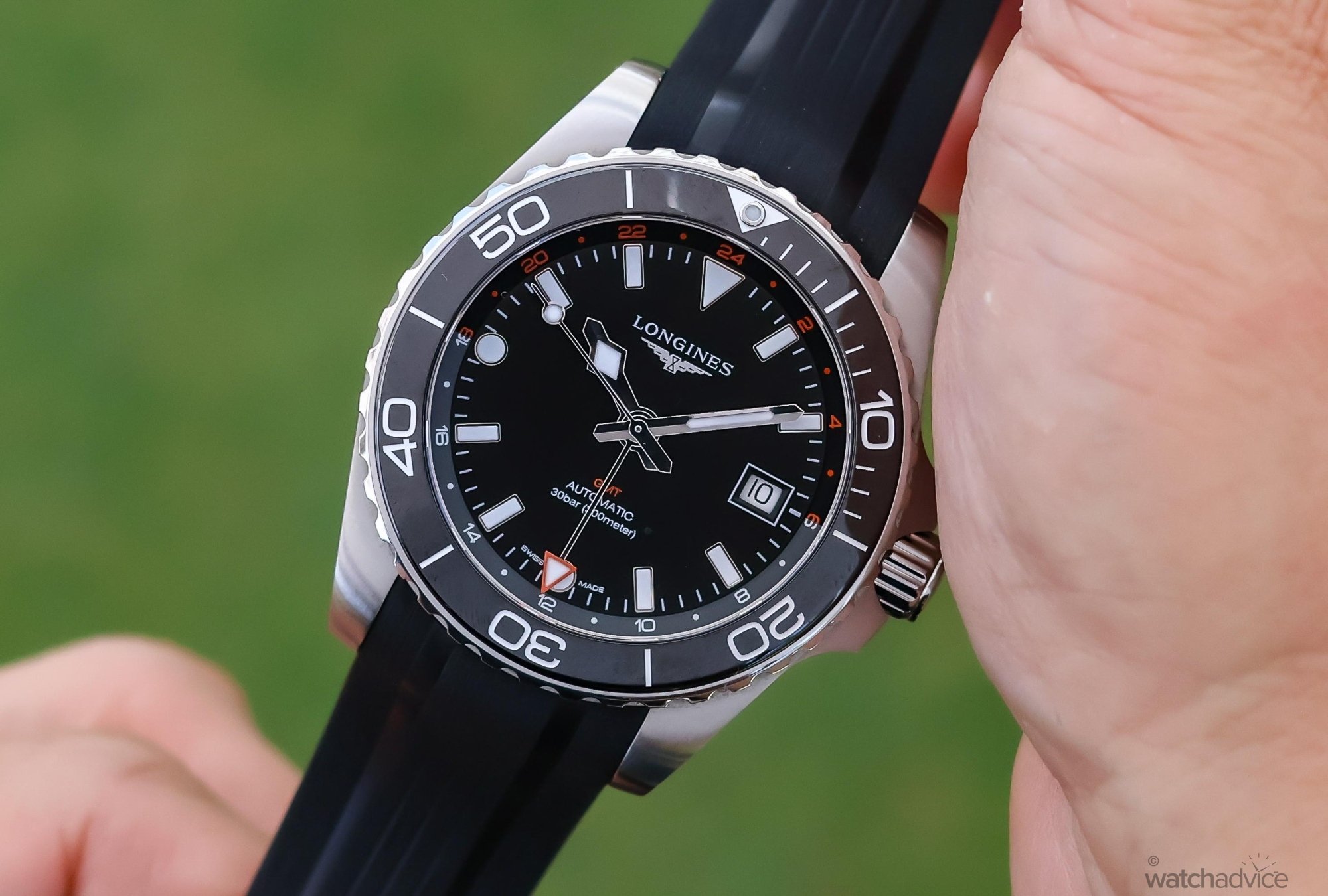
“I think what they could have improved on is the indexes. Rather than have a rectangle, a triangle, and a circle, I would have opted for all rectangles, and one triangle… It would make it aesthetically easier to look at. But I guess, now that I’m wearing it, it does help in the dark so you can see where six, nine, and twelve o’clock are.“
In any case, the index and dial design are echoed by the hands. The hours and minutes use a set of baton hands, with the hour hand featuring an almost Tudor ‘snowflake’-style rhomboid lume plot. The seconds hand mirrors the circular indexes, while the GMT hand, indicating the second time zone, is marked by a large orange triangle.
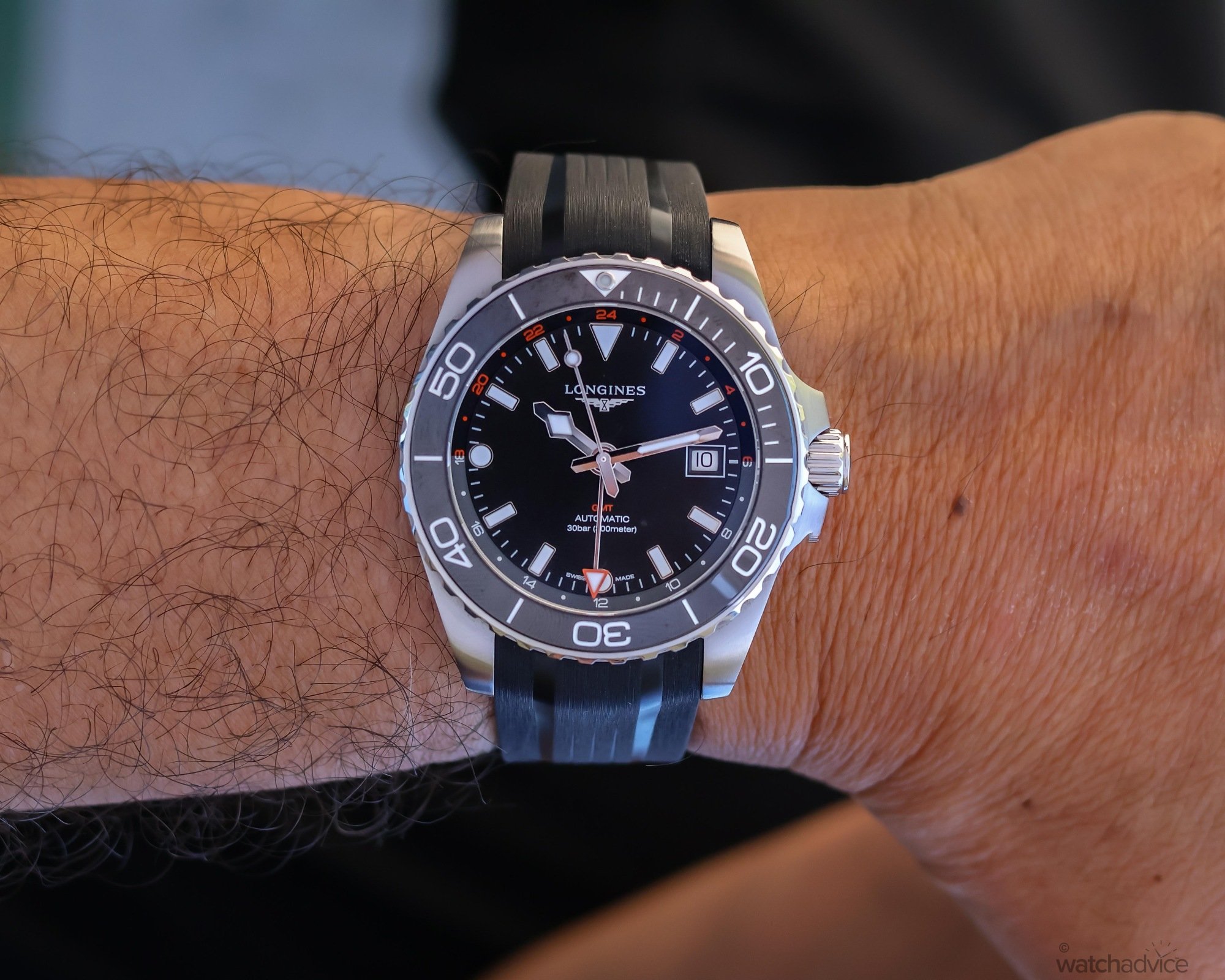
The orange accents continue around the periphery of the dial. Here sits the 24-hour scale, split between a dark orange and black upper section and a grey and white lower section to denote day and night. Just beneath it, a simple white set of lines forms the encircling minute track.
Another neat detail is the additional white square border surrounding the date window, which is white with black text. Despite the contrast, my dad found difficulty in quickly seeing the date. In conversation, he wondered if it perhaps could have been improved with the use of a date magnifier.
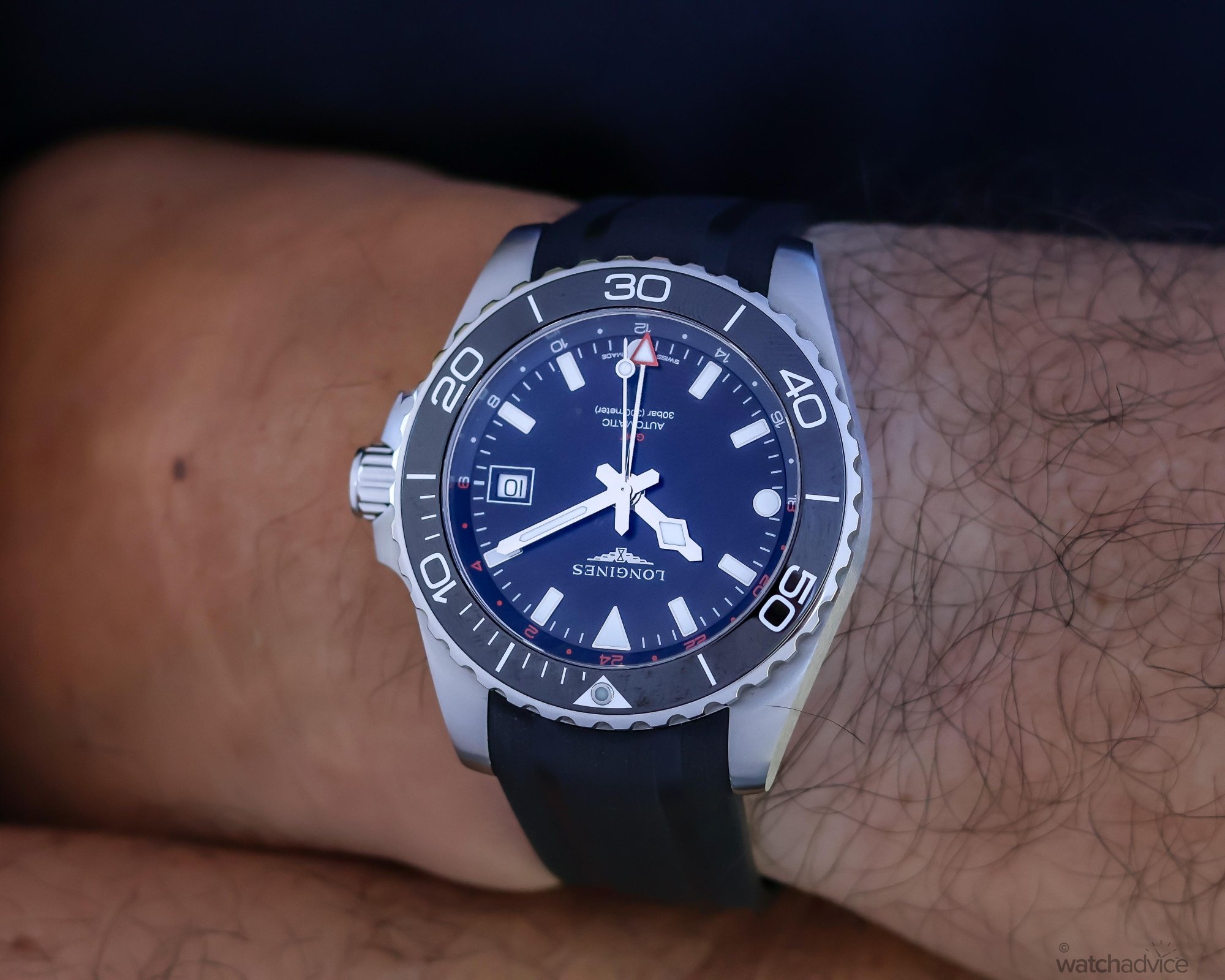
“If I had to choose a watch for diving, I’d choose a no date, but because you can use this for travel, a date isn’t too bad. But I need glasses to view the date… [A date magnifier] would be an improvement, but whether or not that’s aesthetically appropriate, or look like an homage, I’m not too sure.“
Swiss Made appears near the six o’clock index, with the usual Longines branding and flavour text above. The orange accents make one last return in the GMT designation. Personally, I could have done with less text, but it’s far less distracting than what you’ll find on, for example, certain Seiko dials.
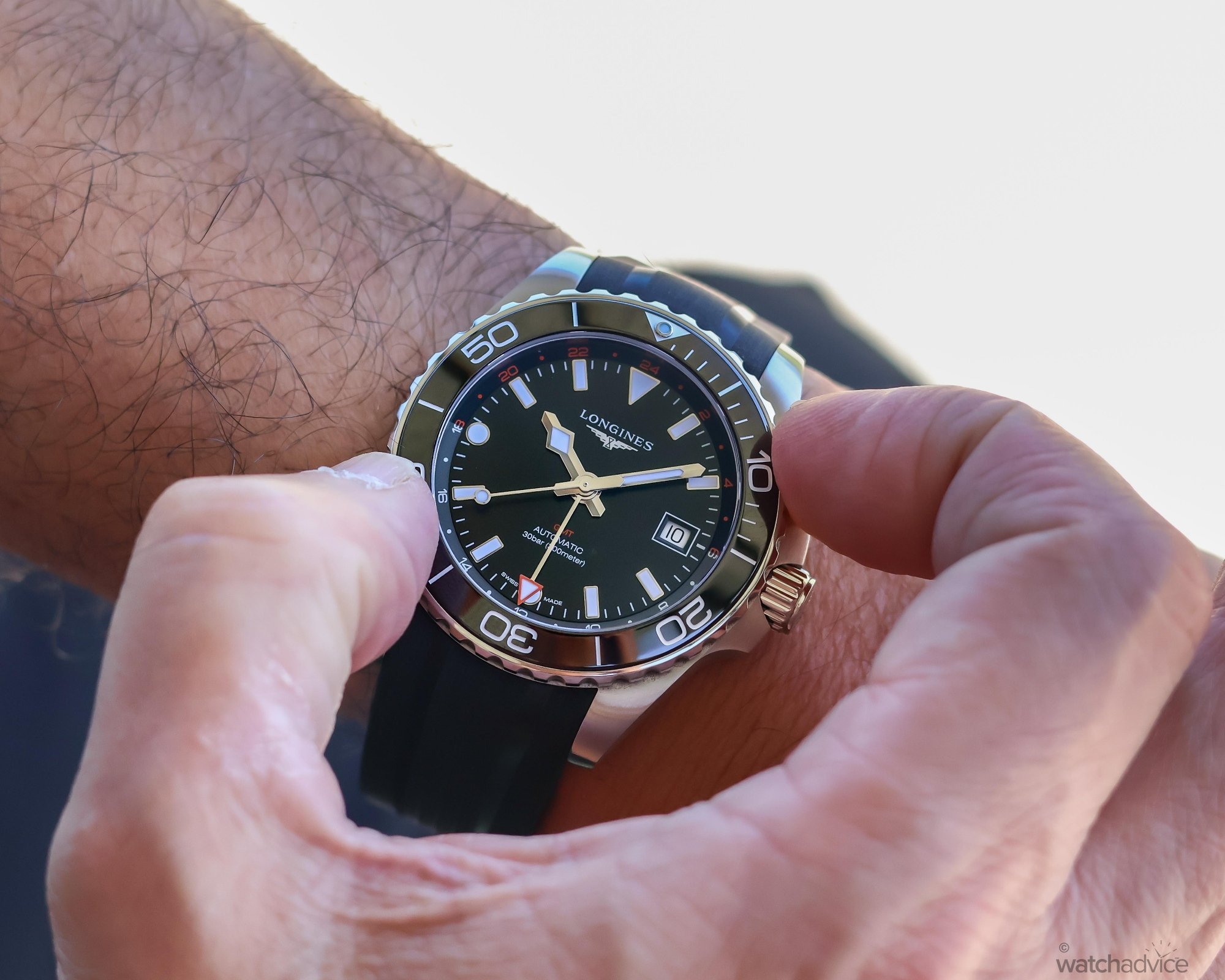
Moving away from the dial, you’re met with a glossy black ceramic bezel, knurled and unidirectional with a 120-click action. As the HydroConquest GMT is a diver, it also features a lumed bezel pip set within a triangular marker at 12 o’clock. Along the case side, the watch is predominantly brushed, aside from the fluted and signed crown.
For presentation’s sake, polished chamfers might have been nice, but a fully brushed case suits the tool-watch aesthetic my dad loves. It doesn’t mean that there was a lack of care in refining the watch, though.
In fact, Longines has taken time to improve on the HydroConquest GMT’s silhouette. The crown guards, for example, have been rounded to flow more elegantly into the crown. This is a feature that my dad has a vested interest in.
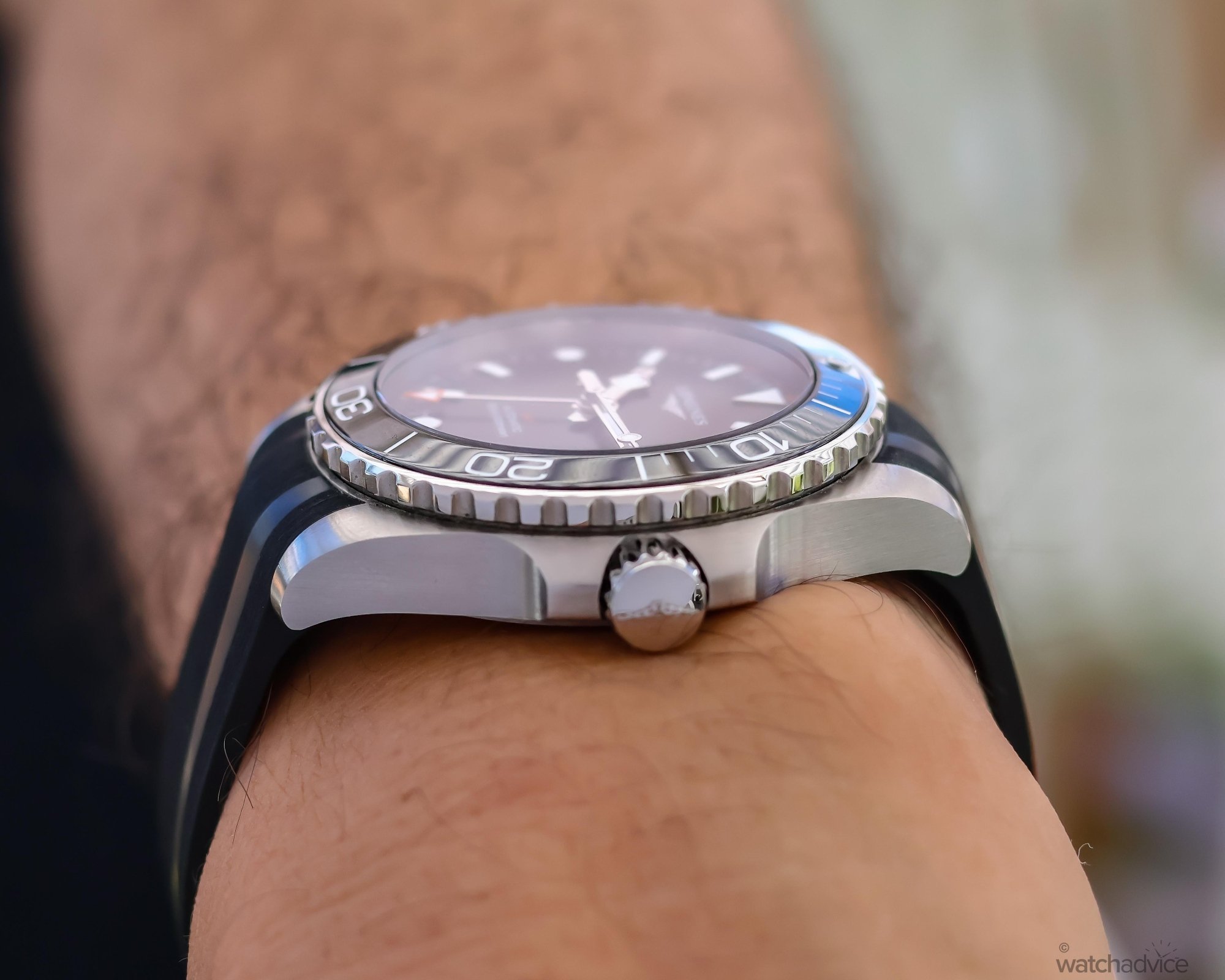
“I didn’t like the crown on the [Spirit Zulu Time]. It’s too big and doesn’t have a crown guard. Looking at both, I asked, “What would be the purpose of the watch for me?” Going back to that utilitarian, tool kind of thing… I’d prefer the HydroConquest GMT over the Zulu.”
Comparative to the standard line, the case has few rough, sharp, and blockier edges, allowing it to be a perfect daily beater if necessary. All in all, this makes the HydroConquest feel more like a duty-bound tool than a simple block of metal.
My father’s watch comes on a solid black rubber strap, which inexplicably doesn’t include a quick-exchange system. What it does include is a deployant clasp with an in-built micro-adjustment — but more on that in a moment.
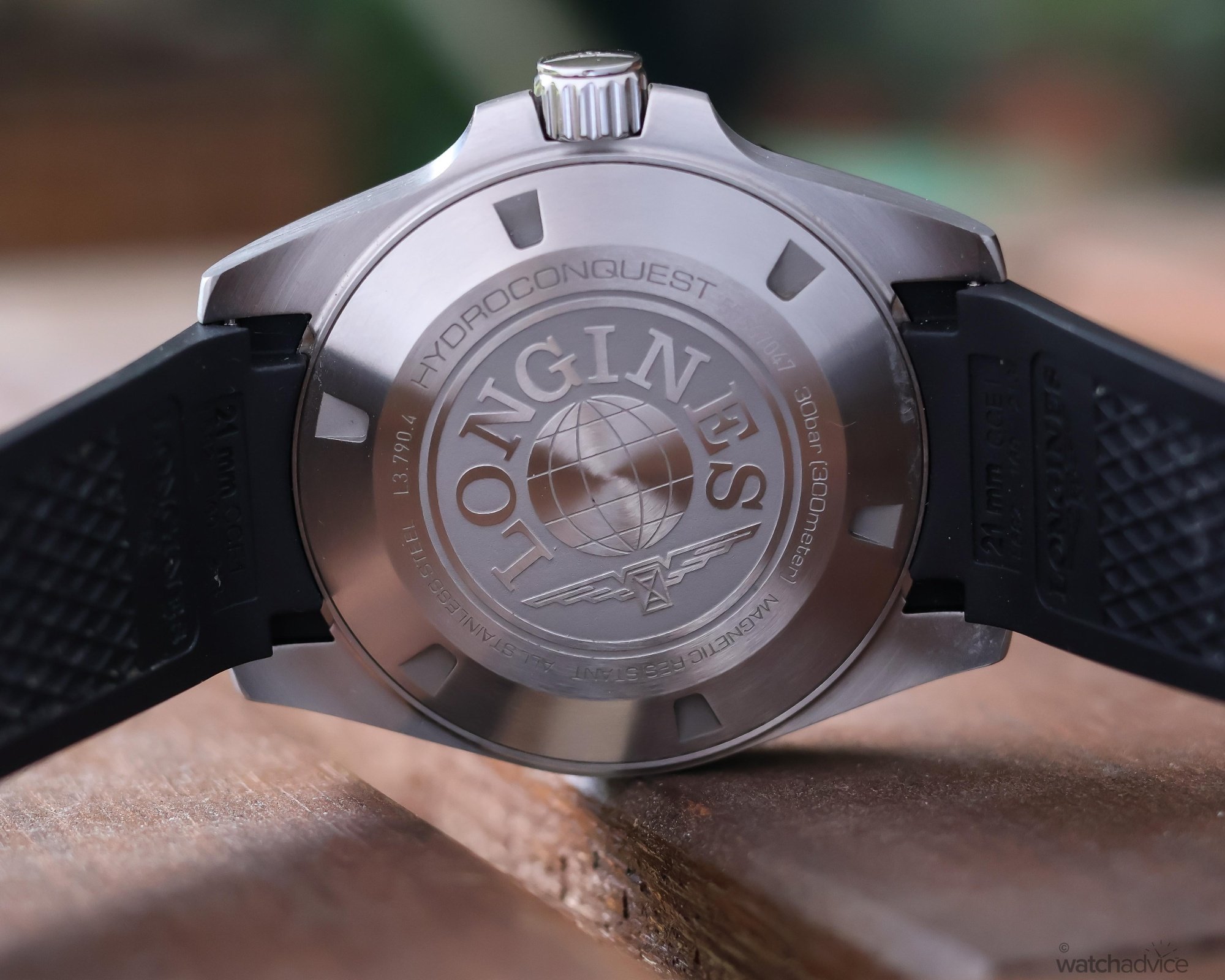
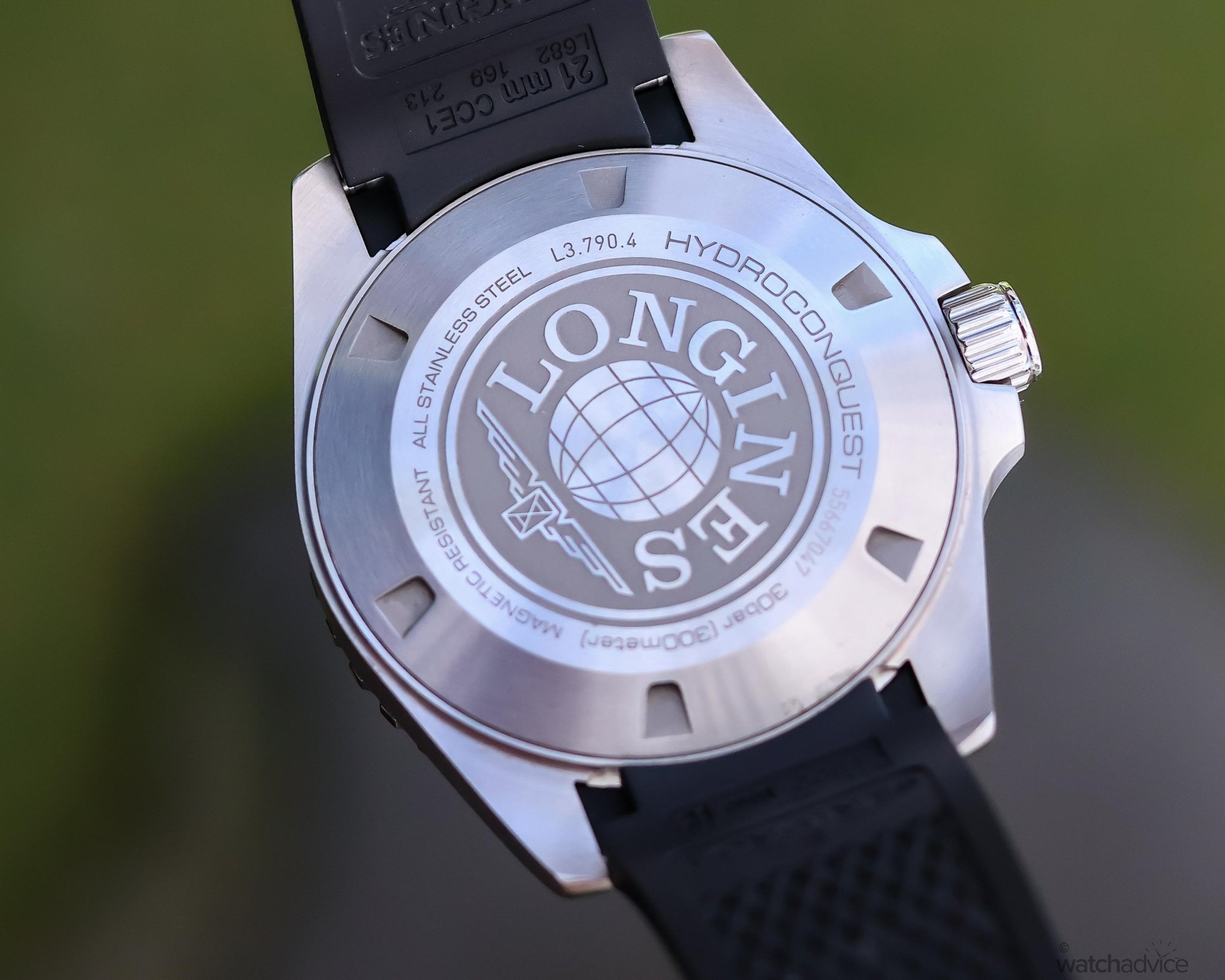
Finally, the solid caseback is about what you’d expect from a utilitarian piece like the HydroConquest GMT. Although it’s brushed like the rest of the watch, Longines deserves credit for laser-engraving a handsome logo detail into the centre of the screw-in caseback.
Some have lamented not being able to see the movement, but I don’t think an exhibition back would add much to the overall appeal of the piece. As usual, though, the typical flavour text describing the watch’s qualities is found here as well.
How It Wears
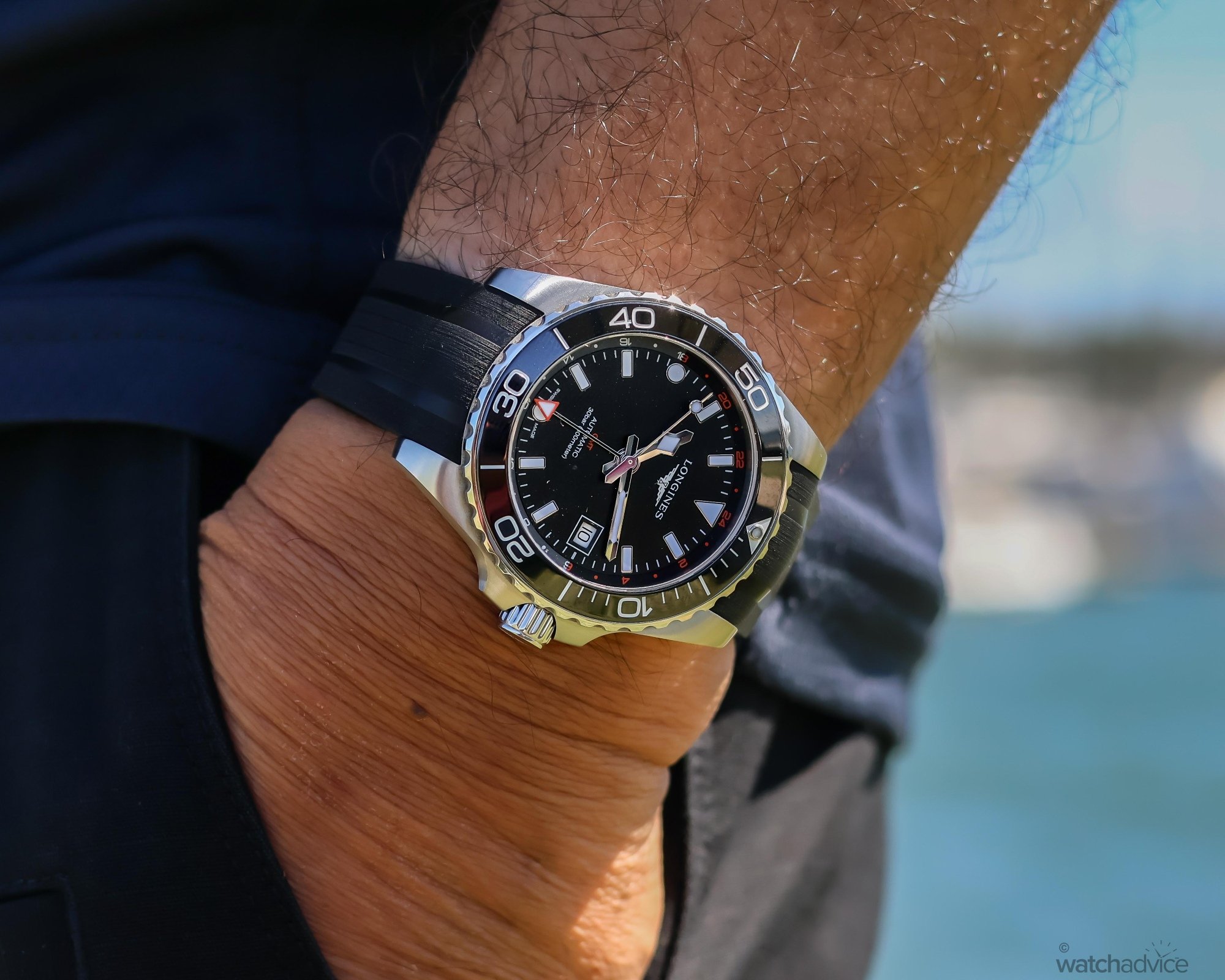
The case profile of the Longines HydroConquest GMT measures 41mm in case diameter, 49.4mm lug-to-lug, and 12.9mm in thickness. But on my dad’s wrist, which he insists is small, it wears remarkably well. Of course, some credit goes to Longines for designing the case profile in such an ergonomic way, but the HydroConquest GMT’s wearability can also be attributed to my dad’s choice of strap.
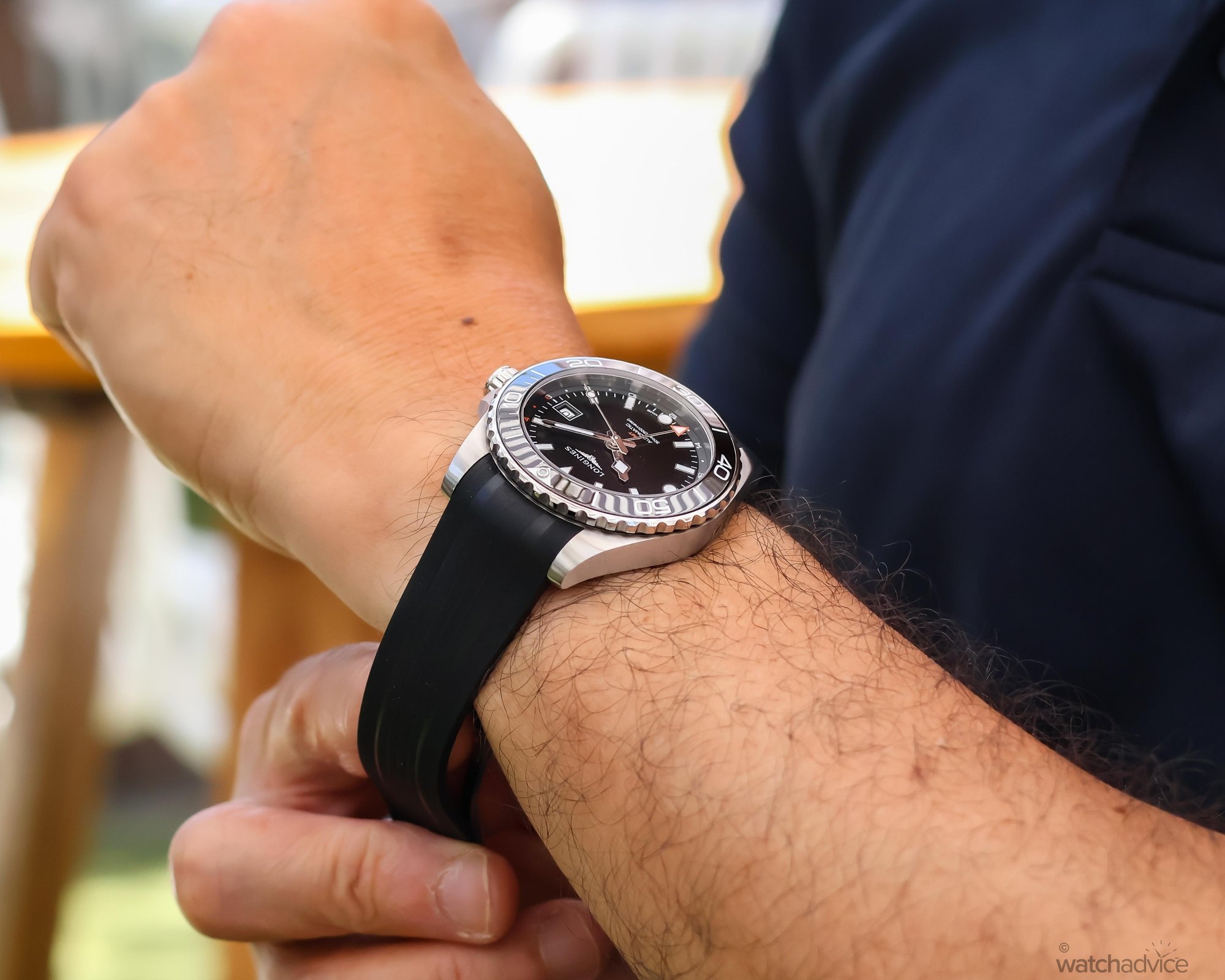
“I think I made the right choice, picking the rubber strap over the metal bracelet. It fits snugly on me; I’ve got a small wrist, and I don’t think the metal would’ve done the same trick.
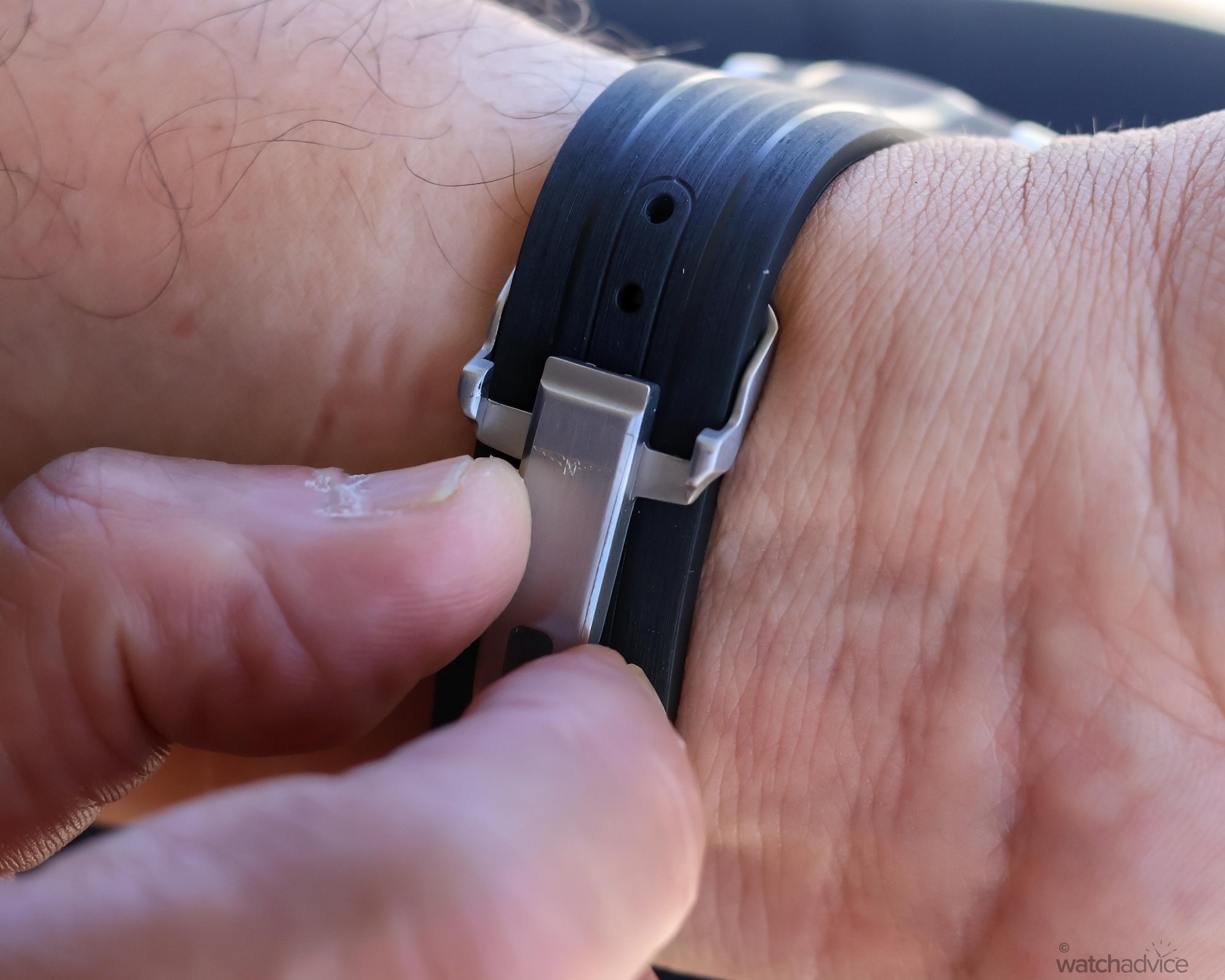
One feature I previously hinted at is the micro-adjustable clasp available on the rubber strap. The inclusion of a micro-adjustment system on a strap is almost unheard of; even I had no idea it existed, until the Longines client advisor gleefully showed my father and I how it worked.
It’s a remarkable feature that speaks volumes about Longines’ dedication to quality watchmaking, setting the standard for what other luxury watch brands should be considering.
It’s not all sunshine and rainbows for the HydroConquest GMT, though. Once we got home, we made a startling discovery with the rubber strap: it had split open and was breaking apart! Granted, it was likely a one-off manufacturing fault, but it’s still a shock that nobody wants after spending four figures on a brand-new timepiece.
To Longines’ credit, they jumped on the situation immediately. They got to work sourcing a replacement, while my dad used the Otis Hope Carey collaboration NATO strap in the meantime.
The ordeal with the rubber strap ended up being a blessing in disguise for my dad. He’s a big fan of NATO straps for their durability and comfort – goodness knows how many times he’s lamented to me about the Tudor Pelagos FXD Marine Nationale for that exact reason.
However, it did raise a major question about the long-term durability of the HydroConquest GMT’s rubber strap. Thankfully, we haven’t encountered any further issues since Longines sourced a replacement, but it remains something we’re keeping a close eye on.
“If I had initially been given to option to buy [the HydroConquest GMT] on a NATO strap, I probably would’ve taken it. The rubber strap was broken when we first got it, so I don’t know if it’s going to break when it gets into rough seas. But like I said, I like the snug fit of the rubber. I hope it’s just a one-time thing.”
The Movement
Behind the solid caseback of my dad’s Longines HydroConquest GMT is the automatic Calibre L844.5. Running at Longines’ signature 3.5Hz (25,200VpH), and offering a 72-hour power reserve, it’s a heavily modified version of the ETA 2892-A2 with a flyer-style GMT mechanism.
If you’re just getting into watches, a flyer-style, or traveller’s, GMT allows the hour hand, and usually the date as well, to be adjusted independently of the rest of the watch. A caller-style GMT, by contrast, adjusts the fourth hand to track a second time zone, making it ideal for someone who doesn’t travel but regularly takes international calls.
You might be inclined to think that an out-of-house movement base raises alarm bells in the luxury watch industry. Not quite, though, as Longines is part of the Swatch Group, which also owns the ETA movement manufacturer. This vertically integrated system has its benefits.
The ETA 2892-A2 is one of the most widely used, and most heavily derived, movements in the industry’s history. As a result, Longines doesn’t really need to question the quality of the movements ETA produces for them, allowing the brand to deliver high-quality timepieces at a consistently impressive clip.
Something particularly interesting about the HydroConquest GMT is that it uses the Calibre L844.5 instead of the more widely adopted L844.4. For context, the difference is that the L844.4, most commonly seen in the Spirit Zulu Time collection, is the COSC chronometer-certified version of the movement found in my dad’s HydroConquest GMT.
Perhaps this comes down to the HydroConquest’s positioning relative to the Spirit line. Having two different collections at the same price point could easily confuse buyers and muddy sales. Longines is smart in how it segments its catalogue, and the HydroConquest GMT’s price of $4,725 positions it as a premium reference within the lineup, while still sitting a step below something as luxurious as the Spirit Zulu Time.
My dad isn’t the biggest stickler for COSC certification, though. If the time on his watch is off, he’ll simply hop onto time.gov to sync it back up. He will notice when something is awry, however, and so far I’ve heard no complaints about the timekeeping accuracy of the Calibre L844.5. It’s safe to say that the HydroConquest GMT has proven itself as a hardy and reliable watch, with a capable movement to match.
Final Thoughts
In every watch review I’ve ever written, I try to skirt around answering one specific question: “Is the watch fit for purpose?” The truth is, I can’t really answer that.
You live your life the way you choose to, and I can’t tell you whether a watch is ‘fit for purpose’ when your purpose is so wildly different from anyone else’s. The broader strokes may sound similar, but only you know the intricacies of your life.
That’s why I love owner’s perspectives so much. They go beyond what we, as journalists, can typically speak to. The experience they have comes from well beyond the honeymoon period, offering a more realistic insight.
In this case, that person is my dad, who I’ve known since I was very young. Shocker, I know. But I’ve seen how his lifestyle has changed and evolved over the years, and I’ve also gained insight into how his past has shaped the way he collects watches today.
So, is the Longines HydroConquest GMT ‘fit for purpose?’ In the case of my dad’s lifestyle, he definitely thinks so. It’s a practical, easy-to-wear watch with all the complications he needs in his daily life.
But I said, I was present on the day that my dad bought the Longines HydroConquest GMT. I had made a massive purchase of my own that same year: the Tudor Black Bay GMT Opaline Dial. As egotistical as it sounds, I had assumed that my renewed interest in watches was a part of the motivation my father had to gear up for a new luxury timepiece.
While he agreed that it was part of the truth, it was but half of the story. To paraphrase (and to not disclose too much detail of my family history), my mother had then undertaken a major career change. In celebration, my dad and I picked out a 33mm Zenith Elite Moonphase, Ref. 03.2330.692 as a gift. Given she now had a new timepiece, it made sense to us that my father got one for himself.
“When [your mother and I] celebrated and bought our watches, it was so we could say to ourselves, you know… “We earned this.””
Sure, the Longines HydroConquest was the perfect companion to his other purpose-driven timepieces, like his Omega, Seiko, and Hamiltons. He’s becoming a bit of a Swatch Group fanboy, but don’t tell him I said that. Despite it all, though, the most important reason he bought the watch was the story attached to it.
“I buy the watch because I like the watch. Not because I want to impress someone else. But there should be a story… and the good thing about a watch is that it’s obviously going to be around. Even if the owner is long gone, you can pass it on as an heirloom.”
In the end, that’s what really matters. For him, buying the new watch was more than just a vanity call. It was about marking a new chapter in our family’s life. It certainly helps that the mark looks and functions like the Longines HydroConquest GMT. Robust, practical, and durable, it’s the perfect watch to withstand the rigours of his daily routine for two years — and one that will continue to do so for a very, very long time.
Reference: L3.790.4.56.9
Specifications
- Dimensions: 41mm case diameter x 49.4mm lug-to-lug x 12.9mm thick
- Case Material: Stainless steel
- Dial: Sunray brushed black with grey & orange accents
- Movement: Automatic Cal. L844.5 with date & flyer-style GMT complications
- Beat Rate: 3.5Hz (25,200VpH)
- Power Reserve: 72h
- Water Resistance: 300m (30bar)
- Strap: Black rubber strap with micro-adjustable folding clasp
Australian RRP: AU$4,725 (2025)
Availability: Available now, through Longines boutiques and authorised retailers, or online at Longines.com
Image Gallery