
Bvlgari’s Aluminium collection is one of their most disruptive collections, but does the cult classic still hold up? Let’s find out!
What We Love:
- Highly wearable
- Unconventional, fun design
- Accessible relative to the catalogue
What We Don’t:
- Underdeveloped movement
- Round lugs get caught under sleeves
- Can a cult classic become a flagship piece?
Overall Rating: 7.5/10
- Value for Money: 7/10
- Wearability: 8/10
- Design: 8/10
- Build Quality:7/10
‘Accessibility’ and ‘Bvlgari’ aren’t two terms that usually go hand-in-hand. This is mostly by design; the Italo-Swiss brand is mostly known for its extreme luxuries, combining the very best of the jewellery and watchmaking industries to do so. This often leads to designs of equally high ambition and extravagance, such as the Octo Finissimo’s record-breaking history or the inspired silhouette of its Diva’s Dream collection.
But for as ostentatious as Bvlgari’s average price tag can be, the brand also offers its signature disruption at a relatively accessible price point. Through the Bvlgari Aluminium, a collection assembled from a medley of design cues from watches past, the brand proposes a sporty timepiece that is neither built nor designed like anything else.
Not only does the line look like it was frozen in time, but its combination of aluminium and rubber is an experiment in materials unlike anything else on the market. But does the watch’s uniqueness still stand on its own, even when surrounded by a sea of hot new competitors? Well, that’s what I wanted to figure out when Bvlgari let me take a couple of its new white Aluminium models for a spin.
First Impressions
Now, I wouldn’t exactly blame you if your first reaction to the Bvlgari Aluminium was to say, “The Bvlgari what now?” But while it’s not as prevalent as it once was within the cultural zeitgeist, the Aluminium line does have quite the heritage behind it. To make a long story short, the watch was first introduced in the late ’90s, most famously advertised on the side of an Alitalia 747 airliner.
And from my first glance, it seemed like the design had stayed in the ’90s, too. It’s got this cold, industrialised look to it, perfectly matching the neo-futuristic aesthetic of the decade it was made in. Think Terminator 2, The Matrix, Total Recall, or Men in Black. At one point in time, this watch could have realistically popped up in any of those films. But that was the point.
While Carlo Crocco and Hublot paved the way with the Classic Fusion, Bvlgari beat them to the punch when it came to using rubber in sports watch cases. Furthermore, they remain the only watch brand to also use aluminium, another factory-grade material that had basically no business being anywhere near the watch world.
Still, the Bvlgari Aluminium persisted, and has since turned from a cult classic into a mainstay of the brand’s entry-level and sports watch offerings following its 2020 reintroduction. So, as I picked two models up, I only knew to expect the unexpected. Everything about these watches, both good and less so, was uncharted territory for me.
The Design
In terms of design, there’s so much to talk about with the Bvlgari Aluminium collection. I might have already emphasised it quite a bit, but I’ll say it again: when’s the last time you saw anything that looked quite like these?
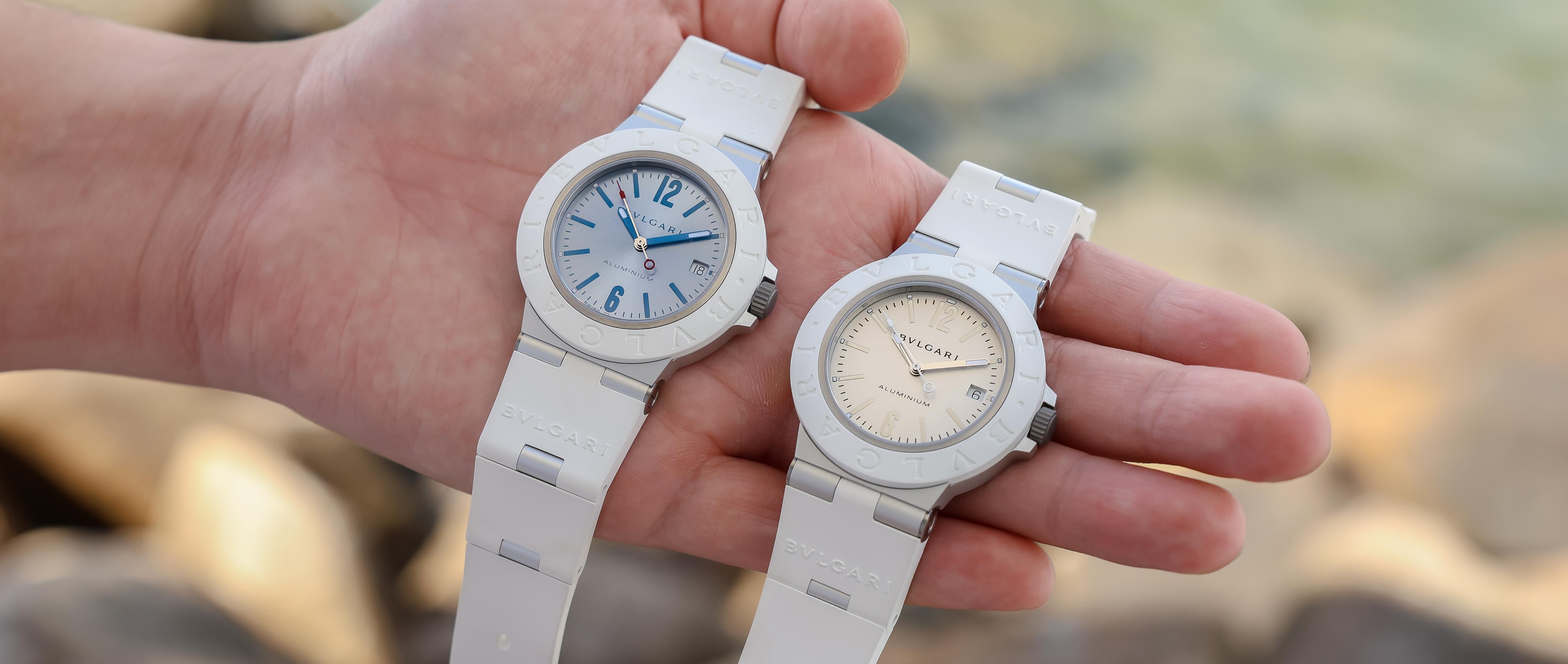
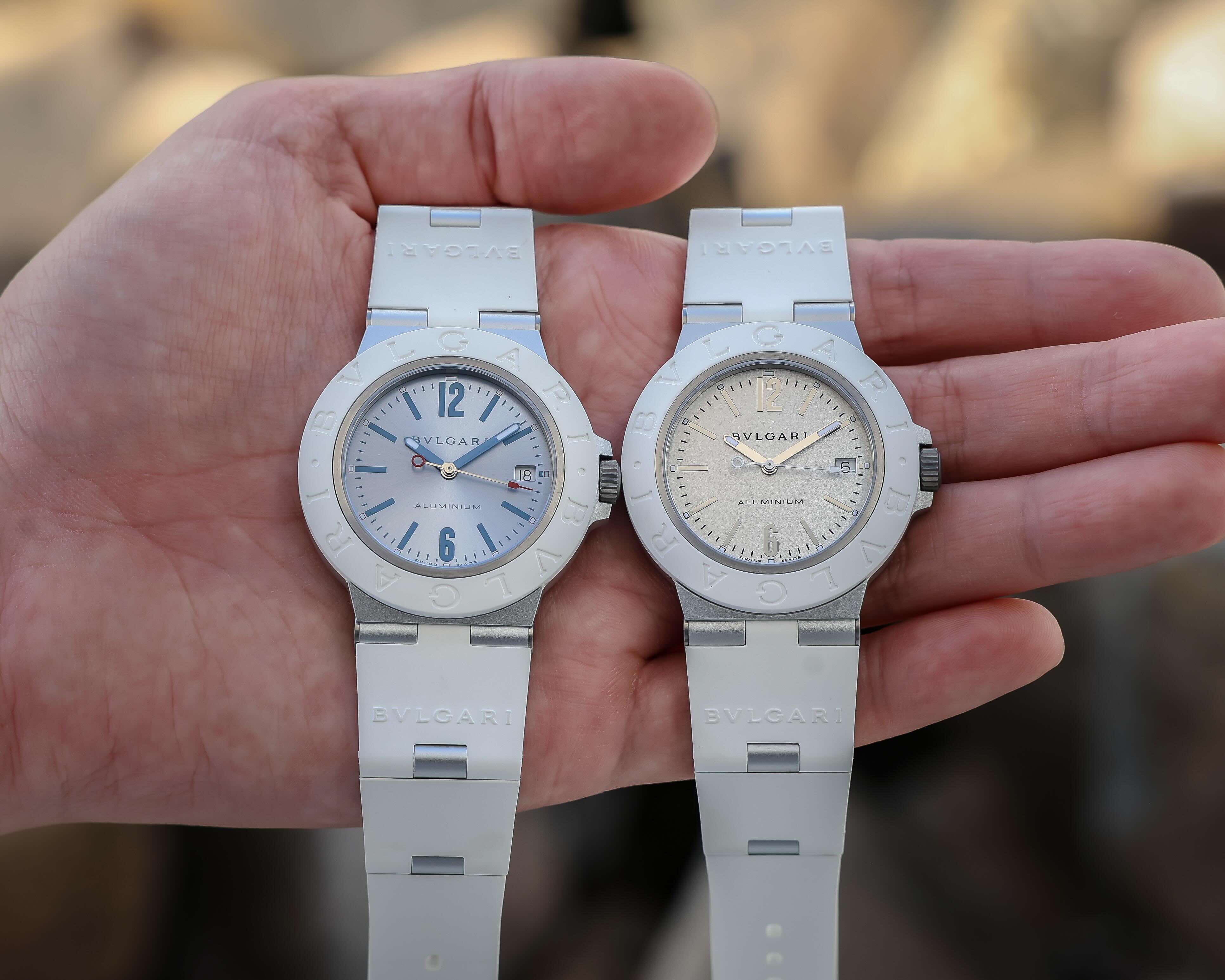
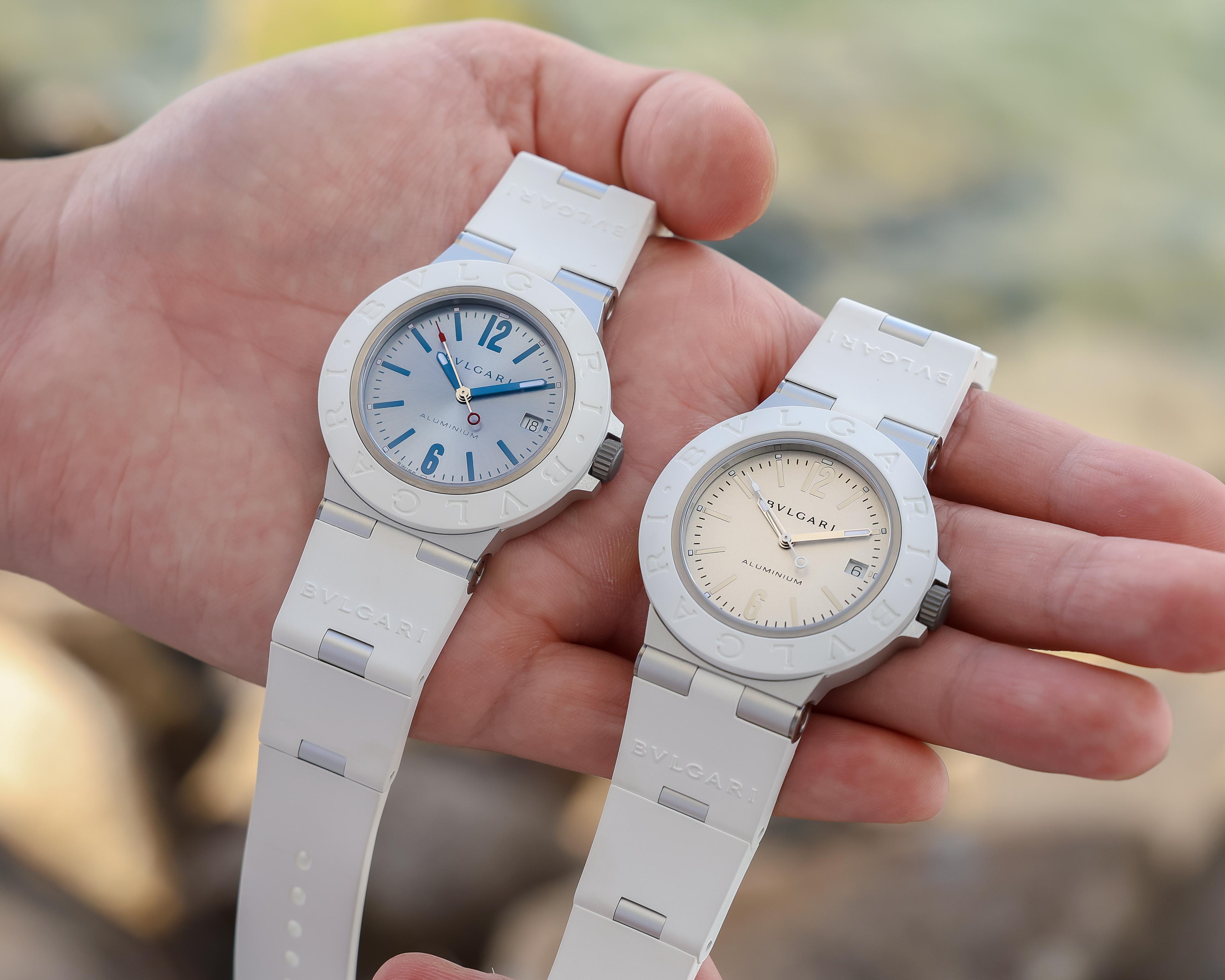
We’ll start with the most familiar aspect of the watch, though, which is the dial. The first choice available to you is a sunray-brushed ice blue, complemented by applied indexes and Arabic numerals in a shade darker. The hour and minute hands match the indexes and numerals in the slightly darker blue shade. Meanwhile, the seconds hand adds a welcome pop of contrast, with red across the tip and circular counterbalance.
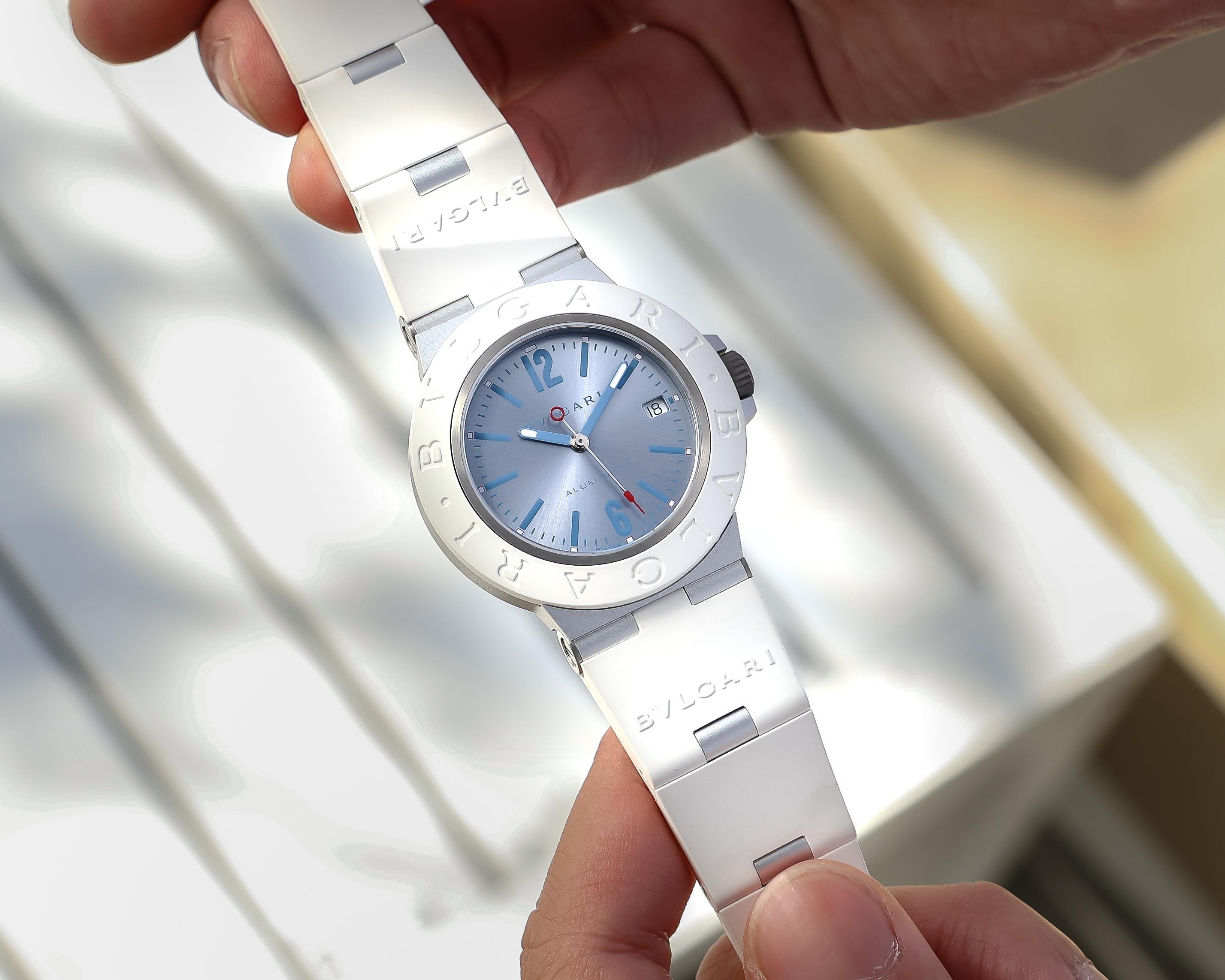
Ice blue seems to be the flavour of the decade, and Bvlgari is the latest to jump on the bandwagon. Not to say that’s a bad thing, though; that would be like saying a song is bad because it’s popular. In that sense, and as a deviation from the grey-white palette of the case and bracelet, it works perfectly well on the Bvlgari Aluminium. The only other intrusions to the dial are the small white plots of lume placed behind each index and numeral, the printed minute track, and the three o’clock date window in white for legibility.
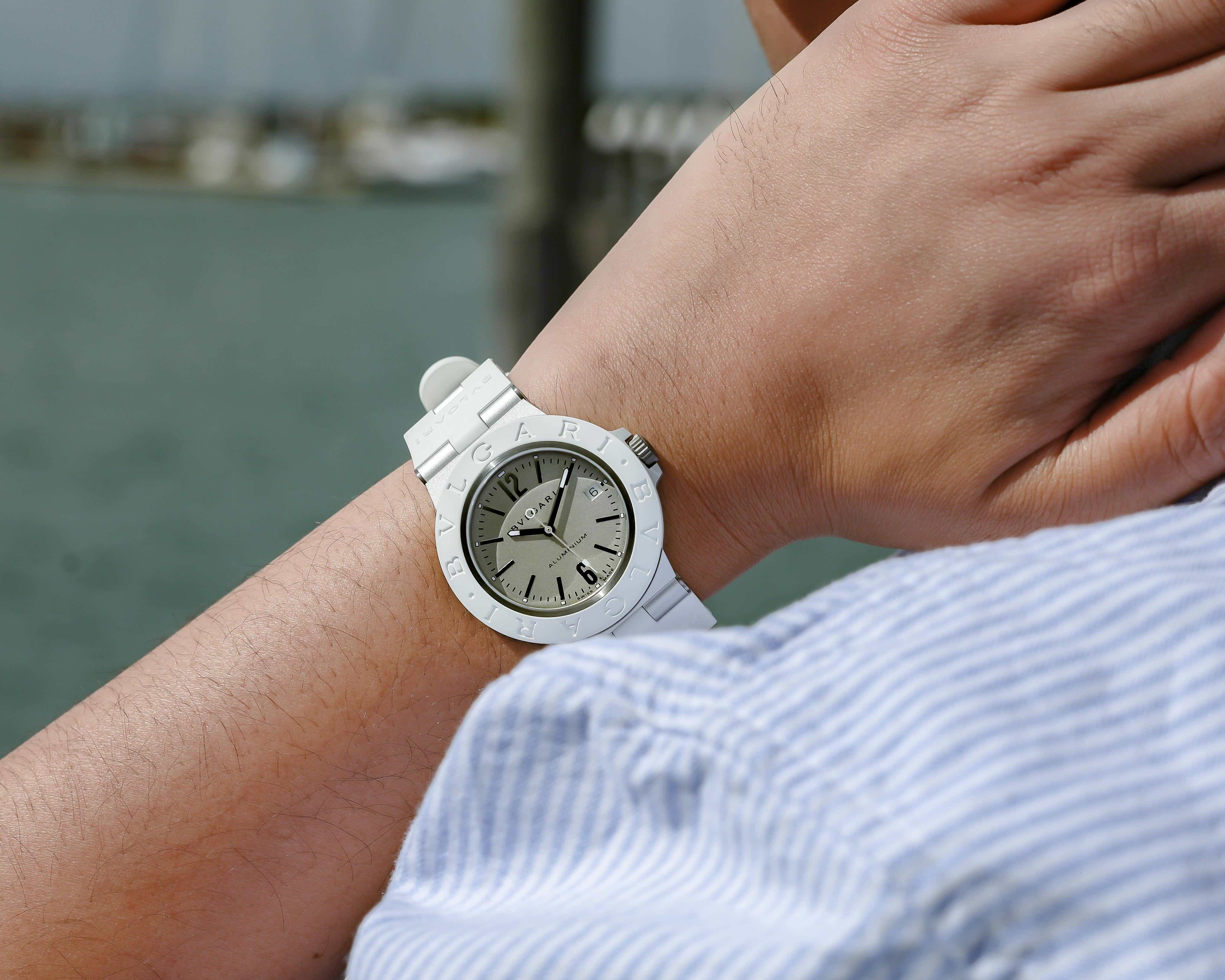
But if you like a more uniform set of features, fear not: Bvlgari’s standard Aluminium collection has you covered. This second reference does away with the sunray-brushed ice blue, replacing it with a white opaline dial and classic rhodium-plated accents. It doesn’t have the same radiant brilliance as the ice blue, but the opaline twinkles and shines on its own, making it stand out among its peers. Somewhat ironically, I found that the opaline dial looked far better in direct sunlight, while the sunray-brushed ice blue dominated in the shade.
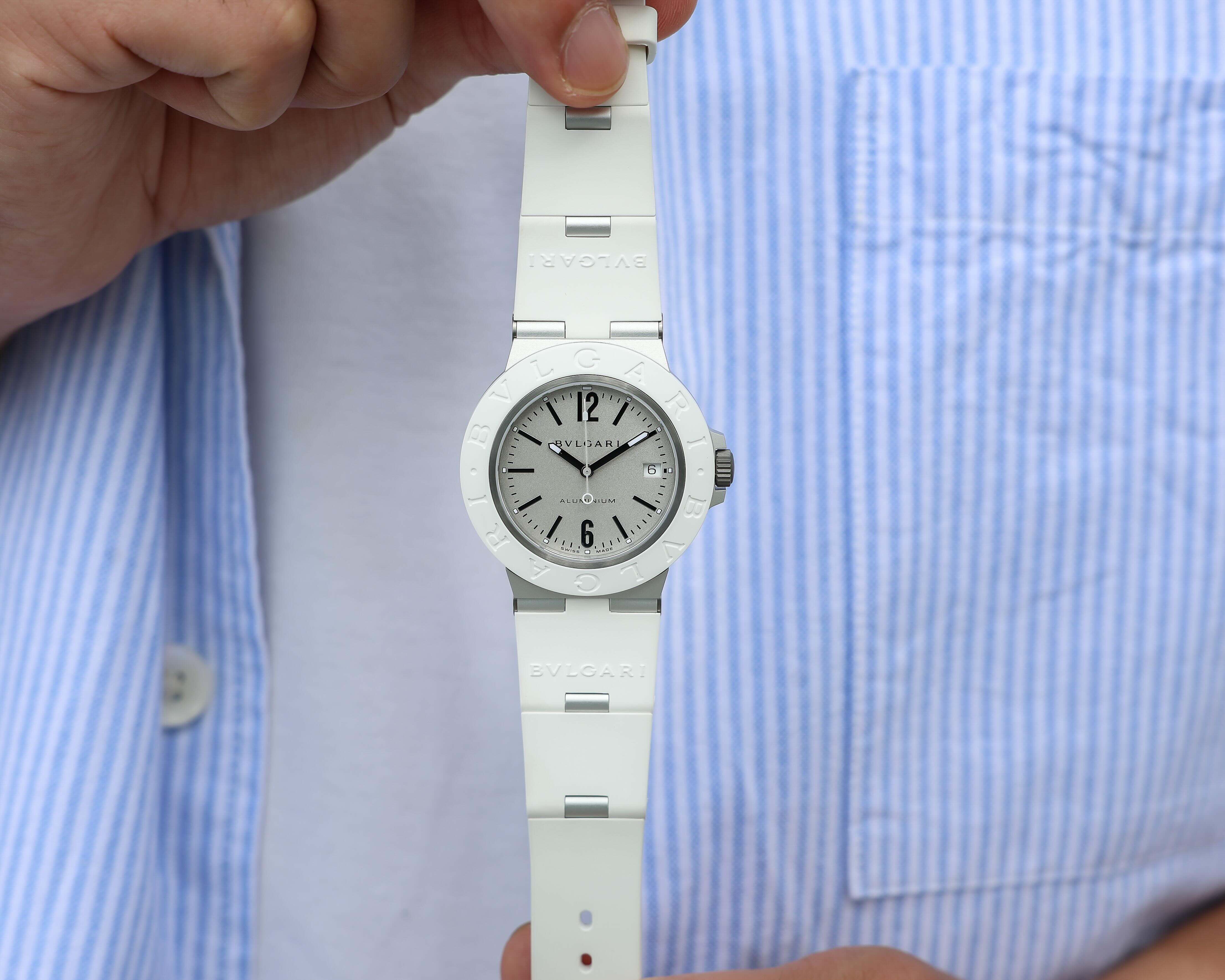
While I have no major issues with the dial layout, which is as standard as they come, I will say that more lume could perhaps have been applied. Not that I want the watch to meet the same standards as a diver, but I think full lume on the hands could have been warranted, and wouldn’t have disrupted or distracted from the case’s crowning features.
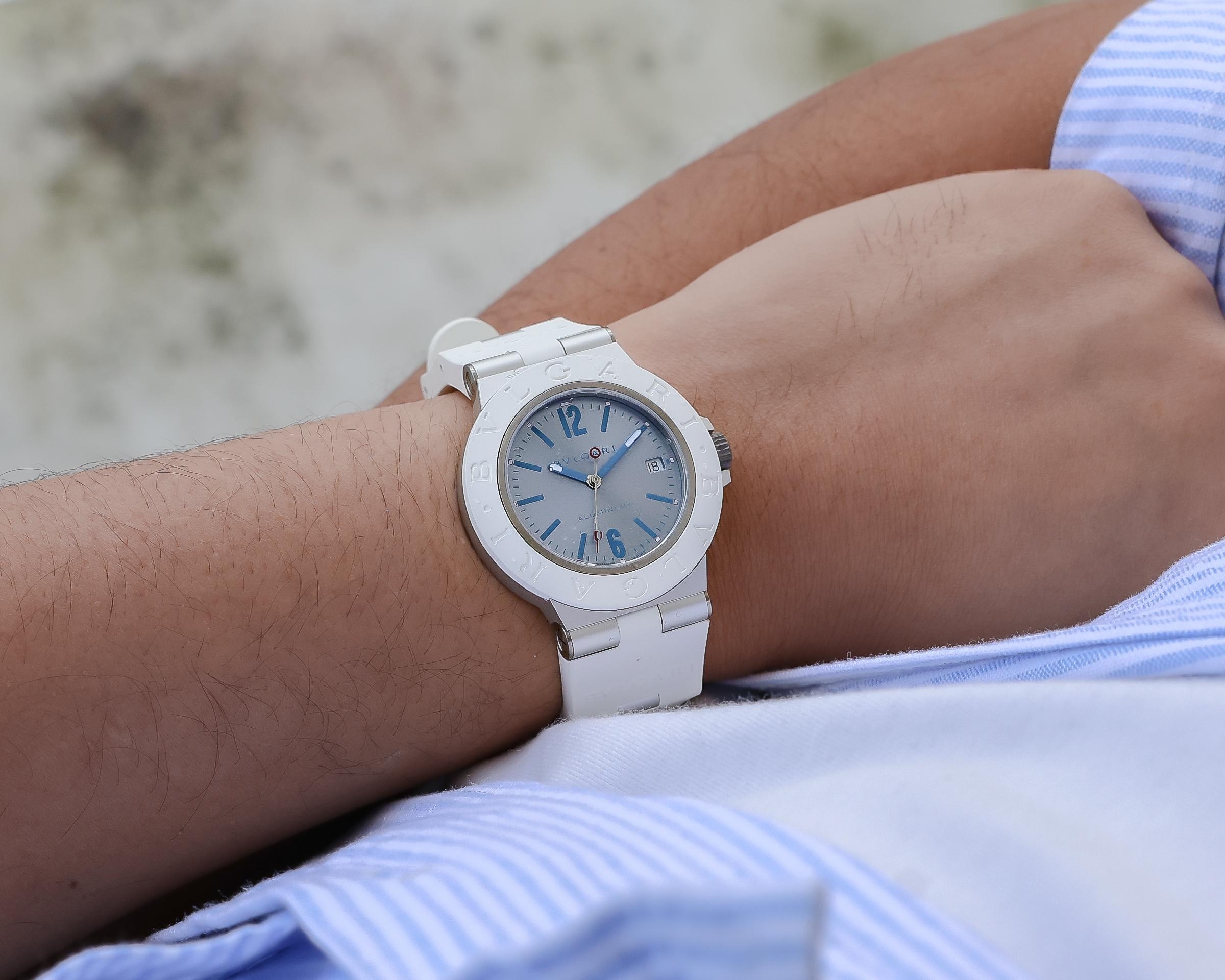
Speaking of those crowning features, both watches come outfitted in one of the most interesting case silhouettes I’ve ever come across. Moving outwards from the dial, you’re greeted by a radially brushed ring of aluminium, encased further by a thick white rubber bezel. Embossed with a bold ‘BVLGARI/BVLGARI’ typeface, it makes way for slightly hooded tubular lugs and a crown, itself surrounded by a set of crown guards. The matte, bead-blasted aluminium complements the similarly matte bezel, and falls sharply downwards with minimal chamfering.
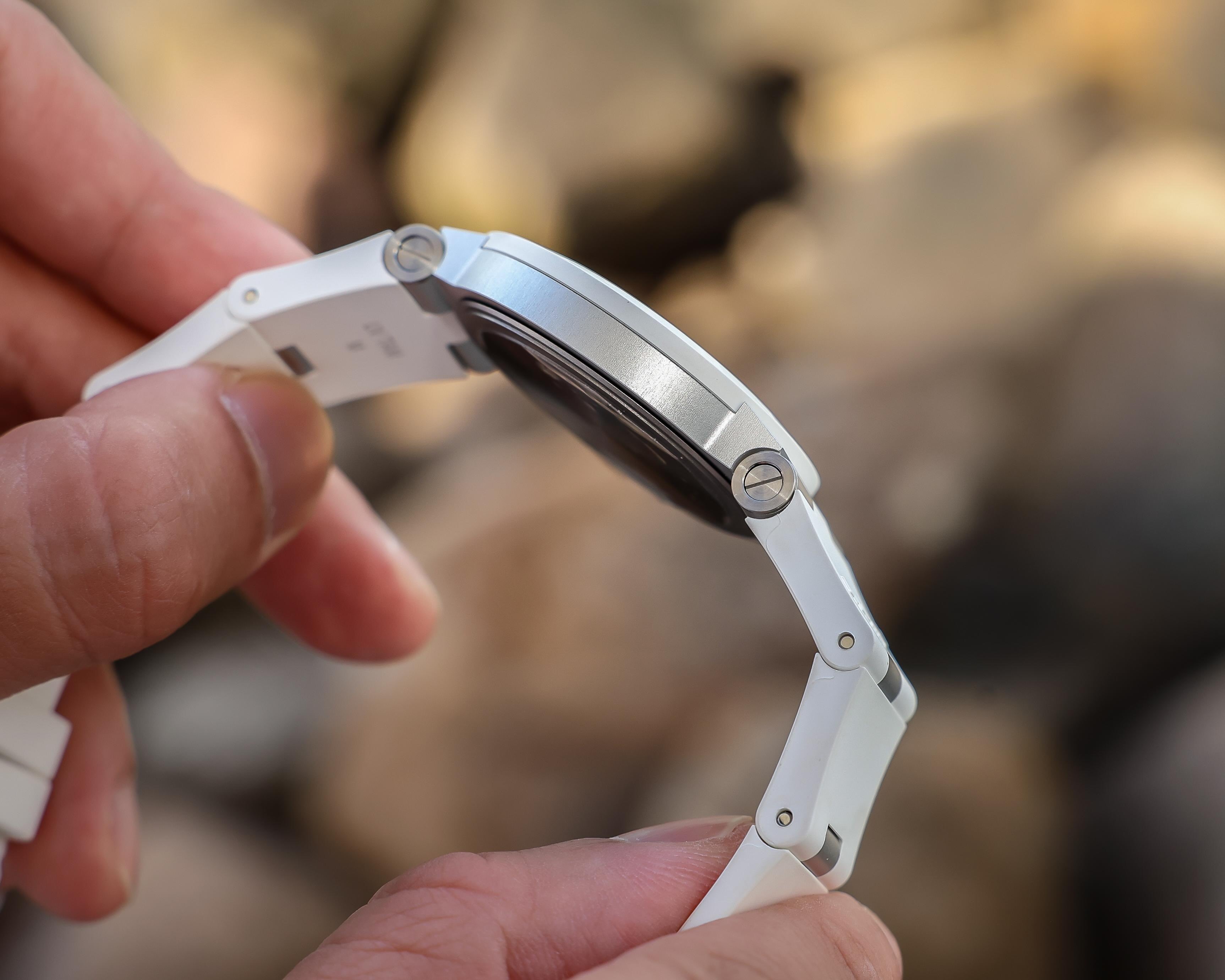
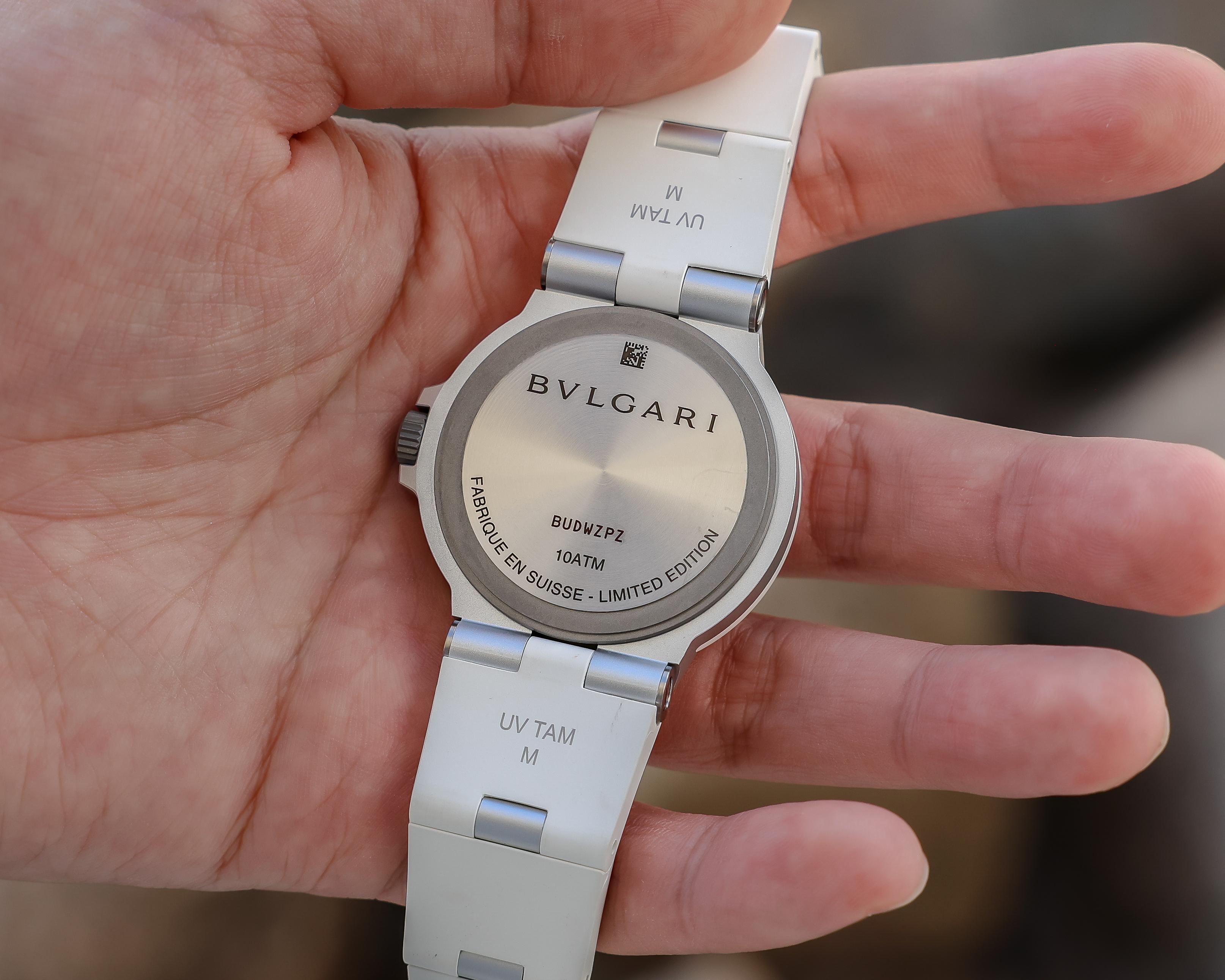
Turning the watch around further cements the simplicity: a bare, radially brushed titanium caseback possesses all the typical serial text. Flowing out from the lugs is the Aluminium’s strange strap arrangement, set in white rubber with a pair of articulating aluminium links on each end. Ending in an aluminium buckle that mimics the rounded lugs, it’s a delightfully campy, sporty look, but one that is steeped in a surprisingly deep heritage.
You see, the Aluminium didn’t launch as its own standalone line, but as an offshoot of the Bvlgari Diagono. Introduced in 1988, the Diagono paved the way for the more maximalist design cues of the Aluminium, such as the tubular lugs and general case profile.
You might think the Bvlgari Diagono also introduced that bold bezel shape, a logical but incorrect assumption. In fact, that bezel was introduced in 1975 by none other than Gérald Genta for the Bvlgari Bvlgari and Bvlgari Roma models, from which he took inspiration from an ancient Roman coin.
For a watch that looks as ambitious as the Aluminium, Bvlgari have put a significant amount of themselves into the overall design, which might be missed by those who judge the watch at a surface level. It won’t be everyone’s cup of tea, but Bvlgari’s intent with the Diagono and Aluminium was to showcase their passion for industrial, neo-futuristic design. Thus, even from the surface level, these watches maintain the compelling silhouette that’s caught the attention of watch enthusiasts for nearly thirty years.
How It Wears
But with such an ambitious design on the hands, how well does the wearing experience translate to the wrist? The result was certainly interesting, to say the least. The Bvlgari Aluminium doesn’t quite wear like anything else I’ve ever worn, and yes, I am aware I’ve been saying that ad nauseam. However, it doesn’t make it any less true.
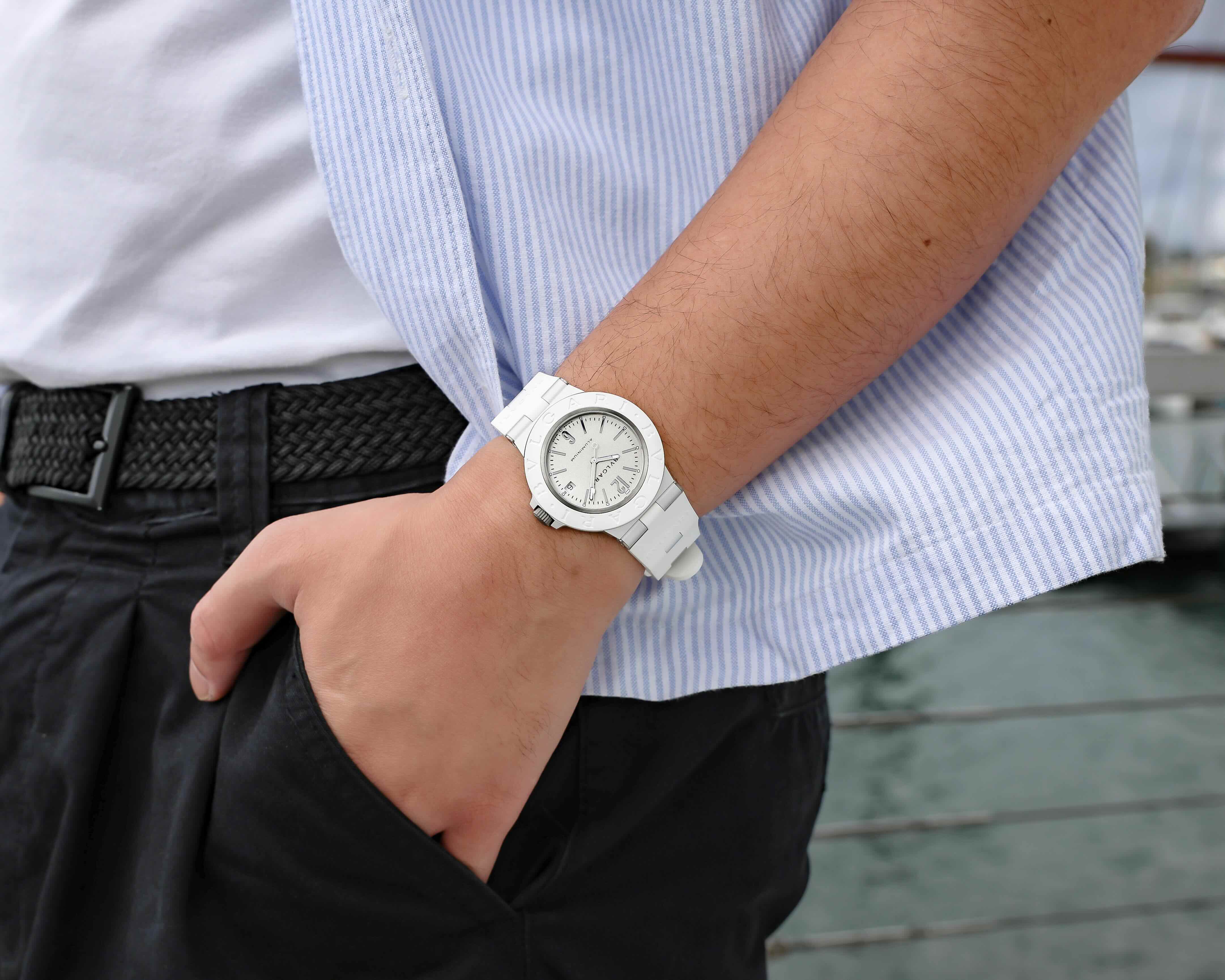
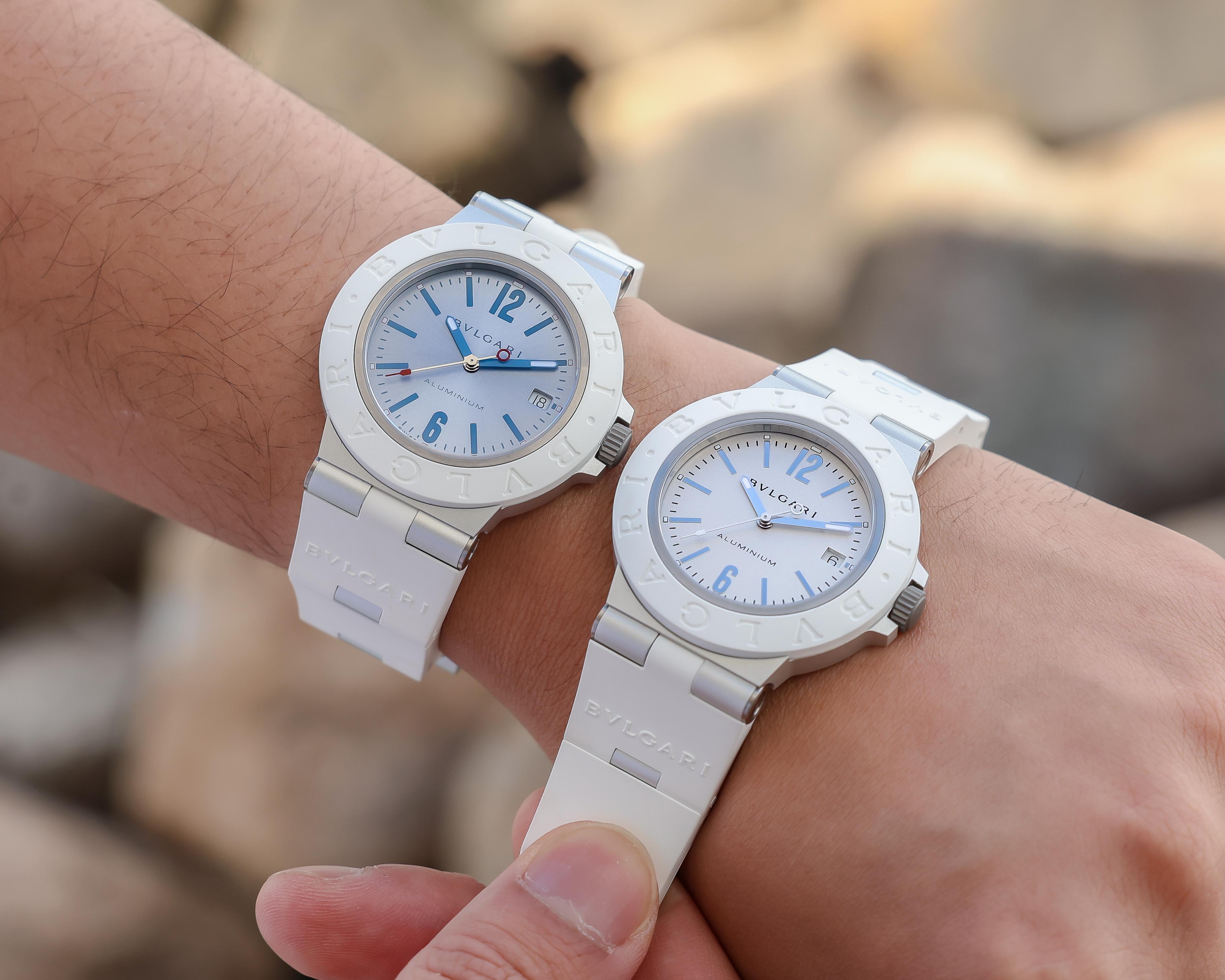
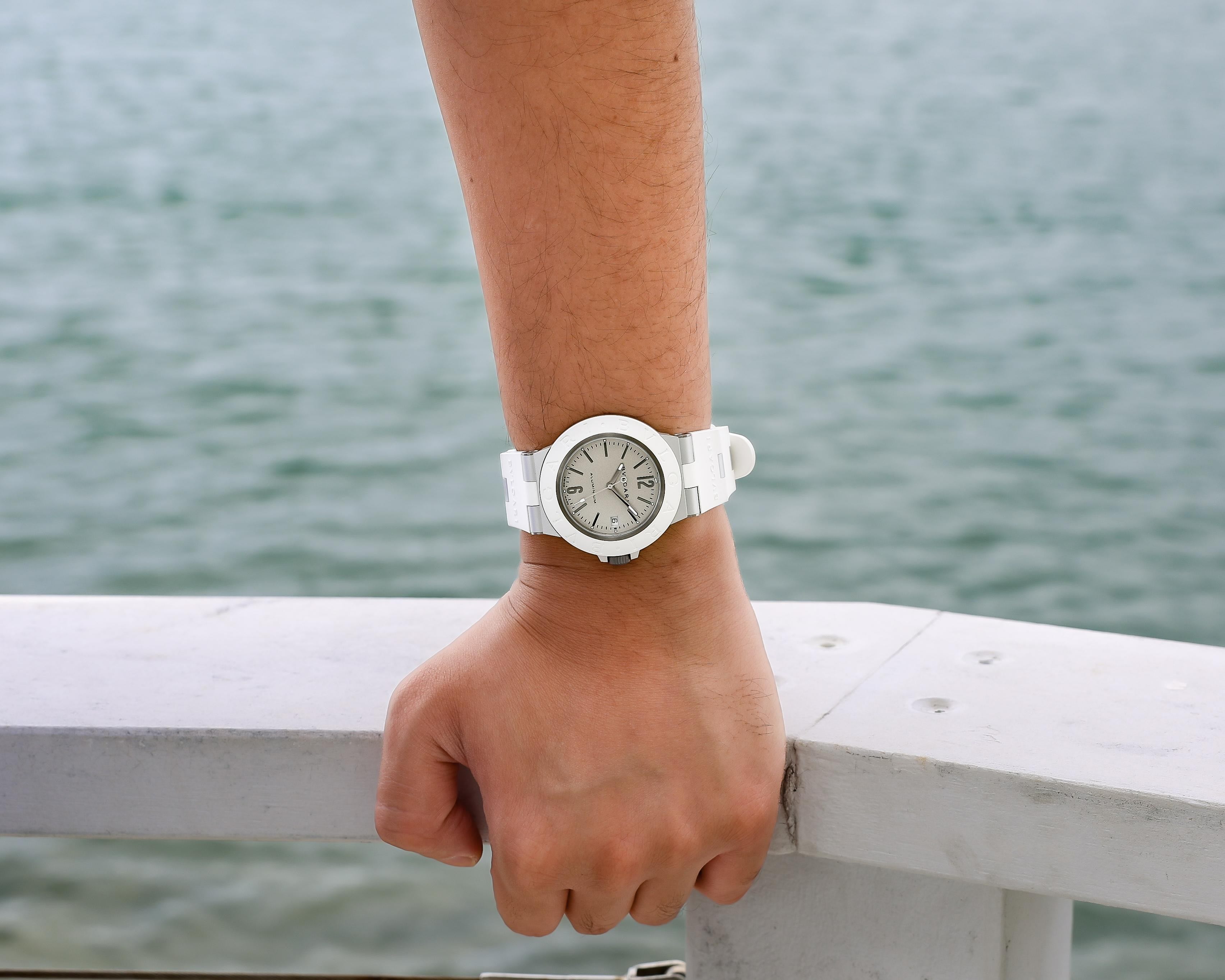
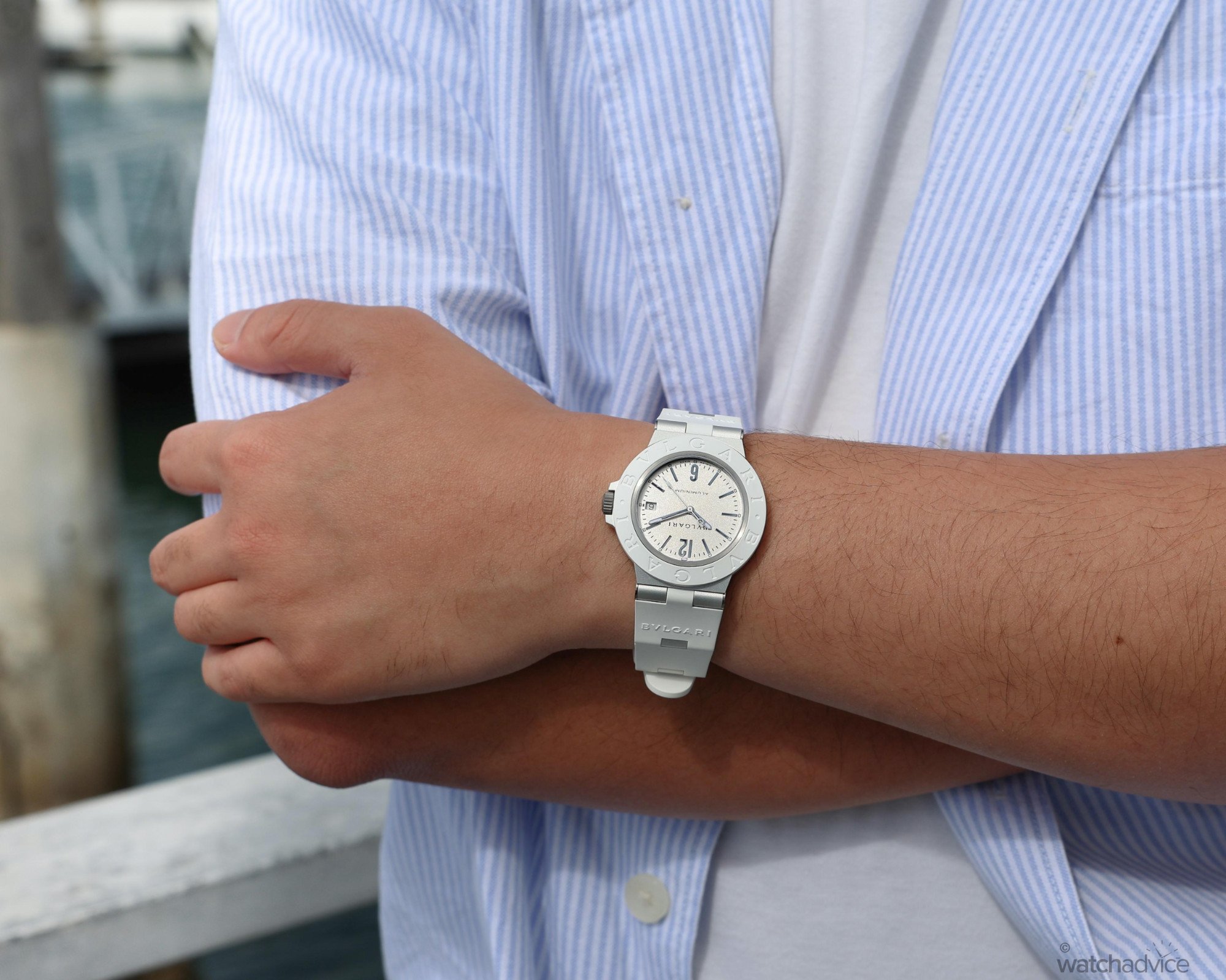
Standing at 40mm in case diameter, 48mm lug-to-lug, and 9.4mm thick, the duo of watches wears slim and low to the wrist. The slab sides of the case, as well as the perfectly rounded centre, make for a timepiece that wears about as true to size as you’d expect, maybe even smaller. In the lead-up to this review, I even had to repeatedly research the case diameter to make sure it was correct, because it certainly didn’t feel like it.
Perhaps the most inspired choice in the watch, amongst fierce competition, is Bvlgari’s use of aluminium as the case material, save for the caseback. While aluminium is typically known for industrial-grade applications, such as aerospace or even cans of soft drink, Bvlgari interspliced it with rubber to demonstrate that even everyday materials can be used in the luxury industry. Not only that, but aluminium provides the same lightweight feel you get from titanium for a fraction of the price.
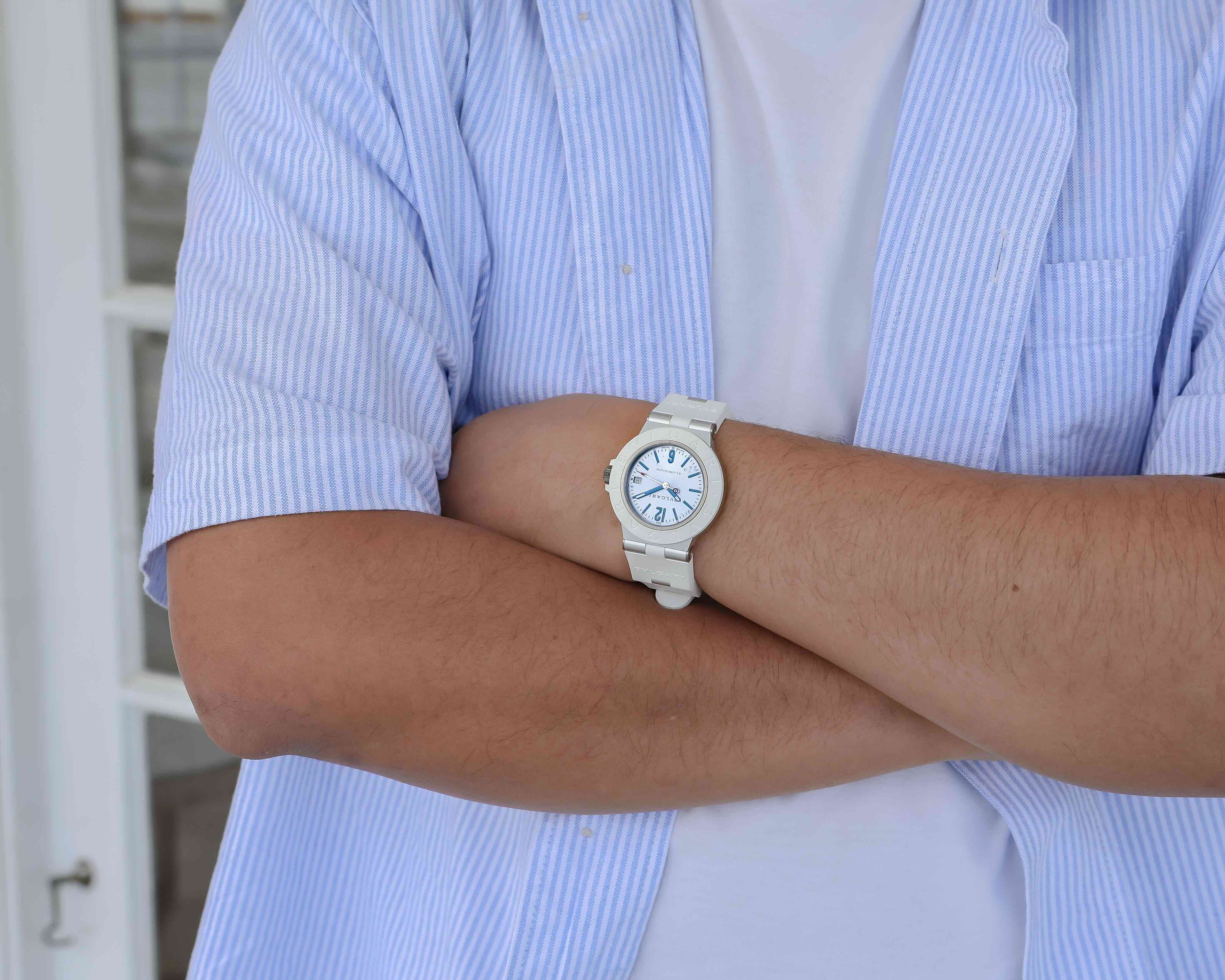
So, why don’t more watches in the industry use aluminium as a baseline? Well, a few reasons. One: the gold standard for the watch industry, 316L stainless steel, is typically harder than aluminium. That means scratches, dents, and chips are going to be much harder to get on a stainless steel watch than an aluminium one. The second challenge is corrosion; steel has much higher resistance to corrosion, especially from sources like saltwater or other marine settings. Again, solved. The third is completely subjective, where some watch lovers prefer the weight and presence of steel over a lighter aluminium or titanium watch.
While this might seem like a case of flying too close to the sun for Bvlgari, the brand has had the foresight to use aerospace-grade aluminium alloys for superior scratch and corrosion resistance. It’s more than capable of protecting itself, though it’s also supported by the smart use of titanium in the crown and caseback alongside the white rubber. Perhaps that’s why it’s rated to 100m of water resistance, an emerging standard for sports watches, so I wouldn’t be afraid of wearing it daily. Maybe just don’t stick it in the microwave – I’m sure you’ll manage to avoid that.
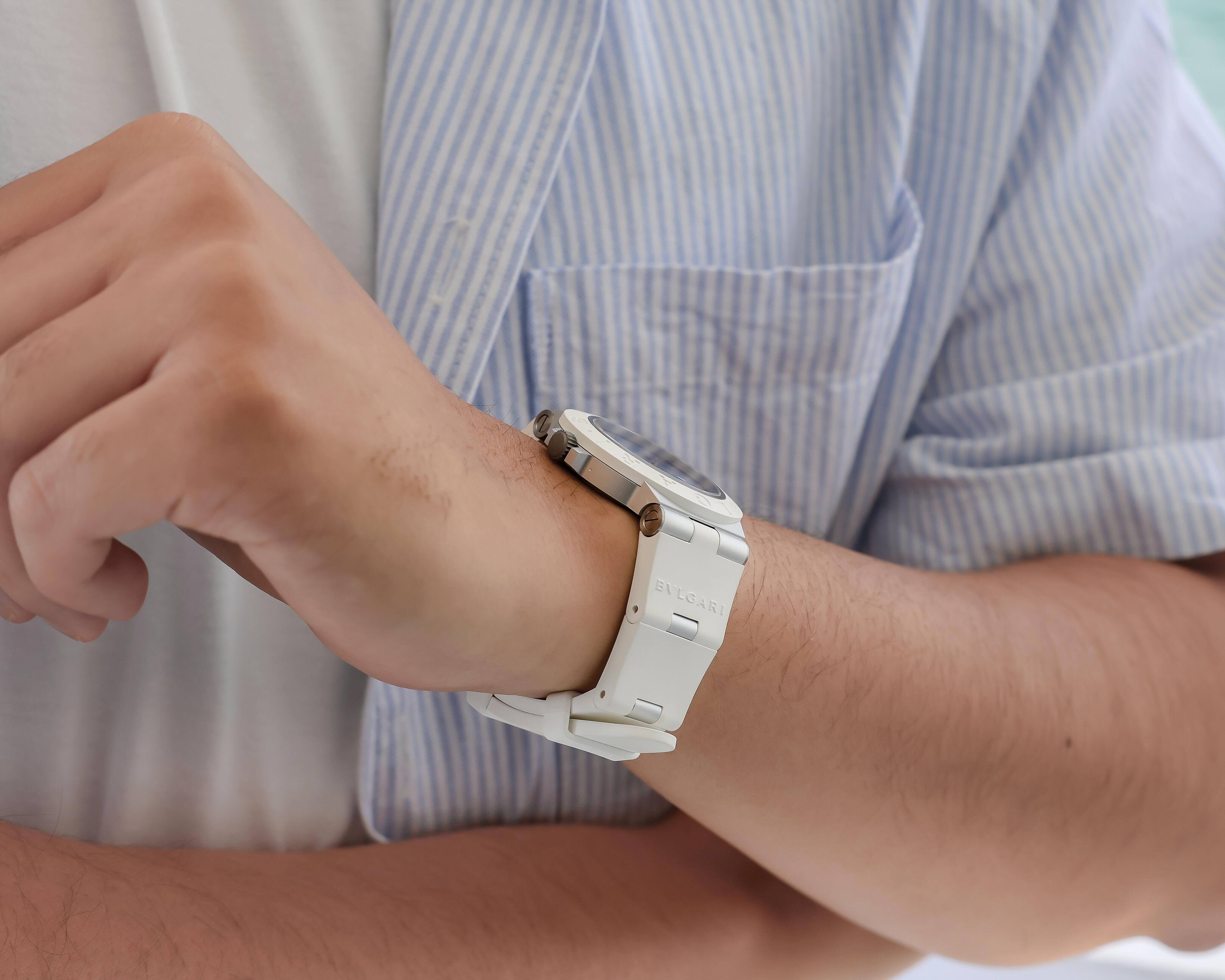
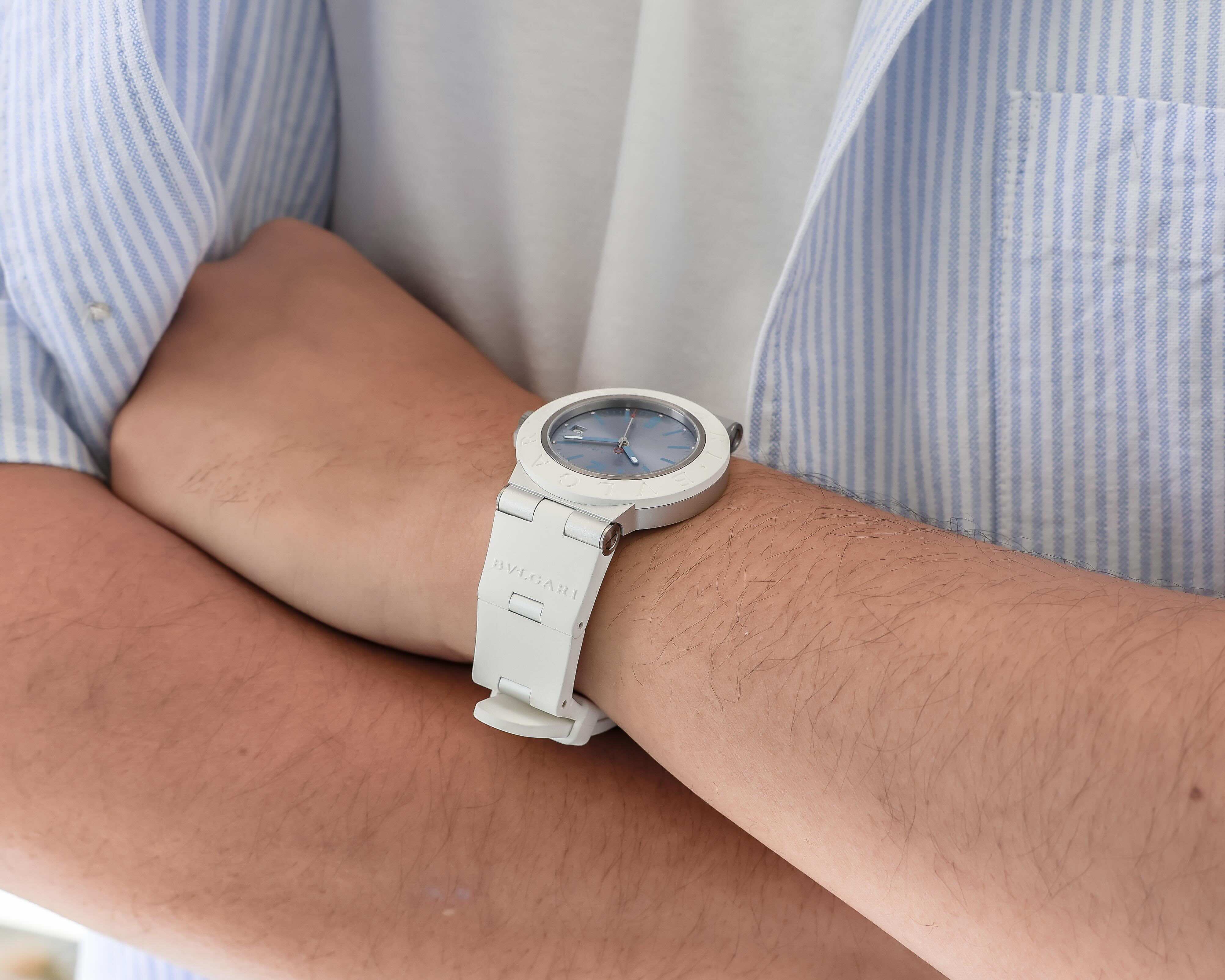
In any case, the extension of the case into the tubular lugs and strap feels both comfortable and intuitive. I did find some trouble wearing it with a jacket and long shirts, though, as the lugs do tend to get caught in a sleeve if you’re wanting to pull it up and check the time. If it were a heavier watch, this would be a big red flag, but the aluminium and rubber make rectifying this issue easy. Perhaps if the tubular lugs were a little smaller, it may help.
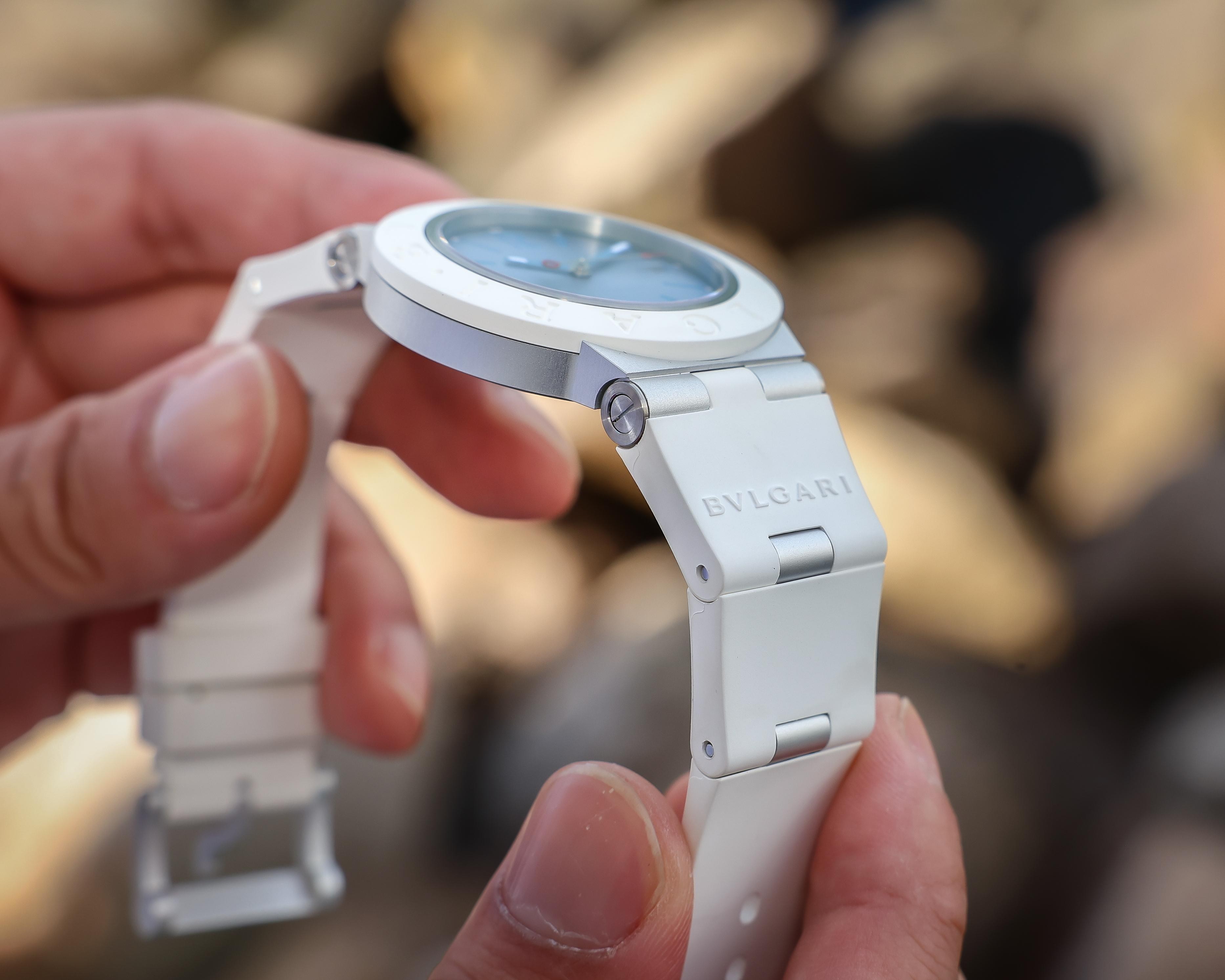
But finally, we get to the million-dollar question: What is up with that strap? Well, it’s not as unusual as you might think. The segmented rubber-aluminium links aren’t just a fun design choice, but also a remedy in function. Most rubber straps are pulled taut as they curl around the wrist, which can cause them to spring outward unexpectedly as you remove the watch. The Bvlgari Aluminium’s segmented strap eliminates this problem entirely. It’s a wild visual to get used to from the side, wrapping and flaring around the wrist like a giant robotic finger, but there’s no denying the comfort it provides.
As a complete package, wearing the Bvlgari Aluminium day-to-day felt strange at first, largely due to the case material and strap. But the longer I wore it, the more appreciative of the experience I became, coming to understand how the eccentric design became one of Bvlgari’s most beloved provocateurs.
The Movement
For this duo of Bvlgari Aluminium watches, the brand has incorporated the same movement as the rest of the three-hand collection: the Calibre B77. Beating from within the closed titanium caseback, the Cal. B77 operates at the luxury standard beat rate of 4Hz (28,800VpH), atop a reasonable 42-hour power reserve.
If the stat sheet sounds familiar, then you’d be correct. The Cal. B77 is Bvlgari’s interpretation of the classic ETA 2892-A2 architecture, a tried-and-true movement base that has been replicated throughout the watch industry. Just like my review of the Hublot Classic Fusion Black Magic Chronograph, Bvlgari’s inclusion of ETA-based architecture has been hotly debated by the watch community. But while I err on the side of concern, I understand its use given the watch’s positioning within the wider catalogue.
I see it in the same way a watch like the TAG Heuer Formula One collection is positioned within its hierarchy: as a relatively accessible and disruptive entry into the brand’s horological heritage. One of the major promotional photos on the website even depicts the Aluminium at a skate park, which gives further credence to the youthful character of the model line.
So, should an out-of-house movement be a turn-off for a watch? Absolutely not, no matter the brand. In the case of the Bvlgari Aluminium, I think the Cal. B77 makes sense for the watch’s positioning and intended character. That said, it does leave me curious about what a future generation of the Aluminium might look like with a more extensively developed movement.
For a brand of Bvlgari’s size and horological ambitions, there is certainly scope for the Aluminium to evolve alongside the rest of the catalogue. Such a development would inevitably require considerable time and investment, and I wouldn’t expect it to happen overnight. Nevertheless, the prospect of a movement upgrade is an exciting one, even if it were to bring a modest increase in price.
Final Thoughts
After spending some quality time with these two Bvlgari Aluminium models, I can see why it became such a cult classic in its category. From the outset, it seems so out of place. With the brand’s close association with figures of refinement like Elizabeth Taylor and Anne Hathaway, a collection like the Aluminium might seem completely left-field.
Yet, it’s a distillation of Bvlgari’s deep horological heritage, presented in a singular, unexpected manner for an equally unexpectedly wide audience. For that, the Aluminium has earned my respect. I came in not knowing what to anticipate, but as eclectic as the watch seems, everything falls into place when you least expect it.
But for what it is, and the price point it competes at, the competition is stiff as ever. At AU$5,650, it’s firmly positioned within that mid-market to entry-level luxury space, where a plethora of brands have consistently excelled.
In the sports watch space, the AU$5,180 Tudor Royal collection provides a COSC Chronometer-certified, in-house movement alongside the very latest in modern consumer convenience. Slightly above, at AU$6,700, is the TAG Heuer Carrera Day-Date, which offers a massive 80-hour power reserve alongside quality-of-life features like tool-less strap and link changes. Both are incredibly compelling choices if you’re going for a classic watch.
But tangibly speaking, it’s hard to compare anything to the silhouette, experience, and aesthetic of the Bvlgari Aluminium. This is where much of its appeal draws from, as an accessible and unconventional expression of Bvlgari’s design language.
Yet, there are still opportunities to compete on more fronts than design alone. Continuing to introduce incremental improvements across the collection could make an already compelling entry point even more attractive to budding enthusiasts. It may even give them another reason to stay within the Bvlgari family as their appreciation for watchmaking develops, even if it came at a slight mark-up.
Ultimately, I don’t imagine the positioning of the Bvlgari Aluminium within the brand’s hierarchy changing dramatically, nor does it really need to. Making the cult classic a mainstay can sometimes be a tall order, but the brand has been able to reintroduce the Aluminium to a modern crowd with few hiccups.
If you’re a collector looking for a unique expression of the world of watchmaking, a horological historian with an eye for deep heritage, or even a new watch lover seeking out a timepiece with an urban flair, the Bvlgari Aluminium offers all three. Just in time for summer Down Under, you might want to give this one a try for yourself. Trust me – you’ll be surprised!
References & Specifications
| Feature | Specification |
|---|---|
| Reference | 104309 (Ice blue) 104335 (White) |
| Dimensions | 40mm case diameter x 48mm lug-to-lug x 9.4mm thickness |
| Case | Aluminium with white rubber bezel |
| Dial | Sunray-brushed ice blue with red accents White opaline |
| Crystal | Sapphire |
| Caseback | Closed, brushed |
| Movement | Automatic Cal. B77 with date complication |
| Power Reserve | 42h |
| Beat Rate | 4Hz / 28,800VpH |
| Water Resistance | 100m / 10bar |
| Strap/Bracelet | White rubber & aluminium link strap with aluminium pin buckle |
Australian Retail Price: $5,650
Availability: Special Limited Edition (Ice Blue). Available now, at Bvlgari boutiques, authorised dealers, or online at Bulgari.com
Image Gallery