

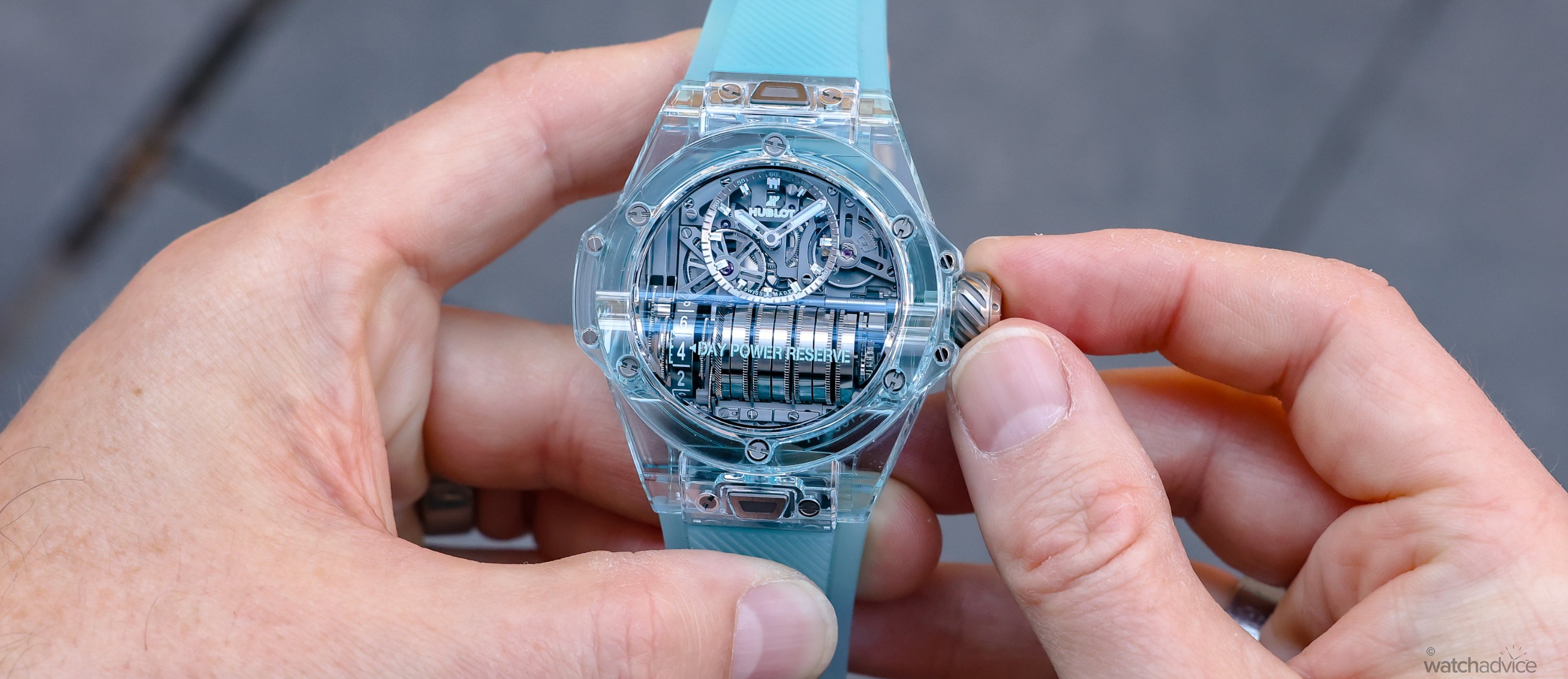
The Hublot Big Bang MP-11 forms part of Hublot’s Manufacture Piece collection, and for good reason. Now, it’s time to take it out for a test drive…
What We Love
- The Water Blue colour is sensational in person
- The movement is Hubot showcasing what it does best
- The undeniable wrist presence
What We Don’t
- It is a large watch, and not for those with smaller wrists
- The older-style rubber strap is not easy to get the perfect fit, when compared to the newer style
- Will be out of the price range for many watch buyers and is a substantial investment
Overall Rating: 8.4 / 10
- Value For Money: 8/10
- Design: 9/10
- Wearability: 8/10
- Build Quality: 8.5/10
There are some watches that look impressive in a press release, but when you finally see them in the metal, they somehow manage to be, well, less so. Then there are watches like the Hublot Big Bang MP-11 Water Blue Sapphire, where the opposite is true. The photographs give you an idea of what the watch is all about, but they really do not do it a whole lot of justice compared to when you see it in person.
The MP-11 is, like many Manufacture Pieces, out there, but for good reasons. First introduced in 2018, it was designed around a movement with seven series-coupled barrels and a 14-day power reserve, all packaged inside a relatively conventional Big Bang-style case. The Water Blue Sapphire version takes that already unconventional construction and places it inside a transparent blue sapphire case that allows almost every part of the movement to remain visible.
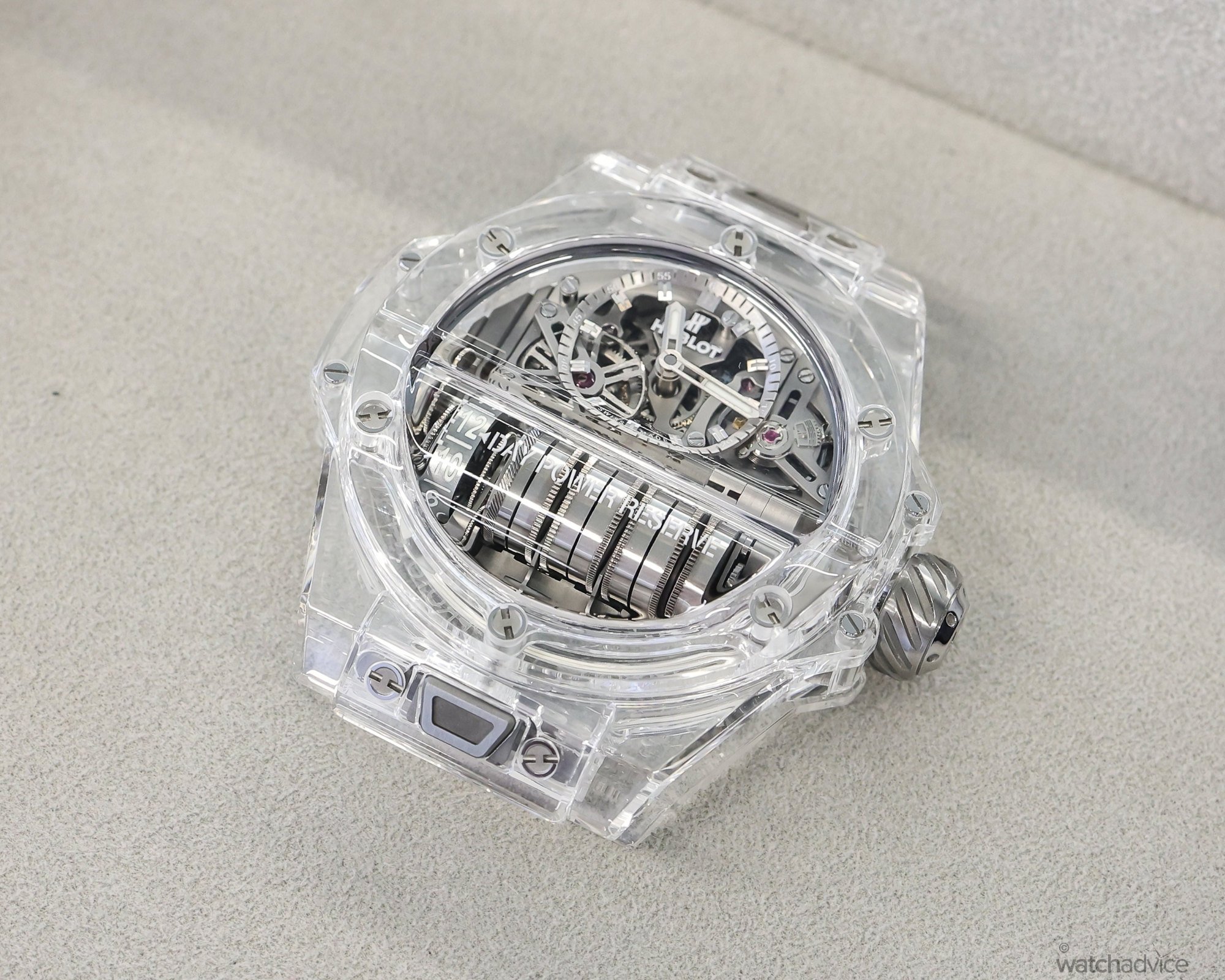
And being a full sapphire watch, you don’t really get an appreciation for what it is until you put it on your wrist. You feel the sapphire and how it creates a different sensation to steel, a precious metal or even carbon or ceramic; you see how it looks in the light, and more importantly, how it wears…
First Impressions
I first saw the MP-11 Water Blue Sapphire at Watches & Wonders in 2024. Even though I was seeing it in person, it was difficult to fully appreciate the sapphire case under the lights of the press room. Thankfully, many brands over the past few years have changed this at the fair, Hublot included, but still, nothing beats getting the watch out and about in actual daylight. So, this is what I did, wearing the Hublot Big Bang MP-11 Water Blue for a day out in Sydney.
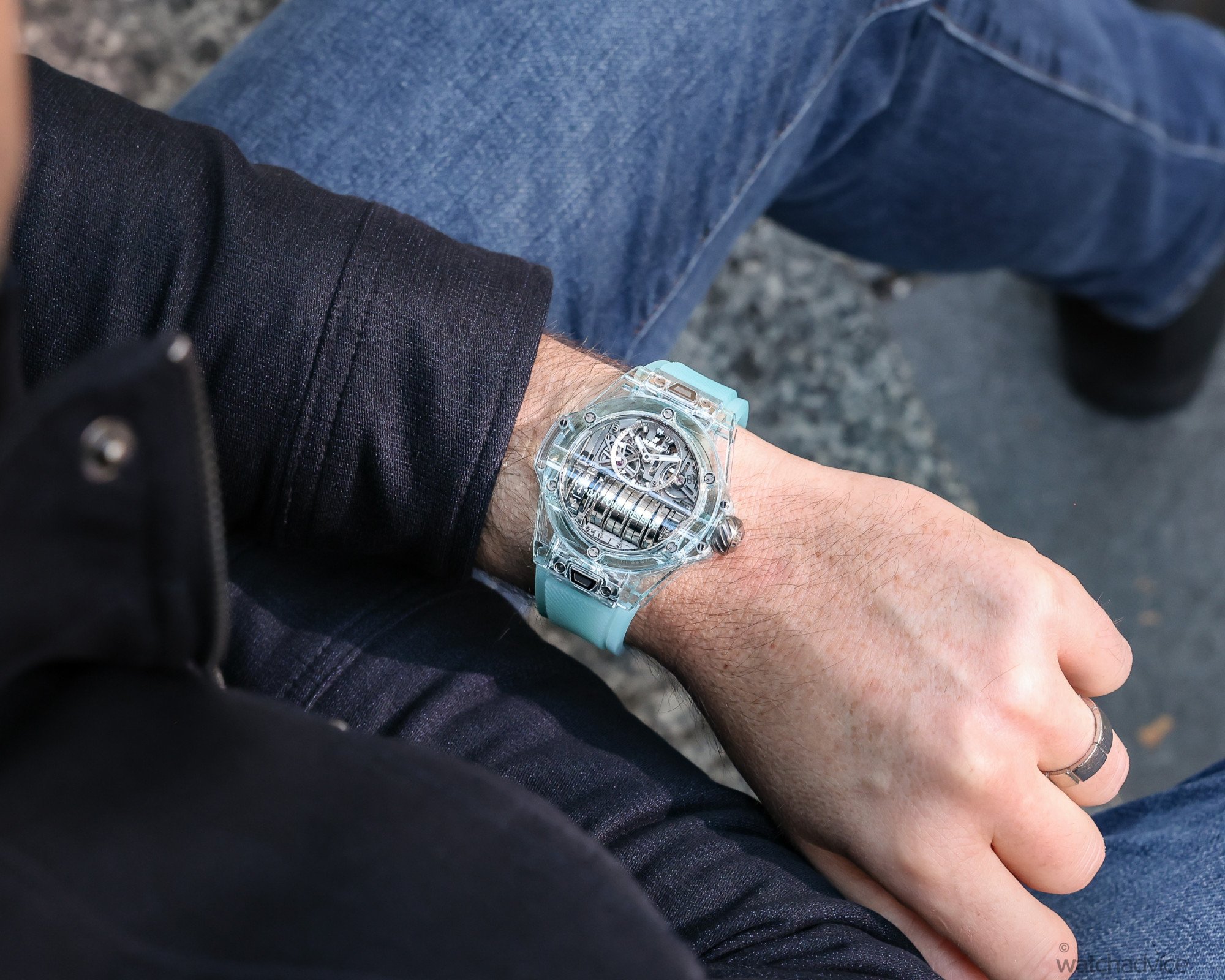
The first thing you notice is the colour. The Water Blue Sapphire is difficult to describe properly because it does not really look like the darker blue sapphire cases we have become accustomed to seeing from various watch brands. Also, when you think of blue sapphire, your mind instantly goes to those darker-looking gems. Water Blue Sapphire hits different.
The clarity of the material is exceptional, and there is a transparency to it that makes the entire case feel like it has been carved out or made from water. If you have spent any time around the Swiss Jura, or the foothills of the Swiss Alps, you will know the kind of colour I mean: the clean, almost crystalline blue you see in a clear lake or stream. It also reminds me of Lake Geneva, where the water is super clear with a bluish tinge to it.
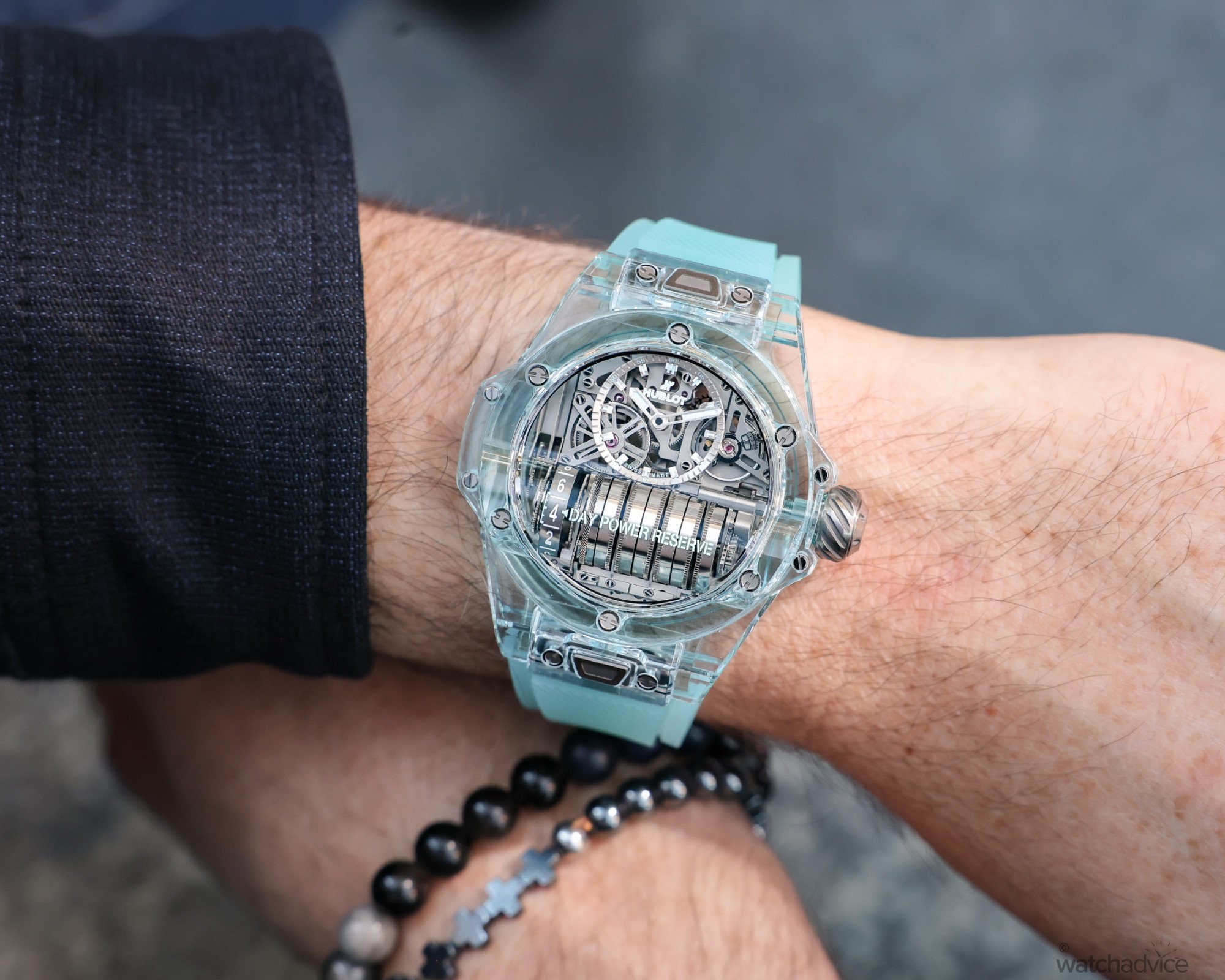
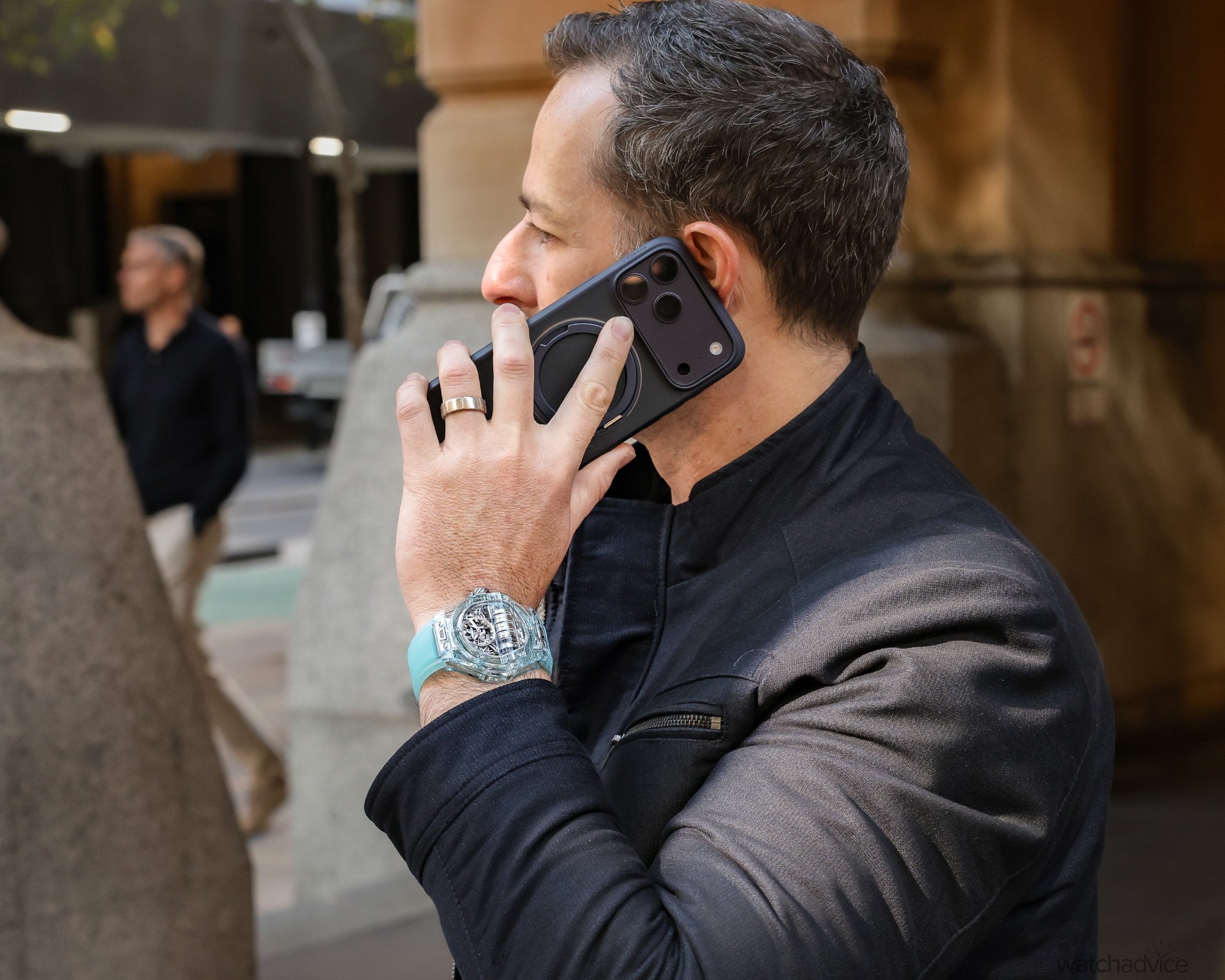
It is also a watch that is meant to be seen. At 45mm, the MP-11 has major wrist presence, and there is no disguising the fact that you are wearing something rather special. Yet the transparency of the Water Blue sapphire somehow stops it from becoming too much. It has plenty of presence, but it does not have the visual heaviness you might expect from a 45mm watch built around seven barrels.
The Design
The basic architecture of the MP-11 will be familiar to anyone who has followed Hublot’s Manufacture Pieces over the years. It takes the familiar Big Bang case shape and adapts it around a movement that was never designed to be particularly conventional. Normally we would talk about the movement in its own section in Watch Advice reviews, and I still will here, but with the MP-11, it is hard to talk about the design of the watch without talking about the movement, as it is all intertwined and there is no dial, so to speak.
The seven barrels are arranged vertically across the front of the movement, which gives the watch its distinctive appearance. This is less an aesthetic design feature than it is functional. Instead of making the movement thicker to accommodate the enormous amount of stored energy, Hublot positioned the barrels coaxially and vertically, effectively placing them in front of the movement at 90 degrees. This allows the calibre itself to remain just 10.9mm thick.
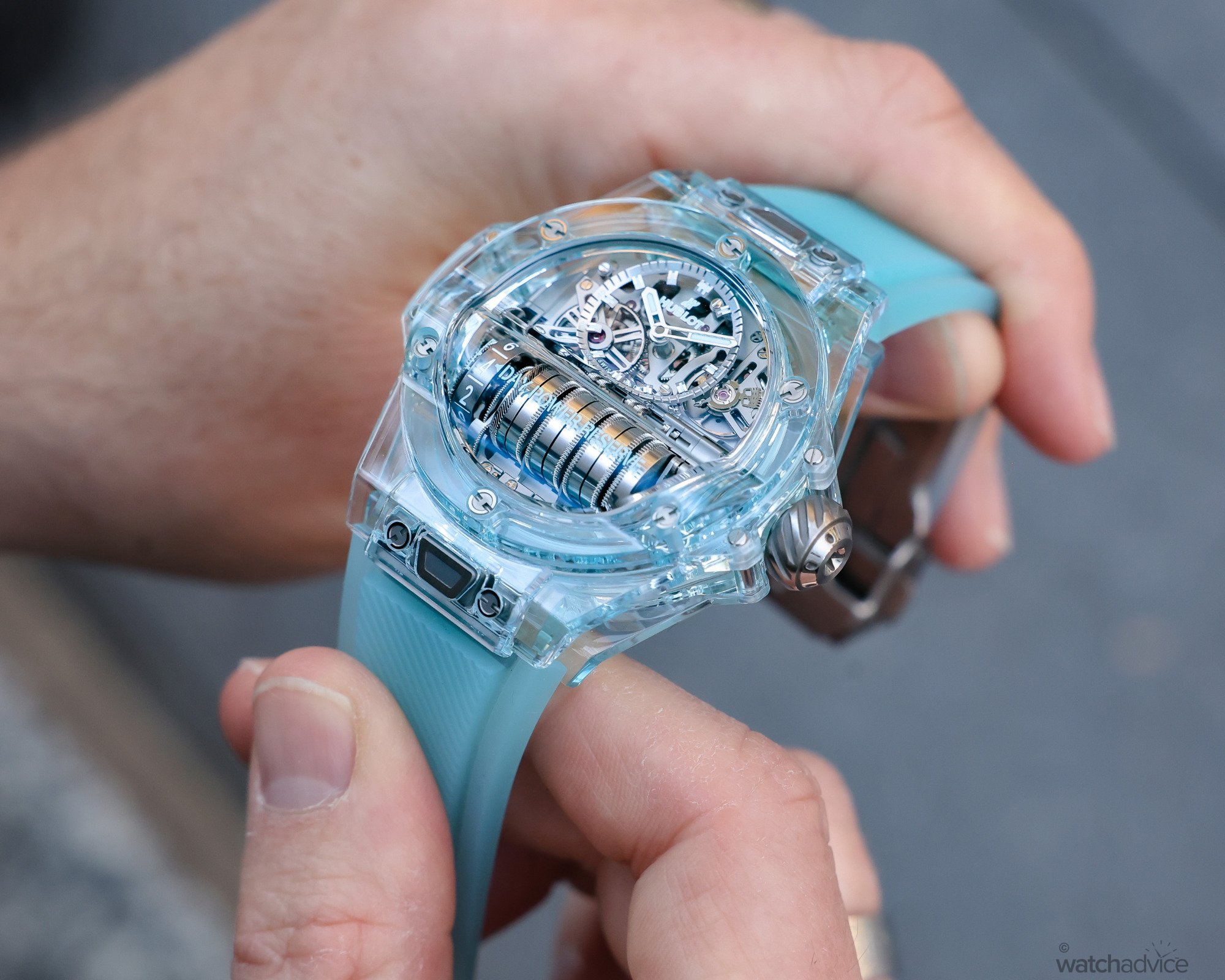
That sounds like a relatively simple solution, but it required Hublot to develop a special 90-degree transmission using a helical worm gear to transfer the energy from the barrels into the movement. The gear can be seen between 9 and 10 o’clock on the dial side, while the balance wheel sits opposite it at around 2 o’clock.
The case has then been shaped around all of this, including the curved sapphire crystal that follows the form of the barrels. It means the movement is not simply sitting inside a sapphire box, because the case itself has been designed around the mechanical architecture.
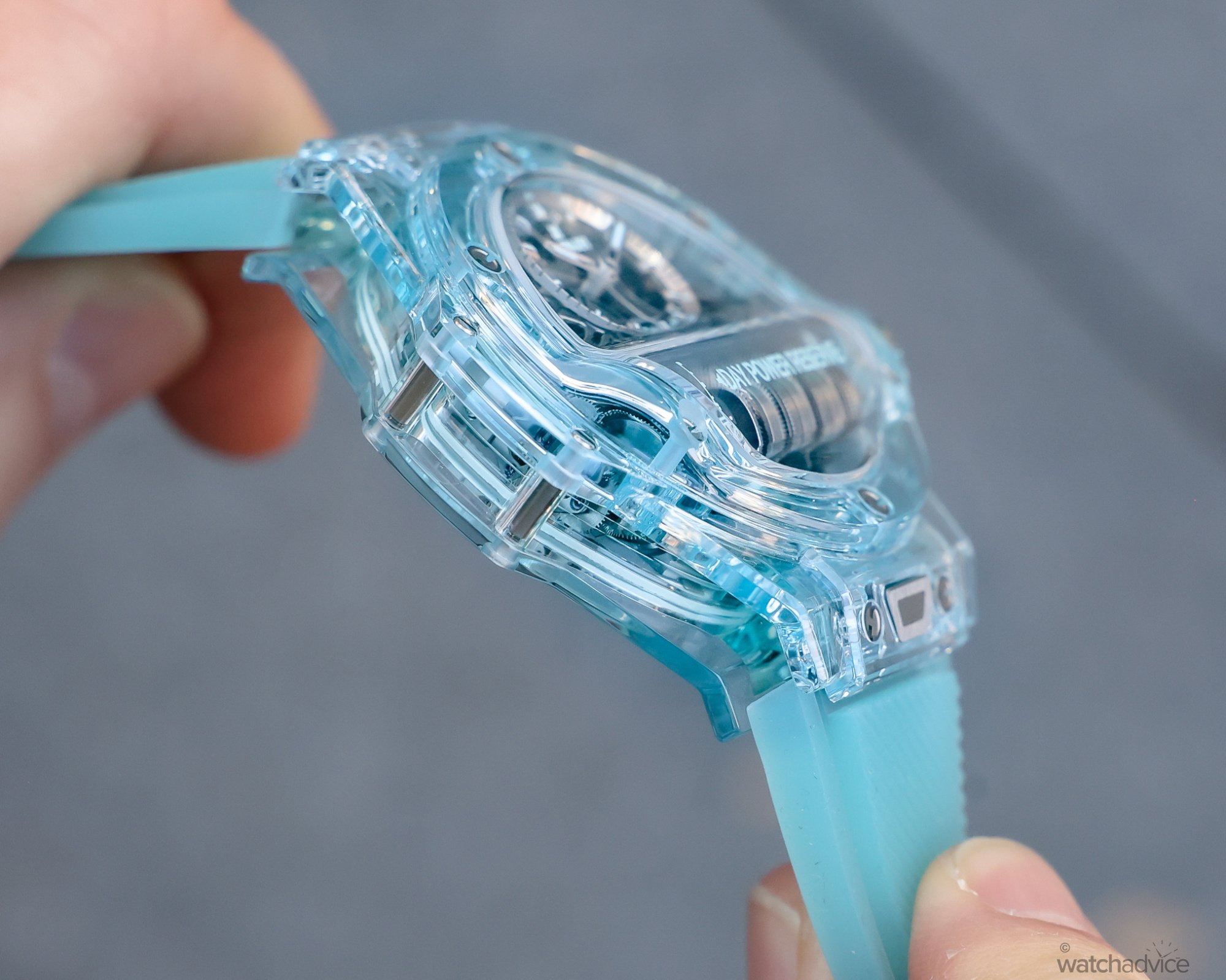
And then there is the Water Blue coloured sapphire. Hublot developed a new chemical formula and a specific transparency index for this particular shade, with the development and testing process taking several years. The material retains the scratch resistance and durability associated with sapphire, while the polishing is an important part of achieving the final appearance, with Hublot noting that this is a particularly delicate process that is generally completed by hand.
It is the combination of this colour and the openworked movement that makes the watch work so well. Because so much of the case is transparent, the overall effect remains surprisingly light. And once you get it outside and into natural light, the sapphire comes alive. The light passes through the case, catches the edges and interacts with the movement underneath, giving the watch a completely different appearance depending on how you look at it.
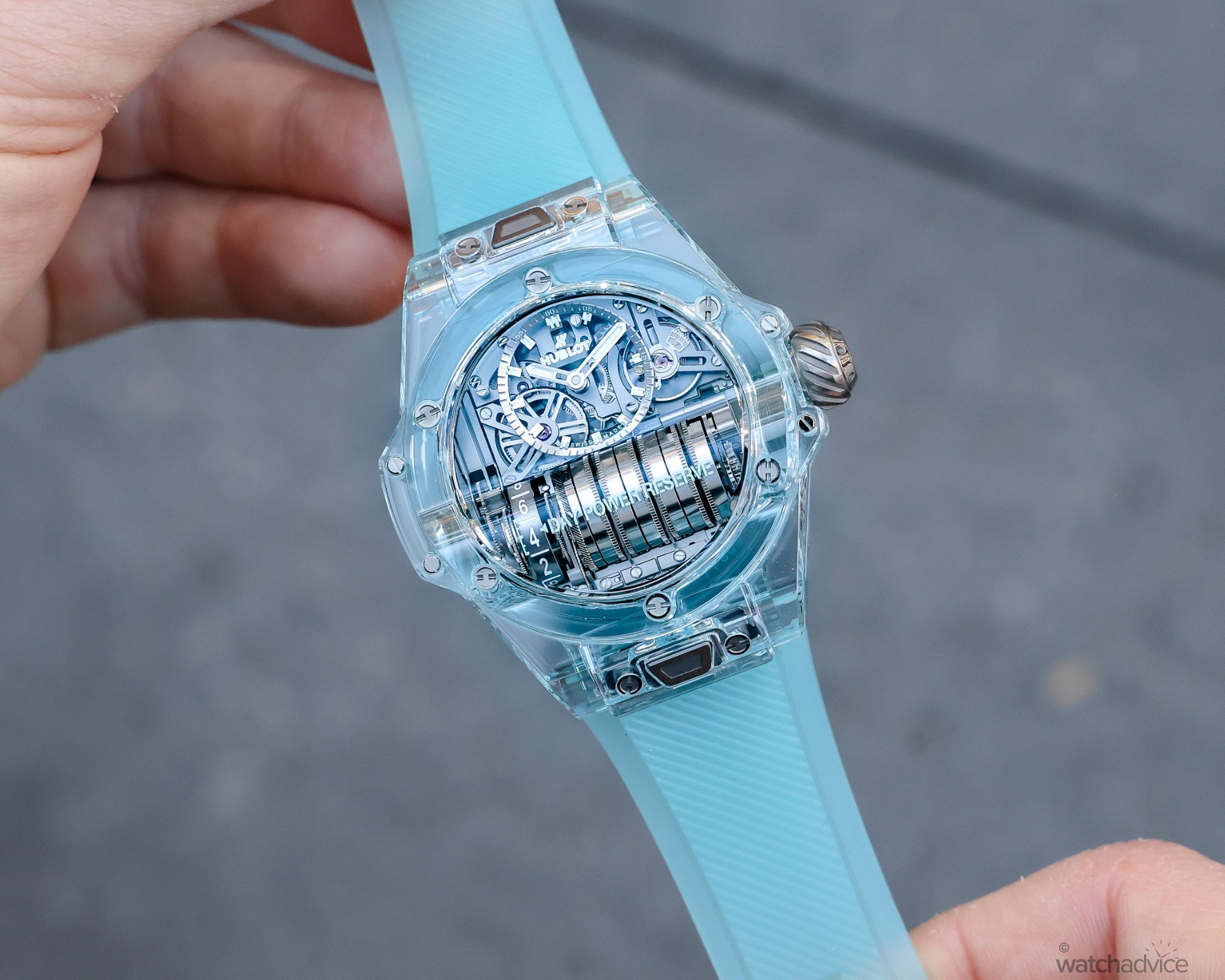
The dial is also made from sapphire crystal, with the time displayed in its own section at 12 o’clock. The hands and hour markers use a light blue Super-LumiNova that works with the colour of the case while still providing enough contrast to read the time.
Hublot has also fitted its One-Click strap change system, which is a welcome addition. Given the character of this watch, I would be very tempted to change the Water Blue strap for a white rubber strap during summer. There is something about the combination of transparent blue sapphire and crisp white rubber that would look particularly good in the Australian sunshine.
How It Wears
The obvious question with a 45mm watch that houses seven barrels and a substantial amount of mechanical hardware is whether it is actually comfortable to wear. To my surprise, it is relatively comfortable on the wrist for long periods of time, but I do think that you need a certain wrist size to make it so. I’ll explain…
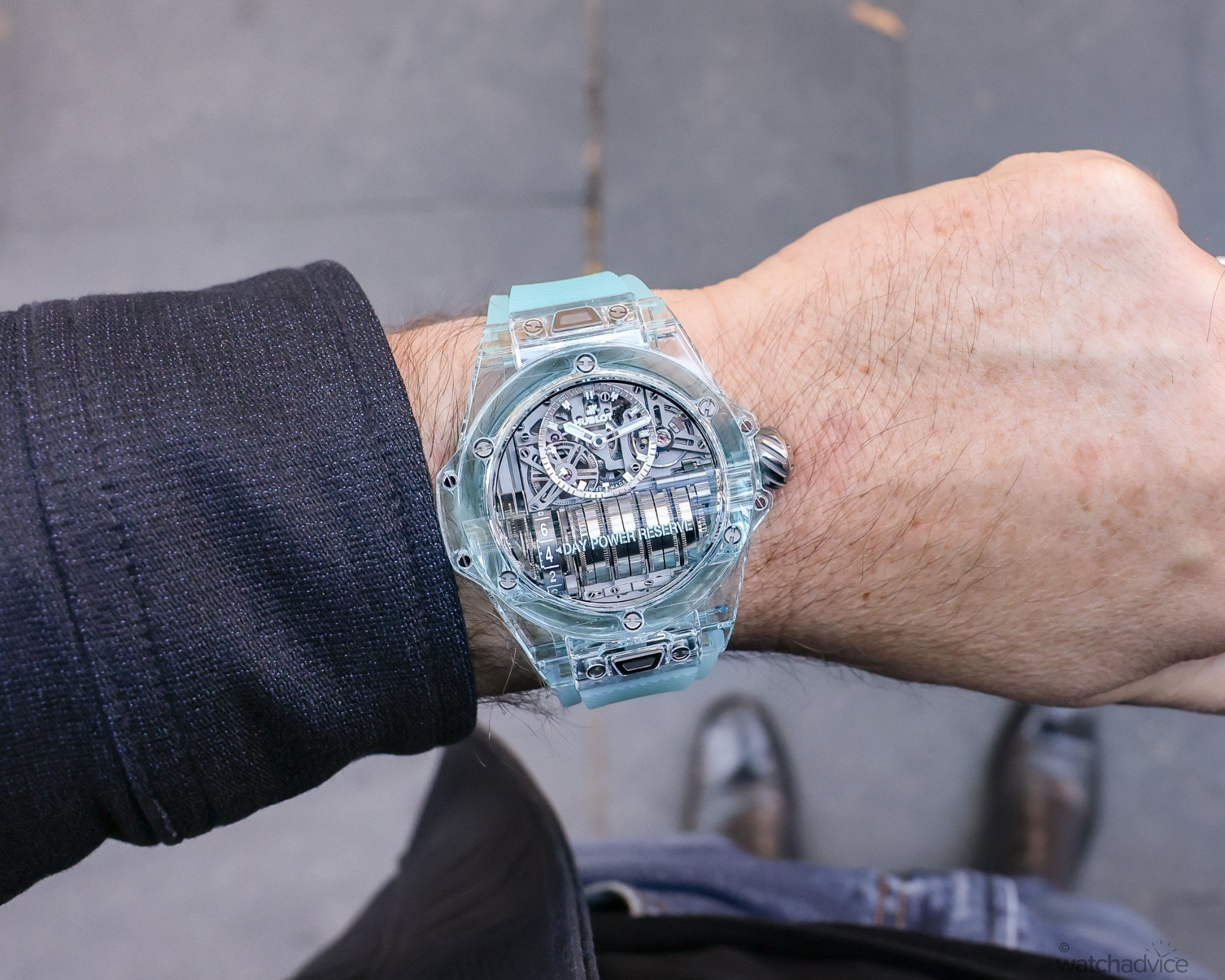
The Water Blue rubber strap is extremely soft and comfortable, almost feeling more like silicone against the wrist than the traditional rubber straps you find on many sports watches. It also does a good job of keeping the watch secure without adding unnecessary weight or bulk. But this is one of the older styles of Hublot rubber straps, with the holes to align the clasp spaced further apart, so getting the exact right fit can be tricky. The newer rubber straps have the holes spaced a lot closer, meaning a fit can be found more easily.
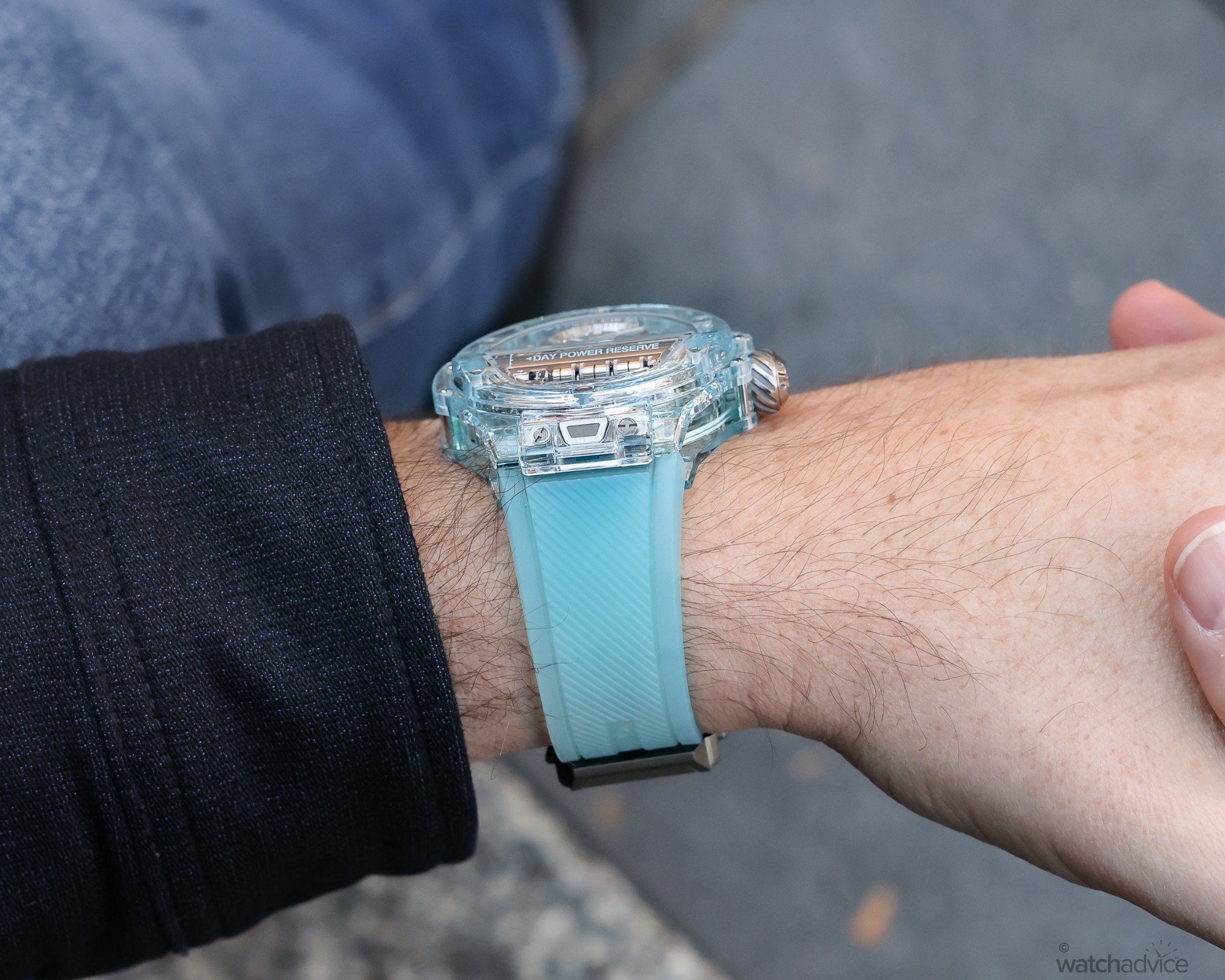
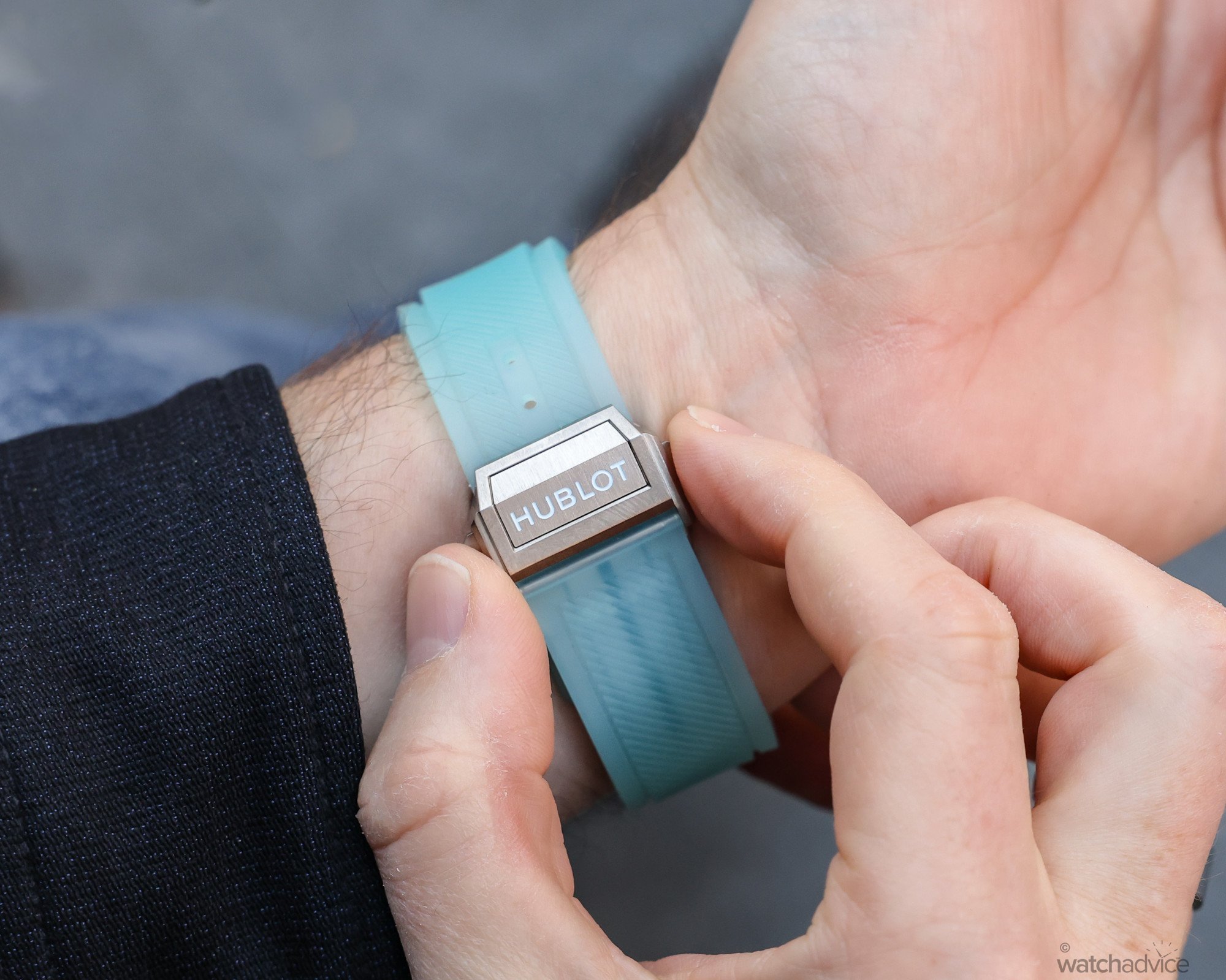
Despite the size of the case, the sapphire construction keeps the overall feel considerably lighter than you might expect. The case shape and strap also help distribute the watch across the wrist, so while you are certainly aware that you have a 45mm watch on, it never feels like having a large amount of steel on your wrist all day. But don’t be fooled, as this is still a larger watch that probably needs a wrist not much smaller than mine to pull it off. However, it still has another trick up its sleave…

The transparency of the sapphire actually assists with the wearability. This is one thing I found when wearing it, and wasn’t something that had occurred to me before I put it on. The illusion is that there is less watch on your wrist, as you can see through much of the case, so there is nothing specific to draw your eye to. It is a nice optical illusion which makes this watch more wearable.
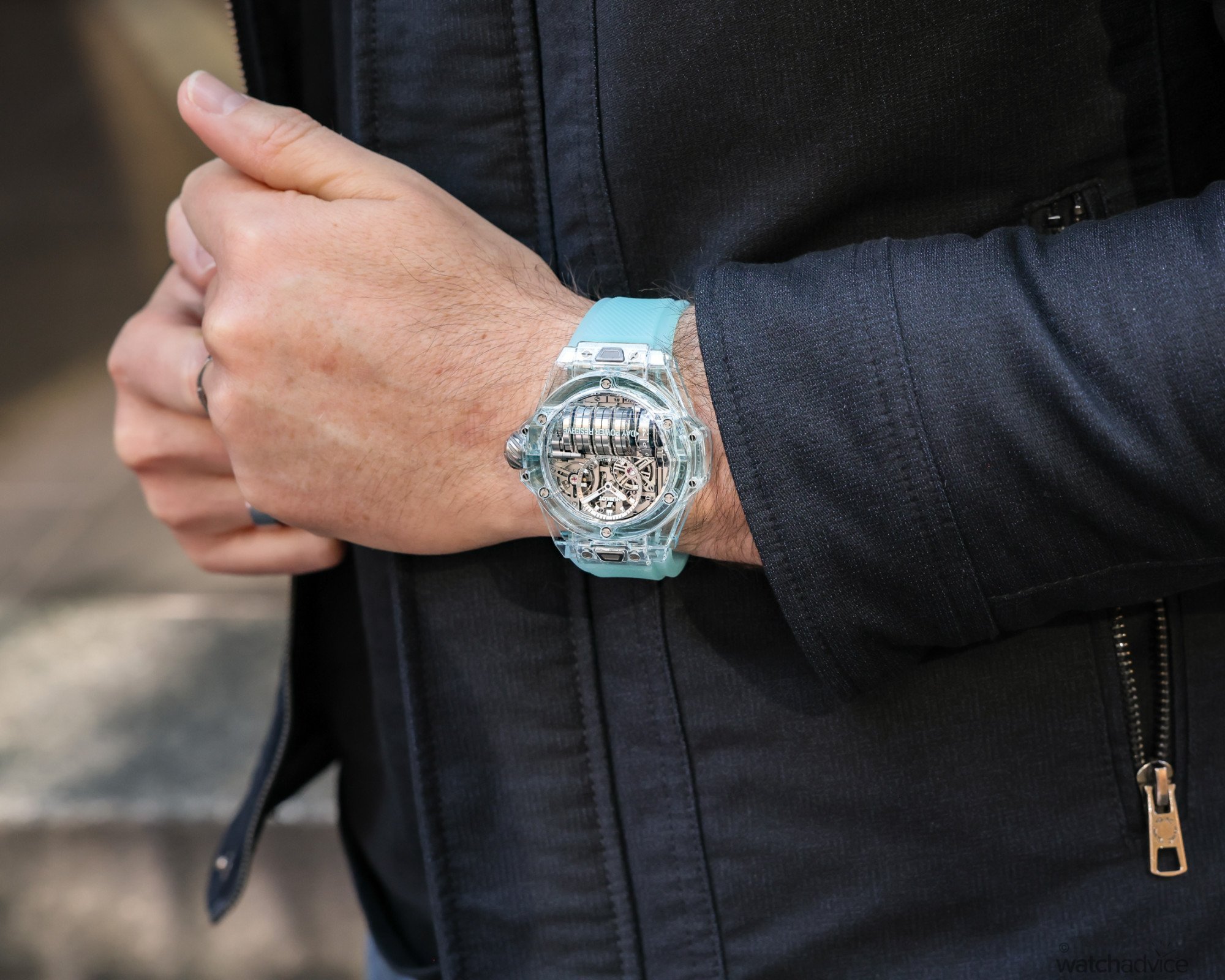
It is definitely more of a casual watch, although at this level of watchmaking I am not sure there is much point in worrying about whether it works with a particular outfit. If you own an MP-11 Water Blue Sapphire, you have probably reached the point in your collecting journey where, if you had it, you may as well wear it with whatever you like!
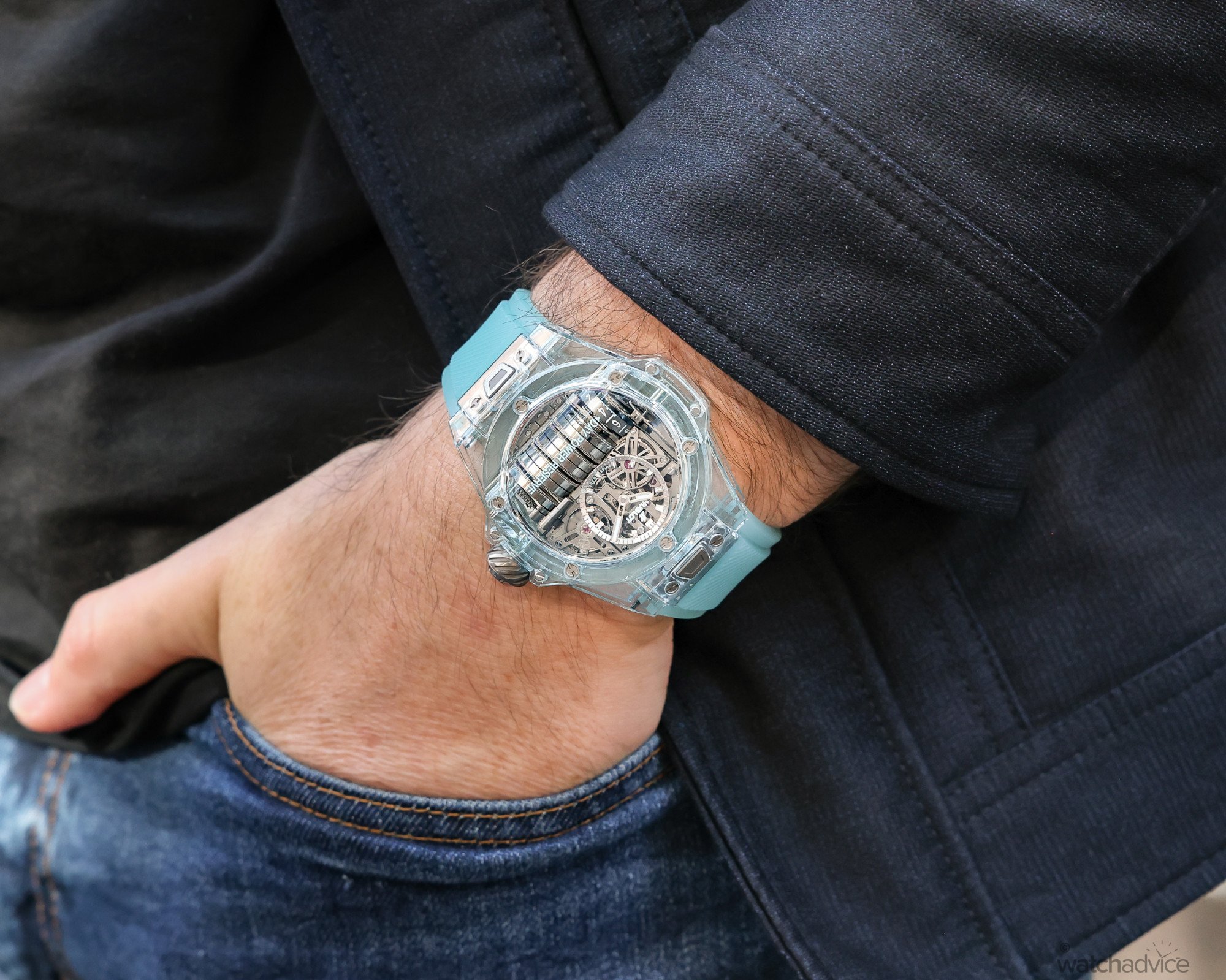
But, to me, this is part of the appeal. This is not a watch designed to be discreet at all. It is designed to be noticed, talked about and enjoyed. Take this to a watch get-together, and you won’t be short of conversations the entire night!
The Movement
As mentioned previously, it is hard to talk about the MP-11 Water Blue design without talking about the movement as part of it. So let’s dive in a little deeper on the movement – the HUB9011 Manufacture calibre. The HUB9011 has a remarkable 14-day power reserve, and this is still one of those specifications that makes you stop and think about how Hublot managed to do this in the first place.
As we’ve discussed, it houses seven barrels that are vertically coupled in series to provide approximately 336 hours, or 14 days, of power reserve. The barrels themselves are visible from the front of the watch, while the openworked movement can be appreciated from the rear.
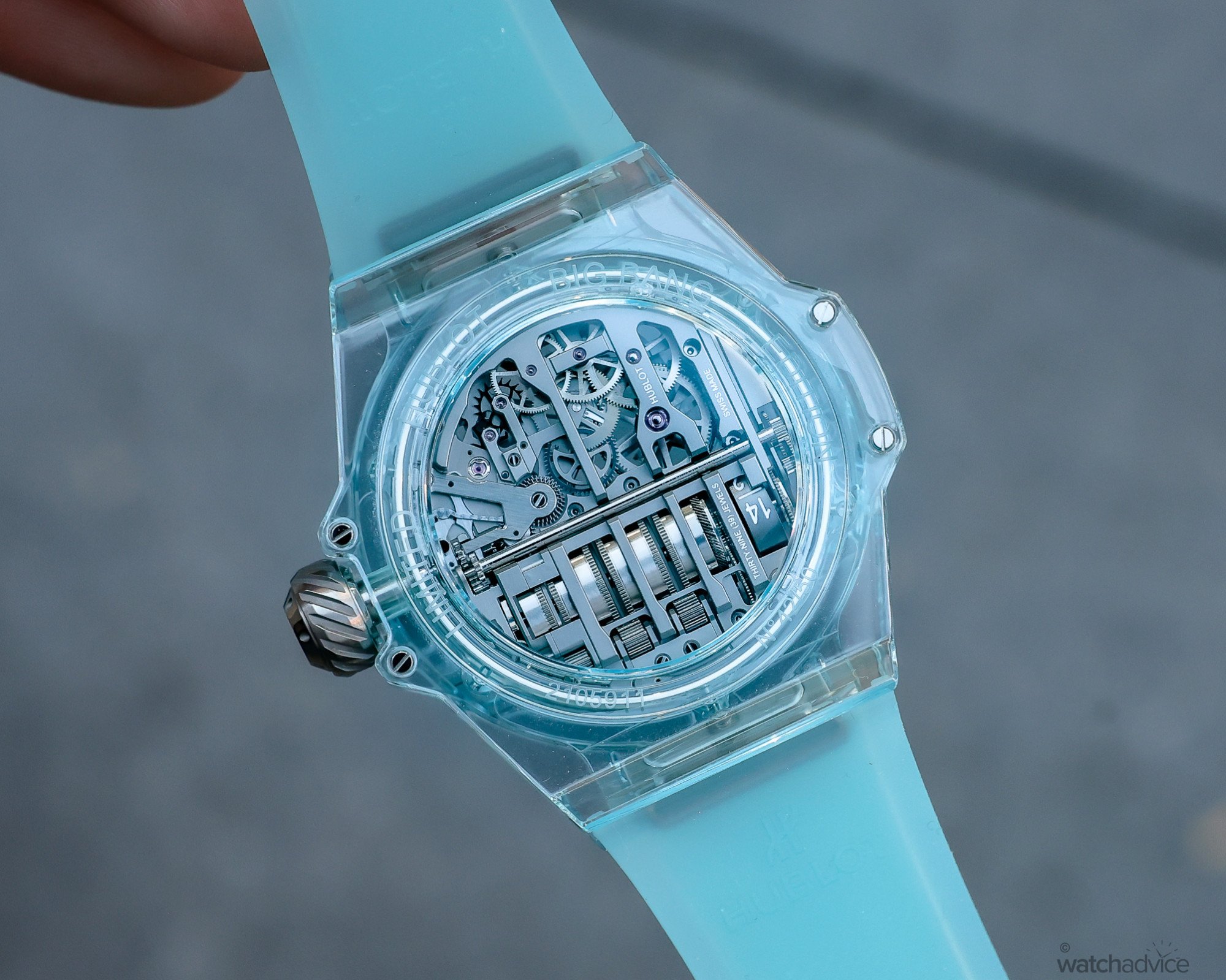
What I particularly like about the architecture is that Hublot has managed to get this enormous power reserve without simply turning the movement into a huge slab of machinery. The seven barrels sit in their own vertical arrangement, while the main movement remains relatively thin behind them. The result is a movement that looks every bit as technical as the specification suggests.
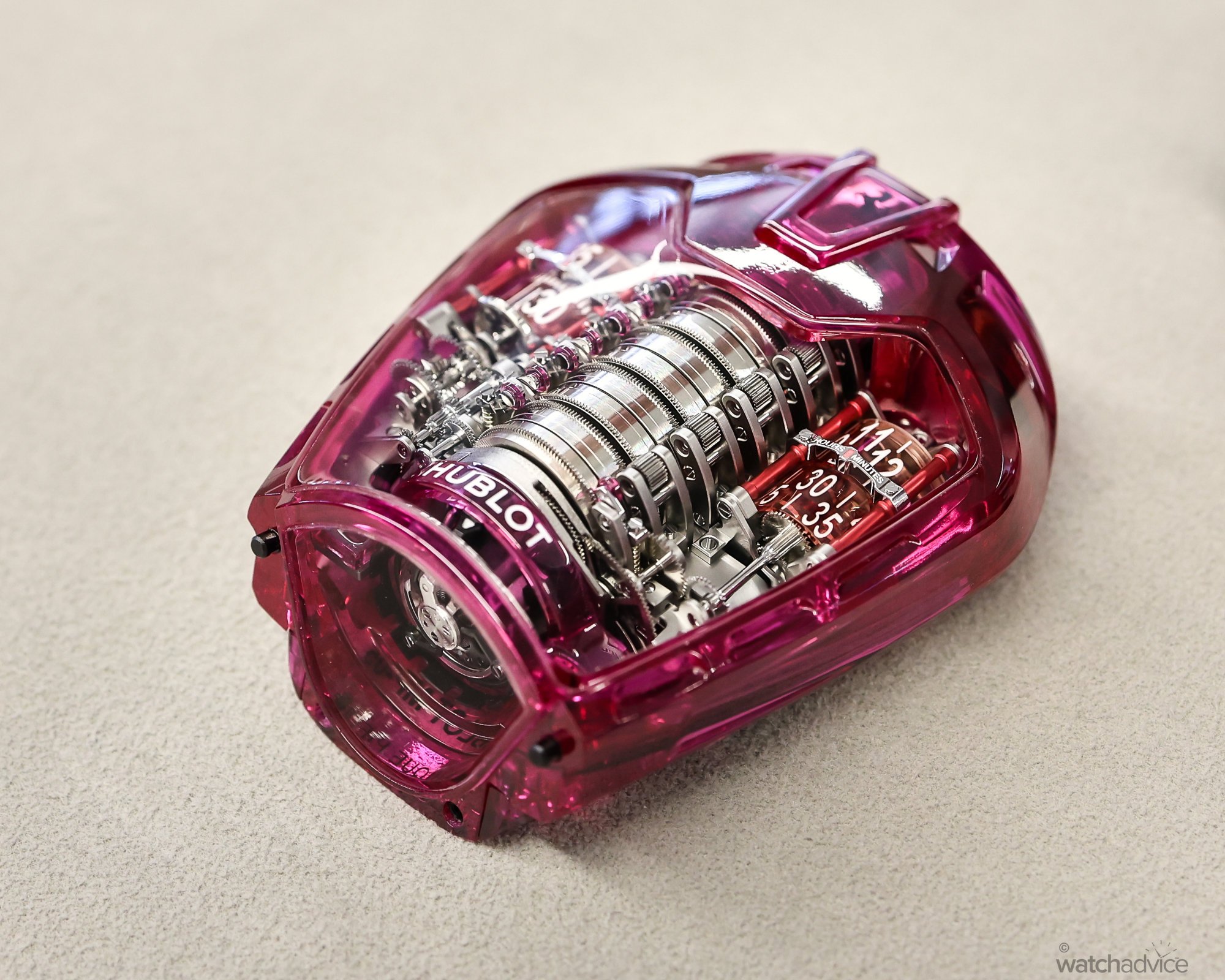
Now, if you think this structure of the barrels looks familiar, you may be onto something, as this is the same style of architecture Hublot first used in the MP-05 La Ferrari, with 11 barrels aligned to mimic the LaFerrari’s engine, delivering an unprecedented 50 days, or 1,200 hours of power via its unique manually wound movement.
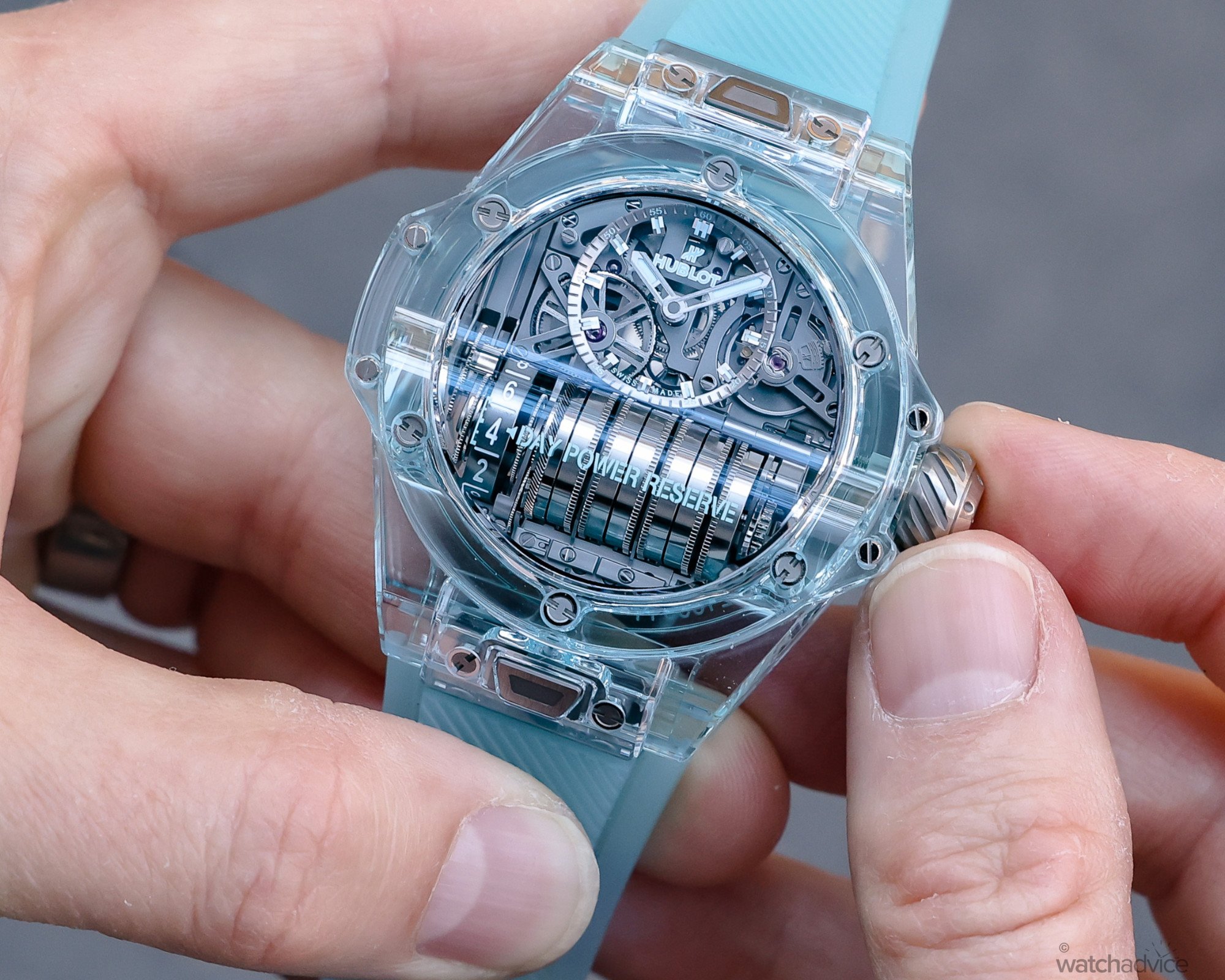
The power reserve display is also a clever touch. Rather than hiding it somewhere on the dial, Hublot has positioned the indicator directly above the seven barrels, with a disc that takes two weeks to complete one rotation. The curved sapphire crystal then magnifies this section, making the power reserve one of the most visually interesting parts of the watch.
I generally prefer an automatic watch because I like being able to pick it up and put it on without thinking about whether it has stopped. The MP-11 gets around that issue in its own way. You only need to wind it every two weeks, and with the power reserve indicator sitting there in plain sight, it is difficult to forget.
The HUB9011 operates at 4Hz, or 28,800 vibrations per hour, and contains 270 components. It also uses a silicon escapement and Hublot’s patented index-assembly system.
Final Thoughts
The Hublot Big Bang MP-11 Water Blue Sapphire is a statement piece. There is no getting around that. It is not the watch you buy because you are looking for something understated, practical or versatile enough to become the only watch in your collection. It is the watch you buy because you have already been there and done that with watch collecting and now you want to have some fun. And there is absolutely nothing wrong with that.
In fact, I think that is one of the things the watch industry sometimes forgets. Watches are supposed to be fun. They can be serious pieces of engineering and examples of incredibly difficult craftsmanship, but they are also objects that we strap to our wrists because we enjoy looking at them. The MP-11 Water Blue Sapphire delivers that in spades, as do many other watches in the wider archives of Hublot.
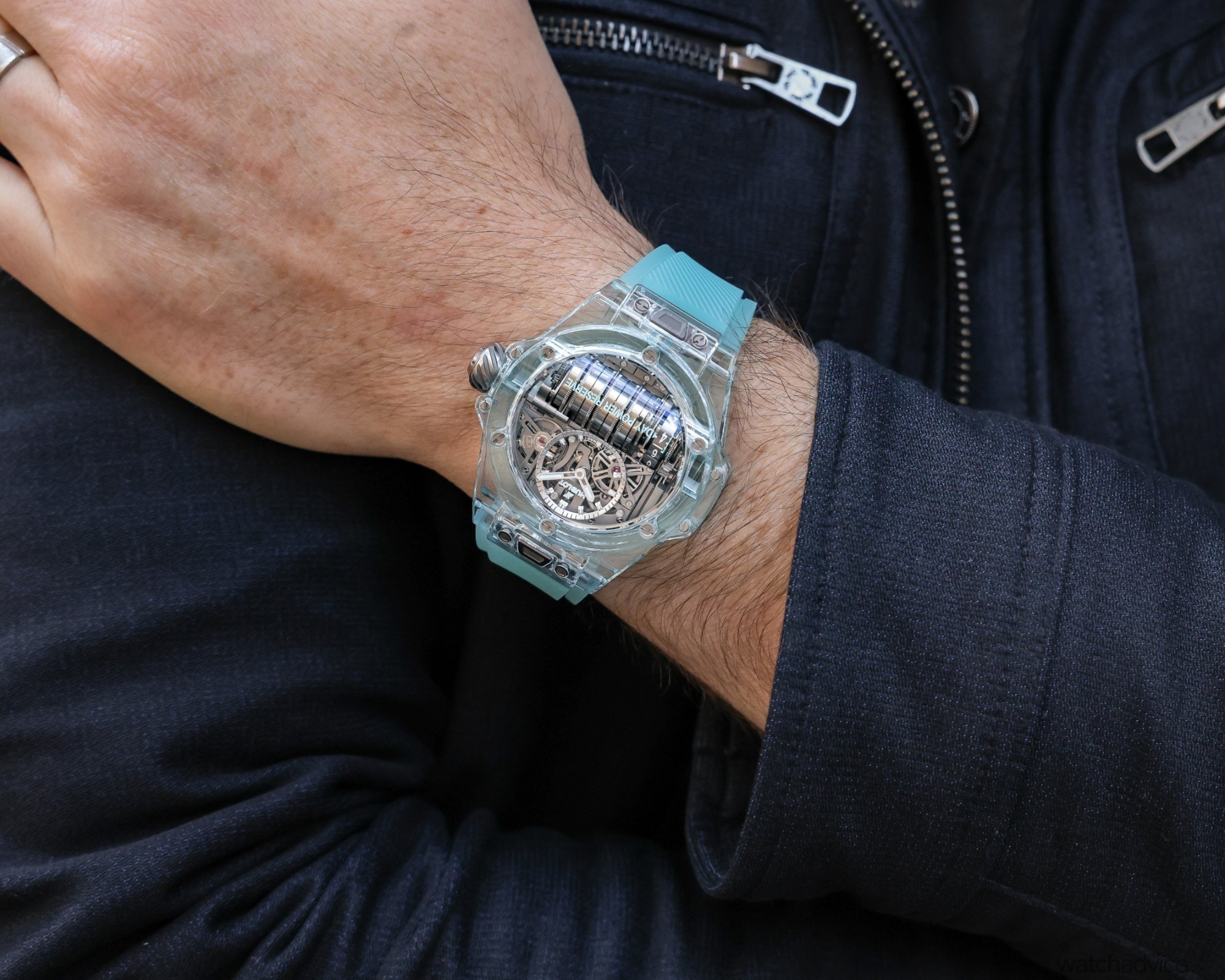
You have the technical audacity of seven barrels, a 336-hour / 14-day power reserve and an unusual transmission system, combined with a sapphire case that took years to develop. You then put the whole thing into a 45mm Big Bang case and give it a transparent blue rubber strap.
The Water Blue sapphire is what really makes this particular MP-11 work for me. Photos don’t really do this watch justice, but seeing it in natural light, and outdoors changes the experience completely. The clarity, the way the light passes through the case, and the way the movement appears to float inside it give the watch a personality that is difficult to capture on a screen.
At around an Australian RRP of $277,000 and limited to just 50 pieces, this was never going to be an impulse purchase, but for the serious, deep-pocketed collector who already has the traditional pieces covered. This is the kind of watch you add to a collection because it makes you smile when you look down at your wrist. That, and knowing that only 49 other people in the world have this.
And if you are at the stage of collecting where you can afford to have a watch like this purely because you think it is cool, rather than because you are trying to tick another box, the MP-11 Water Blue Sapphire makes a pretty compelling argument for having some fun.
Reference & Specifications
| Feature | Specification |
|---|---|
| Reference | 911.JL.0129.RX |
| Dimensions | 45mm x 14.4mm thickness |
| Case | Water Blue Sapphire case with “one-click” strap change system. |
| Dial | Sapphire crystal with openworked movement architecture |
| Crystal | Scratch-resistant sapphire crystal with an anti-reflective treatment. |
| Caseback | Sapphire crystal |
| Water Resistance | 30m (3 Bar) |
| Movement | HUB9011 Manufacture manual winding skeleton power reserve movement with 7 series-coupled barrels and power reserve display roll, beating at 4hz (28,800 VpH) |
| Functions | Minutes & hours |
| Power Reserve | 14 days (336 hours!) |
| Strap | Water Blue transparent lined structured rubber strap with titanium deployant buckle clasp |
Australian Recommended Retail Price: A$277,000
Availability: Limited Edition model of 50 timepieces. For availability, see your local Hublot boutique, retailer or head to Hublot.com
Full Image Gallery